
Pulp Fiction, 1922 · page 186 of 202
Adventure Magazine Cover — page 186: what you’re looking at
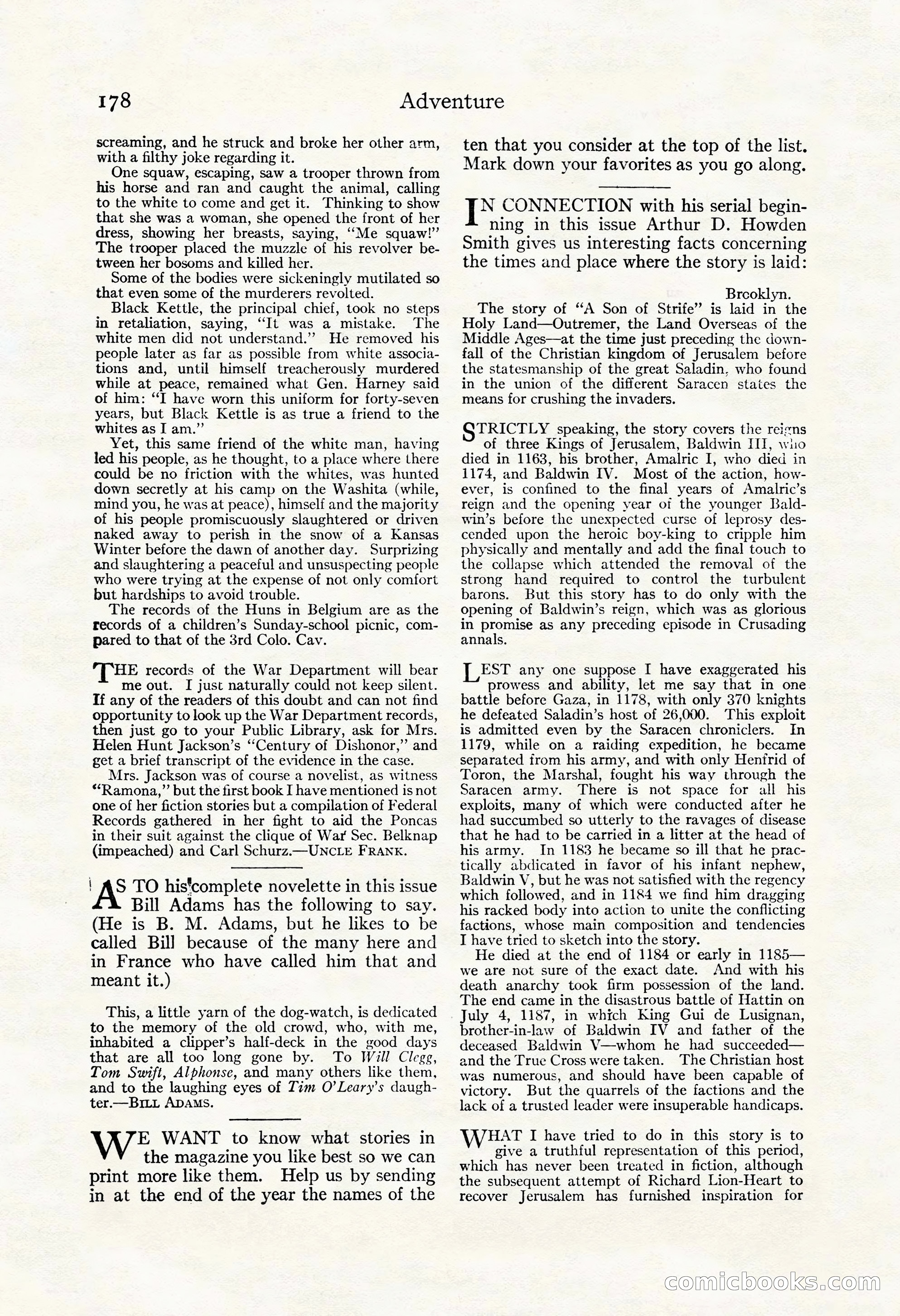
A restored page from Pulp Fiction, 1922. Page through the whole issue in the reader above.
📄 Transcribed text from this page (OCR, searchable)
Machine-transcribed from the original scan — historical spelling and the odd misread are preserved.
178 screaming, and he struck and broke her other arm, with a filthy joke regarding it. One squaw, escaping, saw a trooper thrown from his horse and ran and caught the animal, calling to the white to come and get it. Thinking to show that she was a woman, she opened the front of her dress, showing her breasts, saying, ‘“Me squaw!”’ The trooper placed the muzzle of his revolver be- tween her bosoms and killed her. Some of the bodies were sickeningly mutilated so that even some of the murderers revolted. Black Kettle, the principal chief, took no steps in retaliation, saying, “It was a mistake. The white men did not understand.”’ He removed his people later as far as possible from white associa- tions and, until himself treacherously murdered while at peace, remained what Gen. Harney said of him: “I have worn this uniform for forty-seven years, but Black Kettle is as true a friend to the whites as I am.”’ Yet, this same friend of the white man, having led his people, as he thought, to a place where there could be no friction with the whites, was hunted down secretly at his camp on the Washita (while, mind you, he was at peace), himself and the majority of his people promiscuously slaughtered or driven naked away to perish in the snow of a Kansas Winter before the dawn of another day. Surprizing and slaughtering a peaceful and unsuspecting people who were trying at the expense of not only comfort but hardships to avoid trouble. The records of the Huns in Belgium are as the records of a children’s Sunday-school picnic, com- pared to that of the 3rd Colo. Cav. HE records of the War Department will bear me out. I just naturally could not keep silent. If any of the readers of this doubt and can not find opportunity to look up the War Department records, then just go to your Public Library, ask for Mrs. Helen Hunt Jackson’s “Century of Dishonor,” and get a brief transcript of the evidence in the case. Mrs. Jackson was of course a novelist, as witness “Ramona,” but the first book I have mentioned is not one of her fiction stories but a compilation of Federal Records gathered in her fight to aid the Poncas in their suit against the clique of War Sec. Belknap (impeached) and Carl Schurz.—UNCLE FRANK. | AS TO his'complete novelette in this issue Bill Adams has the following to say. (He is B. M. Adams, but he likes to be called Bill because of the many here and in France who have called him that and meant it.) This, a little yarn of the dog-watch, is dedicated to the memory of the old crowd, who, with me, inhabited a clipper’s half-deck in the good days that are all too long gone by. To Will Clegg, Tom Swift, Alphonse, and many others like them, and to the laughing eyes of Zim O’Leary’s daugh- ter.—BiILL ADAMS. E WANT to know what stories in the magazine you like best so we can print more like them. Help us by sending in at the end of the year the names of the Adventure ten that you consider at the top of the list. Mark down your favorites as you go along. i CONNECTION with his serial begin- ning in this issue Arthur D. Howden Smith gives us interesting facts concerning the times and place where the story is laid: Brceoklyn. The story of “A Son of Strife” is laid in the Holy Land—Outremer, the Land Overseas of the Middle Ages—at the time just preceding the down- fall of the Christian kingdom of Jerusalem before the statesmanship of the great Saladin, who found in the union of the different Saracen states the means for crushing the invaders. OTRICTLY speaking, the story covers the reins of three Kings of Jerusalem, Baldwin III, wio died in 11638, his brother, Amalric I, who died in 1174, and Baldwin IV. Most of the action, how- ever, is confined to the final years of Amalric’s reign and the opening vear of the younger Bald- win’s before the unexpected curse of leprosy des- cended upon the heroic boy-king to cripple him physically and mentally and add the final touch to the collapse which attended the removal of the strong hand required to control the turbulent barons. But this story has to do only with the opening of Baldwin’s reign, which was as glorious in promise as any preceding episode in Crusading annals. EST any one suppose I have exaggerated his prowess and ability, let me say that in one battle before Gaza, in 1178, with only 370 knights he defeated Saladin’s host of 26,000. This exploit is admitted even by the Saracen chroniclers. In 1179, while on a raiding expedition, he became separated from his army, and with only Henfrid of Toron, the Marshal, fought his way through the Saracen army. There is not space for all his exploits, many of which were conducted after he had succumbed so utterly to the ravages of disease that he had to be carried in a litter at the head of his army. In 1183 he became so ill that he prac- tically abdicated in favor of his infant nephew, Baldwin V, but he was not satisfied with the regency which followed, and in 1184 we find him dragging his racked body into action to unite the conflicting factions, whose main composition and tendencies I have tried to sketch into the story. He died at the end of 1184 or early in 1185— we are not sure of the exact date. And with his death anarchy took firm possession of the land. The end came in the disastrous battle of Hattin on July 4, 1187, in which King Gui de Lusignan, brother-in-law of Baldwin IV and father of the deceased Baldwin V—whom he had succeeded— and the True Cross were taken. The Christian host was numerous, and should have been capable of victory. But the quarrels of the factions and the lack of a trusted leader were insuperable handicaps. HAT I have tried to do in this story is to give a truthful representation of this period, which has never been treated in fiction, although the subsequent attempt of Richard Lion-Heart to recover Jerusalem has furnished inspiration for GO NOOLK (Cc S (© in