
Pulp Fiction, 1925 · page 179 of 196
Adventure Magazine Cover — page 179: what you’re looking at
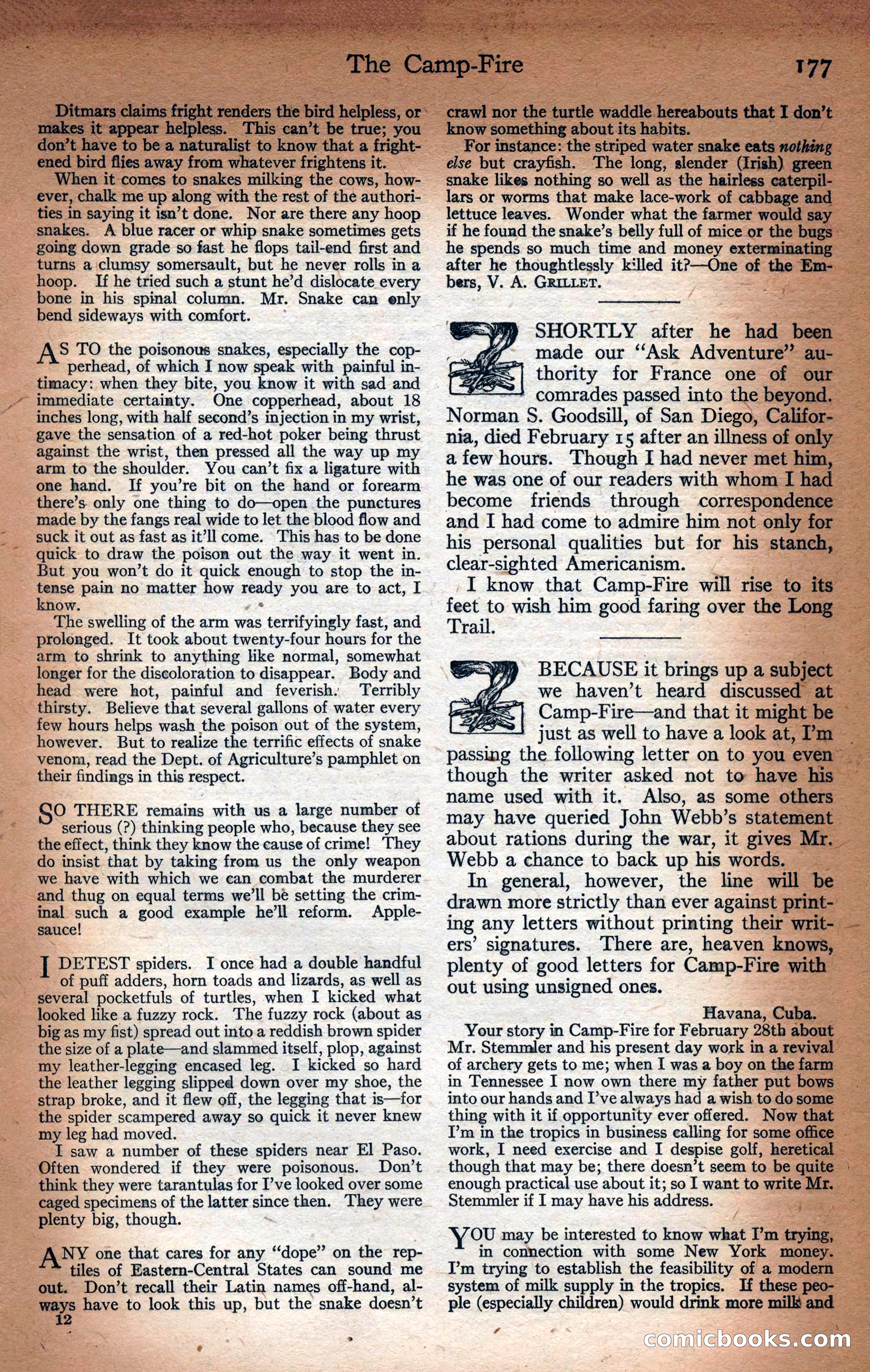
A restored page from Pulp Fiction, 1925. Page through the whole issue in the reader above.
📄 Transcribed text from this page (OCR, searchable)
Machine-transcribed from the original scan — historical spelling and the odd misread are preserved.
The Camp-Fire Ditmars claims fright renders the bird helpless. or’ makes it appear helpless. This can’t be true; you don’t have to be a naturalist to know that a fright- ened bird flies away from whatever frightens it. When it comes to snakes g the cows, how- ever, chalk me up along with the rest of the authori- ties in saying it isn’t done. Nor are there any hoop snakes. A blue racer or whip snake sometimes gets going down grade so fast he flops tail-end first and turns a clumsy somersault, but he never rolls in a hoop. If he tried such a stunt he’d dislocate every bone in his spinal column. Mr. Snake can enly bend sideways with comfort. S TO the poisonous snakes, especially the cop- perhead, of which I now speak with painful in- timacy: when they bite, you know it with sad and immediate certainty. One copperhead, about 18 inches long, with half second’s injection in my wrist, gave the sensation of a red-hot poker being thrust against the wrist, then pressed all the way up my arm to the shoulder. You can’t fix a ligature with one hand. If you’re bit on the hand or forearm there’s only one thing to do—open the punctures made by the fangs real wide to let the blood flow and suck it out as fast as it’ll come. This has to be done quick to draw the poison out the way it went in. But you won’t do it quick enough to stop the in- tense pain no matter how arany you are to act, I ow. The swelling of the arm was terrifyingly fast, and prolonged. It took about twenty-four hours for the arm to shrink to anything like normal, somewhat longer for the discoloration to disappear. Body and head were hot, painful and feverish. Terribly thirsty. Believe that several gallons of water every few hours helps wash the poison out of the system, however. But to realize the terrific effects of snake venom, read the Dept. of Agriculture’s pamphlet on their findings in this respect. So THERE remains with us a large number of serious (?) thinking people who, because they see the effect, think they know the cause of crime! They do insist that by taking from us the only weapon we have with which we can combat the murderer and thug on equal terms we'll bé setting the crim- inal such a good example he’ll reform. Apple- sauce! 1 DETEST spiders. I once had a double handful of puff adders, horn toads and lizards, as well as several pocketfuls of turtles, when I kicked what looked like a fuzzy rock. The fuzzy rock (about as big as my fist) spread out into a reddish brown spider the size of a plate—and slammed itself, plop, against my leather-legging encased leg. I kicked so hard the leather legging slipped down over my shoe, the strap broke, and it flew off, the legging that is—for the spider scampered away so quick it never knew my leg had moved. I saw a number of these spiders near El Paso. Often wondered if they were poisonous. Don’t think they were tarantulas for I’ve looked over some caged specimens of the latter since then. They were plenty big, though. ANY one that cares for any “dope” on the rep- tiles of Eastern-Central States can sound me out. Don’t recall their Latin names off-hand, al- ways have to look this up, but the snake doesn’t 12 °. 177 crawl nor the turtle waddle hereabouts that I don’t know something about its habits. For instance: the striped water snake eats nothing else but crayfish. The long, slender (Irish) green snake likes nothing so well as the hairless smeeie lars or worms that make lace-work of cabbage and lettuce leaves. Wonder what the farmer would say if he found the snake’s belly full of mice or the bugs he spends so much time and money exterminating after he thoughtlessly killed it?-—One of the Em- bers, V. A. GRILLET. SHORTLY after he had been made our ‘‘Ask Adventure” au- thority for France one of our comrades passed into the beyond. Norman S. Goodsill, of San Diego, Califor- nia, died February 15 after an illness of only a few hours. Though I had never met him, he was one of our readers with whom I had become friends through correspondence and I had come to admire him not only for his personal qualities but for his stanch, clear-sighted Americanism. I know that Camp-Fire will rise to its feet to wish him good faring over the Long Trail. BECAUSE it brings up a subject we haven’t heard discussed at Camp-Fire—and that it might be 4 just as well to have a look at, ’m passing the following letter on to you even though the writer asked not to have his name used with it. Also, as some others may have queried John Webb’s statement about rations during the war, it gives Mr. Webb a chance to back up his words. In general, however, the line will be drawn more strictly than ever against print- ing any letters without printing their writ- ers’ signatures. There are, heaven knows, plenty of good letters for Camp-Fire with out using unsigned ones. Havana, Cuba. Your story in Camp-Fire for February 28th about Mr. Stemmler and his present day work in a revival of archery gets to me; when I was a boy on the farm in Tennessee I now own there my father put bows into our hands and I’ve always had a wish to do some thing with it if opportunity ever offered. Now that I’m in the tropics in business calling for some office work, I need exercise and I despise golf, heretical though that may be; there doesn’t seem to be quite ° enough practical use about it; so I want to write Mr. Stemmler if I may have his address. OU may be interested to know what I’m trying, in connection with some New York money. I’m trying to establish the feasibility of a modern system of milk supply in the tropics. If these peo- ple eae children) would drink more milk and Gomicbooks.com