
Pulp Fiction, 1927 · page 16 of 107
Amazing Stories, August 1927 — page 16: what you’re looking at
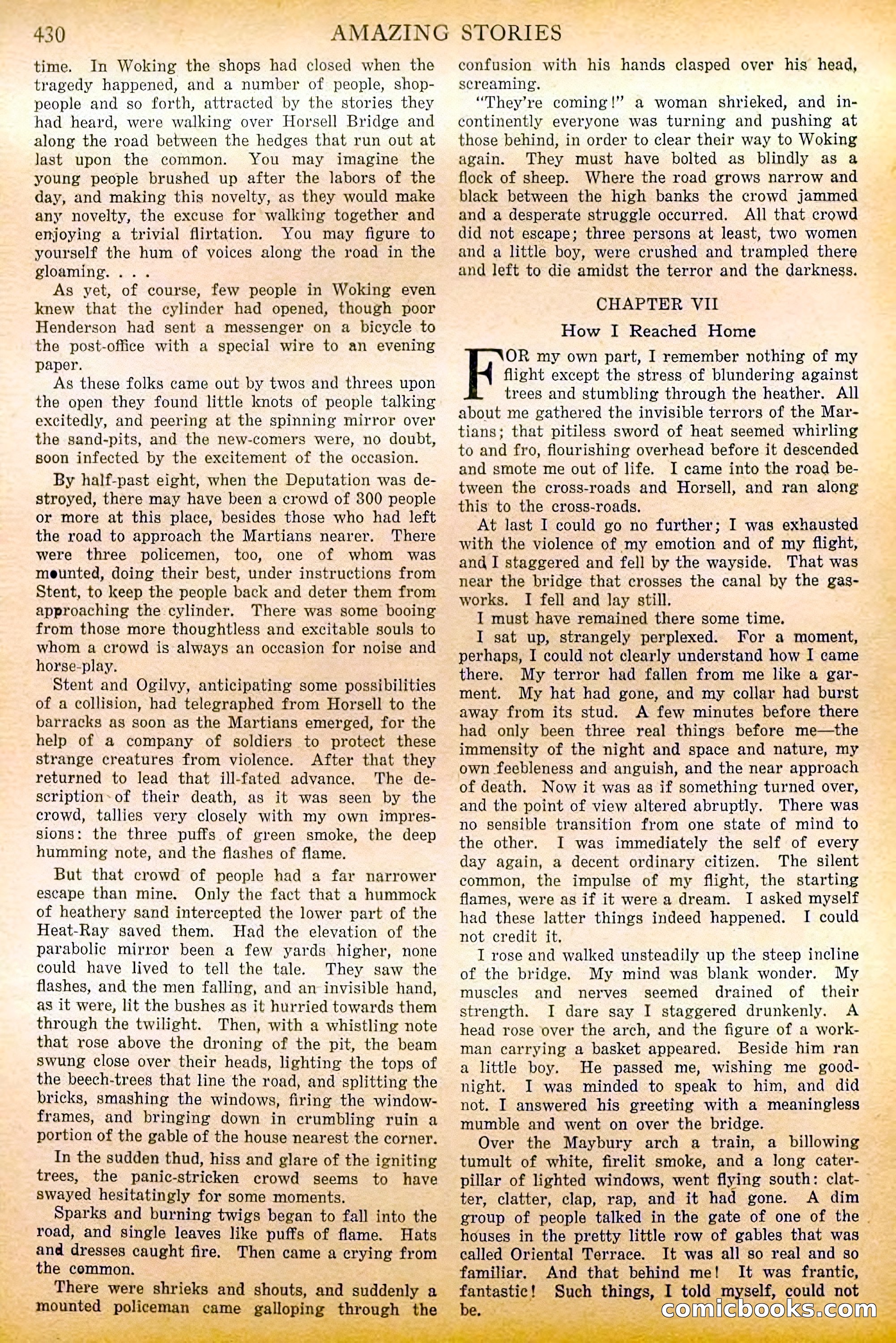
A restored page from Pulp Fiction, 1927. Page through the whole issue in the reader above.
📄 Transcribed text from this page (OCR, searchable)
Machine-transcribed from the original scan — historical spelling and the odd misread are preserved.
Sean a oe on lll > —— 430 time. In Woking the shops had closed when the tragedy happened, and a number of people, shop- people and so forth, attracted by the stories they had heard, were walking over Horsell Bridge and along the road between the hedges that run out at Jast upon the common. You may imagine the young people brushed up after the labors of the day, and making this novelty, as they would make any novelty, the excuse for walking together and enjoying a trivial flirtation. You may figure to yourself the hum of voices along the road in the gloaming. ... As yet, of course, few people in Woking even knew that the cylinder had opened, though poor Henderson had sent a messenger on a bicycle to the post-office with a special wire to an evening paper. As these folks came out by twos and threes upon the open they found little knots of people talking excitedly, and peering at the spinning mirror over the sand-pits, and the new-comers were, no doubt, soon infected by the excitement of the occasion. By half-past eight, when the Deputation was de- stroyed, there may have been a crowd of 800 people or more at this place, besides those who had left the road to approach the Martians nearer. There were three policemen, too, one of whom was meunted, doing their best, under instructions from Stent, to keep the people back and deter them from approaching the cylinder. There was some booing from those more thoughtless and excitable souls to whom a crowd is always an occasion for noise and horse-play. Stent and Ogilvy, anticipating some possibilities of a collision, had telegraphed from Horsell to the barracks as soon as the Martians emerged, for the help of a company of soldiers to protect these strange creatures from violence. After that they returned to lead that ill-fated advance. The de- scription-of their death, as it was seen by the crowd, tallies very closely with my own impyres- sions: the three puffs of green smoke, the deep humming note, and the flashes of flame. But that crowd of people had a far narrower escape than mine. Only the fact that a hummock of heathery sand intercepted the lower part of the Heat-Ray saved them. Had the elevation of the parabolic mirror been a few yards higher, none could have lived to tell the tale. They saw the flashes, and the men falling, and an invisible hand, as it were, lit the bushes as it hurried towards them through the twilight. Then, with a whistling note that rose above the droning of the pit, the beam swung close over their heads, lighting the tops of the beech-trees that line the road, and splitting the bricks, smashing the windows, firing the window- frames, and bringing down in erumbling ruin a portion of the gable of the house nearest the corner. In the sudden thud, hiss and glare of the igniting trees, the panic-stricken crowd seems to have swayed hesitatingly for some moments. Sparks and burning twigs began to fall into the road, and single leaves like puffs of flame. Hats and dresses caught fire. Then came a crying from the common. : f= Repl a ceman cam There were shrieks and ae and. suddenly a 2_ > —_—= AMAZING STORIES confusion with his hands clasped over his head, screaming, “They're coming!’ a woman shrieked, and in- continently everyone was turning and pushing at those behind, in order to clear their way to Woking again. They must have bolted as blindly as a flock of sheep. Where the road grows narrow and black between the high banks the crowd jammed and a desperate struggle occurred. All that crowd did not escape; three persons at least, two women and a little boy, were crushed and trampled there and left to die amidst the terror and the darkness. CHAPTER VII How I Reached Home OR my own part, I remember nothing of my flight except the stress of blundering against trees and stumbling through the heather. All about me gathered the invisible terrors of the Mar- tians; that pitiless sword of heat seemed whirling to and fro, flourishing overhead before it descended and smote me out of life. I came into the road be- tween the cross-roads and Horsell, and ran along this to the cross-roads. At last I could go no further; I was exhausted with the violence of my emotion and of my flight, and I staggered and fell by the wayside, That was near the bridge that crosses the canal by the gas- works. I fell and Jay still. I must have remained there some time, I sat up, strangely perplexed. For a moment, perhaps, I could not clearly understand how I came there. My terror had fallen from me like a gar- ment. My hat had gone, and my collar had burst away from its stud. A few minutes before there had only been three real things before me—the immensity of the night and space and nature, my own feebleness and anguish, and the near approach of death. Now it was as if something turned over, and the point of view altered abruptly, There was no sensible transition from one state of mind to the other. I was immediately the self of every day again, a decent ordinary citizen. The silent common, the impulse of my flight, the starting flames, were as if it were a dream. I asked myself had these latter things indeed happened. I could not credit it, I rose and walked unsteadily up the steep incline of the bridge. My mind was blank wonder. My muscles and nerves seemed drained of their strength. I dare say I staggered drunkenly. A head rose over the arch, and the figure of a work- man carrying a basket appeared. Beside him ran a little boy. He passed me, wishing me good- night. I was minded to speak to him, and did not. I answered his greeting with a meaningless mumble and went on over the bridge. Over the Maybury arch a train, a billowing tumult of white, firelit smoke, and a long cater- pillar of lighted windows, went flying south: clat-— ter, clatter, clap, rap, and it had gone. A dim group of people talked in the gate of one of the . houses in the pretty little row of gables that was called Oriental Terrace. familiar. it was frantic, It was all so real and so —