
Pulp Fiction, 1927 · page 17 of 107
Amazing Stories, August 1927 — page 17: what you’re looking at
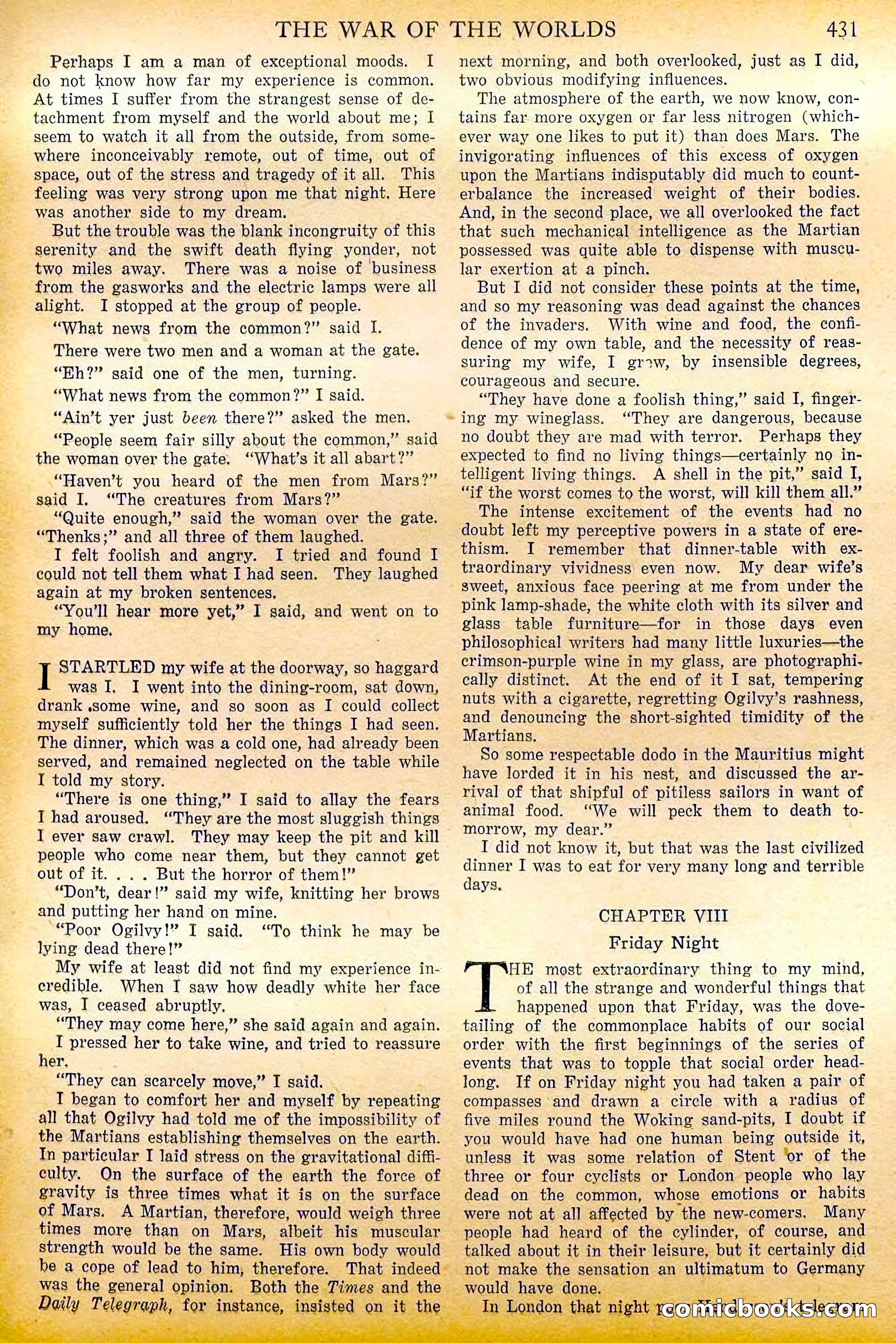
A restored page from Pulp Fiction, 1927. Page through the whole issue in the reader above.
📄 Transcribed text from this page (OCR, searchable)
Machine-transcribed from the original scan — historical spelling and the odd misread are preserved.
els). oe ee of Mars. _ times more than on Mars, albeit his muscular. THE WAR OF THE WORLDS Perhaps I am a man of exceptional moods. I do not know how far my experience is common. At times I suffer from the strangest sense of de- tachment from myself and the world about me; I seem to watch it all from the outside, from some- where inconceivably remote, out of time, out of space, out of the stress and tragedy of it all. This feeling was very strong upon me that night. Here was another side to my dream. But the trouble was the blank incongruity of this serenity and the swift death flying yonder, not two miles away. There was a noise of business from the gasworks and the electric lamps were all alight. I stopped at the group of people. “What news from the common?” said I. There were two men and a woman at the gate. “Hh?” gaid one of the men, turning. “What news from the common?” I said. “Ain’t yer just been there?” asked the men. “People seem fair silly about the common,” said the woman over the gate. “What’s it all abart?” “Haven't you heard of the men from Mars?” said I. “The creatures from Mars?” “Quite enough,” said the woman over the gate. “Thenks;” and all three of them laughed. I felt foolish and angry. I tried and found I could not tell them what I had seen. They laughed again at my broken sentences, “You'll hear more yet,” I said, and went on to my home. I STARTLED my wife at the doorway, so haggard was I. I went into the dining-room, sat down, drank ,some wine, and so soon as I could collect myself sufficiently told her the things I had seen. The dinner, which was a cold one, had already been served, and remained neglected on the table while I told my story. “There is one thing,” I said to allay the fears T had aroused. “They are the most sluggish things I ever saw crawl. They may keep the pit and kill people who come near them, but they cannot get out of it. . . . But the horroy of them!” “Don’t, dear!” said my wife, knitting her brows and putting her hand on mine. “Poor Ogilvy!” I said. “To think he may be lying dead there!” My wife at least did not find my experience in- credible. When I saw how deadly white her face was, I ceased abruptly, “They may come here,” she said again and again. ‘ I pressed her to take wine, and tried to reassure er, “They can scarcely move,” I said. I began to comfort her and myself by repeating all that Ogilvy had told me of the impossibility of the Martians establishing themselves on the earth. In particular I laid stress on the gravitational diffi- ‘ culty. On the surface of the earth the force of gravity is three times what it is on the surface A Martian, therefore, would weigh three strength would be the same. His own body would a cope of lead to ; : people had heard of the cylinder, of course, and thei 431 next morning, and both overlooked, just as I did, two obvious modifying influences. The atmosphere of the earth, we now know, con- tains far more oxygen or far less nitrogen (which- ever way one likes to put it) than does Mars. The invigorating influences of this excess of oxygen upon the Martians indisputably did much to count- erbalance the increased weight of their bodies. And, in the second place, we all overlooked the fact that such mechanical intelligence as the Martian possessed was quite able to dispense with muscu- lar exertion at a pinch. But I did not consider these points at the time, and so my reasoning was dead against the chances of the invaders. With wine and food, the confi- dence of my own table, and the necessity of reas- suring my wife, I grow, by insensible degrees, courageous and secure. “They have done a foolish thing,” said I, finger- ing my wineglass. “They are dangerous, because no doubt they are mad with terror. Perhaps they expected to find no living things—certainly no in- telligent living things. A shell in the pit,” said I, “if the worst comes to the worst, will kill them all.” The intense excitement of the events had no doubt left my perceptive powers in a state of ere- thism. I remember that dinner-table with ex- traordinary vividness even now. My dear wife’s sweet, anxious face peering at me from under the pink lamp-shade, the white cloth with its silver and glass table furniture—for in those days even philosophical writers had many little luxuries—the crimson-purple wine in my glass, are photographi- eally distinct. At the end of it I sat, tempering nuts with a cigarette, regretting Ogilvy’s rashness, and denouncing the short-sighted timidity of the Martians, So some respectable dodo in the Mauritius might have lorded it in his nest, and discussed the ar- rival of that shipful of pitiless sailors in want of animal food. ‘We will peck them to death to- morrow, my dear.” I did not know it, but that was the last civilized dinner I was to eat for very many long and terrible days. CHAPTER VIII Friday Night HE most extraordinary thing to my mind, of all the strange and wonderful things that happened upon that Friday, was the dove- tailing of the commonplace habits of our social order with the first beginnings of the series of events that was to topple that social order head- long. If on Friday night you had taken a pair of compasses and drawn a circle with a radius of five miles round the Woking sand-pits, I doubt if you would have had one human being outside it, unless it was some relation of Stent ‘or of the three or four cyclists or London people who lay dead on the common, whose emotions or habits were not at all affected by “the new-comers. Many r leisure, but it certainly did