
Pulp Fiction, 1927 · page 52 of 107
Amazing Stories, August 1927 — page 52: what you’re looking at
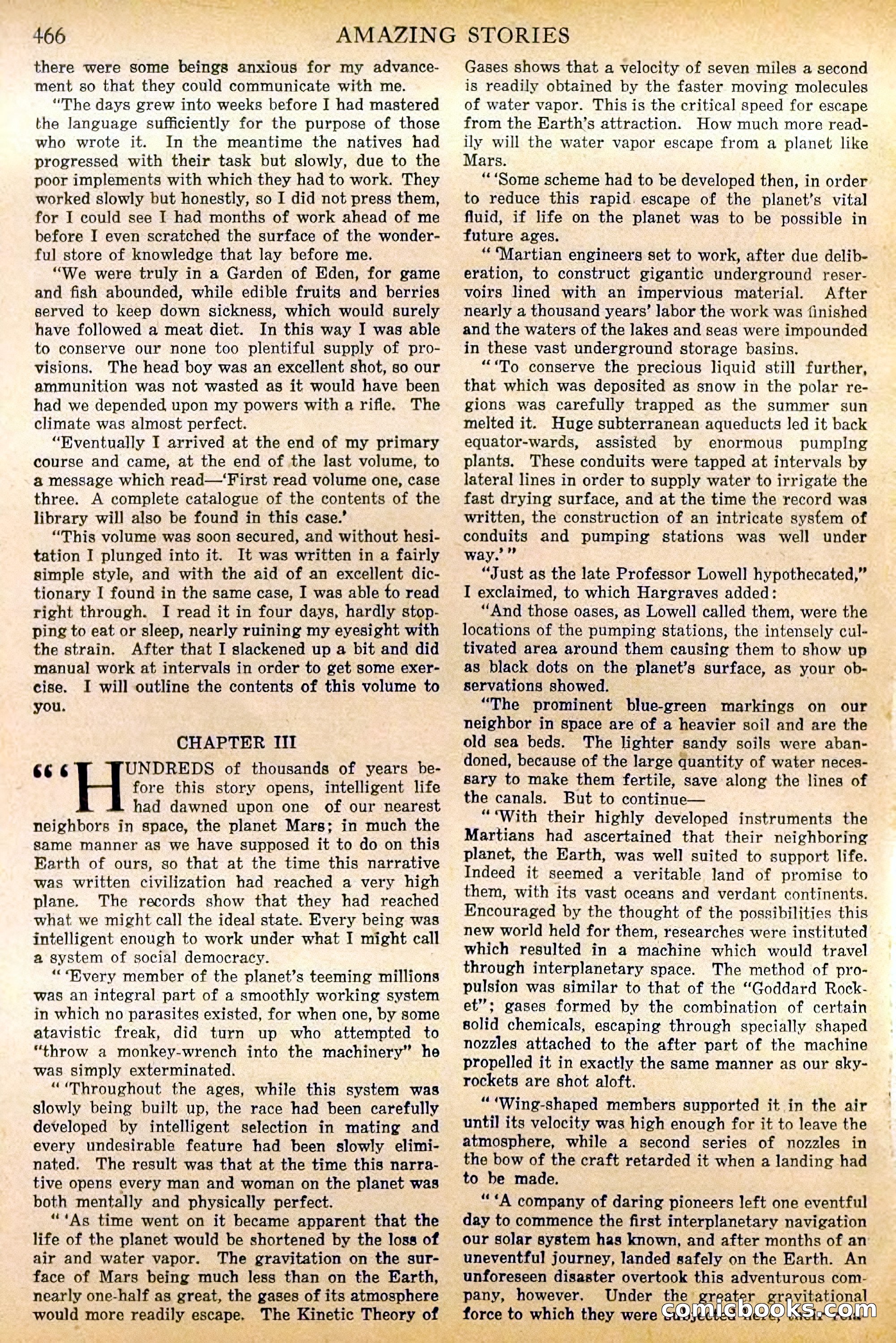
A restored page from Pulp Fiction, 1927. Page through the whole issue in the reader above.
📄 Transcribed text from this page (OCR, searchable)
Machine-transcribed from the original scan — historical spelling and the odd misread are preserved.
=o oo Va Se ee 466 there were some beings anxious for my advance- ment so that they could communicate with me. “The days grew into weeks before I had mastered the language sufficiently for the purpose of those who wrote it. In the meantime the natives had progressed with their task but slowly, due to the poor implements with which they had to work. They worked slowly but honestly, so I did not press them, for I could see I had months of work ahead of me before I even scratched the surface of the wonder- ful store of knowledge that lay before me. “We were truly in a Garden of Eden, for game and fish abounded, while edible fruits and berries served to keep down sickness, which would surely have followed a meat diet. In this way I was able to conserve our none too plentiful supply of pro- visions. The head boy was an excellent shot, so our ammunition was not wasted as it would have been had we depended, upon my powers with a rifle. The climate was almost perfect. “Eventually I arrived at the end of my primary course and came, at the end of the last volume, to a message which read—‘First read volume one, case three. A complete catalogue of the contents of the library will also be found in this case.’ “This volume was soon secured, and without hesi- tation I plunged into it. It was written in a fairly simple style, and with the aid of an excellent dic- tionary I found in the same case, I was able to read right through. I read it in four days, hardly stop- ping to eat or sleep, nearly ruining my eyesight with the strain, After that I slackened up a bit and did manual work at intervals in order to get some exer- cise. I will outline the contents of this volume to you. CHAPTER III 66 Hives: of thousands of years be- fore this story opens, intelligent life had dawned upon one of our nearest neighbors in space, the planet Mars; in much the game manner as we have supposed it to do on this Earth of ours, so that at the time this narrative was written civilization had reached a very high plane. The records show that they had reached what we might call the ideal state. Every being was intelligent enough to work under what I might call a system of social democracy. “Hivery member of the planet’s teeming millions was an integral part of a smoothly working system in which no parasites existed, for when one, by some atavistic freak, did turn up who attempted to “throw a monkey-wrench into the machinery” he was simply exterminated. ““Throughout the ages, while this system was slowly being built up, the race had been carefully developed by intelligent selection in mating and every undesirable feature had been slowly elimi- nated. The result was that at the time this narra- tive opens every man and woman on the planet was both mentally and physically perfect. “ ‘As time went on it became apparent that the life of the planet would be shortened by the loss of air and water vapor. The gravitation on the sur- face of Mars being much less than on the Earth, nearly one-half as great, the gases of its atmosphere would more readily escape, The Kinetic Theory of ak ee eS AMAZING STORIES SFE Se lee} ae Gases shows that a velocity of seven miles a second is readily obtained by the faster moving molecules of water vapor. This is the critical speed for escape from the Earth’s attraction. How much more read- ily will the water vapor escape from a planet like Mars. “Some scheme had to be developed then, in order to reduce this rapid. escape of the planet's vital fluid, if life on the planet was to be possible in future ages. “Martian engineers set to work, after due delib- eration, to construct gigantic underground reser- voirs lined with an impervious material. After nearly a thousand years’ labor the work was finished and the waters of the Jakes and seas were impounded in these vast underground storage basins. “To conserve the precious liquid still further, that which was deposited as snow in the polar re- gions was carefully trapped as the summer sun melted it. Huge subterranean aqueducts led it back equator-wards, assisted by enormous pumping plants. These conduits were tapped at intervals by lateral lines in order to supply water to irrigate the fast drying surface, and at the time the record was written, the construction of an intricate system of conduits and pumping stations was well under way.’ ” “Just as the late Professor Lowell hypothecated,” I exclaimed, to which Hargraves added: “And those oases, as Lowell called them, were the locations of the pumping stations, the intensely cul- tivated area around them causing them to show up as black dots on the planet’s surface, as your ob- servations showed. “The prominent blue-green markings on our neighbor in space are of a heavier soil and are the old sea beds. The lighter sandy soils were aban- doned, because of the large quantity of water neces- sary to make them fertile, save along the lines of the canals. But to continue— “With their highly developed instruments the Martians had ascertained that their neighboring planet, the Earth, was well suited to support life. Indeed it seemed a veritable land of promise to them, with its vast oceans and verdant continents. Encouraged by the thought of the possibilities this new world held for them, researches were instituted which resulted in a machine which would travel through interplanetary space. The method of pro- pulsion was similar to that of the “Goddard Rock- et”; gases formed by the combination of certain solid chemicals, escaping through specially shaped nozzles attached to the after part of the machine propelled it in exactly the same manner as our sky- rockets are shot aloft. ““Wing-shaped members supported it in the air until its velocity was high enough for it to leave the atmosphere, while a second series of nozzles in the bow of the craft retarded it when a landing had to be made. “*A& company of daring pioneers left one eventful day to commence the first interplanetary navigation our solar system has known, and after months of an uneventful journey, landed safely on the Harth. An unforeseen disaster overtook this adventurous com- pany, however. Under the 2a: vewcon force to which they were (42) contiebigdk cre re *