
Pulp Fiction, 1927 · page 53 of 107
Amazing Stories, August 1927 — page 53: what you’re looking at
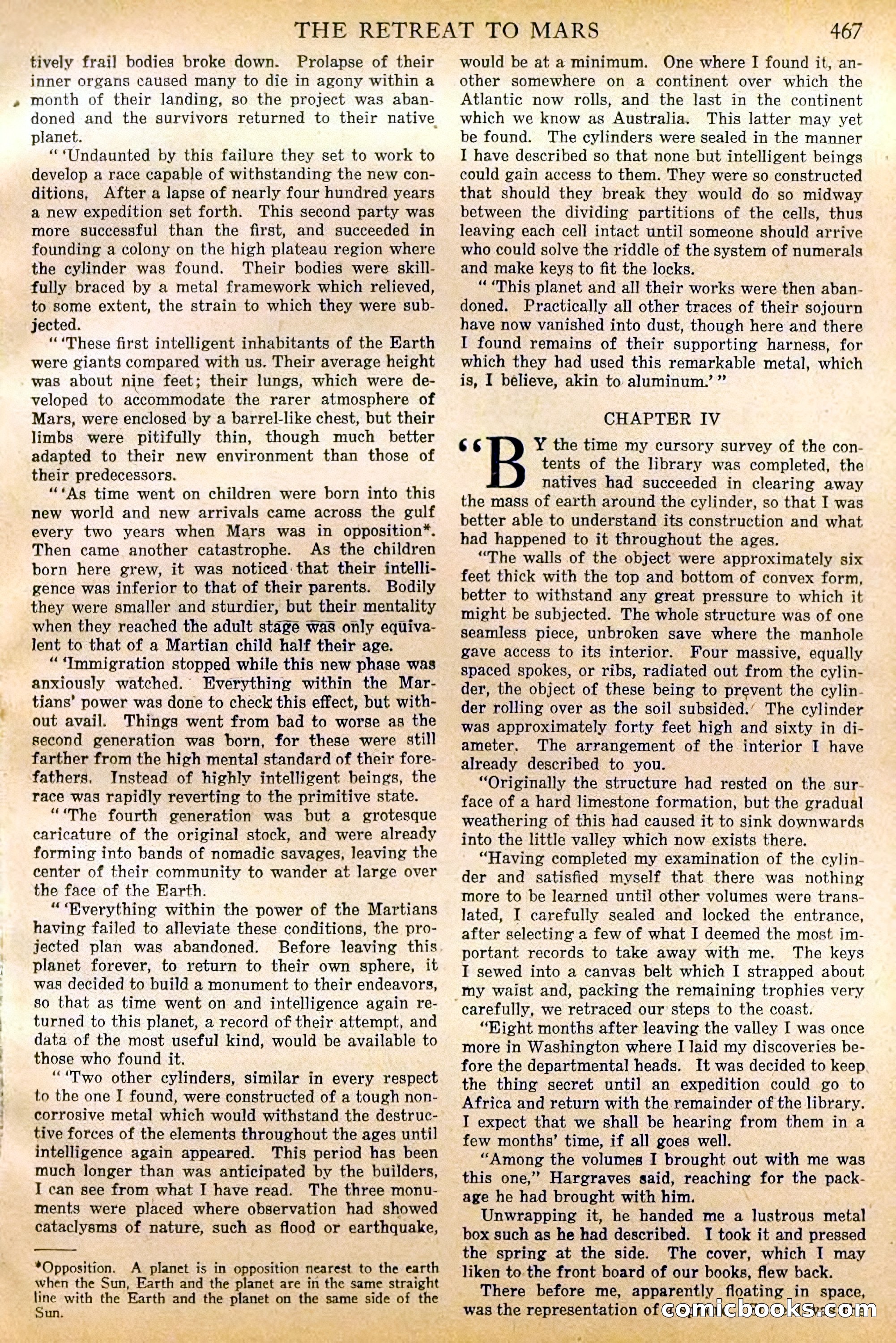
A restored page from Pulp Fiction, 1927. Page through the whole issue in the reader above.
📄 Transcribed text from this page (OCR, searchable)
Machine-transcribed from the original scan — historical spelling and the odd misread are preserved.
THE RETREAT TO MARS tively frail bodies broke down. Prolapse of their inner organs caused many to die in agony within a month of their landing, so the project was aban- doned and the survivors returned to their native planet. “*TIndaunted by this failure they set to work to develop a race capable of withstanding the new con- ditions, After a lapse of nearly four hundred years a new expedition set forth. This second party was more successful than the first, and succeeded in founding a colony on the high plateau region where the cylinder was found. Their bodies were skill- fully braced by a metal framework which relieved, to some extent, the strain to which they were sub- jected. “‘These first intelligent inhabitants of the Earth were giants compared with us. Their average height was about nine feet; their lungs, which were de- veloped to accommodate the rarer atmosphere of Mars, were enclosed by a barrel-like chest, but their limbs were pitifully thin, though much better adapted to their new environment than those of their predecessors. “*As time went on children were born into this new world and new arrivals came across the gulf every two years when Mars was in opposition*. Then came another catastrophe. As the children born here grew, it was noticed: that their intelli- gence was inferior to that of their parents. Bodily they were smaller and sturdier, but their mentality when they reached the adult stage waa only equiva- lent to that of a Martian child half their age. “Tmmigration stopped while this new phase was anxiously watched. Everything within the Mar- tians’ power was done to check this effect, but with- out avail. Things went from bad to worse as the second generation was born, for these were still farther from the high mental standard of their fore- fathers. Instead of highly intelligent beings, the race was rapidly reverting to the primitive state. “The fourth generation was but a grotesque caricature of the original stock, and were already forming into bands of nomadic savages, leaving the center of their community to wander at large over the face of the Barth. “Hvyerything within the power of the Martians having failed to alleviate these conditions, the pro- jected plan was abandoned. Before leaving this planet forever, to return to their own sphere, it was decided to build a monument to their endeavors, so that as time went on and intelligence again re- turned to this planet, a record of their attempt, and data of the most useful kind, would be available to those who found it. ““Two other cylinders, similar in every respect to the one I found, were constructed of a tough non- corrosive metal which would withstand the destruc- tive forces of the elements throughout the ages until intelligence again appeared. This period has been much longer than was anticipated by the builders, I can see from what I have read. The three monu- ments were placed where observation had showed cataclysms of nature, such as flood or earthquake, “Opposition. A_planet is in opposition nearest to the earth when the Sun, Earth and the planet are in the same straight eG with the Earth and the planet on the same side of the un. eA eR Sen thie Me ws) e wae 467 would be at a minimum. One where I found it, an- other somewhere on a continent over which the Atlantic now rolls, and the last in the continent which we know as Australia, This latter may yet be found. The cylinders were sealed in the manner I have described so that none but intelligent beings could gain access to them. They were so constructed that should they break they would do so midway between the dividing partitions of the cells, thus leaving each cell intact until someone should arrive who could solve the riddle of the system of numerals and make keys to fit the locks. “ “This planet and all their works were then aban- doned. Practically all other traces of their sojourn have now vanished into dust, though here and there I found remains of their supporting harness, for which they had used this remarkable metal, which is, I believe, akin to aluminum.’ ” CHAPTER IV 7 Y the time my cursory survey of the con- tents of the library was completed, the natives had succeeded in clearing away the mass of earth around the cylinder, so that I was better able to understand its construction and what had happened to it throughout the ages. “The walls of the object were approximately six feet thick with the top and bottom of convex form, better to withstand any great pressure to which it might be subjected. The whole structure was of one seamless piece, unbroken save where the manhole gave access to its interior. Four massive, equally spaced spokes, or ribs, radiated out from the cylin- der, the object of these being to prevent the cylin- der rolling over as the soil subsided.’ The cylinder was approximately forty feet high and sixty in di- ameter. The arrangement of the interior I have already described to you. “Originally the structure had rested on the sur- face of a hard limestone formation, but the gradual weathering of this had caused it to sink downwards into the little valley which now exists there. “Having completed my examination of the cylin- der and satisfied myself that there was nothing more to be learned until other volumes were trans- lated, I carefully sealed and locked the entrance, after selecting a few of what I deemed the most im- portant records to take away with me. The keys I sewed into a canvas belt which I strapped about _my waist and, packing the remaining trophies very carefully, we retraced our steps to the coast. “Eight months after leaving the valley I was once more in Washington where I laid my discoveries be- fore the departmental heads. It was decided to keep the thing secret until an expedition could go to Africa and return with the remainder of the library. I expect that we shall be hearing from them in a few months’ time, if all goes well. “Among the volumes I brought out with me was this one,” Hargraves said, reaching for the pack- age he had brought with him. Unwrapping it, he handed me a lustrous metal box such as he had described. I took it and pressed the spring at the side. The cover, which I may liken to. the front board of our books, flew back. There before me, apparently floating in space, was the representation of @(yAniKcl SXOe) exer)