
Pulp Fiction, 1927 · page 54 of 107
Amazing Stories, August 1927 — page 54: what you’re looking at
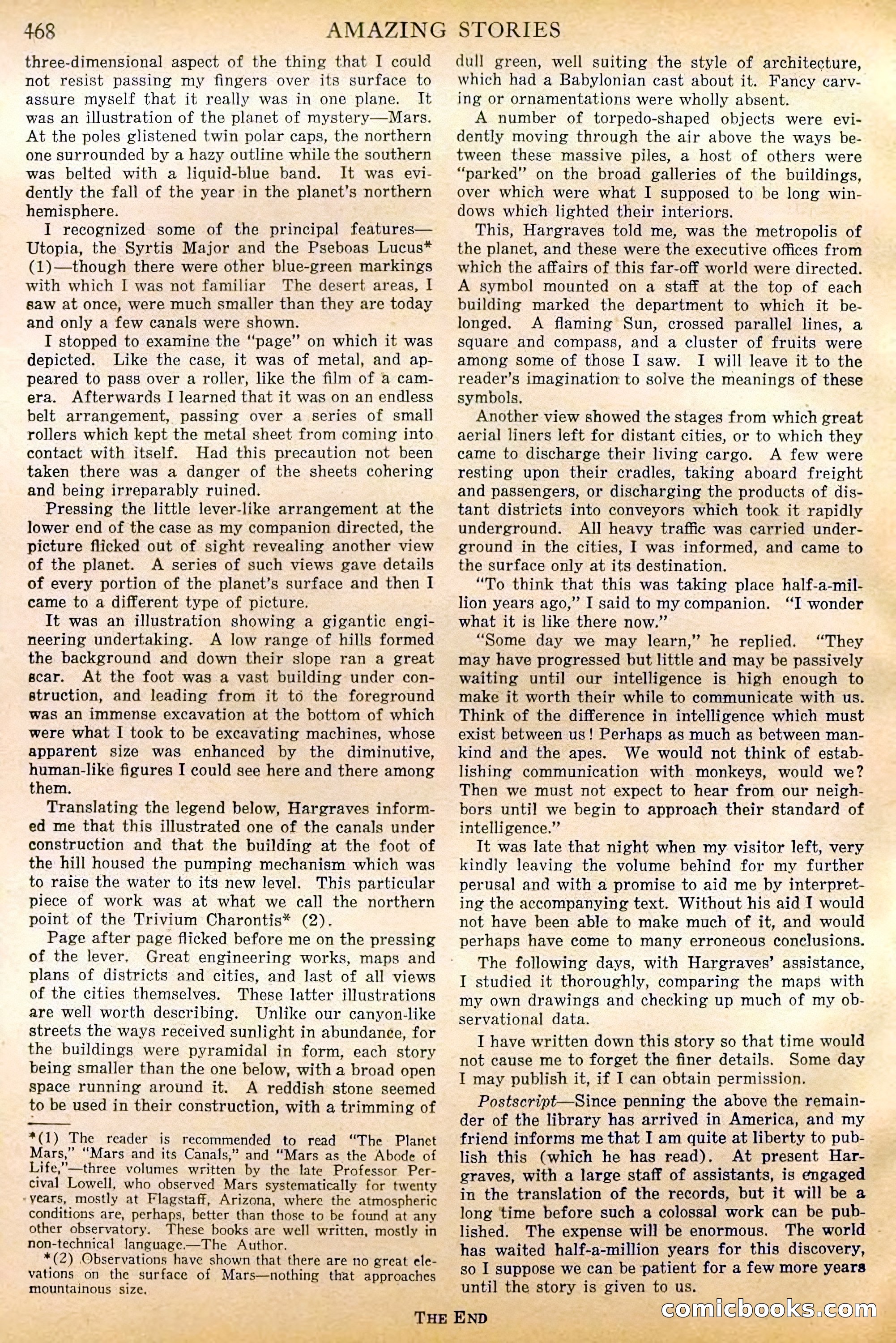
A restored page from Pulp Fiction, 1927. Page through the whole issue in the reader above.
📄 Transcribed text from this page (OCR, searchable)
Machine-transcribed from the original scan — historical spelling and the odd misread are preserved.
468 three-dimensional aspect of the thing that I could not resist passing my fingers over its surface to assure myself that it really was in one plane. It was an illustration of the planet of mystery—Mars. At the poles glistened twin polar caps, the northern one surrounded by a hazy outline while the southern was belted with a liquid-blue band. It was eyi- dently the fall of the year in the planet’s northern hemisphere. I recognized some of the principal features— Utopia, the Syrtis Major and the Pseboas Lucus* (1)—though there were other blue-green markings with which I was not familiar The desert areas, I saw at once, were much smaller than they are today and only a few canals were shown. I stopped to examine the ‘‘page” on which it was depicted. Like the case, it was of metal, and ap- peared to pass over a roller, like the film of a cam- era. Afterwards I learned that it was on an endless belt arrangement, passing over a series of small rollers which kept the metal sheet from coming into contact with itself. Had this precaution not been taken there was a danger of the sheets cohering and being irreparably ruined. Pressing the little lever-like arrangement at the lower end of the case as my companion directed, the picture flicked out of sight revealing another view of the planet. A series of such views gave details of every portion of the planet’s surface and then I came to a different type of picture. It was an illustration showing a gigantic engi- neering undertaking. A low range of hills formed the background and down their slope ran a great sacar. At the foot was a vast building under con- struction, and leading from it to the foreground was an immense excavation at the bottom of which were what I took to be excavating machines, whose apparent size was enhanced by the diminutive, human-like figures I could see here and there among them. Translating the legend below, Hargraves inform- ed me that this illustrated one of the canals under construction and that the building at the foot of the hill housed the pumping mechanism which was to raise the water to its new level. This particular piece of work was at what we call the northern point of the Trivium Charontis* (2). Page after page flicked before me on the pressing of the lever, Great engineering works, maps and plans of districts and cities, and last of all views of the cities themselves. These latter illustrations are well worth describing. Unlike our canyon-like streets the ways received sunlight in abundance, for the buildings were pyramidal in form, each story being smaller than the one below, with a broad open space running around it. A reddish stone seemed to be used in their construction, with a trimming of *(1) The reader is recommended to read “The Planet Mars,” ‘Mars and its Canals,” and “Mars as the Abode of Life,"—three volumes written by the late Professor Per- cival Lowell, who observed Mars systematically for twenty ~years, mostly at Flagstaff, Arizona, where the atmospheric conditions are, perhaps, better than those to be found at any other observatory. These books are well written, mostly in non-technical Janguage—The Author. *(2) Observations have shown that there are no great ele- vations on the surface of Mars—nothing that approaches mountainous size, te ae Fe aR oe fy, So SPE Fe eh eae RA ee eS Se a ee ee el AMAZING STORIES dull green, well suiting the style of architecture, which had a Babylonian cast about it. Fancy carv- ing or ornamentations were wholly absent. A number of torpedo-shaped objects were evi- dently moving through the air above the ways be- tween these massive piles, a host of others were “parked” on the broad galleries of the buildings, over which were what, I supposed to be long win- dows which lighted their interiors. This, Hargraves told me, was the metropolis of the planet, and these were the executive offices from which the affairs of this far-off world were directed. A symbol mounted on a staff at the top of each building marked the department to which it be- longed. A flaming Sun, crossed parallel lines, a square and compass, and a cluster of fruits were among some of those I saw. I will leave it to the reader’s imagination to solve the meanings of these symbols, Another view showed the stages from which great aerial liners left for distant cities, or to which they came to discharge their living cargo. A few were resting upon their cradles, taking aboard freight and passengers, or discharging the products of dis- tant districts into conveyors which took it rapidly underground. All heavy traffic was carried under- ground in the cities, I was informed, and came to the surface only at its destination. “To think that this was taking place half-a-mil- lion years ago,” I said to my companion. “I wonder what it is like there now.” “Some day we may learn,” he replied. ‘They may have progressed but little and may be passively waiting until our intelligence is high enough to make it worth their while to communicate with us. Think of the difference in intelligence which must exist between us! Perhaps as much as between man- kind and the apes. We would not think of estab- lishing communication with monkeys, would we? Then we must not expect to hear from our neigh- bors until we begin to approach their standard of intelligence.” It was late that night when my visitor left, very kindly leaving the volume behind for my further perusal and with a promise to aid me by interpret- ing the accompanying text. Without his aid I would not have been able to make much of it, and would perhaps have come to many erroneous conclusions. The following days, with Hargraves’ assistance, I studied it thoroughly, comparing the maps with my own drawings and checking up much of my ob- servational data. I have written down this story so that time would not cause me to forget the finer details. Some day I may publish it, if I can obtain permission. Postscript—Since penning the above the remain- der of the library has arrived in America, and my friend informs me that I am quite at liberty to pub- lish this (which he has read). At present Har- graves, with a large staff of assistants, is engaged in the translation of the records, but it will be a long ‘time before such a colossal work can be pub- lished. The expense will be enormous. has waited half-a-million years for this discovery, so I suppose we can be patient for a few more years until the story is given to us. COMMICOOxS.COnl a ee Se The world -