
Pulp Fiction, 1927 · page 65 of 107
Amazing Stories, August 1927 — page 65: what you’re looking at
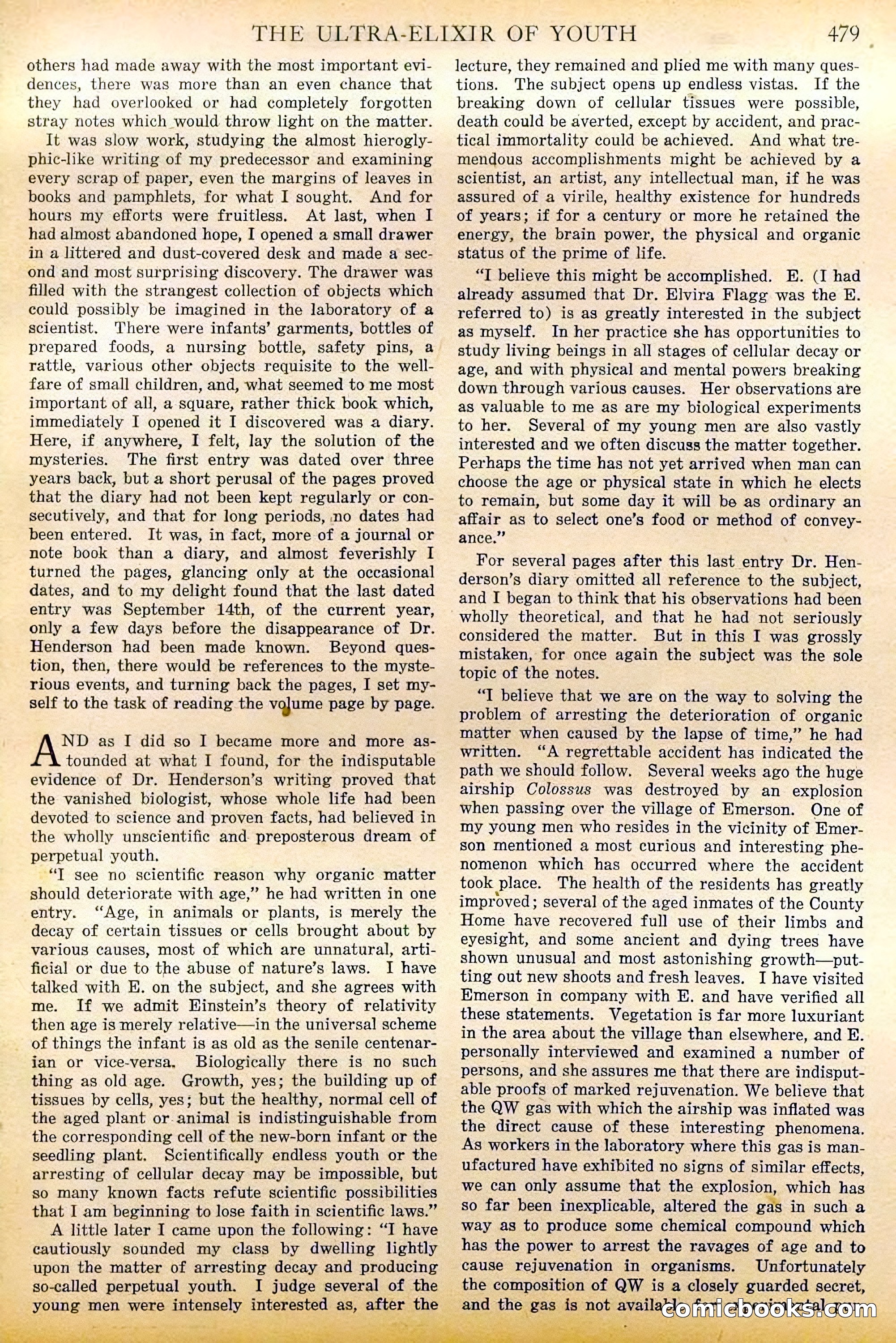
A restored page from Pulp Fiction, 1927. Page through the whole issue in the reader above.
📄 Transcribed text from this page (OCR, searchable)
Machine-transcribed from the original scan — historical spelling and the odd misread are preserved.
THE ULTRA-ELIXIR OF YOUTH others had made away with the most important evi- dences, there was more than an even chance that they had overlooked or had completely forgotten stray notes which would throw light on the matter. It was slow work, studying the almost hierogly- phic-like writing of my predecessor and examining every scrap of paper, even the margins of leaves in books and pamphlets, for what I sought. And for hours my efforts were fruitless. At last, when I had almost abandoned hope, I opened a small drawer in a littered and dust-covered desk and made a sec- ond and most surprising discovery. The drawer was filled with the strangest collection of objects which could possibly be imagined in the laboratory of a scientist. There were infants’ garments, bottles of prepared foods, a nursing bottle, safety pins, a rattle, various other objects requisite to the well- fare of small children, and, what seemed to me most important of all, a square, rather thick book which, immediately I opened it I discovered was a diary. Here, if anywhere, I felt, lay the solution of the mysteries. The first entry was dated over three years back, but a short perusal of the pages proved that the diary had not been kept regularly or con- secutively, and that for long periods, no dates had been entered. It was, in fact, more of a journal or note book than a diary, and almost feverishly I turned the pages, glancing only at the occasional dates, and to my delight found that the last dated entry was September 14th, of the current year, only a few days before the disappearance of Dr. Henderson had been made known. Beyond ques- tion, then, there would be references to the myste- rious events, and turning back the pages, I set my- self to the task of reading the volume page by page. ND as I did so I became more and more as- tounded at what I found, for the indisputable evidence of Dr. Henderson’s writing proved that the vanished biologist, whose whole life had been devoted to science and proven facts, had believed in the wholly unscientific and. preposterous dream of perpetual youth. “T see no scientific reason why organic matter should deteriorate with age,” he had written in one entry. “Age, in animals or plants, is merely the decay of certain tissues or cells brought about by various causes, most of which are unnatural, arti- ficial or due to the abuse of nature’s laws. I have talked with E. on the subject, and she agrees with me. If we admit Hinstein’s theory of relativity then age is merely relative—in the universal scheme of things the infant is as old as the senile centenar- jan or vice-versa, Biologically there is no such thing as old age. Growth, yes; the building up of tissues by cells, yes; but the healthy, normal cell of the aged plant or-animal is indistinguishable from the corresponding cell of the new-born infant or the seedling plant. Scientifically endless youth or the arresting of cellular decay may be impossible, but so many known facts refute scientific possibilities that I am beginning to lose faith in scientific laws.” A little later I came upon the following: “TI have cautiously sounded my class by dwelling lightly upon the matter of arresting decay and producing so-called perpetual youth. I judge several of the young men were intensely interested as, after 479 lecture, they remained and plied me with many ques- tions. The subject opens up endless vistas. If the breaking down of cellular tissues were possible, death could be averted, except by accident, and prac- tical immortality could be achieved. And what tre- mendous accomplishments might be achieved by a scientist, an artist, any intellectual man, if he was assured of a virile, healthy existence for hundreds of years; if for a century or more he retained the energy, the brain power, the physical and organic status of the prime of life. “T believe this might be accomplished. E. (I had already assumed that Dr. Elvira Flagg was the E. referred to) is as greatly interested in the subject as myself. In her practice she has opportunities to study living beings in all stages of cellular decay or age, and with physical and mental powers breaking down through various causes. Her observations are as valuable to me as are my biological experiments to her. Several of my young men are also vastly interested and we often discuss the matter together. Perhaps the time has not yet arrived when man can choose the age or physical state in which he elects to remain, but some day it will be as ordinary an affair as to select one’s food or method of convey- ance.” For several pages after this last entry Dr. Hen- derson’s diary omitted all reference to the subject, and I began to think that his observations had been wholly theoretical, and that he had not seriously considered the matter. But in this I was grossly mistaken, for once again the subject was the sole topic of the notes. “T believe that we are on the way to solving the problem of arresting the deterioration of organic matter when caused by the lapse of time,” he had written. “A regrettable accident has indicated the path we should follow. Several weeks ago the huge airship Colossus was destroyed by an explosion when passing over the village of Emerson. One of my young men who resides in the vicinity of Emer- son mentioned a most curious and interesting phe- nomenon which has occurred where the accident took place. The health of the residents has greatly improved; several of the aged inmates of the County Home have recovered full use of their limbs and eyesight, and some ancient and dying trees have shown unusual] and most astonishing growth—put- ting out new shoots and fresh leaves. I have visited Emerson in company with E. and have verified all these statements. Vegetation is far more luxuriant in the area about the village than elsewhere, and E. personally interviewed and examined a number of persons, and she assures me that there are indisput- able proofs of marked rejuvenation. We believe that the QW gas with which the airship was inflated was the direct cause of these interesting phenomena. As workers in the laboratory where this gas is man- ufactured have exhibited no signs of similar effects, we can only assume that the explosion, which has so far been inexplicable, altered the on in such a way as to produce some chemical compound which has the power to arrest the ravages of age and to cause rejuvenation in organisms. Unfortunately the composition of ou is a glorely euarded secret,