
Pulp Fiction, 1927 · page 66 of 107
Amazing Stories, August 1927 — page 66: what you’re looking at
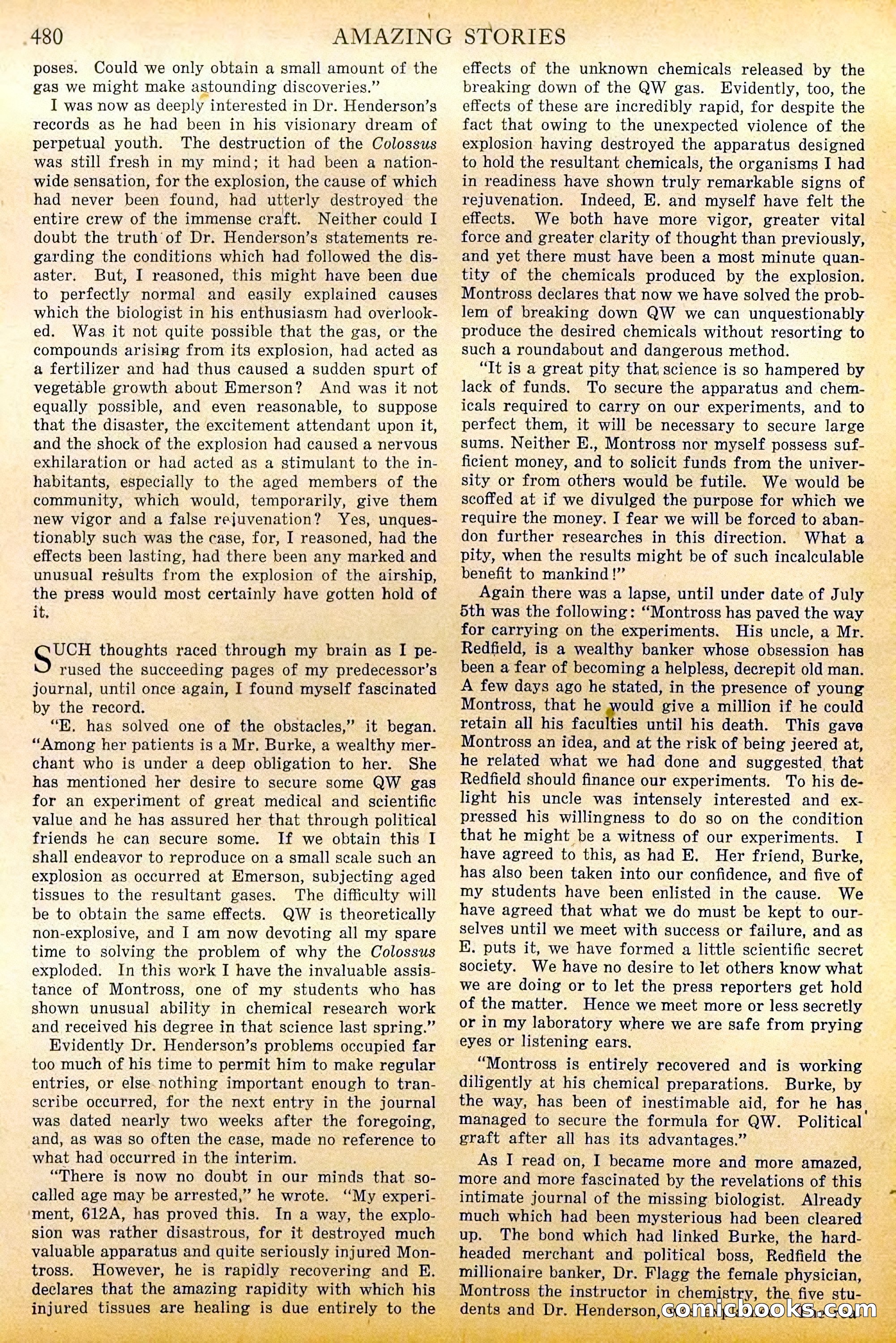
A restored page from Pulp Fiction, 1927. Page through the whole issue in the reader above.
📄 Transcribed text from this page (OCR, searchable)
Machine-transcribed from the original scan — historical spelling and the odd misread are preserved.
480 poses. Could we only obtain a small amount of the gas we might make astounding discoveries.” I was now as deeply interested in Dr. Henderson’s records as he had been in his visionary dream of perpetual youth. The destruction of the Colossus was still fresh in my mind; it had been a nation- wide sensation, for the explosion, the cause of which had never bean found, had utterly destroyed the entire crew of the immense craft. Neither could I doubt the truth of Dr. Henderson’s statements re- garding the conditions which had followed the dis- aster. But, I reasoned, this might have been due to perfectly normal and easily explained causes which the biologist in his enthusiasm had overlook- ed. Was it not quite possible that the gas, or the compounds arising from its explosion, had acted as a fertilizer and had thus caused a sudden spurt of vegetable growth about Emerson? And was it not equally possible, and even reasonable, to suppose that the disaster, the excitement attendant upon it, and the shock of the explosion had caused a nervous exhilaration or had acted as a stimulant to the in- habitants, especially to the aged members of the community, which would, temporarily, give them new vigor and a false rejuvenation? Yes, unques- tionably such was the case, for, I reasoned, had the effects been lasting, had there been any marked and unusual results from the explosion of the airship, the press would most certainly have gotten hold of it, UCH thoughts raced through my brain as I pe- rused the succeeding pages of my predecessor’s journal, until once again, I found myself fascinated by the record. “E. has solved one of the obstacles,” it began. “Among her patients is a Mr, Burke, a wealthy mer- chant who is under a deep obligation to her. She has mentioned her desire to secure some QW gas for an experiment of great medical and scientific value and he has assured her that through political friends he can secure some. If we obtain this I shall endeavor to reproduce on a small scale such an explosion as occurred at Emerson, subjecting aged tissues to the resultant gases. The difficulty will be to obtain the same effects. QW is theoretically non-explosive, and I am now devoting all my spare time to solving the problem of why the Colossus exploded. In this work I have the invaluable assis- tance of Montross, one of my students who has shown unusual ability in chemical research work and received his degree in that science last spring.” Evidently Dr. Henderson’s problems occupied far too much of his time to permit him to make regular entries, or else.nothing important enough to tran- scribe occurred, for the next entry in the journal was dated nearly two weeks after the foregoing, and, as was so often the case, made no reference to what had occurred in the interim. “There is now no doubt in our minds that so- called age may be arrested,” he wrote. “My experi- ‘ment, 612A, has proved this. In a way, the explo- sion was rather disastrous, for it destroyed much valuable apparatus and quite seriously injured Mon- tross. However, he is rapidly recovering and E. declares that the amazing rapidity with which his aling is due entir “the AMAZING STORIES effects of the unknown chemicals released by the breaking down of the QW gas. Evidently, too, the effects of these are incredibly rapid, for despite the fact that owing to the unexpected violence of the explosion having destroyed the apparatus designed to hold the resultant chemicals, the organisms I had in readiness have shown truly remarkable signs of rejuvenation. Indeed, E, and myself have felt the effects. We both have more vigor, greater vital force and greater clarity of thought than previously, and yet there must have been a most minute quan- tity of the chemicals produced by the explosion. Montross declares that now we have solved the prob- lem of breaking down QW we can unquestionably produce the desired chemicals without resorting to such a roundabout and dangerous method. “It is a great pity that science is so hampered by lack of funds. To secure the apparatus and chem- icals required to carry on our experiments, and to perfect them, it will be necessary to secure large sums. Neither E., Montross nor myself possess suf- ficient money, and to solicit funds from the univer- sity or from others would be futile. We would be scoffed at if we divulged the purpose for which we require the money. I fear we will be forced to aban- don further researches in this direction. What a pity, when the results might be of such incalculable benefit to mankind!” Again there was a lapse, until under date of July 5th was the following: “Montross has paved the way for carrying on the experiments. His uncle, a Mr. Redfield, is a wealthy banker whose obsession has been a fear of becoming a helpless, decrepit old man. A few days ago he stated, in the presence of young Montross, that he would give a million if he could retain all his faculties until his death. This gava Montross an idea, and at the risk of being jeered at, he related what we had done and suggested that Redfield should finance our experiments. To his de- light his uncle was intensely interested and ex- pressed his willingness to do so on the condition that he might be a witness of our experiments. I have agreed to this, as had E, Her friend, Burke, has also been taken into our confidence, and five of my students have been enlisted in the cause. We have agreed that what we do must be kept to our- selves until we meet with success or failure, and as E. puts it, we have formed a little scientific secret society. We have no desire to let others know what we are doing or to let the press reporters get hold of the matter. Hence we meet more or less secretly or in my laboratory where we are safe from prying eyes or listening ears. “Montross is entirely recovered and is working diligently at his chemical preparations. Burke, by the way, has been of inestimable aid, for he has managed to secure the formula for QW. Political’ graft after all has its advantages.” As I read on, I became more and more amazed, more and more fascinated by the revelations of this intimate journal of the missing biologist. Already much which had been mysterious had been cleared up. The bond which had linked Burke, the hard- headed merchant and political boss, Redfield the millionaire banker, Dr. Flagg the female physician, Montro he instructo