
Pulp Fiction, 1927 · page 67 of 107
Amazing Stories, August 1927 — page 67: what you’re looking at
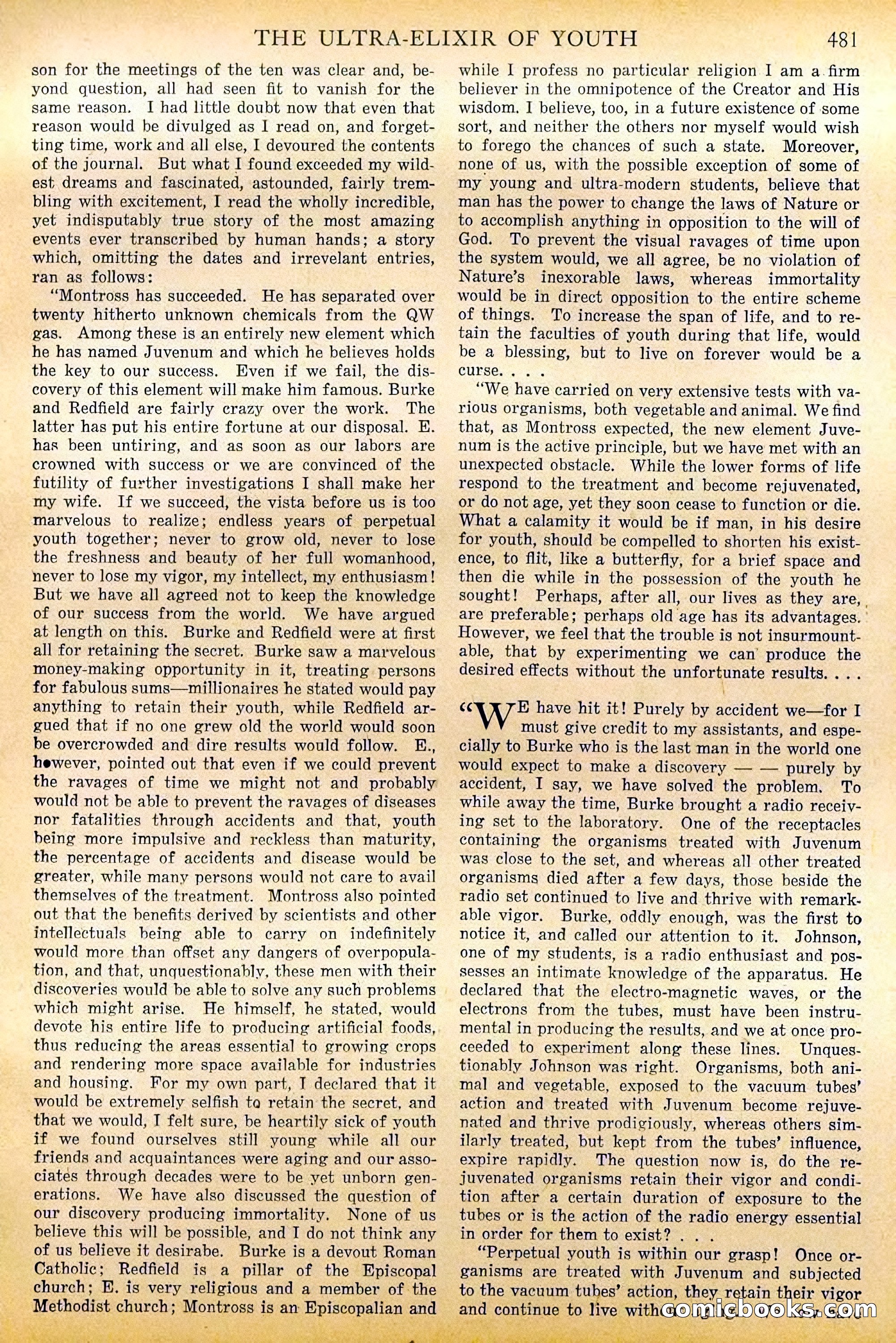
A restored page from Pulp Fiction, 1927. Page through the whole issue in the reader above.
📄 Transcribed text from this page (OCR, searchable)
Machine-transcribed from the original scan — historical spelling and the odd misread are preserved.
THE ULTRA-ELIXIR OF YOUTH son for the meetings of the ten was clear and, be- yond question, all had seen fit to vanish for the same reason. I had little doubt now that even that reason would be divulged as I read on, and forget- ting time, work and all else, I devoured the contents of the journal. But what I found exceeded my wild- est dreams and fascinated, astounded, fairly trem- bling with excitement, I read the wholly incredible, yet indisputably true story of the most amazing events ever transcribed by human hands; a story which, omitting the dates and irrevelant entries, ran as follows: “Montross has succeeded. He has separated over twenty hitherto unknown chemicals from the QW gas. Among these is an entirely new element which he has named Juvenum and which he believes holds the key to our success. Even if we fail, the dis- covery of this element will make him famous. Burke and Redfield are fairly crazy over the work. The latter has put his entire fortune at our disposal. E. has been untiring, and as soon as our labors are crowned with success or we are convinced of the futility of further investigations I shall make her my wife. If we succeed, the vista before us is too marvelous to realize; endless years of perpetual youth together; never to grow old, never to lose the freshness and beauty of her full womanhood, never to lose my vigor, my intellect, my enthusiasm! But we have all agreed not to keep the knowledge of our success from the world. We have argued at length on this. Burke and Redfield were at first all for retaining the secret. Burke saw a marvelous money-making opportunity in it, treating persons for fabulous sums—millionaires he stated would pay anything to retain their youth, while Redfield ar- gued that if no one grew old the world would soon be overcrowded and dire results would follow. E., hewever, pointed out that even if we could prevent the ravages of time we might not and probably would not be able to prevent the ravages of diseases nor fatalities through accidents and that, youth being more impulsive and reckless than maturity, the percentage of accidents and disease would be greater, while many persons would not care to avail themselves of the treatment. Montross also pointed out that the benefits derived by scientists and other intellectuals being able to carry on indefinitely would more than offset any dangers of overpopula- tion, and that, unquestionably, these men with their discoveries would be able to solve any such problems which might arise. He himself, he stated, would devote his entire life to producing artificial foods, thus reducing the areas essential to growing crops and rendering more space available for industries and housing. For my own part, I declared that it would be extremely selfish ta retain the secret, and that we would, I felt sure, be heartily sick of youth if we found ourselves still young while all our friends and acquaintances were aging and our asso- ciates through decades were to be yet unborn gen- erations. We have also discussed the question of our discovery producing immortality. None of us believe this will be possible, and I do not think any of us believe it desirabe. Burke is a devout Roman Catholic; Redfield is a pillar of the Episcopal church; E. is very religious and a member of the _ Methodist church; Montross is an Episcopalian and and contin 481 while I profess no particular religion I am a.firm believer in the omnipotence of the Creator and His wisdom, I believe, too, in a future existence of some sort, and neither the others nor myself would wish to forego the chances of such a state. Moreover, none of us, with the possible exception of some of my young and ultra-modern students, believe that man has the power to change the laws of Nature or to accomplish anything in opposition to the will of God. To prevent the visual ravages of time upon the system would, we all agree, be no violation of Nature’s inexorable laws, whereas immortality would be in direct opposition to the entire scheme of things. To increase the span of life, and to re- tain the faculties of youth during that life, would be a blessing, but to live on forever would be a curse... . “We have carried on very extensive tests with va- rious organisms, both vegetable and animal. We find that, as Montross expected, the new element Juve- num is the active principle, but we have met with an unexpected obstacle. While the lower forms of life respond to the treatment and become rejuvenated, or do not age, yet they soon cease to function or die. What a calamity it would be if man, in his desire for youth, should be compelled to shorten his exist- ence, to flit, like a butterfly, for a brief space and then die while in the possession of the youth he sought! Perhaps, after all, our lives as they are;. are preferable; perhaps old age has its advantages. However, we feel that the trouble is not insurmount- able, that by experimenting we can’ produce the desired effects without the unfortunate results. .. . “We have hit it! Purely by accident we—for I must give credit to my assistants, and espe- cially to Burke who is the last man in the world one would expect to make a discovery — — purely by accident, I say, we have solved the problem. To while away the time, Burke brought a radio receiv- ing set to the laboratory. One of the receptacles containing the organisms treated with Juvenum was close to the set, and whereas all other treated organisms died after a few days, those beside the radio set continued to live and thrive with remark- able vigor. Burke, oddly enough, was the first to notice it, and called our attention to it. Johnson, one of my students, is a radio enthusiast and pos- sesses an intimate knowledge of the apparatus. He declared that the electro-magnetic waves, or the electrons from the tubes, must have been instru- mental in producing the results, and we at once pro- ceeded to experiment along these lines. Unques- tionably Johnson was right. Organisms, both ani- mal and vegetable, exposed to the vacuum tubes’ action and treated with Juvenum become rejuve- nated and thrive prodigiously, whereas others sim- ilarly treated, but kept from the tubes’ influence, expire rapidly. The question now is, do the re- juvenated organisms retain their vigor and condi- tion after a certain duration of exposure to the tubes or is the action of the radio energy essential in order for them to exist? .. . “Perpetual youth is within our grasp! Once or- ganisms are treated with Juvenum and subjected to the vacuum tubes’ action, they retain their vigor i e with@Oigie «COM ue to liv