
Pulp Fiction, 1927 · page 86 of 107
Amazing Stories, August 1927 — page 86: what you’re looking at
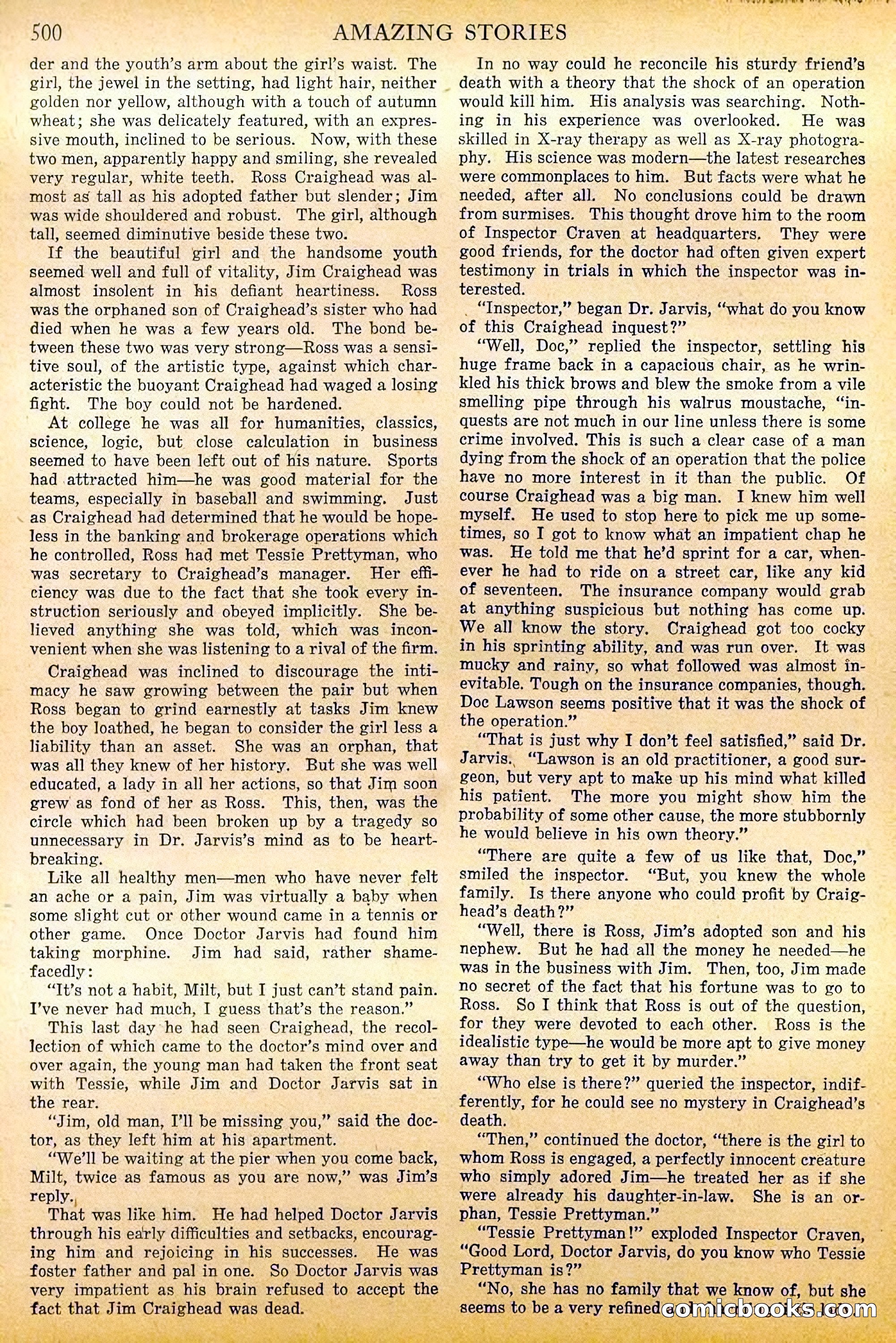
A restored page from Pulp Fiction, 1927. Page through the whole issue in the reader above.
📄 Transcribed text from this page (OCR, searchable)
Machine-transcribed from the original scan — historical spelling and the odd misread are preserved.
500 der and the youth’s arm about the girl’s waist. The girl, the jewel in the setting, had light hair, neither _ golden nor yellow, although with a touch of autumn wheat; she was delicately featured, with an expres- sive mouth, inclined to be serious. Now, with these two men, apparently happy and smiling, she revealed very regular, white teeth. Ross Craighead was al- most as tall as his adopted father but slender; Jim was wide shouldered and robust. The girl, although tall, seemed diminutive beside these two. If the beautiful girl and the handsome youth seemed well and full of vitality, Jim Craighead was almost insolent in his defiant heartiness. Ross was the orphaned son of Craighead’s sister who had died when he was a few years old. The bond be- tween these two was very strong—Ross was a sensi- tive soul, of the artistic type, against which char- acteristic the buoyant Craighead had waged a losing fight. The boy could not be hardened. At college he was all for humanities, classics, science, logic, but close calculation in business seemed to have been left out of his nature. Sports had attracted him—he was good material for the teams, especially in baseball and swimming. Just . as Craighead had determined that he would be hope- less in the banking and brokerage operations which he controlled, Ross had met Tessie Prettyman, who was secretary to Craighead’s manager. Her effi- ciency was due to the fact that she took every in- struction seriously and obeyed implicitly. She be- lieved anything she was told, which was incon- venient when she was listening to a rival of the firm. Craighead was inclined to discourage the inti- macy he saw growing between the pair but when Ross began to grind earnestly at tasks Jim knew the boy loathed, he began to consider the girl less a liability than an asset. She was an orphan, that was all they knew of her history. But she was well educated, a lady in all her actions, so that Jim soon grew as fond of her as Ross. This, then, was the circle which had been broken up by a tragedy so unnecessary in Dr. Jarvis’s mind as to be heart- breaking. Like all healthy men—men who have never felt an ache or a pain, Jim was virtually a baby when some slight cut or other wound came in a tennis or other game. Once Doctor Jarvis had found him taking morphine. Jim had said, rather shame- facedly: “Tt’s not a habit, Milt, but I just can’t stand pain. I’ve never had much, I guess that’s the reason.” This last day he had seen Craighead, the recol- lection of which came to the doctor’s mind over and over again, the young man had taken the front seat with Tessie, while Jim and Doctor Jarvis sat in the rear. “Jim, old man, I’ll be missing you,” said the doc- tor, as they left him at his apartment. “We’ll be waiting at the pier when you come back, Milt, twice as famous as you are now,” was Jim’s reply., That was like him. He had helped Doctor Jarvis through his early difficulties and setbacks, encourag- ing him and rejoicing in his successes. He was foster father and pal in one. So Doctor Jarvis was very aap as Se brain refused to. accept the = AMAZING STORIES In no way could he reconcile his sturdy friend’s death with a theory that the shock of an operation would kill him. His analysis was searching. Noth- ing in his experience was overlooked. He was skilled in X-ray therapy as well as X-ray photogra- phy. His science was modern—the latest researches were commonplaces to him. But facts were what he needed, after all. No conclusions could be drawn from surmises. This thought drove him to the room of Inspector Craven at headquarters, They were good friends, for the doctor had often given expert testimony in trials in which the inspector was in- terested. . “Inspector,” began Dr. Jarvis, “what do you know of this Craighead inquest?” “Well, Doc,” replied the inspector, settling his huge frame back in a capacious chair, as he wrin- kled his thick brows and blew the smoke from a vile smelling pipe through his walrus moustache, “in- quests are not much in our line unless there is some crime involved. This is such a clear case of a man dying from the shock of an operation that the police have no more interest in it than the public. Of course Craighead was a big man. I knew him well myself. He used to stop here to pick me up some- times, so I got to know what an impatient chap he was. He told me that he’d sprint for a car, when- ever he had to ride on a street car, like any kid of seventeen. The insurance company would grab at anything suspicious but nothing has come up. We all know the story. Craighead got too cocky in his sprinting ability, and was run over. It was mucky and rainy, so what followed was almost in- evitable. Tough on the insurance companies, though. Doe Lawson seems positive that it was the shock of the operation.” “That is just why I don’t feel satisfied,” said Dr. Jarvis. “Lawson is an old practitioner, a good sur- geon, but very apt to make up his mind what killed his patient. The more you might show him the probability of some other cause, the more stubbornly he would believe in his own theory.” “There are quite a few of us like that, Doc,” smiled the inspector. “But, you knew the whole family. Is there anyone who could profit by Craig- head’s death?” “Well, there is Ross, Jim’s adopted son and his nephew. But he had all the money he needed—he was in the business with Jim. Then, too, Jim made no secret of the fact that his fortune was to go to Ross. So I think that Ross is out of the question, for they were devoted to each other. Ross is the idealistic type—he would be more apt to give money away than try to get it by murder.” “Who else is there?” queried the inspector, indif- ferently, for he could see no mystery in Craighead’s ~ death. “Then,” continued the doctor, “there is the gir] to whom Ross is engaged, a perfectly innocent creature who simply adored Jim—he treated her as if she were already his daughter-in-law. She is an or- phan, Tessie Prettyman.” — “Tessie Prettyman!” exploded Inspector Craven, “Good Lord, Decor Jarvis, do you know who ‘Tessie 2 Morte TAG wan, ee ae! ee, A eee