
Pulp Fiction, 1927 · page 87 of 107
Amazing Stories, August 1927 — page 87: what you’re looking at
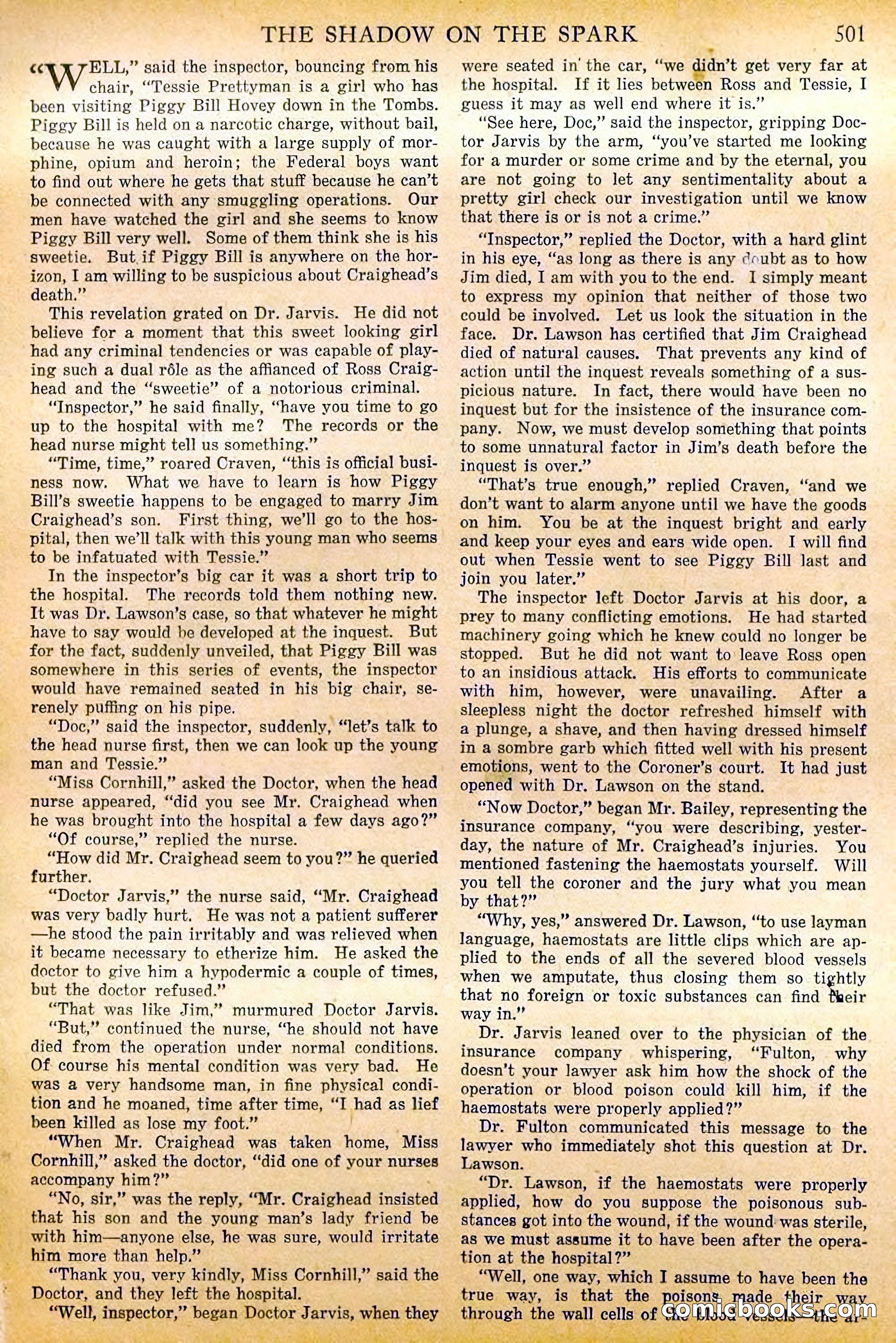
A restored page from Pulp Fiction, 1927. Page through the whole issue in the reader above.
📄 Transcribed text from this page (OCR, searchable)
Machine-transcribed from the original scan — historical spelling and the odd misread are preserved.
See ie St « ELL,” said the inspector, bouncing from his chair, “Tessie Prettyman is a girl who has been visiting Piggy Bill Hovey down in the Tombs. Piggy Bill is held on a narcotic charge, without bail, because he was caught with a large supply of mor- phine, opium and heroin; the Federal boys want to find out where he gets that stuff because he can’t be connected with any smuggling operations. Our men have watched the girl and she seems to know Piggy Bill very well. Some of them think she is his sweetie. But.if Piggy Bill is anywhere on the hor- izon, I am willing to be suspicious about Craighead’s death.” This revelation grated on Dr. Jarvis. He did not believe for a moment that this sweet looking girl had any criminal tendencies or was capable of play- ing such a dual réle as the affianced of Ross Craig- head and the “sweetie” of a notorious criminal. “Inspector,” he said finally, “have you time to go up to the hospital with me? The records or the head nurse might tell us something.” “Time, time,” roared Craven, “this is official busi- ness now. What we have to learn is how Piggy Bill’s sweetie happens to be engaged to marry Jim Craighead’s son. First thing, we'll go to the hos- pital, then we’ll talk with this young man who seems to be infatuated with Tessie.” In the inspector’s big car it was a short trip to the hospital. The records told them nothing new. It was Dr. Lawson’s case, so that whatever he might have to say would he developed at the inquest. But for the fact, suddenly unveiled, that Piggy Bill was somewhere in this series of events, the inspector would have remained seated in his big chair, se- renely puffing on his pipe. “Doe,” said the inspector, suddenly, “let’s talk to the head nurse first, then we can look up the young man and Tessie.” “Miss Cornhill,” asked the Doctor, when the head nurse appeared, “did you see Mr. Craighead when he was brought into the hospital a few days ago?” “Of course,” replied the nurse. “How did Mr. Craighead seem to you?” he queried further. “Doctor Jarvis,” the nurse said, “Mr. Craighead was very badly hurt. He was not a patient sufferer —he stood the pain irritably and was relieved when it became necessary to etherize him. He asked the doctor to give him a hypodermic a couple of times, but the doctor refused.” “That was like Jim,” murmured Doctor Jarvis. “But,” continued the nurse, “he should not have died from the operation under normal conditions. Of course his mental condition was very bad. He was a very handsome man, in fine physical condi- tion and he moaned, time after time, “I pad as lief been killed as lose my foot.” “When Mr. Craighead was taken pia ‘Miss _ Cornhill,” asked the doctor, “did one of your nurses - accompany him?” “No, sir,” was the reply, “Mr. Craighead inatated that his son and the young man’s lady friend be with him—anyone else, he was sure, would irritate him more than help.” “Thank you, very kindly, Miss Cornhill,” said the Doctor, and they left the hospital : ew SOL * were seated in’ the car, ‘‘we gent get very far at the hospital. If it lies between Ross and Tessie, I guess it may as well end where it is.” “See here, Doc,” said the inspector, gripping Doc- tor Jarvis by the arm, “‘you’ve started me looking for a murder or some crime and by the eternal, you are not going to let any sentimentality about a pretty girl check our investigation until we know that there is or is not a crime.” “Inspector,” replied the Doctor, with a hard glint in his eye, “as long as there is any doubt as to how Jim died, I am with you to the end. I simply meant to express my opinion that neither of those two could be involved. Let us look the situation in the face. Dr. Lawson has certified that Jim Craighead died of natural causes. That prevents any kind of action until the inquest reveals something of a sus- picious nature. In fact, there would have been no inquest but for the insistence of the insurance com- pany. Now, we must develop something that points to some unnatural factor in Jim’s death before the inquest is over.” “That’s true enough,” replied Craven, ‘and we don’t want to alarm anyone until we have the goods on him. You be at the inquest bright and early and keep your eyes and ears wide open. I will find out when Tessie went to see Piggy Bill last and join you later.” The inspector left Doctor Jarvis at his door, a prey to many conflicting emotions. He had started machinery going which he knew could no longer be stopped. But he did not want to leave Ross open to an insidious attack. His efforts to communicate with him, however, were unavailing. After a sleepless night the doctor refreshed himself with a plunge, a shave, and then having dressed himself ina sombre garb which fitted well with his present emotions, went to the Coroner’s court. It had just opened with Dr, Lawson on the stand. “Now Doctor,” began Mr. Bailey, representing the insurance company, “you were describing, yester- day, the nature of Mr. Craighead’s injuries. You mentioned fastening the haemostats yourself. Will you tell the coroner and the jury what you mean by that?” “Why, yes,” answered Dr. Lawson, “to use layman language, haemostats are little clips which are ap- plied to the ends of all the severed blood vessels when we amputate, thus closing them so tightly that no foreign or toxic substances can find teeir way in.” Dr. Jarvis leaned over to the physician of the insurance company whispering, ‘Fulton, why doesn’t your lawyer ask him how the shock of the operation or blood poison could kill him, if the haemostats were properly applied?” Dr. Fulton communicated this message to the lawyer who immediately shot this question at Dr. Lawson. “Dr. Lawson, if the haemostats were properly applied, how do you suppose the poisonous sub- stances got into the wound, if the wound: was sterile, as we must assume it to have been after the opera- tion at the hospital?” “Well, one © WAY, which I assume ua have Deen the THE SHADOW « ON THE SPARK