
Pulp Fiction, 1927 · page 89 of 107
Amazing Stories, August 1927 — page 89: what you’re looking at
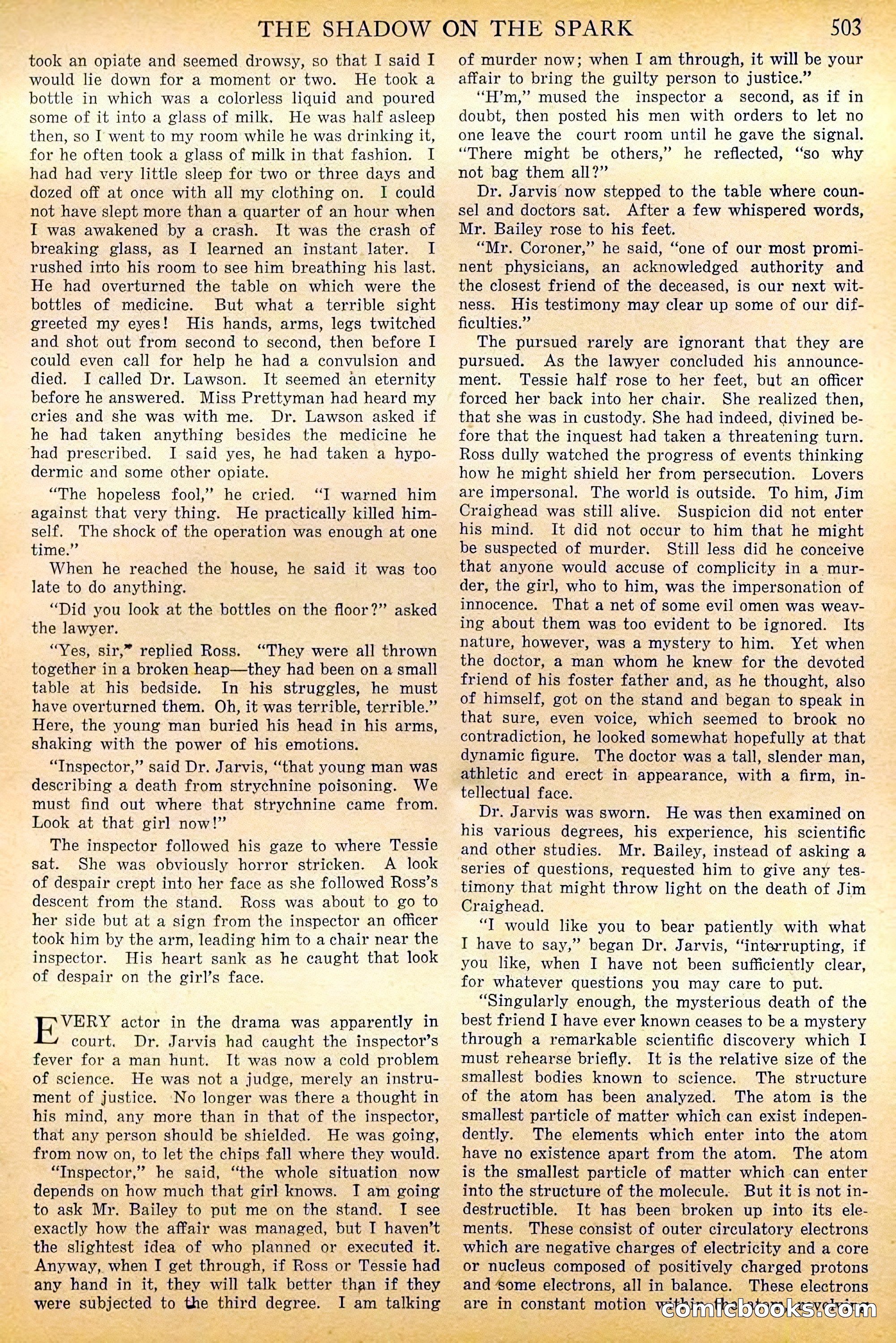
A restored page from Pulp Fiction, 1927. Page through the whole issue in the reader above.
📄 Transcribed text from this page (OCR, searchable)
Machine-transcribed from the original scan — historical spelling and the odd misread are preserved.
oes er, THE SHADOW ON THE SPARK took an opiate and seemed drowsy, so that I said I would lie down for a moment or two. He took a bottle in which was a colorless liquid and poured some of it into a glass of milk. He was half asleep then, so I went to my room while he was drinking it, for he often took a glass of milk in that fashion. I had had very little sleep for two or three days and dozed off at once with all my clothing on. I could not have slept more than a quarter of an hour when I was awakened by a crash. It was the crash of breaking glass, as I learned an instant later. I rushed into his room to see him breathing his last. He had overturned the table on which were the bottles of medicine. But what a terrible sight greeted my eyes! His hands, arms, legs twitched and shot out from second to second, then before I could even call for help he had a convulsion and died. I called Dr. Lawson. It seemed an eternity before he answered. Miss Prettyman had heard my cries and she was with me. Dr. Lawson asked if he had taken anything besides the medicine he had prescribed. I said yes, he had taken a hypo- dermic and some other opiate. “The hopeless fool,’ he cried. “I warned him against that very thing. He practically killed him- self. The shock of the operation was enough at one time.” When he reached the house, he said it was too late to do anything. “Did you look at the bottles on the floor?” asked the lawyer. “Yes, sir,” replied Ross. “They were all thrown together in a broken heap—they had been on a small table at his bedside. In his struggles, he must have overturned them. Oh, it was terrible, terrible.” Here, the young man buried his head in his arms, shaking with the power of his emotions. “Inspector,” said Dr. Jarvis, “that young man was describing a death from strychnine poisoning. We must find out where that strychnine came from. Look at that girl now!” The inspector followed his gaze to where Tessie sat. She was obviously horror stricken. A look of despair crept into her face as she followed Ross’s descent from the stand. Ross was about to go to her side but at a sign from the inspector an officer took him by the arm, leading him to a chair near the inspector. His heart sank as he caught that look of despair on the girl’s face. pees actor in the drama was apparently in court. Dr. Jarvis had caught the inspector’s fever for a man hunt. It was now a cold problem of science. He was not a judge, merely an instru- ment of justice. No longer was there a thought in his mind, any more than in that of the inspector, that any person should be shielded. He was going, from now on, to let the chips fall where they would. “Inspector,” he said, “the whole situation now depends on how much that girl knows. I am going to ask Mr. Bailey to put me on the stand. I see exactly how the affair was managed, but I haven’t the slightest idea of who planned or executed it. Anyway, when I get through, if Ross or Tessie had any hand in it, they will talk better than if they were subjected to the third degree. I am talking ist Pd hc ae eS Se ESS Sagi Sloe Oe ee ro 503 of murder now; when I am through, it will be your affair to bring the guilty person to justice.” “A’m,” mused the inspector a_ second, as if in doubt, then posted his men with orders to let no one leave the court room until he gave the signal. “There might be others,” he reflected, “so why not bag them all?” Dr. Jarvis now stepped to the table where coun- sel and doctors sat. After a few whispered words, Mr. Bailey rose to his feet. “Mr. Coroner,” he said, “one of our most promi- nent physicians, an acknowledged authority and the closest friend of the deceased, is our next wit- ness. His testimony may clear up some of our dif- ficulties.” The pursued rarely are ignorant that they are pursued. As the lawyer concluded his announce- ment. Tessie half rose to her feet, but an officer forced her back into her chair. She realized then, that she was in custody. She had indeed, divined be- fore that the inquest had taken a threatening turn. Ross dully watched the progress of events thinking how he might shield her from persecution. Lovers are impersonal. The world is outside. To him, Jim Craighead was still alive. Suspicion did not enter his mind. It did not occur to him that he might be suspected of murder. Still less did he conceive that anyone would accuse of complicity in a mur- der, the girl, who to him, was the impersonation of innocence. That a net of some evil omen was weay- ing about them was too evident to be ignored. Its nature, however, was a mystery to him. Yet when the doctor, a man whom he knew for the devoted friend of his foster father and, as he thought, also of himself, got on the stand and began to speak in that sure, even voice, which seemed to brook no contradiction, he looked somewhat hopefully at that dynamic figure. The doctor was a tall, slender man, athletic and erect in appearance, with a firm, in- tellectual face. Dr. Jarvis was sworn. He was then examined on his various degrees, his experience, his scientific and other studies. Mr. Bailey, instead of asking a series of questions, requested him to give any tes- timony that might throw light on the death of Jim Craighead. “T would like you to bear patiently with what I have to say,” began Dr, Jarvis, “interrupting, if you like, when I have not been sufficiently clear, for whatever questions you may care to put. “Singularly enough, the mysterious death of the best friend I have ever known ceases to be a mystery through a remarkable scientific discovery which I must rehearse briefly. It is the relative size of the smallest bodies known to science. The structure of the atom has been analyzed. The atom is the smallest particle of matter which can exist indepen- dently. The elements which enter into the atom have no existence apart from the atom. The atom is the smallest particle of matter which can enter into the structure of the molecule. But it is not in- destructible. It has been broken up into its ele- ments. These consist of outer circulatory electrons which are negative charges of electricity and a core or nucleus composed of positively charged protons and Some electr ons, all in balance. These electrons are in constant motion gecomicboolsicors fe ee Cee