
Pulp Fiction, 1927 · page 90 of 107
Amazing Stories, August 1927 — page 90: what you’re looking at
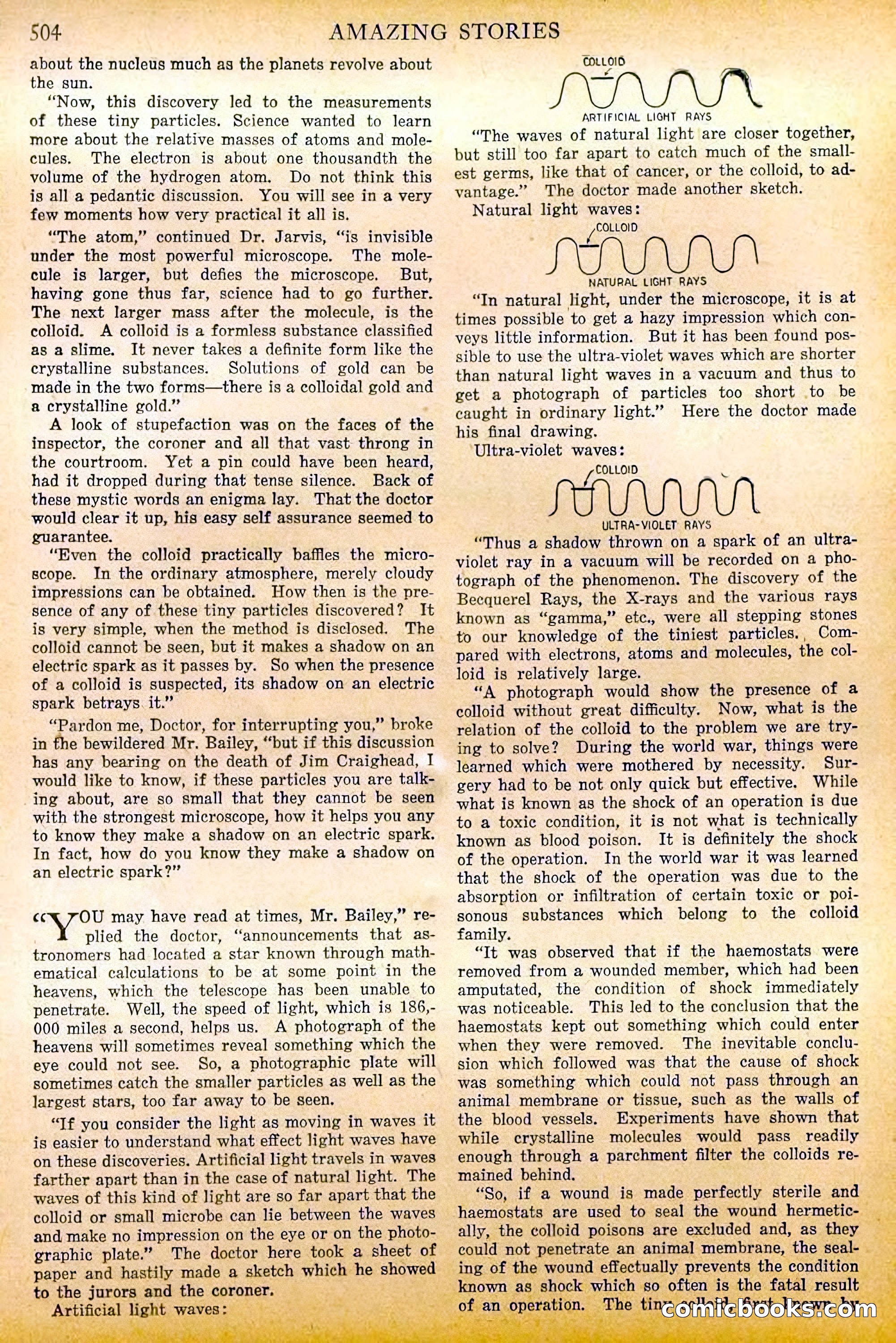
A restored page from Pulp Fiction, 1927. Page through the whole issue in the reader above.
📄 Transcribed text from this page (OCR, searchable)
Machine-transcribed from the original scan — historical spelling and the odd misread are preserved.
~~ ea ee 504 about the nucleus much as the planets revolve about the sun. “Now, this discovery led to the measurements of these tiny particles. Science wanted to learn more about the relative masses of atoms and mole- cules. The electron is about one thousandth the volume of the hydrogen atom. Do not think this is all a pedantic discussion. You will see in a very few moments how very practical it all is. “The atom,” continued Dr. Jarvis, “is invisible under the most powerful microscope. The mole- cule is larger, but defies the microscope. But, having gone thus far, science had to go further. The next larger mass after the molecule, is the colloid. A colloid is a formless substance classified as a slime. It never takes a definite form like the crystalline substances. Solutions of gold can be made in the two forms—there is a colloidal gold and a crystalline gold.” ‘ A look of stupefaction was on the faces of th inspector, the coroner and all that vast throng in the courtroom. Yet a pin could have been heard, had it dropped during that tense silence. Back of these mystic words an enigma lay. That the doctor would clear it up, his easy self assurance seemed to guarantee. “Even the colloid practically baffles the micro- scope. In the ordinary atmosphere, merely cloudy impressions can be obtained. How then is the pre- sence of any of these tiny particles discovered? It is very simple, when the method is disclosed. The colloid cannot be seen, but it makes a shadow on an electric spark as it passes by. So when the presence of a colloid is suspected, its shadow on an electric spark betrays. it.” “Pardon me, Doctor, for interrupting you,” broke in fhe bewildered Mr. Bailey, “but if this discussion has any bearing on the death of Jim Craighead, I would like to know, if these particles you are talk- ing about, are so small that they cannot be seen with the strongest microscope, how it helps you any to know they make a shadow on an electric spark. In fact, how do you know they make a shadow on an electric spark?” « OU may have read at times, Mr. Bailey,” re- plied the doctor, “announcements that as- tronomers had located a star known through math- ematical calculations to be at some point in the heavens, which the telescope has been unable to penetrate. Well, the speed of light, which is 186,- 000 miles a second, helps us. A photograph of the heavens will sometimes reveal something which the eye could not see. So, a photographic plate will sometimes catch the smaller particles as well as the largest stars, too far away to be seen, “If you consider the light as moving in waves it is easier to understand what effect light waves have on these discoveries. Artificial light travels in waves farther apart than in the case of natural light. The waves of this kind of light are so far apart that the colloid or small microbe can lie between the waves and make no impression on the eye or on the photo- graphic plate.” The doctor here took a sheet of paper and hastily made a sketch which he show 2d _ to the jurors and the coron oe ants AMAZING STORIES— eer oe ¥ COLLOIO a ARTIFICIAL LIGHT RAYS “The waves of natural light are closer together, but still too far apart to catch much of the small- est germs, like that of cancer, or the colloid, to ad- vantage.” The doctor made another sketch. Natural light waves: /fouLo1o NATURAL LIGHT RAYS “In natural light, under the microscope, it is at times possible to get a hazy impression which con- veys little information. But it has been found pos- sible to use the ultra-violet waves which are shorter than natural light waves in a vacuum and thus to get a photograph of particles too short to be caught in ordinary light.” Here the doctor made his final drawing. Ultra-violet waves: peculo ULTRA-VIOLET RAYS “Thus a shadow thrown on a spark of an ultra- violet ray in a vacuum will be recorded on a pho- tograph of the phenomenon. The discovery of the Beequerel Rays, the X-rays and the various rays known as “gamma,” ete., were all stepping stones to our knowledge of the tiniest particles., Com- pared with electrons, atoms and molecules, the col- loid is relatively large. “A photograph would show the presence of a colloid without great difficulty. Now, what is the relation of the colloid to the problem we are try- ing to solve? During the world war, things were learned which were mothered by necessity. Sur- gery had to be not only quick but effective. While what is known as the shock of an operation is due to a toxic condition, it is not what is technically known as blood poison. It is definitely the shock of the operation. In the world war it was learned that the shock of the operation was due to the absorption or infiltration of certain toxic or poi- sonous substances which belong to the colloid family. “Tt was observed that if the haemostats were removed from a wounded member, which had been amputated, the condition of shock immediately was noticeable. This led to the conclusion that the haemostats kept out something which could enter when they were removed. The inevitable conclu- sion which followed was that the cause of shock was something which could not pass through an animal membrane or tissue, such as the walls of the blood vessels. Experiments have shown that while crystalline molecules would pass readily enough through a parchment filter the colloids re- mained behind. : “So, if a wound is made perfectly sterile and haemostats are used to seal the wound hermeti ally, the colloid poisons are excluded and, a could not penetrate an animal membrane, the : ng of the wound effectually prevents the W. i | 0 : th ‘