
Pulp Fiction, 1919 · page 32 of 196
Argosy and Railroad Man's Magazine — page 32: what you’re looking at
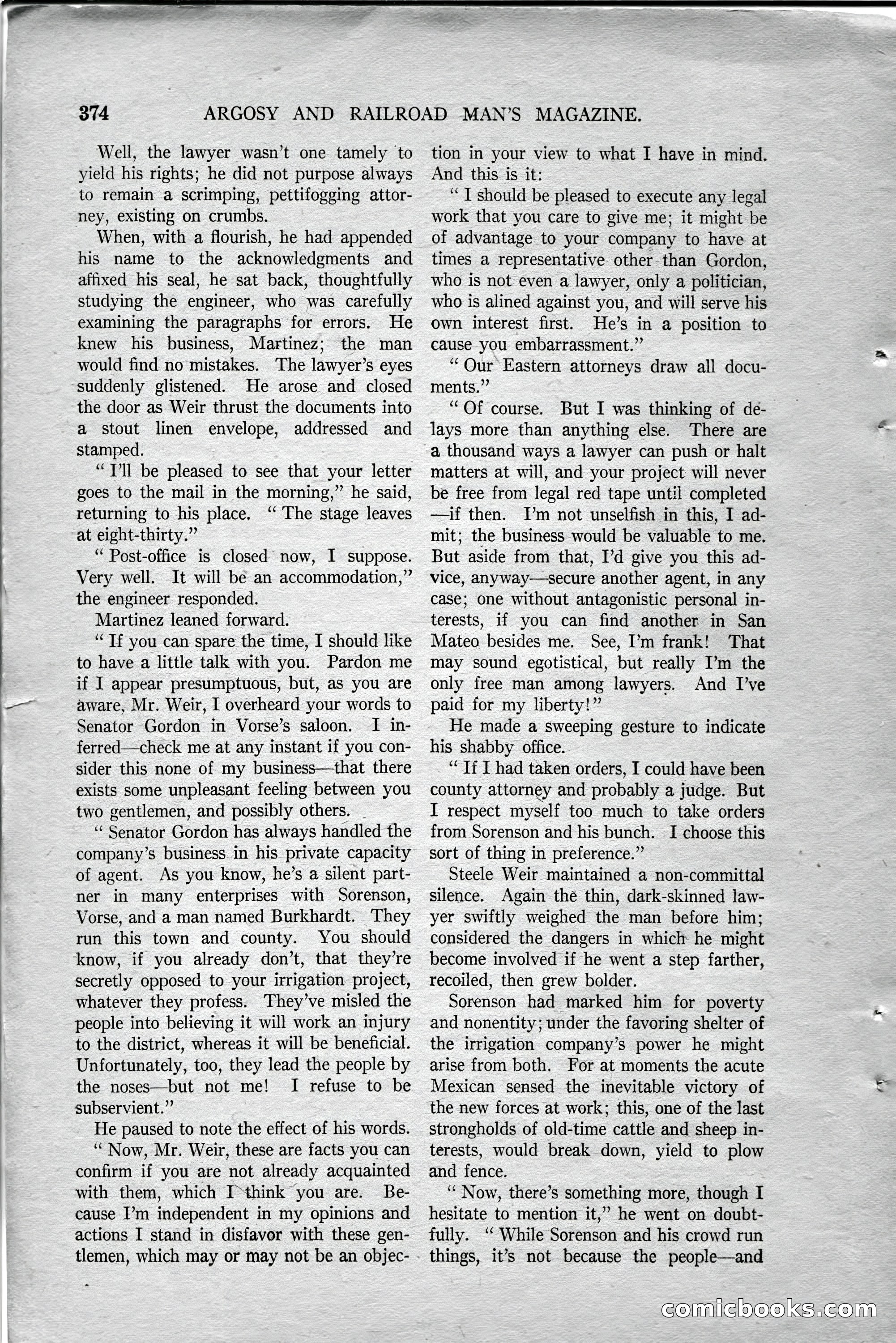
A restored page from Pulp Fiction, 1919. Page through the whole issue in the reader above.
📄 Transcribed text from this page (OCR, searchable)
Machine-transcribed from the original scan — historical spelling and the odd misread are preserved.
374 ARGOSY AND RAILROAD MAN’S MAGAZINE. Well, the lawyer wasn’t one tamely to yield his rights; he did not purpose always to remain a scrimping, pettifogging attor- ney, existing on crumbs. When, with a flourish, he had appended his name to the acknowledgments and affixed his seal, he sat back, thoughtfully studying the engineer, who was carefully examining the paragraphs for errors. He knew his business, Martinez; the man would find no mistakes. The lawyer’s eyes suddenly glistened. He arose and closed the door as Weir thrust the documents into a stout linen envelope, addressed and stamped. “Tl be pleased to see that your letter goes to the mail in the morning,” he said, returning to his place. ‘‘ The stage leaves at eight-thirty.”’ “ Post-office is closed now, I suppose. Very well. It will be an accommodation,” the engineer. responded. Martinez leaned forward. “Tf you can spare the time, I should like to have a little talk with you. Pardon me if I appear presumptuous, but, as you are aware, Mr. Weir, I overheard your words to Senator Gordon in Vorse’s saloon. I in- ferred—check me at any instant if you con- sider this none of my business—that there exists some unpleasant feeling between you two gentlemen, and possibly others. _ “Senator Gordon has always handled the company’s business in his private capacity of agent. As you know, he’s a silent part- ner in many enterprises with Sorenson, Vorse, and a man named Burkhardt. They run this town and county. You should know, if you already don’t, that they’re secretly opposed to your irrigation project, whatever they profess. They’ve misled the people into believing it will work an injury to the district, whereas it will be beneficial. Unfortunately, too, they lead the people by the noses—but not me! I refuse to be subservient.” He paused to note the effect of his words. “Now, Mr. Weir, these are facts you can confirm if you are not already acquainted with them, which I™think you are. Be- cause I’m independent in my opinions and actions I stand in disfavor with these gen- tlemen, which may or may not be an objec- tion in your view to what I have in mind. And this is it: “T should be pleased to execute any legal work that you care to give me; it might be of advantage to your company to have at times a representative other than Gordon, who is not even a lawyer, only a politician, who is alined against you, and will serve his own interest first. He’s in a position to cause you embarrassment.” “ Our Eastern attorneys draw all docu- ments.” “Of course. But I was thinking of de- lays more than anything else. There are a thousand ways a lawyer can push or halt matters at will, and your project: will never be free from legal red tape until completed —if then. I’m not unselfish in this, I ad- mit; the business would be valuable to me. But aside from that, I’d give you this ad- vice, anyway—secure another agent, in any case; one without antagonistic personal in- terests, if you can find another in San Mateo besides me. See, I’m frank! That may sound egotistical, but really I’m the only free man among lawyers. And I’ve paid for my liberty!” He made a sweeping gesture to indicate his shabby office. “Tf I had taken orders, I could have been county attorney and probably a judge. But I respect myself too much to take orders from Sorenson and his bunch. I choose this sort of thing in preference.” Steele Weir maintained a non-committal silence. Again thé thin, dark-skinned law- yer swiftly weighed the man before him; considered the dangers in which he might become involved if he went a step farther, recoiled, then grew bolder. Sorenson had marked him for poverty and nonentity; under the favoring shelter of the irrigation company’s power he might arise from both. For at moments the acute Mexican sensed the inevitable victory of the new forces at work; this, one of the last strongholds of old-time cattle and sheep in- terests, would break down, yield to plow and fence. “ Now, there’s something more, though I hesitate to mention it,” he went on doubt- fully. “ While Sorenson and his crowd run things, it’s not because the people—and ro comicbhooks-com