
Pulp Fiction, 1919 · page 33 of 196
Argosy and Railroad Man's Magazine — page 33: what you’re looking at
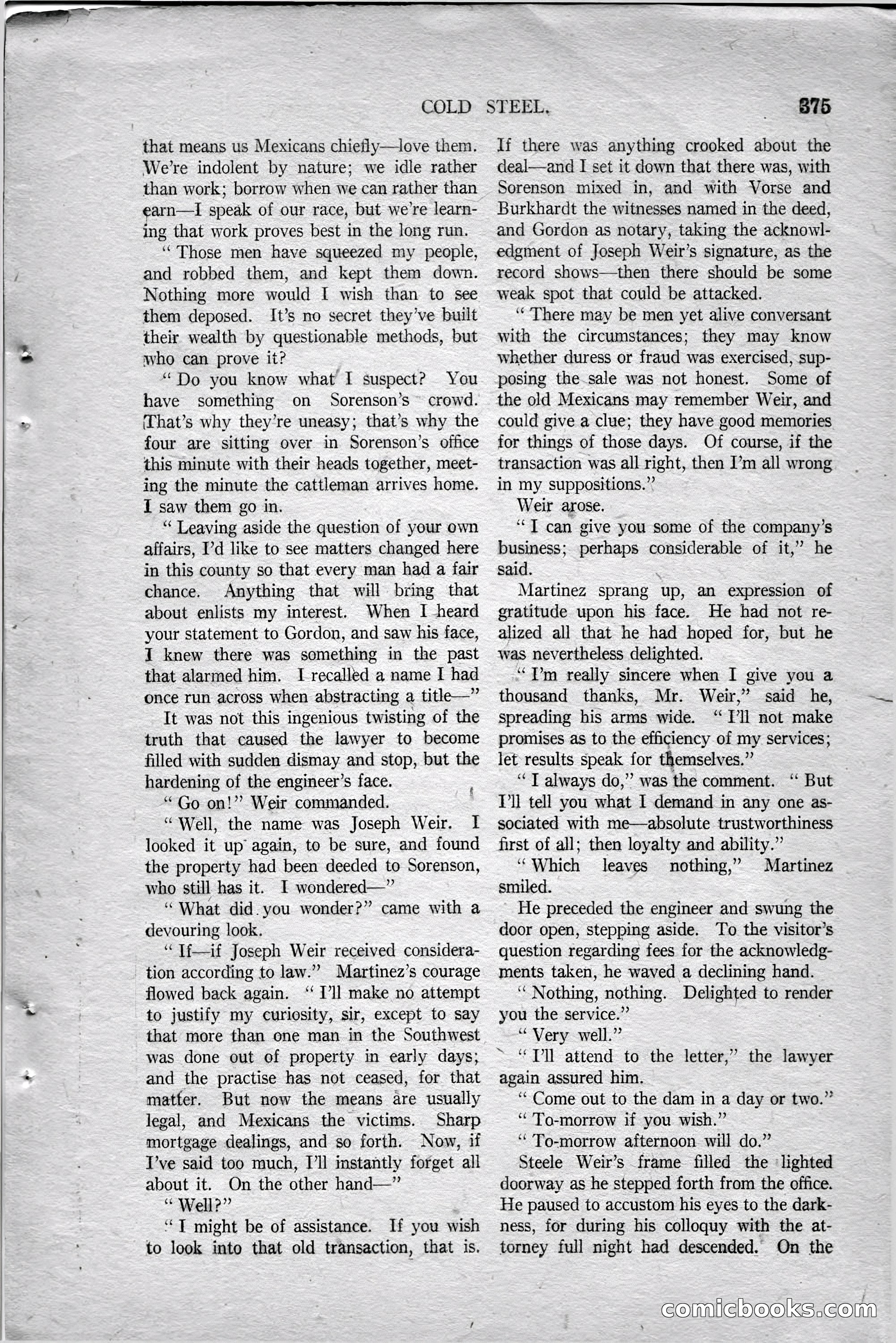
A restored page from Pulp Fiction, 1919. Page through the whole issue in the reader above.
📄 Transcribed text from this page (OCR, searchable)
Machine-transcribed from the original scan — historical spelling and the odd misread are preserved.
” r” COLD STEEL, that means us Mexicans chiefly—love them. We're indolent by nature; we idle rather than work; borrow when we can rather than earn—I speak of our race, but we’re learn- ing that work proves best in the long run. “Those men have squeezed my people, and robbed them, and kept them down. Nothing more would I wish than to see them deposed. It’s no secret they’ve built their wealth by questionable methods, but who can prove it? “To you know what I suspect? You have something on Sorenson’s © crowd. (That’s why they’re uneasy; that’s why the four are sitting over in Sorenson’s office this minute with their heads together, meet- ing the minute the cattleman arrives home. I saw them go in. “ Leaving aside the question of your own affairs, I’d like to see matters changed here in this county so that every man had a fair chance. Anything that will bring that about enlists my interest. When I heard your statement to Gordon, and saw his face, I knew there was something in the past that alarmed him. I-recalled a name I had once run across when abstracting a title—” It was not this ingenious twisting of the truth that caused the lawyer to become filled with sudden dismay and stop, but the hardening of the engineer’s face. “Go on!” Weir commanded. “Well, the name was Joseph Weir. I looked it up’ again, to be sure, and found the property had been deeded to Sorenson, who still has it. I wondered—” “ What did. you wonder?” came with a devouring look. “Tf—if Joseph Weir received considera- tion according to law.” Martinez’s courage flowed back again. ‘I'll make no attempt to justify my curiosity, sir, except to say that more than one man in the Southwest was done out of property in early days; and the practise has not ceased, for that matter. But now the means are usually legal, and Mexicans the victims. Sharp mortgage dealings, and so forth. Now, if I’ve said too much, I’ll instantly forget all about it. On the other hand—” “Well?” ‘‘T might be of assistance. If you wish to look into that old transaction, that is. t B75 If there was anything crooked about the deal—and I set it down that there was, with Sorenson mixed in, and with Vorse and Burkhardt the witnesses named in the deed, and Gordon as notary, taking the acknowl- edgment of Joseph Weir’s signature, as the record shows—then there should be some weak spot that could be attacked. “There may be men yet alive conversant with the circumstances; they may know whether duress or fraud was exercised, sup- posing the sale was not honest. Some of the old Mexicans may remember Weir, and could give a clue; they have good memories for things of those days. Of course, if the transaction was all right, then I’m all wrong in my suppositions.” Weir arose. “IT can give you some of the company’s business; perhaps considerable of it,” he said. : Martinez sprang up, an expression of gratitude upon his face. He had not re- alized all that he had hoped for, but he was nevertheless delighted. “Pm really sincere when I give you a thousand thanks, Mr. Weir,” said he, spreading his arms wide. “Tl not make promises as to the efficiency of my services; let results speak for themselves.” “T always do,” was the comment. “ But Tl tell you what I demand in any one as- sociated with me—absolute trustworthiness first of all; then loyalty and ability.” ‘“Which leaves nothing,” Martinez smiled. He preceded the engineer and swung the door open, stepping aside. To the visitor’s question regarding fees for the acknowledg- ments taken, he waved a declining hand. “Nothing, nothing. Delighted to render you the service.” “Very well.” ‘‘ [ll attend to the letter,’ the lawyer again assured him. ** Come out to the dam in a day or two.” “To-morrow if you wish.” “To-morrow afternoon will do.” Steele Weir’s frame filled the ‘lighted doorway as he stepped forth from the office. He paused to accustom his eyes to the dark- ness, for during his colloquy with the at- torney full night had descended. On the \ eomiicnoolks.con