
Pulp Fiction, 1924 · page 15 of 180
Argosy All-Story Weekly — page 15: what you’re looking at
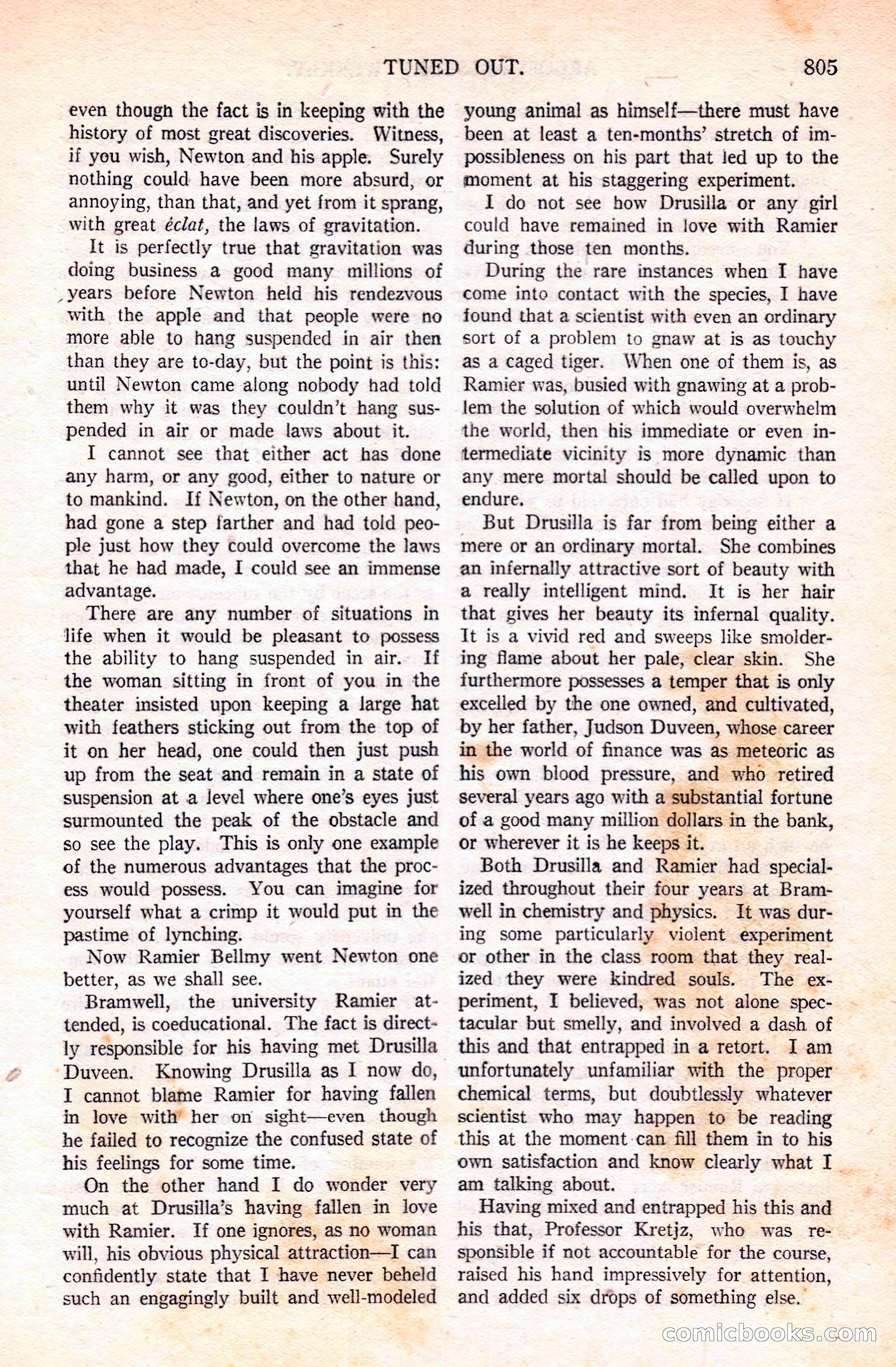
A restored page from Pulp Fiction, 1924. Page through the whole issue in the reader above.
📄 Transcribed text from this page (OCR, searchable)
Machine-transcribed from the original scan — historical spelling and the odd misread are preserved.
TUNED OUT. even though the fact is in keeping with the history of most great discoveries. Witness, if you wish, Newton and his apple. Surely nothing could have been more absurd, or annoying, than that, and yet from it sprang, with great éclat, the laws of gravitation. It is perfectly true that gravitation was doing business a good many millions of _years before Newton held his rendezvous with the apple and that people were no more able to hang suspended in air then than they are to-day, but the point is this: until Newton came along nobody had told them why it was they couldn’t hang sus- pended in air or made laws about it. I cannot see that either act has done any harm, or any good, either to nature or to mankind. If Newton, on the other hand, had gone a step farther and had told peo- ple just how they could overcome the laws that he had made, I could see an immense advantage. There are any number of situations in life when it would be pleasant to possess the ability to hang suspended in air. If the woman sitting in front of you in the theater insisted upon keeping a large hat with feathers sticking out from the top of it on her head, one could then just push up from the seat and remain in a state of suspension at a level where one’s eyes just surmounted the peak of the obstacle and so see the play. This is only one example of the numerous advantages that the proc- ess would possess. You can imagine for yourself what a crimp it would put in the pastime of lynching. Now Ramier Bellmy went Newton one better, as we shall see. Bramwell, the university Ramier at- tended, is coeducational. The fact is direct- ly responsible for his having met Drusilla ‘Duveen. Knowing Drusilla as I now do, I cannot blame Ramier for having fallen in love with’ her on sight—even though he failed to recognize the confused state of his feelings for some time. On the other hand I do wonder very much at Drusilla’s having fallen in love with Ramier. If one ignores, as no woman will, his obvious physical attraction—I can confidently state that I have never beheld such an engagingly built and well-modeled 805 young animal as himself—there must have been at least a ten-months’ stretch of im- possibleness on his part that led up to the moment at his staggering experiment. I do not see how Drusilla or any girl could have remained in love with Ramier during those ten months. During the rare instances when I have come inte contact with the species, I have found that a scientist with even an ordinary sort of a problem to gnaw at is as touchy as a caged tiger. When one of them is, as Ramier was, busied with gnawing at a prob- lem the solution of which would overwhelm the world, then his immediate or even in- termediate vicinity is more dynamic than any mere mortal should be called upon to endure. But Drusilla is far from being either a mere or an ordinary mortal. She combines an infernally attractive sort of beauty with a really intelligent mind. It is her hair that gives her beauty its infernal quality. It is a vivid red and sweeps like smolder- ing flame about her pale, clear skin. She furthermore possesses a temper that is only excelled by the one owned, and cultivated, by her father, Judson Duveen, whose career in the world of finance was as meteoric as his own blood pressure, and who retired several years ago with a substantial fortune of a good many million dollars in the bank, or wherever it is he keeps it. Both Drusilla and Ramier had special- ized throughout their four years at Bram- well in chemistry and physics. It was dur- ing some particularly violent experiment or other in the class room that they real- ized they were kindred souls. The ex- periment, I believed, was not alone spec- tacular but smelly, and involved a dash of this and that entrapped in a retort. I am unfortunately unfamiliar with the proper chemical terms, but doubtlessly whatever scientist who may happen to be reading this at the moment can fill them in to his own satisfaction and know clearly what I _ am talking about. Having mixed and entrapped his this and his that, Professor Kretjz, who was re- sponsible if not accountable for the course, raised his hand impressively for attention, and added six drops of something else. S oO COMICOO© (CO)