
Pulp Fiction, 1924 · page 16 of 180
Argosy All-Story Weekly — page 16: what you’re looking at
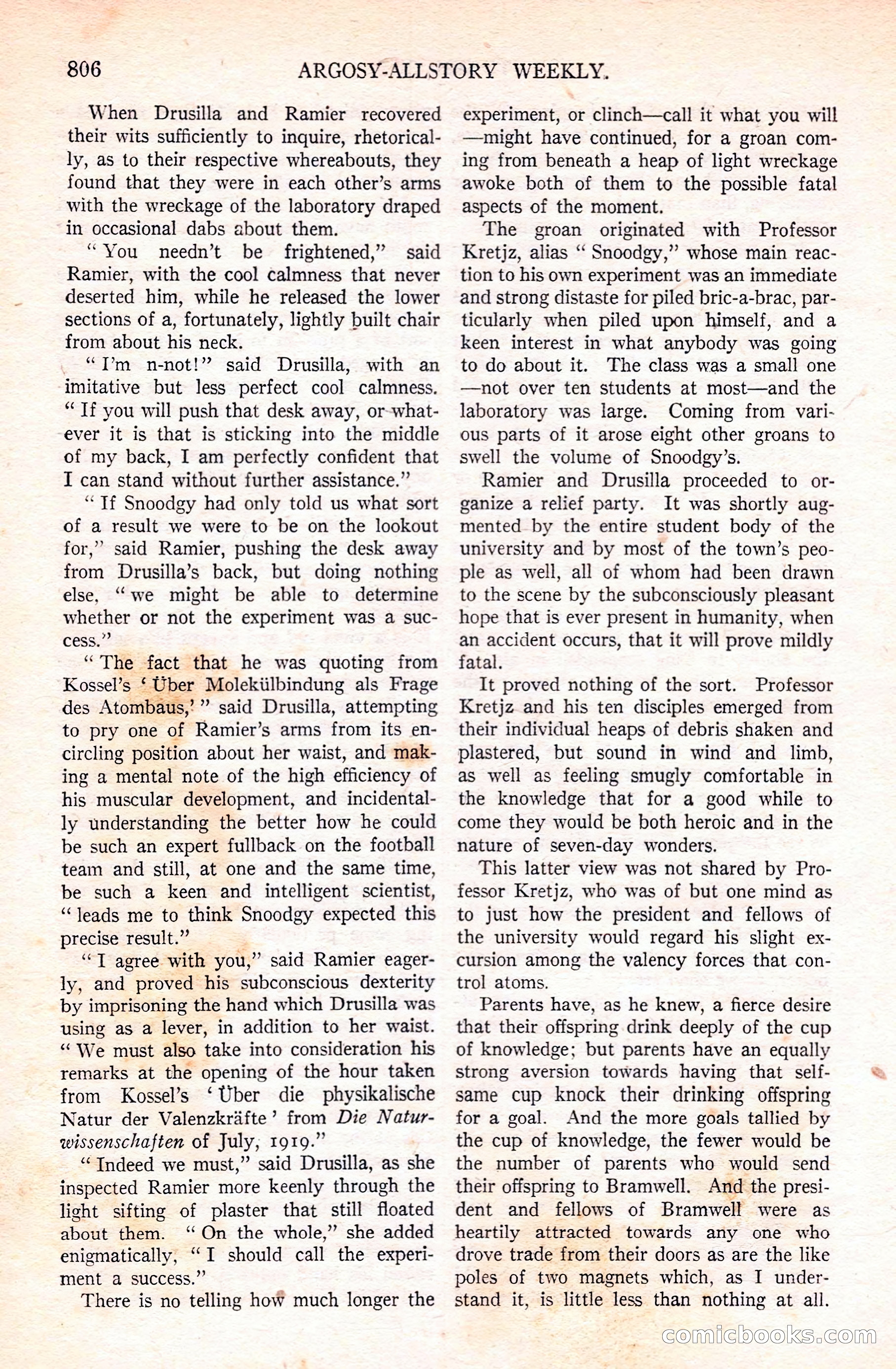
A restored page from Pulp Fiction, 1924. Page through the whole issue in the reader above.
📄 Transcribed text from this page (OCR, searchable)
Machine-transcribed from the original scan — historical spelling and the odd misread are preserved.
806 When Drusilla and Ramier recovered their wits sufficiently to inquire, rhetorical- ly, as to their respective whereabouts, they found that they were in each other’s arms with the wreckage of the laboratory draped in occasional dabs about them. “You needn’t be frightened,” said Ramier, with the cool calmness that never deserted him, while he released the lower sections of a, fortunately, lightly built chair from about his neck. “Pm n-not!” said Drusilla, with an imitative but less perfect cool calmness. “Tf you will push that desk away, or-what- ever it is that is sticking into the middle of my back, I am perfectly confident that I can stand without further assistance.” “Tf Snoodgy had only told us what sort of a result we were to be on the lookout for,” said Ramier, pushing the desk away from Drusilla’s back, but doing nothing else, “we might be able to determine whether or not the experiment was a suc- cess.” “The fact that he was quoting from Kossel’s ‘ Uber Molckiilbindung als Frage des Atombaus,’” said Drusilla, attempting to pry one of Ramier’s arms from its en- circling position about her waist, and mak- ing a mental note of the high efficiency of his muscular development, and incidental- ly understanding the better how he could be such an expert fullback on the football team and still, at one and the same time, be such a keen and intelligent scientist, “leads me to think Snoodgy expected this precise result.” ‘“T agree with you,” said Ramier eager- ly, and proved his subconscious dexterity by imprisoning the hand which Drusilla was using as a lever, in addition to her waist. ‘We must also take into consideration his remarks at the opening of the hour taken from Kossel’s ‘Uber die physikalische Natur der Valenzkrafte’ from Die Natur- wissenschaften of July, 1919.” “Indeed we must,” said Drusilla, as she inspected Ramier more keenly through the light sifting of plaster that still floated about them. ‘‘ On the whole,” she added enigmatically, “I should call the experi- ment a success.” There is no telling how much longer the ARGOSY-ALLSTORY WEEKLY. experiment, or clinch—call it what you will —might have continued, for a groan com- ing from beneath a heap of light wreckage awoke both of them to the possible fatal aspects of the moment. The groan originated with Professor Kretjz, alias ‘“‘ Snoodgy,” whose main reac- tion to his own experiment was an immediate and strong distaste for piled bric-a-brac, par- ticularly when piled upon himself, and a keen interest in what anybody was going to do about it. The class was a small one —not over ten students at most—and the laboratory was large. Coming from vari- ous parts of it arose eight other groans to swell the volume of Snoodgy’s. Ramier and Drusilla proceeded to or- ganize a relief party. It was shortly aug- mented by the entire student body of the university and by most of the town’s peo- ple as well, all of whom had been drawn to the scene by the subconsciously pleasant hope that is ever present in humanity, when an accident occurs, that it will prove mildly fatal. It proved nothing of the sort. Professor Kretjz and his ten disciples emerged from their individual heaps of debris shaken and plastered, but sound in wind and limb, as well as feeling smugly comfortable in the knowledge that for a good while to come they would be both heroic and in the nature of seven-day wonders. This latter view was not shared by Pro- fessor Kretjz, who was of but one mind as to just how the president and fellows of the university would regard his slight ex- cursion among the valency forces that con- trol atoms. Parents have, as he knew, a fierce desire that their offspring drink deeply of the cup of knowledge; but parents have an equally strong aversion towards having that self- same cup knock their drinking offspring for a goal. And the more goals tallied by the cup of knowledge, the fewer would be the number of parents who would send their offspring to Bramwell. And the presi- dent and fellows of Bramwell were as heartily attracted towards any one who drove trade from their doors as are the like poles of two magnets which, as I under- stand it, is little less than nothing at all. S oO COMMCLOO C@