
Pulp Fiction, 1924 · page 94 of 180
Argosy All-Story Weekly — page 94: what you’re looking at
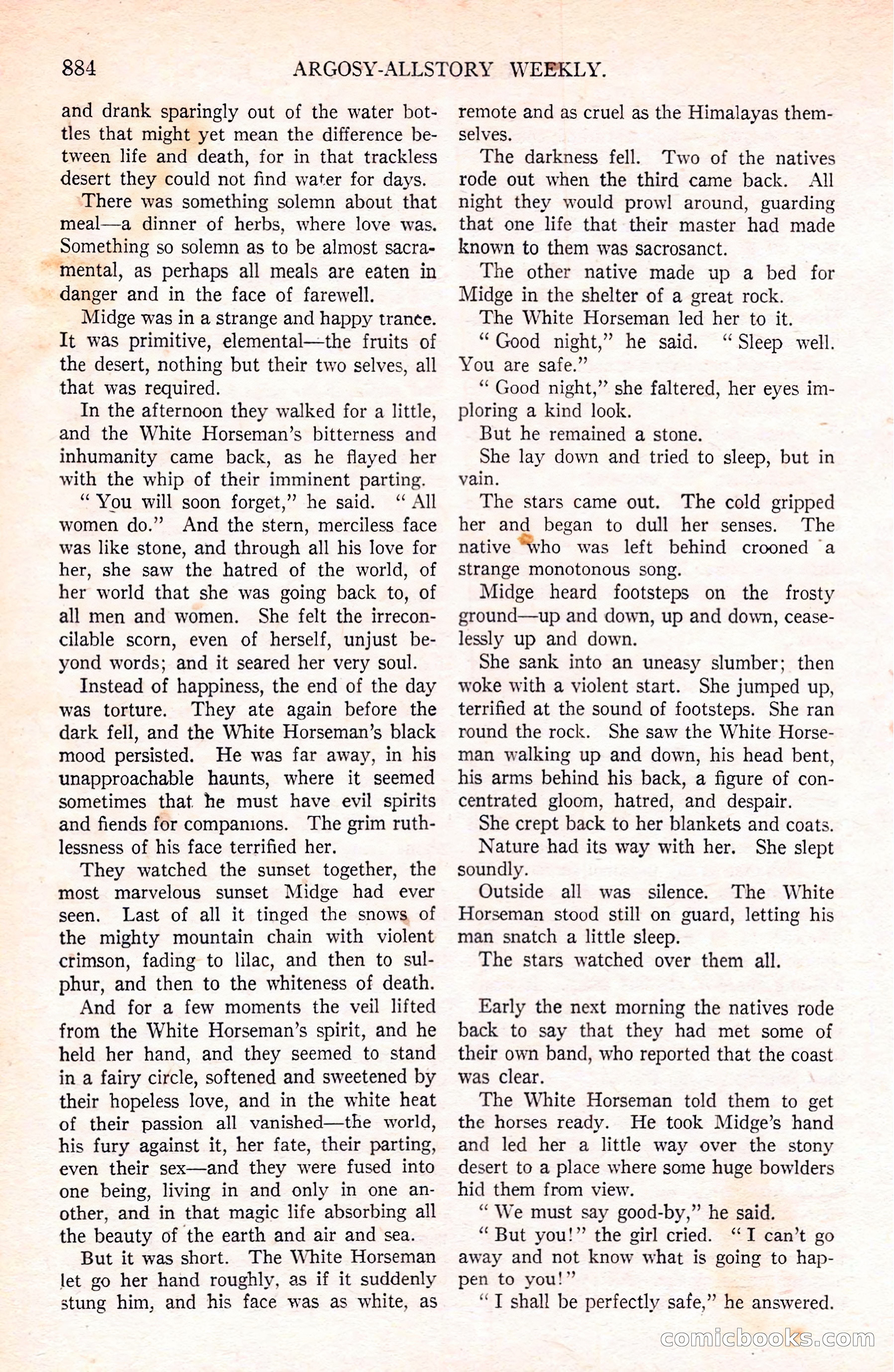
A restored page from Pulp Fiction, 1924. Page through the whole issue in the reader above.
📄 Transcribed text from this page (OCR, searchable)
Machine-transcribed from the original scan — historical spelling and the odd misread are preserved.
884 and drank sparingly out of the water bot- tles that might yet mean the difference be- tween life and death, for in that trackless desert they could not find water for days. There was something solemn about that meal—a dinner of herbs, where love was. Something so solemn as to be almost sacra- ~ mental, as perhaps all meals are eaten in danger and in the face of farewell. Midge was in a strange and happy trance. It was primitive, elemental—the fruits of the desert, nothing but their two selves, all that was required. In the afternoon they walked for a little, and the White Horseman’s bitterness and inhumanity came back, as he flayed her with the whip of their imminent parting. “You will soon forget,” he said. “ All women do.” And the stern, merciless face was like stone, and through all his love for her, she saw the hatred of the world, of her world that she was going back to, of all men and women. She felt the irrecon- cilable scorn, even of herself, unjust be- yond words; and it seared her very soul. Instead of happiness, the end of the day was torture. They ate again before the dark fell, and the White Horseman’s black mood persisted. He was far away, in his unapproachable haunts, where it seemed sometimes that. he must have evil spirits and fiends for companions. The grim ruth- lessness of his face terrified her. They watched the sunset together, the most marvelous sunset Midge had ever seen. Last of all it tinged the snows of the mighty mountain chain with violent crimson, fading to lilac, and then to sul- phur, and then to the whiteness of death. And for a few moments the veil lifted from the White Horseman’s spirit, and he held her hand, and they seemed to stand in a fairy circle, softened and sweetened by their hopeless love, and in the white heat of their passion all vanished—the world, his fury against it, her fate, their parting, even their sex—and they were fused into one being, living in and only in one an- other, and in that magic life absorbing all the beauty of the earth and air and sea. But it was short. The White Horseman let go her hand roughly, as if it suddenly stung him, and his face was as white, as ARGOSY-ALLSTORY WEEKLY. remote and as cruel as the Himalayas them- selves. The darkness fell. Two of the natives rode out when the third came back. All night they would prowl around, guarding that one life that their master had made known to them was sacrosanct. The other native made up a bed for Midge in the shelter of a great rock. The White Horseman led her to it. “Good night,” he said. “Sleep well. You are safe.” “Good night,” she faltered, her eyes im- ploring a kind look. But he remained a stone. She lay down and tried to sleep, but in vain. The stars came out. The cold gripped her and began to dull her senses. The native “who was left behind crooned ‘a strange monotonous song. Midge heard footsteps on the frosty ground—up and down, up and down, cease- lessly up and down. She sank into an uneasy slumber; then woke with a violent start. She jumped up, terrified at the sound of footsteps. She ran round the rock. She saw the White Horse- man walking up and down, his head bent, his arms behind his back, a figure of con- centrated gloom, hatred, and despair. She crept back to her blankets and coats. Nature had its way with her. She slept soundly. Outside all was silence. The White Horseman stood still on guard, letting his man snatch a little sleep. The stars watched over them all. Early the next morning the natives rode back to say that they had met some of their own band, who reported that the coast was clear. The White Horseman told them to get the horses ready. He took Midge’s hand and led her a little way over the stony desert to a place where some huge bowlders hid them from view. “We must say good-by,” he said. “But you!” the girl cried. “I can’t go away and not know what is going to hap- pen to you!” “T shall be perfectly safe,” he answered. COMIC NOOKS CO