
Pulp Fiction, 1924 · page 95 of 180
Argosy All-Story Weekly — page 95: what you’re looking at
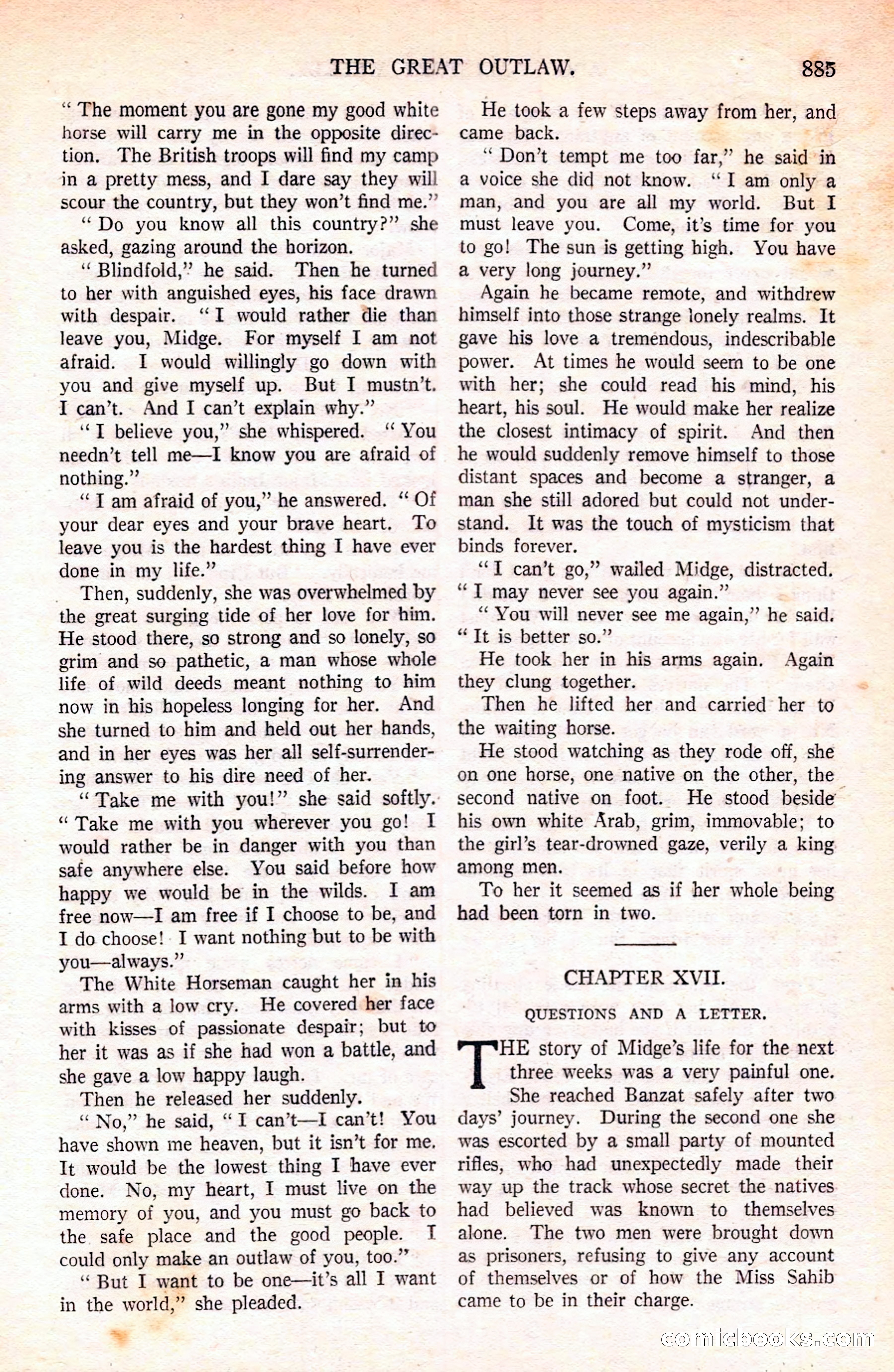
A restored page from Pulp Fiction, 1924. Page through the whole issue in the reader above.
📄 Transcribed text from this page (OCR, searchable)
Machine-transcribed from the original scan — historical spelling and the odd misread are preserved.
THE GREAT OUTLAW. | 885 ‘The moment you are gone my good white horse will carry me in the opposite direc- tion. The British troops will find my camp in a pretty mess, and I dare say they will scour the country, but they won’t find me.” “Do you know all this country?” she asked, gazing around the horizon. ‘‘ Blindfold,” he said. Then he turned to her with anguished eyes, his face drawn with despair. ‘“‘I would rather die than leave you, Midge. For myself I am not afraid. I would willingly go down with you and give myself up. But I mustn’t. I can’t. And I can’t explain why.” ‘‘T believe you,” she whispered. ‘‘ You needn’t tell me—I know you are afraid of nothing.” “ T am afraid of you,” he answered. ‘ Of your dear eyes and your brave heart. To leave you is the hardest thing I have ever done in my life.” Then, suddenly, she was overwhelmed by the great surging tide of her love for him. He stood there, so strong and so lonely, so grim and so pathetic, a man whose whole life of wild deeds meant nothing to him now in his hopeless longing for her. And she turned to him and held out her hands, and in her eyes was her all self-surrender- ing answer to his dire need of her. “Take me with you!” she said softly. “ Take me with you wherever you go! I would rather be in danger with you than safe anywhere else. You said before how happy we would be in the wilds. I am free now—I am free if I choose to be, and I do choose! I want nothing but to be with you—always.” The White Horseman caught her in his arms with a low cry. He covered her face with kisses of passionate despair; but to her it was as if she had won a battle, and she gave a low happy laugh. Then he released her suddenly. “No,” he said, “I can’t—I can’t! You have shown me heaven, but it isn’t for me. It would be the lowest thing I have ever done. No, my heart, I must live on the memory of you, and you must go back to the safe place and the good people. T could only make an outlaw of you, too.” “ But I want to be one—it’s all I want in the world,” she pleaded. > He took a few steps away from her, and came back. ‘Don’t tempt me too far,” he said ai a voice she did not know. “I am only a man, and you are all my world. But I must leave you. Come, it’s time for you to go! The sun is getting high. You have a very long journey.” Again he became remote, and withdrew himself into those strange ionely realms. It gave his love a tremendous, indescribable power. At times he would seern to be one with her; she could read his mind, his heart, his soul. He would make her realize the closest intimacy of spirit. And then he would suddenly remove himself to those distant spaces and become a stranger, a man she still adored but could not under- stand. It was the touch of mysticism that binds forever. ‘““T can’t go,” wailed Midge, distracted. ‘“*{ may never see you again.” “You will never see me again,” he said. “It is better so.” He took her in his arms again. they clung together. Then he lifted her and carried her to the waiting horse. He stood watching as they rode off, she on one horse, one native on the other, the second native on foot. his own white Arab, grim, immovable; to the girl’s tear-drowned gaze, verily a king among men. To her it seemed as if her whole being had been torn in two. Again CHAPTER XVII. QUESTIONS AND A LETTER. HE story of Midge’s life for the next three weeks was a very painful one. She reached Banzat safely after two days’ journey. During the second one she was escorted by a small party of mounted rifles, who had unexpectedly made their way up the track whose secret the natives had believed was known to themselves alone. The two men were brought down as prisoners, refusing to give any account of themselves or of how the Miss Sahib came to be in their charge. oO Comicbooks.€© He stood beside 1 it,