
Pulp Fiction, 1916 · page 100 of 220
The Argosy, April 1916 — page 100: what you’re looking at
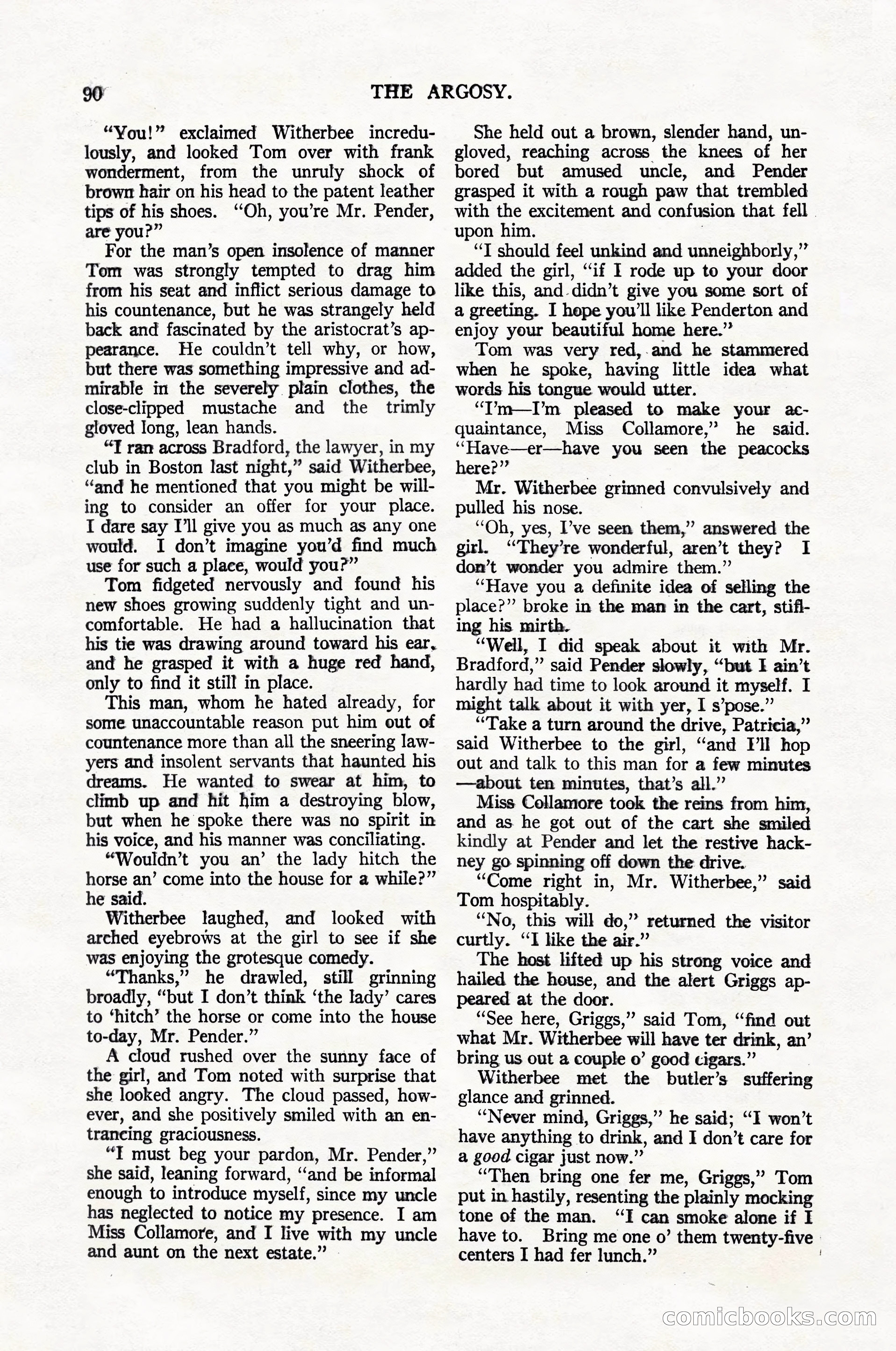
A restored page from Pulp Fiction, 1916. Page through the whole issue in the reader above.
📄 Transcribed text from this page (OCR, searchable)
Machine-transcribed from the original scan — historical spelling and the odd misread are preserved.
90 “Vou!” exclaimed Witherbee incredu- lously, and looked Tom over with frank wonderment, from the unruly shock of brown hair on his head to the patent leather tips of his shoes. “Oh, you’re Mr. Pender, are your” For the man’s open insolence of manner Tom was strongly tempted to drag him from his seat and inflict serious damage to his countenance, but he was strangely held back and fascinated by the aristocrat’s ap- pearance. He couldn’t tell why, or how, but there was something impressive and ad- mirable in the severely plain clothes, the close-clipped mustache and the trimly gloved Jong, lean hands. “T ran across Bradford, the lawyer, in my club in Boston last night,” said Witherbee, “and he mentioned that you might be will- ing to consider an offer for your place. I dare say I'll give you as much as any one would. I don’t imagine you’d find much use for such a place, would you?” Tom fidgeted nervously and found his new shoes growing suddenly tight and un- comfortable. He had a hallucination that his tie was drawing around toward his ear, and he grasped it with a huge red hand, only to find it still in place. This man, whom he hated already, for some unaccountable reason put him out of countenance more than all the sneering law- yers and insolent servants that haunted his dreams. He wanted to swear at him, to climb up and hit him a destroying blow, but when he spoke there was no spirit in his voice, and his manner was conciliating. “Wouldn’t you an’ the lady hitch the horse an’ come into the house for a while?” he said. Witherbee laughed, and looked with arched eyebrows at the girl to see if she was enjoying the grotesque comedy. “Thanks,” he drawled, still grinning broadly, “but I don’t think ‘the lady’ cares to ‘hitch’ the horse or come into the house to-day, Mr. Pender.” A cloud rushed over the sunny face of the girl, and Tom noted with surprise that she looked angry. The cloud passed, how- ever, and she positively smiled with an en- trancing graciousness. “T must beg your pardon, Mr. Pender,” she said, leaning forward, “and be informal enough to introduce myself, since my uncle has neglected to notice my presence. I am Miss Collamore, and I live with my uncle and aunt on the next estate.” | THE ARGOSY. She held out a brown, slender hand, un- gloved, reaching across the knees of her bored but amused uncle, and Pender grasped it with a rough paw that trembled with the excitement and confusion that fell - upon him. “T should feel unkind and unneighborly,”’ added the girl, “if I rode up to your door like this, and didn’t give you some sort of a greeting. I hope you'll like Penderton and enjoy your beautiful home here.” Tom was very red,.and he stammered when he spoke, having little idea what words his tongue would utter. “T’m—I’m pleased to make your ac- quaintance, Miss Collamore,” he said. ‘“Hlave—er—have you seen the peacocks here?” = Mr. Witherbee grinned convulsively and pulled his nose. “Oh, yes, I’ve seen them,”’ answered the girl. ‘“They’re wonderful, aren’t they? I don’t wonder you admire them.” “Have you a definite idea of selling the place?” broke in the man in the cart, stifl- ing his mirth. “Well, I did speak about it with Mr. Bradford,” said Pender slowly, “but I ain’t hardly had time to look around it myself. I might talk about it with yer, I s’pose.” ‘Take a turn around the drive, Patricia,” said Witherbee to the girl, “and PVH hop out and talk to this man for a few minutes —about ten minutes, that’s all.” Miss Collamore took the reins from him, and as he got out of the cart she smiled kindly at Pender and let the restive hack- ney go spinning off down the drive. “Come right in, Mr. Witherbee,” said Tom hospitably. “No, this will do,” returned the visitor curtly. ‘I like the air.” The host lifted up his strong voice and hailed the house, and the alert Griggs ap- peared at the door. “See here, Griggs,” said Tom, “find out what Mr. Witherbee will have ter drink, an’ bring us out a couple o’ good cigars.” Witherbee met the butler’s suffering glance and grinned. ‘Never mind, Griggs,”’ he said; “I won’t have anything to drink, and I don’t care for a good cigar just now.” “Then bring one fer me, Griggs,” Tom put in hastily, resenting the plainly mocking tone of the man. “I can smoke alone if I have to. centers I had fer lunch.” Co LOOOLK Bring me one o’ them twenty-five | C@