
Pulp Fiction, 1916 · page 101 of 220
The Argosy, April 1916 — page 101: what you’re looking at
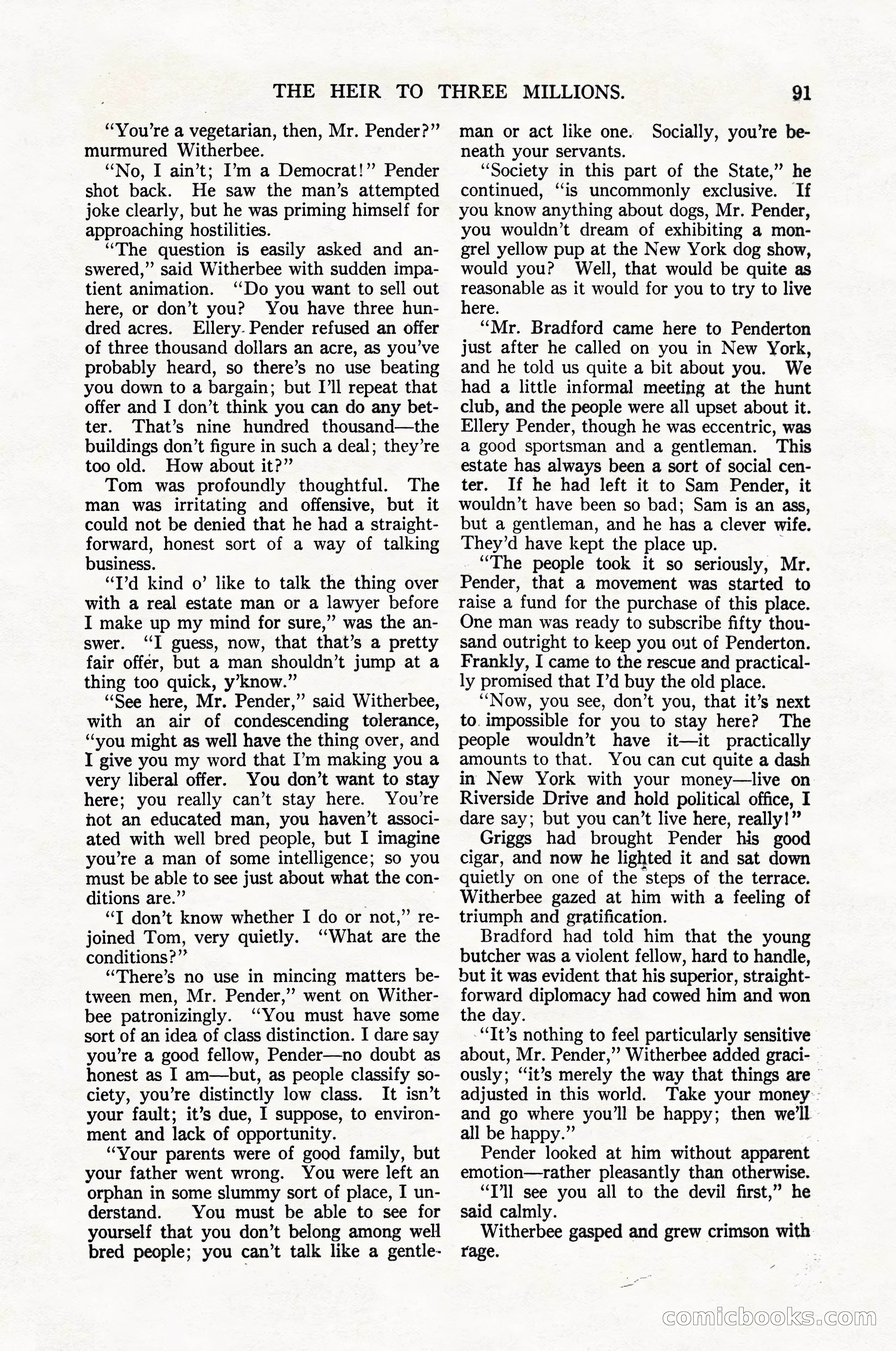
A restored page from Pulp Fiction, 1916. Page through the whole issue in the reader above.
📄 Transcribed text from this page (OCR, searchable)
Machine-transcribed from the original scan — historical spelling and the odd misread are preserved.
THE HEIR TO THREE MILLIONS. “You’re a vegetarian, then, Mr. Pender?” murmured Witherbee. “No, I ain’t; I’m a Democrat!’ Pender shot back. He saw the man’s attempted joke clearly, but he was priming himself for approaching hostilities. “The question is easily asked and an- swered,” said Witherbee with sudden impa- tient animation. ‘Do you want to sell out here, or don’t you? You have three hun- dred acres. Ellery. Pender refused an offer of three thousand dollars an acre, as you’ve probably heard, so there’s no use beating you down to a bargain; but I'll repeat that offer and I don’t think you can do any bet- ter. That’s nine hundred thousand—the buildings don’t figure in such a deal; they’re too old. How about it?” Tom was profoundly thoughtful. The man was irritating and offensive, but it could not be denied that he had a straight- forward, honest sort of a way of talking business. “T’d kind o’ like to talk the thing over with a real estate man or a lawyer before I make up my mind for sure,” was the an- swer. “I guess, now, that that’s a pretty fair offer, but a man shouldn’t jump at a thing too quick, y’know.” ‘“‘See here, Mr. Pender,’ said Witherbee, with an air of condescending tolerance, “vou might as well have the thing over, and I give you my word that I’m making you a very liberal offer. You don’t want to stay here; you really can’t stay here. You're hot an educated man, you haven’t associ- ated with well bred people, but I imagine you’re a man of some intelligence; so you must be able to see just about what the con- ditions are.” ‘“T don’t know whether I do or not,” re- joined Tom, very quietly. ‘What are the conditions?” “There’s no use in mincing matters be- tween men, Mr. Pender,” went on Wither- bee patronizingly. ‘You must have some sort of an idea of class distinction. I dare say you're a good fellow, Pender—no doubt as honest as I am—but, as people classify so- ciety, you’re distinctly low class. It isn’t your fault; it’s due, I suppose, to environ- ment and lack of opportunity. ‘Your parents were of good family, but your father went wrong. You were left an orphan in some slummy sort of place, I un- derstand. You must be able to see for yourself that you don’t belong among well bred people; you can’t talk like a gentle- 91 man or act like one. Socially, you’re be- neath your servants. ‘Society in this part of the State,” he continued, ‘‘is uncommonly exclusive. If you know anything about dogs, Mr. Pender, you wouldn’t dream of exhibiting a mon- grel yellow pup at the New York dog show, would your Well, that would be quite as reasonable as it would for you to try to live here. ‘Mr. Bradford came here to Penderton just after he called on you in New York, and he told us quite a bit about you. We had a little informal meeting at the hunt club, and the people were all upset about it. Ellery Pender, though he was eccentric, was a good sportsman and a gentleman. This estate has always been a sort of social cen- ter. If he had left it to Sam Pender, it wouldn’t have been so bad; Sam is an ass, but a gentleman, and he has a clever wife. They’d have kept the place up. ‘The people took it so seriously, Mr. Pender, that a movement was started to raise a fund for the purchase of this place. One man was ready to subscribe fifty thou- sand outright to keep you out of Penderton. Frankly, I came to the rescue and practical- ly promised that I’d buy the old place. ‘‘Now, you see, don’t you, that it’s next to. impossible for you to stay here? The people wouldn’t have it—it practically amounts to that. You can cut quite a dash in New York with your money—live on Riverside Drive and hold political office, I dare say; but you can’t live here, really!” Griggs had brought Pender his good cigar, and now he lighted it and sat down quietly on one of the steps of the terrace. Witherbee gazed at him with a feeling of triumph and gratification. Bradford had told him that the young butcher was a violent fellow, hard to handle, but it was evident that his superior, straight- forward diplomacy had cowed him and won the day. -“Tt’s nothing to feel particularly sensitive about, Mr. Pender,” Witherbee added graci- ously; ‘‘it’s merely the way that things are adjusted in this world. Take your money: and go where you’ll be happy; then we'll all be happy.” Pender looked at him without apparent ) emotion—rather pleasantly than otherwise. “T’ll see you all to the devil first,” he said calmly. Witherbee gasped and grew crimson with rage. MICLOOOK C@