
Pulp Fiction, 1916 · page 186 of 220
The Argosy, April 1916 — page 186: what you’re looking at
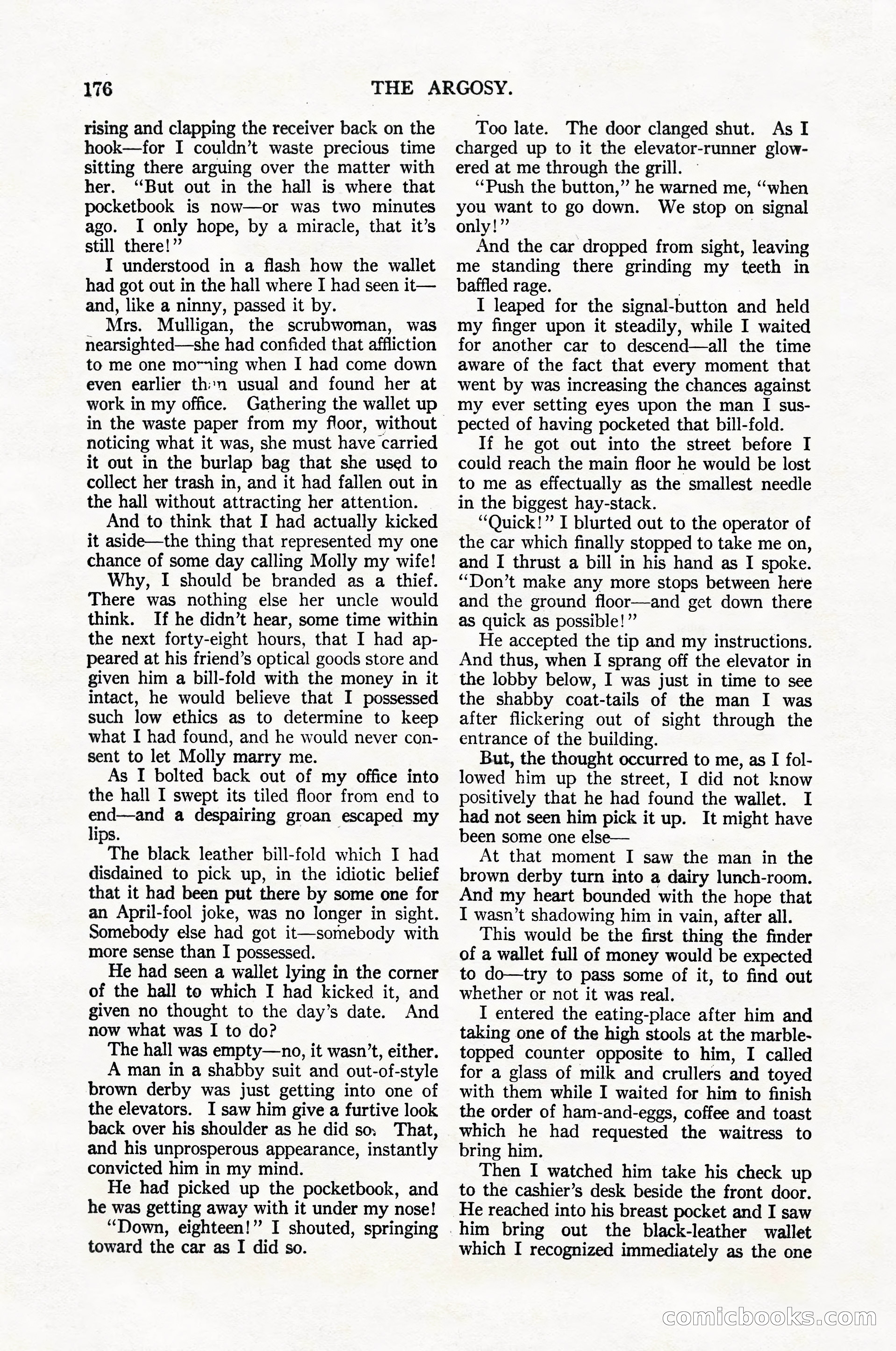
A restored page from Pulp Fiction, 1916. Page through the whole issue in the reader above.
📄 Transcribed text from this page (OCR, searchable)
Machine-transcribed from the original scan — historical spelling and the odd misread are preserved.
176 rising and clapping the receiver back on the hook—for I couldn’t waste precious time sitting there arguing over the matter with her. ‘But out in the hall is where that pocketbook is now—or was two minutes ago. I only hope, by a miracle, that it’s still there!” I understood in a flash how the wallet had got out in the hall where I had seen it— and, like a ninny, passed it by. Mrs. Mulligan, the scrubwoman, was nearsighted—she had confided that affliction to me one moming when I had come down even earlier thin usual and found her at work in my office. Gathering the wallet up in the waste paper from my floor, without noticing what it was, she must have carried it out in the burlap bag that she used to collect her trash in, and it had fallen out in the hall without attracting her attention. | And to think that I had actually kicked it aside—the thing that represented my one chance of some day calling Molly my wife! Why, I should be branded as a thief. There was nothing else her uncle would think. If he didn’t hear, some time within the next forty-eight hours, that I had ap- peared at his friend’s optical goods store and given him a bill-fold with the money in it intact, he would believe that I possessed such low ethics as to determine to keep what I had found, and he would never con- sent to let Molly marry me. As I bolted back out of my office into the hall I swept its tiled floor from end to end—and a despairing groan escaped my lips. The black leather bill-fold which I had disdained to pick up, in the idiotic belief that it had been put there by some one for an April-fool joke, was no longer in sight. somebody else had got it—somebody with more sense than I possessed. He had seen a wallet lying in the corner of the hall to which I had kicked it, and given no thought to the day’s date. And now what was I to do? The hall was empty—no, it wasn’t, either. A man in a shabby suit and out-of-style brown derby was just getting into one of the elevators. I saw him give a furtive look back over his shoulder as he did so; That, and his unprosperous appearance, instantly convicted him in my mind. He had picked up the pocketbook, and he was getting away with it under my nose! ‘Down, eighteen!” I shouted, springing toward the car as I did so. THE ARGOSY. Too late. The door clanged shut. As I charged up to it the elevator-runner glow- ered at me through the grill. © ‘‘Push the button,” he warned me, ‘“‘when you want to go down. We stop on signal only!” : And the car dropped from sight, leaving me standing there grinding my teeth in baffled rage. | I leaped for the signal-button and held my finger upon it steadily, while I waited for another car to descend—all the time aware of the fact that every moment that went by was increasing the chances against my ever setting eyes upon the man I sus- pected of having pocketed that bill-fold. If he got out into the street before I could reach the main floor he would be lost to me as effectually as the smallest needle in the biggest hay-stack. “Quick!” I blurted out to the operator of the car which finally stopped to take me on, and I thrust a bill in his hand as I spoke. “Don’t make any more stops between here and the ground floor—and get down there as quick as possible!” He accepted the tip and my instructions. And thus, when I sprang off the elevator in the lobby below, I was just in time to see the shabby coat-tails of the man I was after flickering out of sight through the entrance of the building. But, the thought occurred to me, as I fol- lowed him up the street, I did not know positively that he had found the wallet. I had not seen him pick it up. It might have been some one else— . At that moment I saw the man in the brown derby turn into a dairy lunch-room. And my heart bounded with the hope that I wasn’t shadowing him in vain, after all. This would be the first thing the finder of a wallet full of money would be expected to do—try to pass some of it, to find out whether or not it was real. I entered the eating-place after him and taking one of the high stools at the marble- topped counter opposite to him, I called for a glass of milk and crullers and toyed with them while I waited for him to finish the order of ham-and-eggs, coffee and toast which he had requested the waitress to bring him. Then I watched him take his check up to the cashier’s desk beside the front door. He reached into his breast pocket and I saw him bring out the black-leather wallet which I recognized immediately as the one COMmiclboo S (C@