
Pulp Fiction, 1916 · page 187 of 220
The Argosy, April 1916 — page 187: what you’re looking at
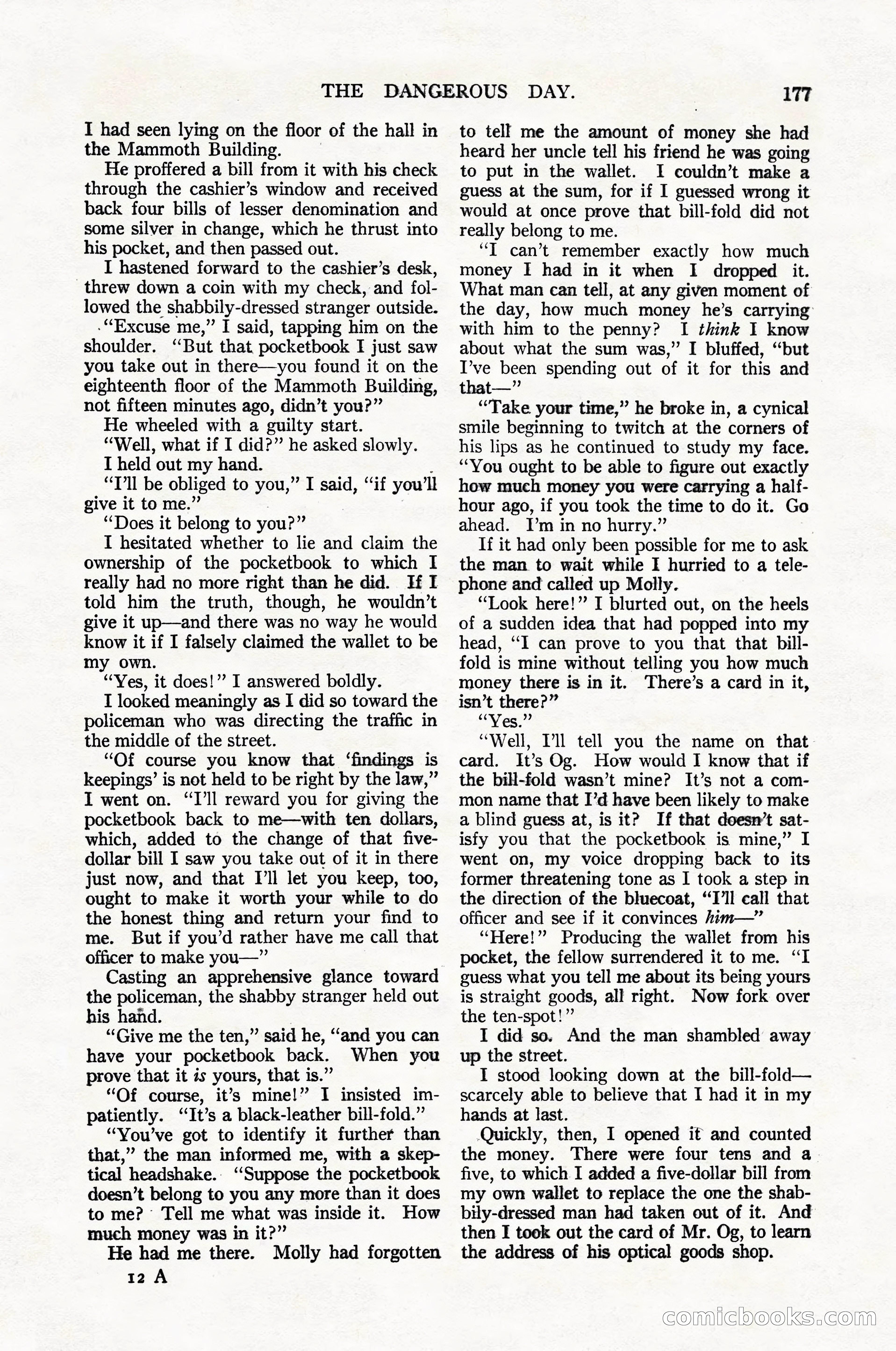
A restored page from Pulp Fiction, 1916. Page through the whole issue in the reader above.
📄 Transcribed text from this page (OCR, searchable)
Machine-transcribed from the original scan — historical spelling and the odd misread are preserved.
THE DANGEROUS DAY. I had seen lying on the floor of the hall in the Mammoth Building. | He proffered a bill from it with his check through the cashier’s window and received back four bills of lesser denomination and some silver in change, which he thrust into his pocket, and then passed out. I hastened forward to the cashier’s desk, threw down a coin with my check, and fol- lowed the shabbily-dressed stranger outside. .“Excuse me,’ I said, tapping him on the shoulder. “But that pocketbook I just saw you take out in there—you found it on the eighteenth floor of the Mammoth Building, not fifteen minutes ago, didn’t you?” He wheeled with a guilty start. “Well, what if I did?” he asked slowly. T held out my hand. “T’ll be obliged to you,” I said, “‘if you'll give it to me.’ | “Does it belong to you?” I hesitated whether to lie and claim the ownership of the pocketbook to which I really had no more right than he did. Hf I told him the truth, “though, he wouldn’t give it up—and there was no way he would know it if I falsely claimed the wallet to be my own. “Ves, it does!’’ I answered boldly. I looked meaningly as I did so toward the policeman who was directing the traffic in the middle of the street. “Of course you know that ‘findings keepings’ is not held to be right by the law,” I went on. “I'll reward you for giving the pocketbook back to me—with ten dollars, which, added to the change of that five- dollar bill I saw you take out of it in there just now, and that I’ll let you keep, too, ought to make it worth your while to do the honest thing and return your find to me. But if you’d rather have me call that officer to make you—”’ is Casting an apprehensive glance toward the policeman, the shabby stranger held out his hand. “Give me the ten,” said he, “and you can have your pocketbook back. When you prove that it is yours, that is.” “Of course, it’s mine!” I insisted im- patiently. ‘It’s a black-leather bill-fold.” “VYou’ve got to identify it further than that,” the man informed me, with a skep- tical headshake.: ‘Suppose the pocketbook doesn’t belong to you any more than it does to me? Tell me what was inside it. How much money was in it?” He had me there. Molly had forgotten 12 A 177 to telf me the amount of money she had heard her uncle tell his friend he was going to put in the wallet. I couldn’t make a guess at the sum, for if I guessed wrong it would at once prove that bill-fold did not really belong to me. “TI can’t remember exactly how much money I had in it when I dropped it. What man can tell, at any given moment of the day, how much money he’s carrying: with him to the penny? I think I know about what the sum was,” I bluffed, “but I’ve been spending out of it for this and that—”’ “Take your time,” he broke in, a cynical smile beginning to twitch at the corners of his lips as he continued to study my face. ‘You ought to be able to figure out exactly how much money you were carrying a half- hour ago, if you took the time to do it. Go ahead. I’m in no hurry.” If it had only been possible for me to ask the man to wait while I hurried to a tele- phone and called up Molly. ‘Look here!” I blurted out, on the heels of a sudden idea that had popped into my head, “I can prove to you that that bill- fold is mine without telling you how much money there is in it. There’s a card in it, isn’t there?” “Ves.” “Well, Vil tell you the name on that. card. It’s Og. How would I know that if the bill-fold wasn’t mine? It’s not a com- mon name that I’d have been likely to make a blind guess at, is it? If that doesn’t sat- isfy you that the pocketbook is mine,” I went on, my voice dropping back to its former threatening tone as I took a step in the direction of the bluecoat, “Ill call that officer and see if it convinces him—” “Here!” Producing the wallet from his pocket, the fellow surrendered it to me. “I guess what you tell me about its being yours is straight goods, all right. Now fork over the ten-spot!” I did so. And the man shambled away up the street. I stood looking down at the bill-fold— scarcely able to believe that I had it in my hands at last. Quickly, then, I opened it and counted the money. There were four tens and a five, to which I added a five-dollar bill from my own wallet to replace the one the shab- bily-dressed man had taken out of it. And then I took out the card of Mr. Og, to learn the address of his optical goods shop. Co 1OOOLK nn C@