
Pulp Fiction, 1916 · page 43 of 220
The Argosy, April 1916 — page 43: what you’re looking at
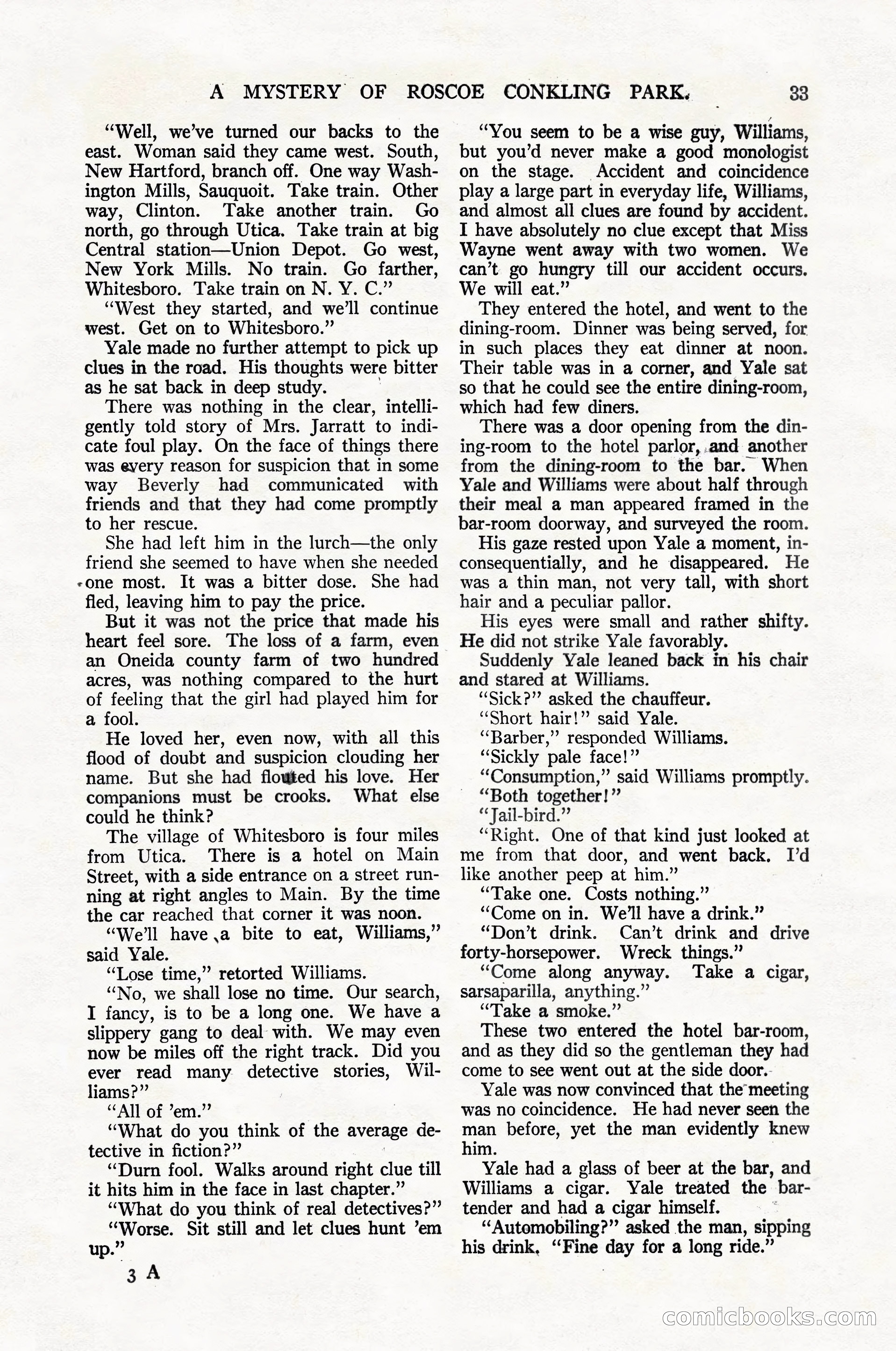
A restored page from Pulp Fiction, 1916. Page through the whole issue in the reader above.
📄 Transcribed text from this page (OCR, searchable)
Machine-transcribed from the original scan — historical spelling and the odd misread are preserved.
A MYSTERY OF ROSCOE CONKLING PARK. “Well, we’ve turned our backs to the east. Woman said they came west. South, New Hartford, branch off. One way Wash- ington Mills, Sauquoit. Take train. Other way, Clinton. Take another train. Go north, go through Utica. Take train at big Central station—Union Depot. Go west, New York Mills. No train. Go farther, Whitesboro. Take train on N. Y. C.” ‘West they started, and we'll continue west. Get on to Whitesboro.” Yale made no further attempt to pick up clues in the road. His thoughts were bitter as he sat back in deep Study. There was nothing in the clear, intelli- gently told story of Mrs. Jarratt to indi- cate foul play. On the face of things there was every reason for suspicion that in some way Beverly had communicated with friends and that they had come promptly to her rescue. She had left him in the lurch—the only friend she seemed to have when she needed «one most. It was a bitter dose. She had fled, leaving him to pay the price. But it was not the price that made his heart feel sore. The loss of a farm, even an Oneida county farm of two hundred acres, was nothing compared to the hurt of feeling that the girl had played him for a fool. He loved her, even now, with all this flood of doubt and suspicion clouding her name. But she had flowted his love. Her companions must be crooks. What else could he think? The village of Whitesboro is four miles from Utica. There is a hotel on Main Street, with a side entrance on a street run- ning at right angles to Main. By the time the car reached that corner it was noon. “We'll have ,a bite to eat, Williams,” said Yale. “Lose time,” retorted Williams. ‘No, we shall lose no time. Our search, I fancy, is to be a long one. We have a slippery gang to deal with. We may even now be miles off the right track. Did you ever read many. detective stories, Wil- liams?”’ | ‘All of ’em.” “What do you think of the average de- tective in fiction?” “Durn fool. Walks around right clue till it hits him in the face in last chapter.” “What do you think of real detectives?”’ “Worse. Sit still and let clues hunt ’em up.” 3 A 33 ‘You seem to be a wise guy, Williams, but you’d never make a good monologist on the stage. Accident and coincidence play a large part in everyday life, Williams, and almost all clues are found by accident. I have absolutely no clue except that Miss Wayne went away with two women. We can’t go hungry till our accident occurs. We will eat.” They entered the hotel, and went to the dining-room. Dinner was being served, for in such places they eat dinner at noon. Their table was in a corner, and Yale sat so that he could see the entire dining-room, which had few diners. There was a door opening from the din- ing-room to the hotel parlor,.and another from the dining-room to the bar. When Yale and Williams were about half through their meal a man appeared framed in the bar-room doorway, and surveyed the room. His gaze rested upon Yale a moment, in- consequentially, and he disappeared. He was a thin man, not very tall, with short hair and a peculiar pallor. His eyes were small and rather shifty. He did not strike Yale favorably. Suddenly Yale leaned back in his chair and stared at Williams. ‘“Sick?”’ asked the chauffeur. ‘Short hair!” said Yale. “Barber,” responded Williams. ““Sickly pale face!” “Consumption,”’ said Williams promptly. “Both together!” “Jail-bird.” “Right. One of that kind just looked at me from that door, and went back. I’d like another peep at him.” “Take one. Costs nothing.” “Come on in. We'll have a drink.” “Don’t drink. Can’t drink and drive forty-horsepower. Wreck things.” “Come along anyway. Take a cigar, sarsaparilla, anything.” “Take a smoke.” These two entered the hotel bar-room, and as they did so the gentleman they had come to see went out at the side door.- Yale was now convinced that the’meeting was no coincidence. He had never seen the man before, yet the man evidently knew him. Yale had a glass of beer at the bar, and Williams a cigar. Yale treated the’ bar- tender and had a cigar himself. “Automobiling?” asked the man, sipping his drink, “Fine day for a long ride.” Gomiicovook C@