
Pulp Fiction, 1916 · page 44 of 220
The Argosy, April 1916 — page 44: what you’re looking at
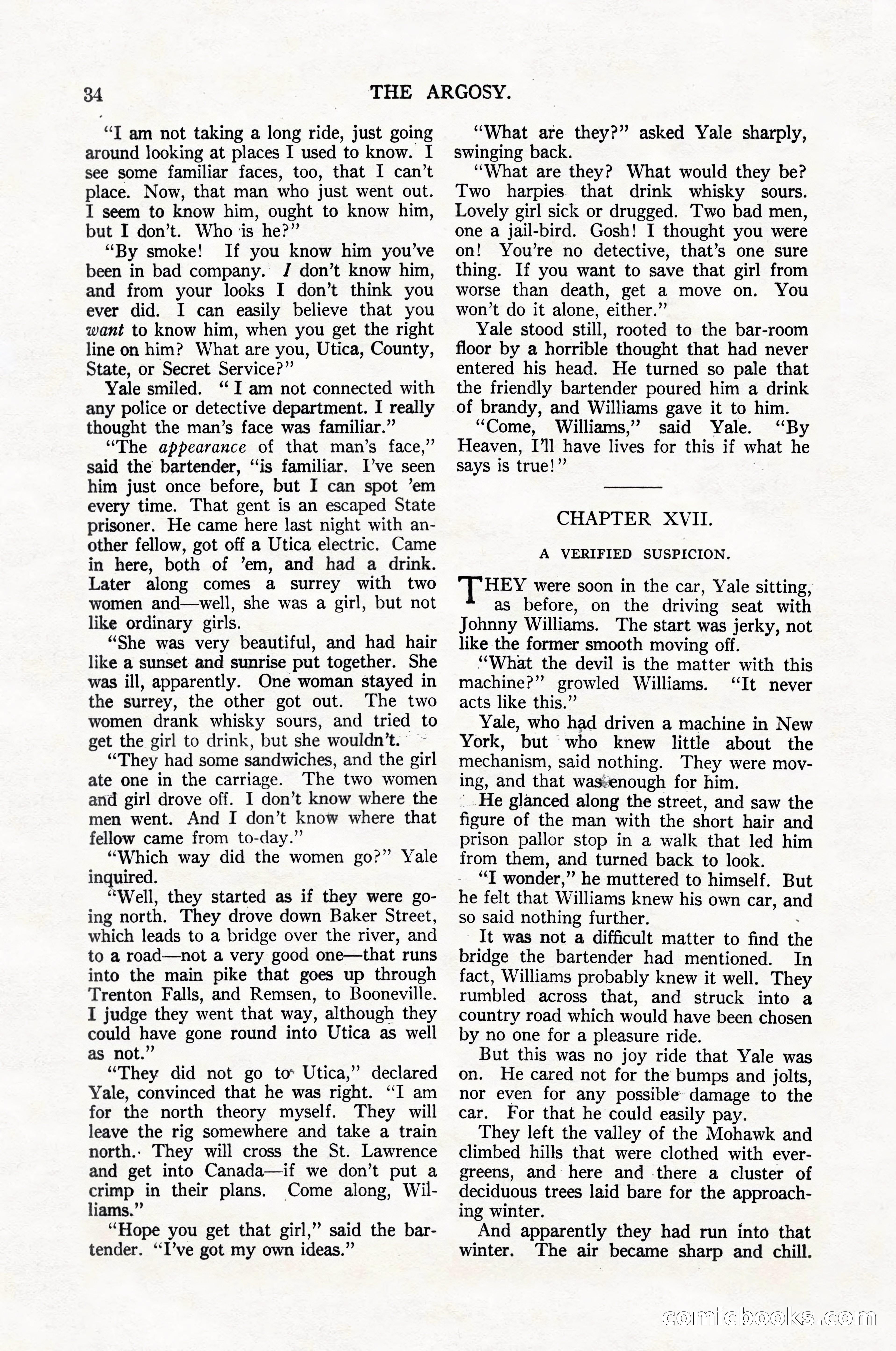
A restored page from Pulp Fiction, 1916. Page through the whole issue in the reader above.
📄 Transcribed text from this page (OCR, searchable)
Machine-transcribed from the original scan — historical spelling and the odd misread are preserved.
34 “T am not taking a long ride, just going around looking at places I used to know. I see some familiar faces, too, that I can’t place. Now, that man who just went out. I seem to know him, ought to know him, but I don’t. Who ‘is he?” “By smoke! If you know him you’ve been in bad company. J don’t know him, and from your looks I don’t think you ever did. I can easily believe that you want to know him, when you get the right line on him? What are you, Utica, County, State, or Secret Service?” Yale smiled. “I am not connected with any police or detective department. I really thought the man’s face was familiar.” “The appearance of that man’s face,” said the bartender, ‘‘is familiar. I’ve seen him just once before, but I can spot ’em every time. That gent is an escaped State prisoner. He came here last night with an- other fellow, got off a Utica electric. Came in here, both of ’em, and had a drink. Later along comes a surrey with two women and—vwell, she was a girl, but not like ordinary girls. “She was very beautiful, and had hair like a sunset and sunrise put together. She was ill, apparently. One woman stayed in the surrey, the other got out. The two women drank whisky sours, and tried to get the girl to drink, but she wouldn’t. ~ “They had some sandwiches, and the girl ate one in the carriage. The two women and girl drove off. I don’t know where the men went. And I don’t know where that fellow came from to-day.” “Which way did the women go?” Yale inquired. “Well, they started as if they were go- ing north. They drove down Baker Street, which leads to a bridge over the river, and to a road—not a very good one—that runs into the main pike that goes up through Trenton Falls, and Remsen, to Booneville. I judge they went that way, although they could have gone round into Utica as well as not.” “They did not go to* Utica,” declared Yale, convinced that he was right. “I am for the north theory myself. They will leave the rig somewhere and take a train north.. They will cross the St. Lawrence and get into Canada—if we don’t put a crimp in their plans. Come along, Wil- liams.”’ “Hope you get that girl,” said the bar- tender. “I’ve got my own ideas.” THE ARGOSY. “What are they?” asked Yale sharply, Swinging back. ‘‘What are they? What would they be? Two harpies that drink whisky sours. Lovely girl sick or drugged. Two bad men, one a jail-bird. Gosh! I thought you were on! You're no detective, that’s one sure thing. If you want to save that girl from worse than death, get a move on. You won’t do it alone, either.” Yale stood still, rooted to the bar-room floor by a horrible thought that had never entered his head. He turned so pale that the friendly bartender poured him a drink of brandy, and Williams gave it to him. “Come, Williams,” said Yale. “By Heaven, [ll have lives for this if what he says is true! ye CHAPTER XVII. A VERIFIED SUSPICION. "THEY were soon in the car, Yale sitting, as before, on the driving seat with Johnny Williams. The start was jerky, not like the former smooth moving off. “What the devil is the matter with this machine?” growled Williams. “It never acts like this.” Yale, who had driven a machine in New York, but who knew little about the mechanism, said nothing. They were mov- ing, and that wassenough for him. _.He glanced along the street, and saw the figure of the man with the short hair and prison pallor stop in a walk that led him from them, and turned back to look. “I wonder,” he muttered to himself. But he felt that Williams knew his own car, and so said nothing further. It was not a difficult matter to find fhe bridge the bartender had mentioned. In fact, Williams probably knew it well. They rumbled across that, and struck into a country road which would have been chosen by no one for a pleasure ride. But this was no joy ride that Yale was on. He cared not for the bumps and jolts, nor even for any possible damage to the car. For that he could easily pay. They left the valley of the Mohawk and climbed hills that were clothed with ever- greens, and: here and there a cluster of deciduous trees laid bare for the approach- ing winter. And apparently they had run into that winter. The air became sharp and chill. Co OO im S C©