
Pulp Fiction, 1916 · page 45 of 220
The Argosy, April 1916 — page 45: what you’re looking at
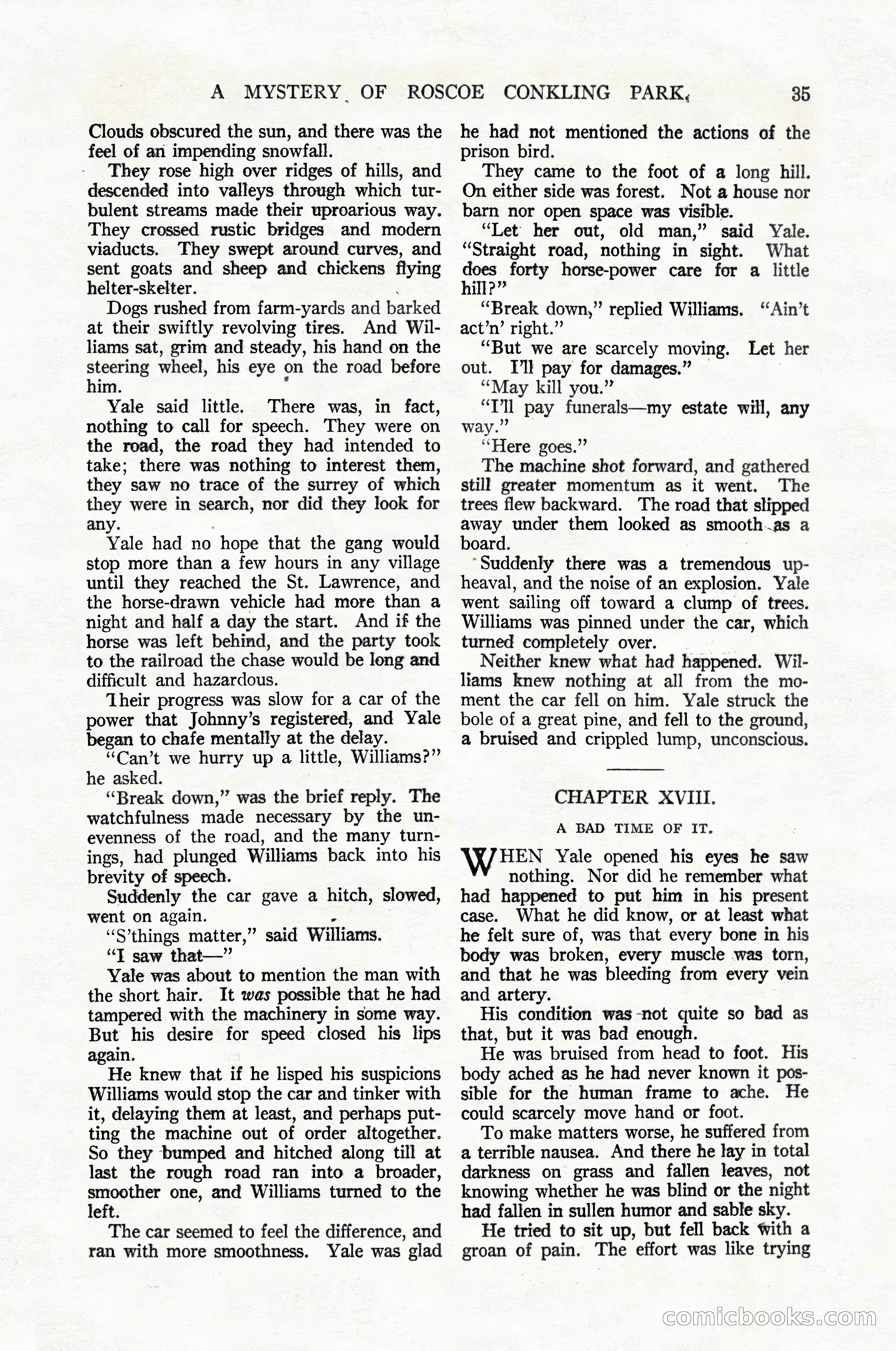
A restored page from Pulp Fiction, 1916. Page through the whole issue in the reader above.
📄 Transcribed text from this page (OCR, searchable)
Machine-transcribed from the original scan — historical spelling and the odd misread are preserved.
A MYSTERY. OF ROSCOE CONKLING PARK, Clouds obscured the sun, and there was the feel of an impending snowfall. They rose high over ridges of hills, and descended into valleys through which tur- bulent streams made their uproarious way. They crossed rustic bridges and modern viaducts. They swept around curves, and sent goats and sheep and chickens flying helter-skelter. Dogs rushed from farm-yards and barked at their swiftly revolving tires. And Wil- liams sat, grim and steady, his hand on the steering wheel, his eye on the road before him. Yale said little. There was, in fact, nothing to call for speech. They were on the road, the road they had intended to take; there was nothing to interest them, they saw no trace of the surrey of which they were in search, nor did they look for any. 3 Yale had no hope that the gang would stop more than a few hours in any village until they reached the St. Lawrence, and the horse-drawn vehicle had more than a night and half a day the start. And if the horse was left behind, and the party took to the railroad the chase would be long and difficult and hazardous. Their progress was slow for a car of the power that Johnny’s registered, and Yale began to chafe mentally at the delay. “Can’t we hurry up a little, Williams?” he asked. “Break down,” was the brief reply. The watchfulness made necessary by the un- evenness of the road, and the many turn- ings, had plunged Williams back into his brevity of speech. Suddenly the car gave a hitch, slowed, went on again. “S’things matter,” said Williams. “T saw that—” Yale was about to mention the man with the short hair. It was possible that he had tampered with the machinery in some way. But his desire for speed closed his lips again. He knew that if he lisped his suspicions Williams would stop the car and tinker with it, delaying them at least, and perhaps put- ting the machine out of order altogether. So they bumped and hitched along till at last the rough road ran into a broader, smoother one, and Williams turned to the left. The car seemed to feel the difference, and ran with more smoothness. Yale was glad 35 he had not mentioned the actions of the prison bird. They came to the foot of a long hill. On either side was forest. Not a house nor barn nor open space was visible. “Let her out, old man,” said Yale. “Straight road, nothing in sight. What does forty horse-power care for a little hill?” “Break down,” replied Williams. act’n’ right.” “But we are scarcely moving. Let her out. It pay for damages.” | “May kill you.” “Tl pay funerals—my estate will, any way.” ‘Here goes.” The machine shot forward, and gathered still greater momentum as it went. The trees flew backward. The road that slipped away under them looked as smooth.as a board. “Suddenly there was a tremendous up- heaval, and the noise of an explosion. Yale went sailing off toward a clump of trees. Williams was pinned under the car, which turned completely over. 7 Neither knew what had happened. Wil- liams knew nothing at all from the mo- ment the car fell on him. Yale struck the bole of a great pine, and fell to the ground, a bruised and crippled lump, unconscious. ““Ain’t CHAPTER XVIII. A BAD TIME OF IT. W HEN Yale opened his eyes he saw nothing. Nor did he remember what had happened to put him in his present case. What he did know, or at least what he felt sure of, was that every bone in his body was broken, every muscle was torn, and that he was bleeding from every vein and artery. His condition was-not quite so bad as that, but it was bad enough. He was bruised from head to foot. His body ached as he had never known it pos- sible for the human frame to ache. He could scarcely move hand or foot. To make matters worse, he suffered from a terrible nausea. And there he lay in total darkness on grass and fallen leaves, not knowing whether he was blind or the night had fallen in sullen humor and sable sky. He tried to sit up, but fell back With a groan of pain. The effort was like trying cComicloooks C@