
Pulp Fiction, 1916 · page 94 of 220
The Argosy, April 1916 — page 94: what you’re looking at
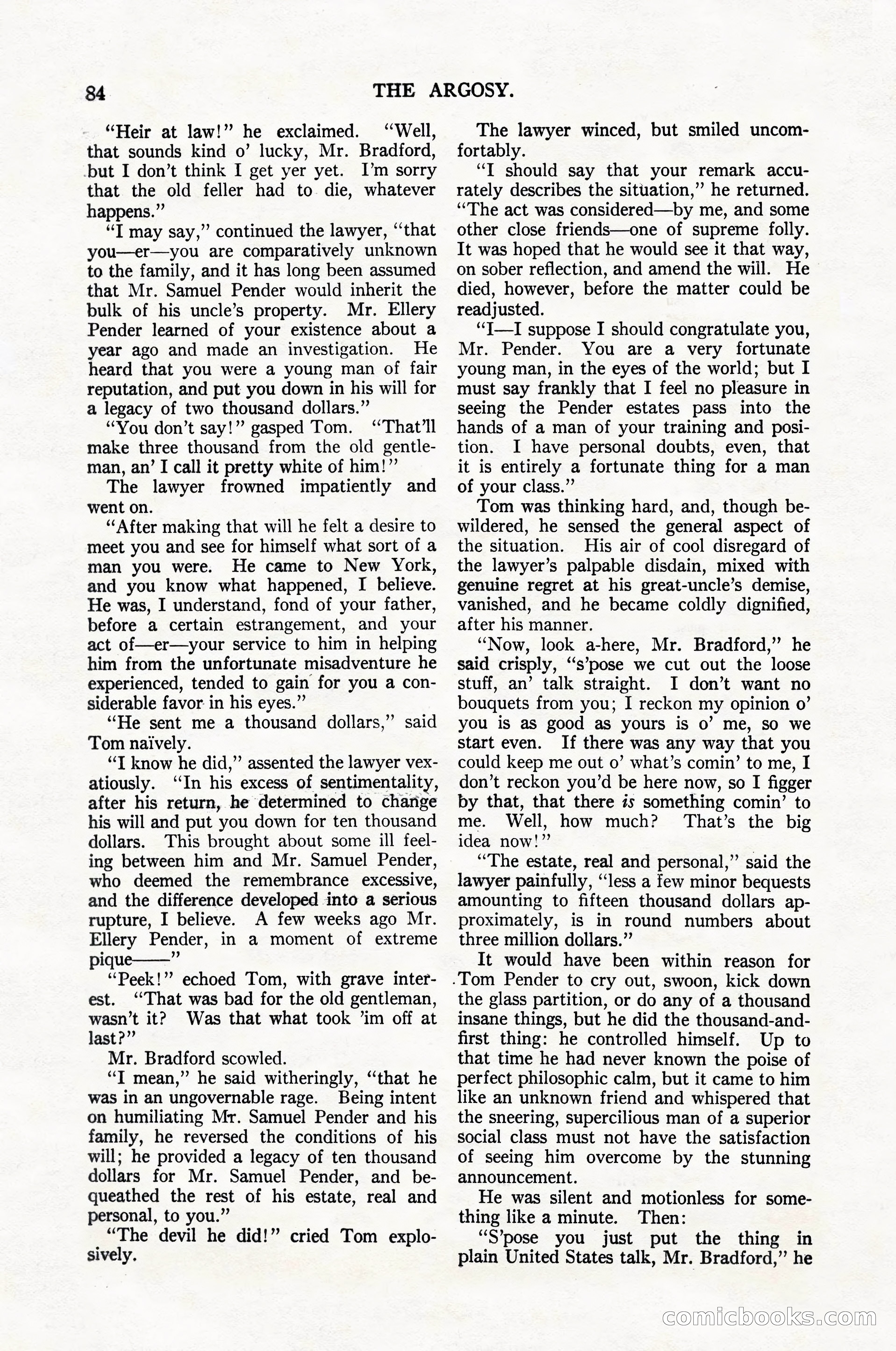
A restored page from Pulp Fiction, 1916. Page through the whole issue in the reader above.
📄 Transcribed text from this page (OCR, searchable)
Machine-transcribed from the original scan — historical spelling and the odd misread are preserved.
84 “Heir at law!” he exclaimed. ‘Well, that sounds kind o’ lucky, Mr. Bradford, -but I don’t think I get yer yet. I’m sorry that the old feller had to. die, whatever happens.” “T may say,” continued the lawyer, “that you—er—you are comparatively unknown to the family, and it has long been assumed that Mr. Samuel Pender would inherit the bulk of his uncle’s property. Mr. Ellery Pender learned of your existence about a year ago and made an investigation. He heard that you were a young man of fair reputation, and put you down in his will for a legacy of two thousand dollars.” “Vou don’t say!” gasped Tom. “That'll make three thousand from the old gentle- man, an’ I call it pretty white of him!” The lawyer frowned impatiently and went on. “After making that will he felt a desire to meet you and see for himself what sort of a man you were. He came to New York, and you know what happened, I believe. He was, I understand, fond of your father, before a certain estrangement, and your act of—er—your service to him in helping him from the unfortunate misadventure he experienced, tended to gain for you a con- siderable favor in his eyes.” “He sent me a thousand dollars,” said Tom naively. “T know he did,” assented the lawyer vex- atiously. ‘In his excess of sentimentality, after his return, he determined to change his will and put you down for ten thousand dollars. This brought about some ill feel- ing between him and Mr. Samuel Pender, who deemed the remembrance excessive, and the difference developed into a serious rupture, I believe. A few weeks ago Mr. Ellery Pender, in a moment of extreme pique——” “Peek!’’ echoed Tom, with grave inter- est. “That was bad for the old gentleman, wasn’t it? Was that what took ’im off at last?” Mr. Bradford scowled. “T mean,” he said witheringly, “that he was in an ungovernable rage. Being intent on humiliating Mr. Samuel Pender and his family, he reversed the conditions of his will; he provided a legacy of ten thousand dollars for Mr. Samuel Pender, and _ be- queathed the rest of his estate, real and personal, to you.”’ “The devil he did!” cried Tom explo- sively. THE ARGOSY. The lawyer winced, but smiled uncom- fortably. “T should say that your remark accu- rately describes the situation,” he returned. “The act was considered—by me, and some other close friends—one of supreme folly. It was hoped that he would see it that way, on sober reflection, and amend the will. He died, however, before the matter could be readjusted. ‘“‘I—I suppose I should congratulate you, Mr. Pender. You are a very fortunate young man, in the eyes of the world; but I must say frankly that I feel no pleasure in seeing the Pender estates pass into the hands of a man of your training and posi- tion. I have personal doubts, even, that it is entirely a fortunate thing for a man of your class.” Tom was thinking hard, and, though be- wildered, he sensed the general aspect of the situation. His air of cool disregard of the lawyer’s palpable disdain, mixed with genuine regret at his great-uncle’s demise, vanished, and he became coldly dignified, after his manner. ‘‘Now, look a-here, Mr. Bradford,” he said crisply, “‘s’pose we cut out the loose stuff, an’ talk straight. I don’t want no bouquets from you; I reckon my opinion o’ you is as good as yours is o’ me, so we start even. If there was any way that you could keep me out 0’ what’s comin’ to me, I don’t reckon you’d be here now, so I figger by that, that there is something comin’ to me. Well, how much? That’s the big idea now!”’ : ‘“‘The estate, real and personal,’’ said the lawyer painfully, “less a few minor bequests amounting to fifteen thousand dollars ap- proximately, is in round numbers about three million dollars.” It would have been within reason for -Tom Pender to cry out, swoon, kick down the glass partition, or do any of a thousand Insane things, but he did the thousand-and- first thing: he controlled himself. Up to that time he had never known the poise of perfect philosophic calm, but it came to him like an unknown friend and whispered that the sneering, supercilious man of a superior social class must not have the satisfaction of seeing him overcome by the stunning announcement. He was silent and motionless for some- thing like a minute. Then: “S’pose you just put the thing in plain United States talk, Mr. Bradford,’ he COMmiCcloo Cc SS C@