
Pulp Fiction, 1916 · page 95 of 220
The Argosy, April 1916 — page 95: what you’re looking at
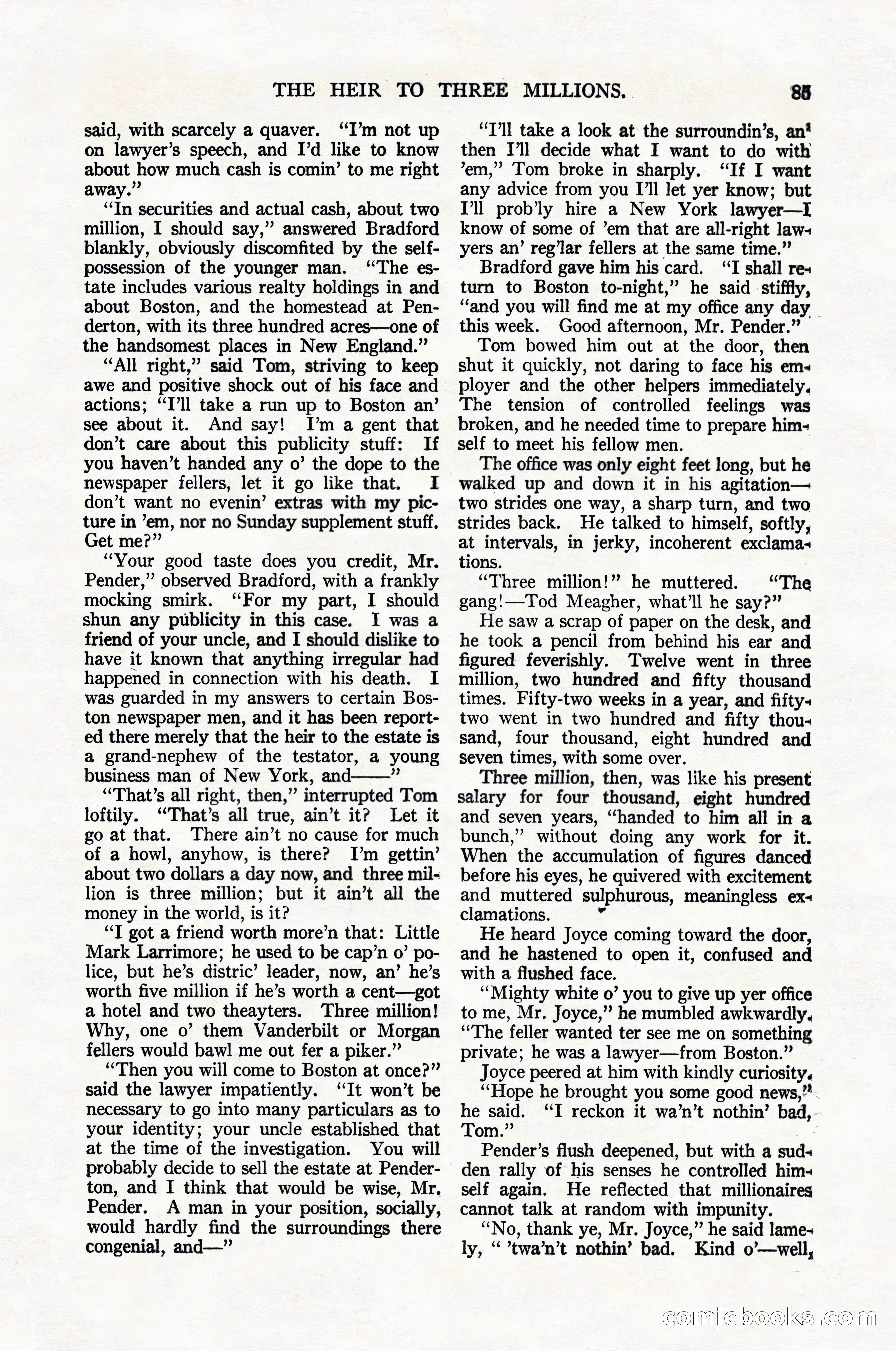
A restored page from Pulp Fiction, 1916. Page through the whole issue in the reader above.
📄 Transcribed text from this page (OCR, searchable)
Machine-transcribed from the original scan — historical spelling and the odd misread are preserved.
THE HEIR TO THREE MILLIONS. . said, with scarcely a quaver. “I’m not up on lawyer’s speech, and I’d like to know about how much cash is comin’ to me right away.” ‘“‘In securities and actual cash, about two million, I should say,’ answered Bradford blankly, obviously discomfited by the self- possession of the younger man. ‘The es- tate includes various realty holdings in and about Boston, and the homestead at Pen- derton, with its three hundred acres—one of the handsomest places in New England.” “All right,” said Tom, striving to keep awe and positive shock out of his face and actions; “‘I’ll take a run up to Boston an’ see about it. And say! I’m a gent that don’t care about this publicity stuff: If you haven’t handed any o’ the dope to the newspaper fellers, let it go like that. I don’t want no evenin’ extras with my pic- ture in ’em, nor no Sunday supplement stuff. Get me?”’ “Your good taste does you credit, Mr. Pender,” observed Bradford, with a frankly mocking smirk. ‘For my part, I should shun any publicity in this case. I was a friend of your uncle, and I should dislike to have it known that anything irregular had happened in connection with his death. I was guarded in my answers to certain Bos- ton newspaper men, and it has been report- ed there merely that the heir to the estate is a grand-nephew of the testator, a young business man of New York, and——” “‘That’s all right, then,” interrupted Tom loftily. ‘“‘That’s all true, ain’t it? Let it go at that. There ain’t no cause for much of a howl, anyhow, is there? I’m gettin’ about two dollars a day now, and three mil- lion is three million; but it ain’t all the money in the world, is it? “T got a friend worth more’n that: Little Mark Larrimore; he used to be cap’n o’ po- lice, but he’s distric’ leader, now, an’ he’s worth five million if he’s worth a cent—got a hotel and two theayters. Three million! Why, one o’ them Vanderbilt or Morgan fellers would bawl me out fer a piker.”’ “Then you will come to Boston at once?” said the lawyer impatiently. “It won’t be necessary to go into many particulars as to your identity; your uncle established that at the time of the investigation. You will probably decide to sell the estate at Pender- © ton, and I think that would be wise, Mr. Pender. A man in your position, socially, would hardly find the surroundings there congenial, and—”’ “T’ll take a look at the surroundin’s, an* then Ill decide what I want to do with 7em,” Tom broke in sharply. “If I want any advice from you I'll let yer know; but Ill prob’ly hire a New York lawyer—I know of some of ’em that are all-right law- yers an’ reg’lar fellers at the same time.” Bradford gave him his card. “TI shall res turn to Boston to-night,” he said stiffly, “and you will find me at my office any day this week. Good afternoon, Mr. Pender.” Tom bowed him out at the door, then shut it quickly, not daring to face his em- ployer and the other helpers immediately, The tension of controlled feelings was broken, and he needed time to prepare him- self to meet his fellow men. The office was only eight feet long, but he walked up and down it in his agitation— two strides one way, a sharp turn, and two strides back. He talked to himself, softly, at intervals, in jerky, incoherent exclama- tions. , “Three million!” he muttered. ‘The gang!—Tod Meagher, what’ll he say?” He saw a scrap of paper on the desk, and he took a pencil from behind his ear and figured feverishly. Twelve went in three million, two hundred and fifty thousand times. Fifty-two weeks in a year, and fifty- two went in two hundred and fifty thou- sand, four thousand, eight hundred and seven times, with some over. Three million, then, was like his present salary for four thousand, eight hundred and seven years, “handed to him all in a bunch,” without doing any work for it. When the accumulation of figures danced before his eyes, he quivered with excitement and muttered sulphurous, meaningless ex; clamations. “A He heard Joyce coming toward the door, and he hastened to open it, confused and with a flushed face. “Mighty white o’ you to give up yer office to me, Mr. Joyce,” he mumbled awkwardly. ‘The feller wanted ter see me on something private; he was a lawyer—from Boston.” Joyce peered at him with kindly curiosity. “Hope he brought you some good news,” he said. Tom.” Pender’s flush deepened, but with a sud- den rally of his senses he controlled him- self again. He reflected that millionaires cannot talk at random with impunity. ‘“‘No, thank ye, Mr. Joyce,” he said lame- ly, “ twa’n’t nothin’ bad. Kind o’—well, COMIGDOO S “T reckon it wa’n’t nothin’ bad, C@