
Pulp Fiction, 1916 · page 98 of 220
The Argosy, April 1916 — page 98: what you’re looking at
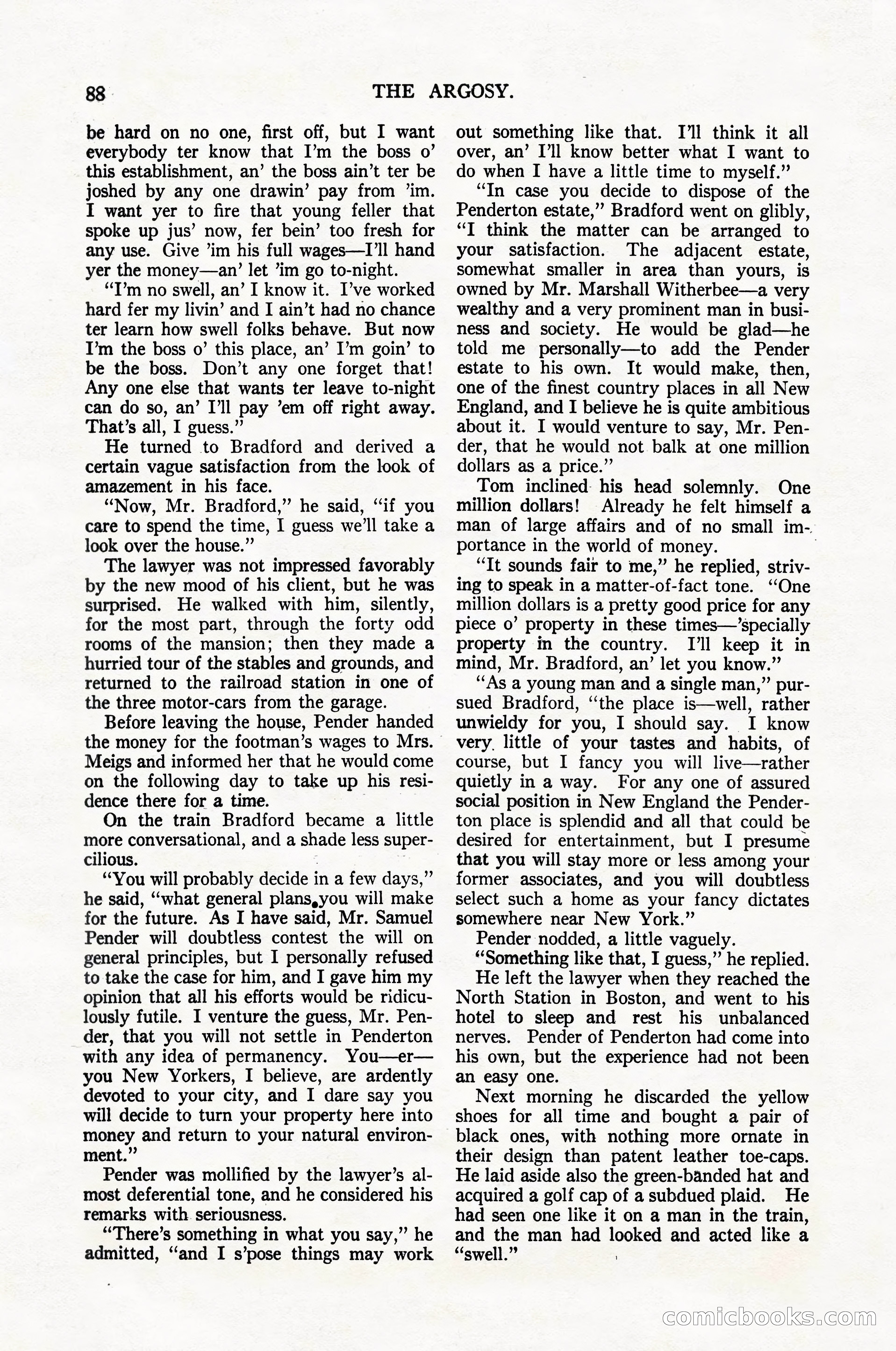
A restored page from Pulp Fiction, 1916. Page through the whole issue in the reader above.
📄 Transcribed text from this page (OCR, searchable)
Machine-transcribed from the original scan — historical spelling and the odd misread are preserved.
88 be hard on no one, first off, but I want everybody ter know that I’m the boss 0’ this establishment, an’ the boss ain’t ter be joshed by any one drawin’ pay from ’im. I want yer to fire that young feller that spoke up jus’ now, fer bein’ too fresh for any use. Give ’im his full wages—I’ll hand yer the money—an’ let ’im go to-night. “T’m no swell, an’ I know it. I’ve worked hard fer my livin’ and I ain’t had no chance ter learn how swell folks behave. But now I’m the boss o’ this place, an’ I’m goin’ to be the boss. Don’t any one forget that! Any one else that wants ter leave to-night can do so, an’ I'll pay ’em off right away. That’s all, I guess.” He turned to Bradford and derived a certain vague satisfaction from the look of amazement in his face. “Now, Mr. Bradford,” he said, “if you care to spend the time, I guess we'll take a look over the house.” The lawyer was not impressed favorably by the new mood of his client, but he was surprised. He walked with him, silently, for the most part, through the forty odd rooms of the mansion; then they made a hurried tour of the stables and grounds, and returned to the railroad station in one of the three motor-cars from the garage. Before leaving the house, Pender handed the money for the footman’s wages to Mrs. Meigs and informed her that he would come on the following day to take up his resi- dence there for a time. On the train Bradford became a little more conversational, and a shade less super- cilious. “You will probably decide in a few days, he said, “what general plans,you will make for the ‘future. As I have said, Mr. Samuel Pender will doubtless contest the will on general principles, but I personally refused to take the case for him, and I gave him my opinion that all his efforts would be ridicu- lously futile. I venture the guess, Mr. Pen- der, that you will not settle in Penderton with any idea of permanency. You—er— you New Yorkers, I believe, are ardently devoted to your city, and I dare say you will decide to turn your property here into money and return to your natural environ- ment.” Pender was mollified by the lawyer’s al- most deferential tone, and he considered his remarks with. seriousness. “‘There’s something in what you say,” he admitted, ‘and I s’pose things may work a THE ARGOSY. out something like that. I’ll think it all over, an’ I'll know better what I want to do when I have a little time to myself.” “In case you decide to dispose of the Penderton estate,” Bradford went on glibly, “YT think the matter can be arranged to your satisfaction. The adjacent estate, somewhat smaller in area than yours, is owned by Mr. Marshall Witherbee—a very wealthy and a very prominent man in busi- ness and society. He would be glad—he told me personally—to add the Pender estate to his own. It would make, then, one of the finest country places in all New England, and I believe he is quite ambitious about it. I would venture to say, Mr. Pen- der, that he would not balk at one million dollars as a price.” Tom inclined his head solemnly. One million dollars! Already he felt himself a man of large affairs and of no small im-. portance in the world of money. “It sounds fair to me,” he replied, striv- ing to speak in a matter-of-fact tone. “One million dollars is a pretty good price for any piece 0’ property in these times—’specially property m the country. I'll keep it in mind, Mr. Bradford, an’ let you know.” ‘‘AsS a young man and a single man,” pur- sued Bradford, “the place is—well, rather unwieldy for you, I should say. I know very. little of your tastes and habits, of course, but I fancy you will live—rather quietly in a way. For any one of assured social position in New England the Pender- ton place is splendid and all that could be desired for entertainment, but I presume that you will stay more or less among your former associates, and you will doubtless select such a home as your fancy dictates somewhere near New York.” Pender nodded, a little vaguely. “Something like that, I guess,”’ he replied. He left the lawyer when they reached the North Station in Boston, and went to his hotel to sleep and rest his unbalanced nerves. Pender of Penderton had come into his own, but the experience had not been an easy one. Next morning he discarded the yellow shoes for all time and bought a pair of black ones, with nothing more ornate in their design than patent leather toe-caps. He laid aside also the green-banded hat and acquired a golf cap of a subdued plaid. He had seen one like it on a man in the train, and the man had poked and acted like a “swell.” comiclbooo (C©@