
Pulp Fiction, 1916 · page 97 of 220
The Argosy, April 1916 — page 97: what you’re looking at
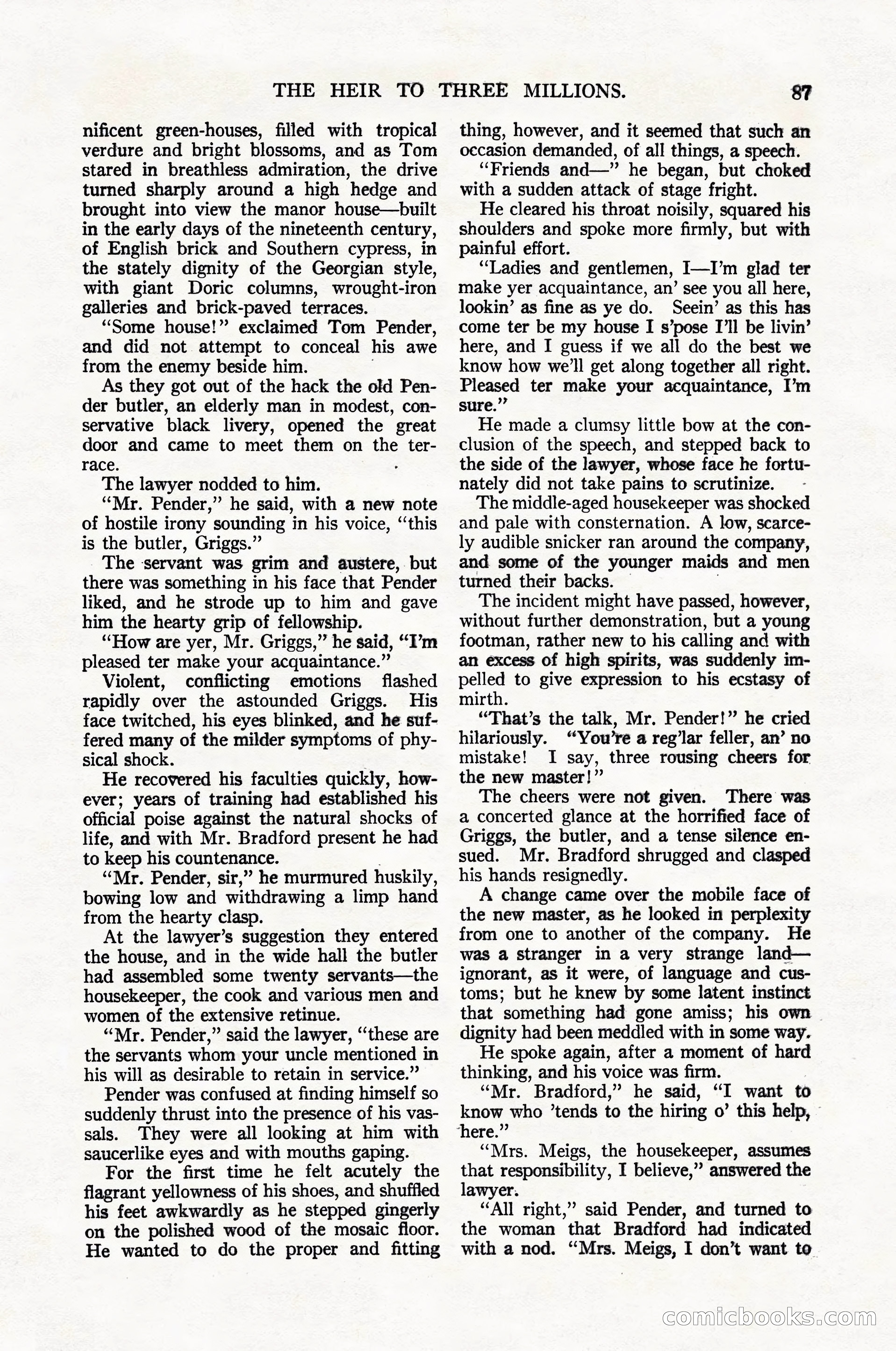
A restored page from Pulp Fiction, 1916. Page through the whole issue in the reader above.
📄 Transcribed text from this page (OCR, searchable)
Machine-transcribed from the original scan — historical spelling and the odd misread are preserved.
THE HEIR TO THREE MILLIONS. nificent green-houses, filled with tropical verdure and bright blossoms, and as Tom stared in breathless admiration, the drive turned sharply around a high hedge and brought into view the manor house—built in the early days of the nineteenth century, of English brick and Southern cypress, in the stately dignity of the Georgian style, with giant Doric columns, wrought-iron galleries and brick-paved terraces. ‘“‘Some house!” exclaimed Tom Pender, and did not attempt to conceal his awe from the enemy beside him. : As they got out of the hack the old Pen- der butler, an elderly man in modest, con- servative black livery, opened the great door and came to meet them on the ter- race. The lawyer nodded to him. “Mr. Pender,” he said, with a new note of hostile irony sounding in his voice, ‘‘this is the butler, Griggs.” The servant was grim and austere, but there was something in his face that Pender liked, and he strode up to him and gave him the hearty grip of fellowship. “How are yer, Mr. Griggs,” he said, “I’m pleased ter make your acquaintance.” Violent, conflicting emotions flashed rapidly over the astounded Griggs. His face twitched, his eyes blinked, and he suf- fered many of the milder symptoms of phy- sical shock. He recovered his faculties quickly, how- ever; years of training had established his official poise against the natural shocks of life, and with Mr. Bradford present he had to keep his countenance. “Mr. Pender, sir,” he murmured huskily, bowing low and withdrawing a limp hand from the hearty clasp. At the lawyer’s suggestion they entered the house, and in the wide hall the butler had assembled some twenty servants—the housekeeper, the cook and various men and women of the extensive retinue. “Mr. Pender,” said the lawyer, “‘these are the servants whom your uncle mentioned in his will as desirable to retain in service.” Pender was confused at finding himself so suddenly thrust into the presence of his vas- sals. They were all looking at him with saucerlike eyes and with mouths gaping. For the first time he felt acutely the flagrant yellowness of his shoes, and shuffled his feet awkwardly as he stepped gingerly on the polished wood of the mosaic floor. He wanted to do the proper and fitting 87 thing, however, and it seemed that such an occasion demanded, of all things, a speech. “Friends and—” he began, but choked with a sudden attack of stage fright. He cleared his throat noisily, squared his shoulders and spoke more firmly, but with painful effort. “Ladies and gentlemen, I—I’m glad ter make yer acquaintance, an’ see you all here, lookin’ as fine as ye do. Seein’ as this has come ter be my house I s’pose I’ll be livin’ here, and I guess if we all do the best we know how we'll get along together all right. Pleased ter make your acquaintance, I’m sure.”’ He made a clumsy little bow at the con- clusion of the speech, and stepped back to the side of the lawyer, whose face he fortu- nately did not take pains to scrutinize. The middle-aged housekeeper was shocked and pale with consternation. A low, scarce- ly audible snicker ran around the company, and some of the younger maids and men turned their backs. — The incident might have passed, however, without further demonstration, but a young footman, rather new to his calling and with an excess of high spirits, was suddenly im- pelled to give expression to his ecstasy of mirth. “‘That’s the talk, Mr. Pender!” he cried hilariously. “You’re a reg’lar feller, an’ no mistake! I say, three rousing cheers for the new master!” The cheers were not given. There was a concerted glance at the horrified face of Griggs, the butler, and a tense silence en- sued. Mr. Bradford shrugged and clasped his hands resignedly. A change came over the mobile face of the new master, as he looked in perplexity from one to another of the company. He was a stranger in a very strange land— ignorant, as it were, of language and cus- toms; but he knew by some latent instinct that something had gone amiss; his own dignity had been meddled with in some way. He spoke again, after a moment of hard thinking, and his voice was firm. “Mr. Bradford,” he said, “I want to know who ’tends to the hiring o’ this help, here.” “Mrs. Meigs, the housekeeper, assumes that responsibility, I believe,” answered the lawyer. “All right,” said Pender, and turned to the woman that Bradford had indicated with a nod. cComicoooks “Mrs. Meigs, I don’t want to C©