
Pulp Fiction, 1922 · page 30 of 187
Argosy All-Story Weekly — page 30: what you’re looking at
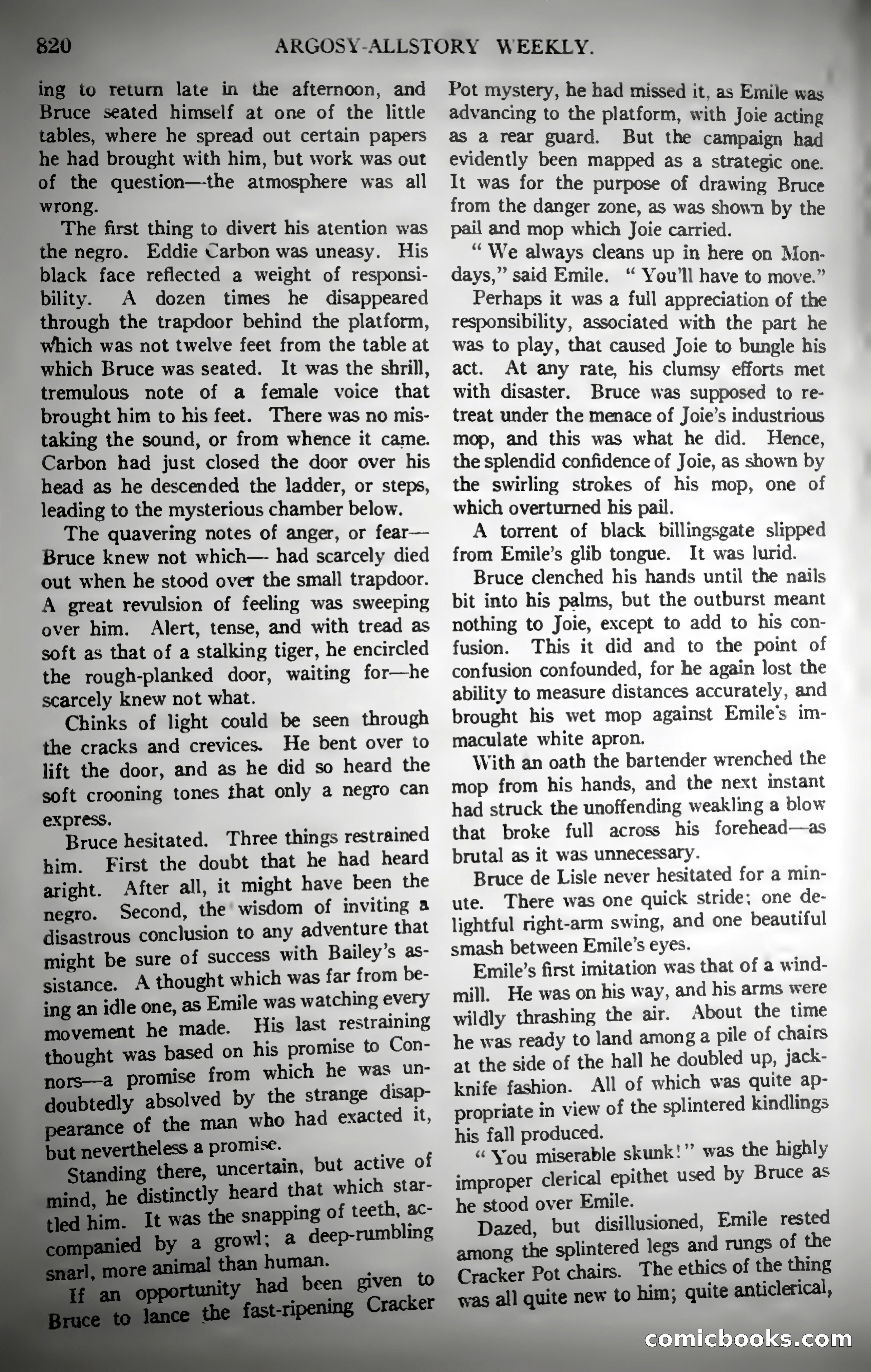
A restored page from Pulp Fiction, 1922. Page through the whole issue in the reader above.
📄 Transcribed text from this page (OCR, searchable)
Machine-transcribed from the original scan — historical spelling and the odd misread are preserved.
o return late in the afternoon, and ice seated himself at one of the little tables, where he spread out certain papers ne had brought with him, but work was out of the question—-the atmosphere was all wrong. The first thing to divert his atention was _ the negro. Eddie Carbon was uneasy. His black face reflected a weight of responsi- bility. A dozen times he disappeared through the trapdoor behind the platform, which was not twelve feet from the table at which Bruce was seated. It was the shrill, tremulous note of a female voice that brought him to his feet. There was no mis- taking the sound, or from whence it came. Carbon had just closed the door over his head as he descended the ladder, or steps, leading to the mysterious chamber below. The quavering notes of anger, or fear— Bruce knew not which— had scarcely died out when he stood over the small trapdoor. A great revulsion of feeling was sweeping over him. Alert, tense, and with tread as soft as that of a stalking tiger, he encircled the rough-planked door, waiting for—he scarcely knew not what. Chinks of light could be seen through the cracks and crevices. He bent over to lift the door, and as he did so heard the soft crooning tones that only a negro can express. Bruce hesitated. Three things restrained him. First the doubt that he had heard aright. After all, it might have been the negro. Second, the wisdom of inviting & disastrous conclusion to any adventure that might be sure of success with Bailey’s as- sistance. A thought which was far from be- ing an idle one, as Emile was watching every movement he made. His last restraining thought was based on his promise to Con- nors—a promise from which he was un- ubtedly absolved by the strange disap- srance of the man who had exacted It, nevertheless a promise. ding there, uncertain, but active of tly heard that which star- as the snapping of teeth, ac- ' eer piven to ARGOSY-ALLSTORY WEEKLY. ker was all quite new to him; Pot mystery, he had missed it, as Emile ae advancing to the platform, with Joie acting as a rear guard. But the campaign had evidently been mapped as a strategic one. It was for the purpose of drawing Bruce from the danger zone, as was shown by the pail and mop which Joie carried. “We always cleans up in here on Mon- days,” said Emile. ‘“ You'll have to move.” Perhaps it was a full appreciation of the responsibility, associated with the part he was to play, that caused Joie to bungle his act. At any rate, his clumsy efforts met with disaster. Bruce was supposed to re- treat under the menace of Joie’s industrious mop, and this was what he did. Hence, the splendid confidence of Joie, as shown by the swirling strokes of his mop, one of which overturned his pail. A torrent of black billingsgate slipped from Emile’s glib tongue. It was lurid. Bruce clenched his hands until the nails bit into his palms, but the outburst meant nothing to Joie, except to add to his con- fusion. This it did and to the point of confusion confounded, for he again lost the ability to measure distances accurately, and brought his wet mop against Emile’s im- maculate white apron. With an oath the bartender wrenched the mop from his hands, and the next instant had struck the unoffending weakling a blow that broke full across his forehead—as brutal as it was unnecessary. Bruce de Lisle never hesitated for a min- ute. There was one quick stride; one de- lightful right-arm swing, and one beautiful smash between Emile’s eyes. Emile’s first imitation was that of a wind- mill. He was on his way, and his arms were wildly thrashing the air. About the time he was ready to land among a pile of chairs at the side of the hall he doubled up, jack- knife fashion. All of which was quite ap- propriate in view of the splintered kindlings his fall produced. ‘You miserable skunk!” was the highly improper clerical epithet used by Bruce as he stood over Emile. Dazed, but disillusioned, Emile rested among the splintered legs and rungs of the Cracker Pot chairs. The ethics of the thing quite anticlerical,