
Pulp Fiction, 1922 · page 31 of 187
Argosy All-Story Weekly — page 31: what you’re looking at
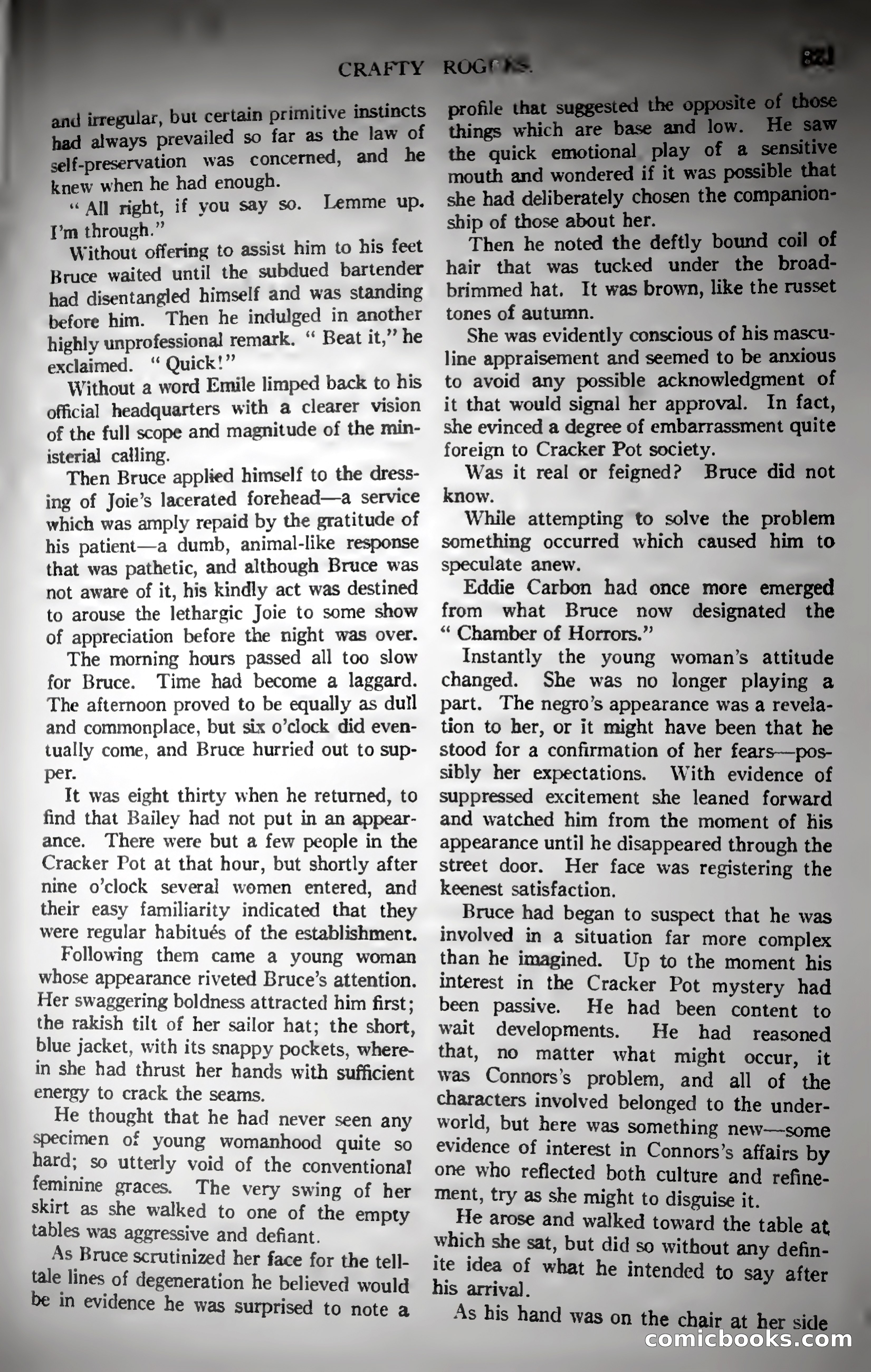
A restored page from Pulp Fiction, 1922. Page through the whole issue in the reader above.
📄 Transcribed text from this page (OCR, searchable)
Machine-transcribed from the original scan — historical spelling and the odd misread are preserved.
a a d irregu ar, but certain primitive instincts | always prevailed so far as the law of _ self-preservation was concerned, and he knew when he had enough. “All right, if you say so. Lemme up. I’m through.” , ‘ Without offering to assist him to his feet Bruce waited until the subdued bartender had disentangled himself and was standing before him. Then he indulged in another highly unprofessional remark. ‘‘ Beat it,” he exclaimed. ‘ Quick!”’ Without a word Emile limped back to his official headquarters with a clearer vision of the full scope and magnitude of the min- isterial calling. Then Bruce applied himself to the dress- ing of Joie’s lacerated forehead—a service which was amply repaid by the gratitude of his patient—a dumb, animal-like response that was pathetic, and although Bruce was not aware of it, his kindly act was destined to arouse the lethargic Joie to some show of appreciation before the night was over. The morning hours passed all too slow for Bruce. Time had become a laggard. The afternoon proved to be equally as dull and commonplace, but six o’clock did even- tually come, and Bruce hurried out to sup- per. It was eight thirty when he returned, to find that Bailey had not put in an appear- ance. There were but a few people in the Cracker Pot at that hour, but shortly after nine o'clock several wemen entered, and their easy familiarity indicated that they were regular habitués of the establishment. Following them came a young woman whose appearance riveted Bruce’s attention. Her swaggering boldness attracted him first; the rakish tilt of her sailor hat; the short, blue jacket, with its snappy pockets, where- in she had thrust her hands with sufficient energy to crack the seams. He thought that he had never seen any specimen of young womanhood quite so hard; so utterly void of the conventional feminine graces. The very swing of her skirt as she walked to one of the empty tables was aggressive and defiant. As Bruce scrutinized her face for the tell- tale lines of degeneration he believed would be in evidence he was surprised to note a 7 the quick emotional plé mouth and wondered if it was 5 she had deliberately chosen the com ship of those about her. « Then he noted the deftly bound coll ¢ hair that was tucked under the broa brimmed hat. It was brown, like the russe tones of autumn. = She was evidently conscious of his mascu- line appraisement and seemed to be anxious to avoid any possible acknowledgment of it that would signal her approval. In fact, she evinced a degree of embarrassment quite foreign to Cracker Pot society. Was it real or feigned? Bruce did not know. While attempting to solve the problem something occurred which caused him to speculate anew. Eddie Carbon had once more emerged from what Bruce now designated the “‘ Chamber of Horrors.” Instantly the young woman’s attitude changed. She was no longer playing a part. The negro’s appearance was a revela- tion to her, or it might have been that he stood for a confirmation of her fears—pos- sibly her expectations. With evidence of suppressed excitement she leaned forward and watched him from the moment of his appearance until he disappeared through the street door. Her face was registering the keenest satisfaction. Bruce had began to suspect that he was involved in a situation far more complex than he imagined. Up to the moment his interest in the Cracker Pot mystery had been passive. He had been content to wait developments. He had _ reasoned that, no matter what might occur, it was Connors’s problem, and all of the characters involved belonged to the under- world, but here was Something new—some evidence of interest in Connors’s affairs by one who reflected both culture and refine- ment, try as she might to disguise it. He arose and walked toward the table at, which she sat, but did so without any defin- ite idea of what he intended to say after — his arrival. ‘As his hand was on the chair at her side comicbooks.c