
Pulp Fiction, 1882 · page 2 of 16
Beadle's Boys Library No. 54 — page 2: what you’re looking at
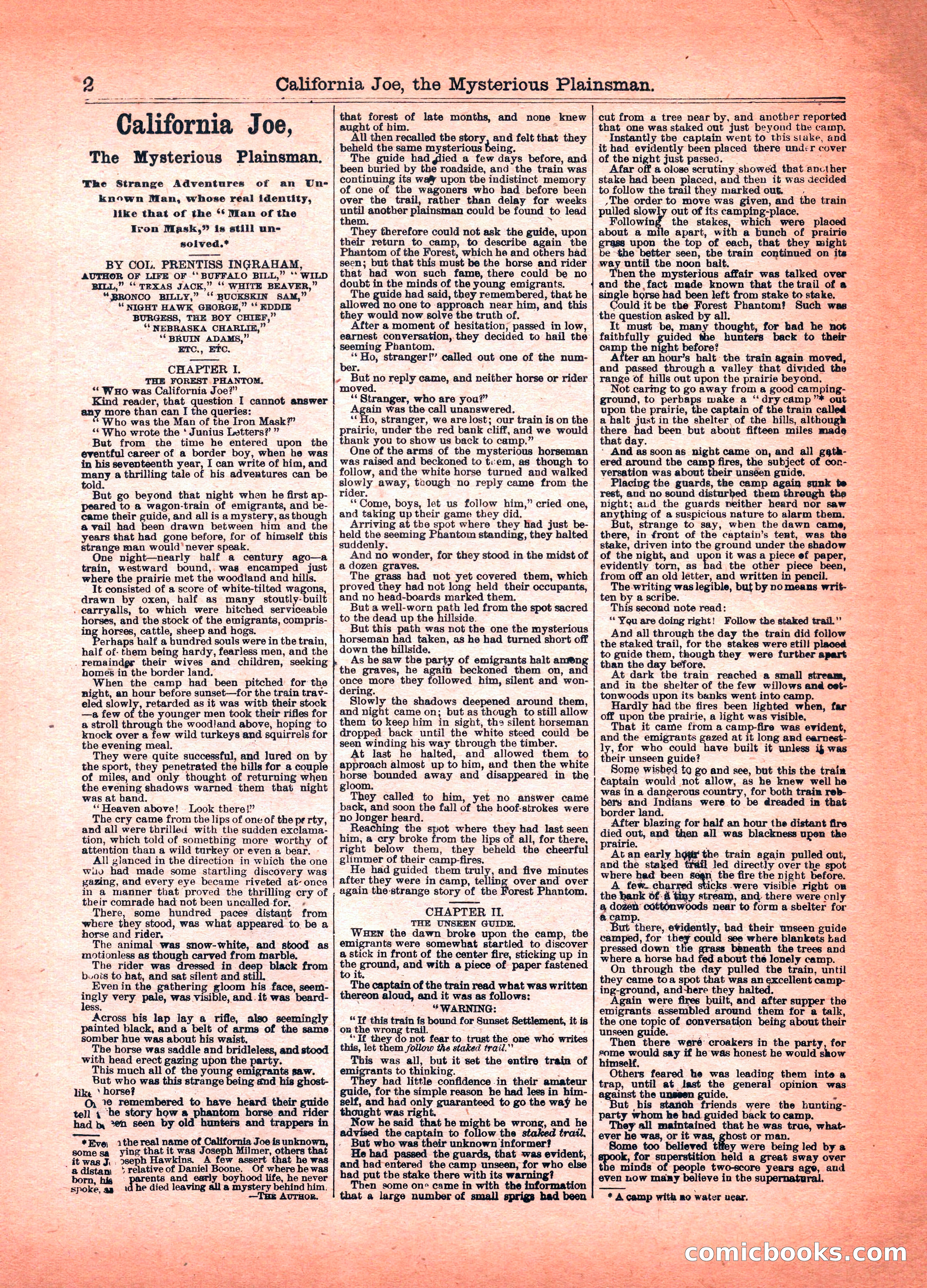
A restored page from Pulp Fiction, 1882. Page through the whole issue in the reader above.
📄 Transcribed text from this page (OCR, searchable)
Machine-transcribed from the original scan — historical spelling and the odd misread are preserved.
California Joe, the Mysterious Plainsman. ae RS er Oe California Joe, The Mysterious Plainsman. The Strange Adventures of an Un- known Man, whose real identity, like that of the ‘* Man of the Iron Mask,” is still un- solved.* BY COL. PRENTISS INGRAHAM, AUTHOR OF LIFE OF ‘BUFFALO BILL,” ‘* WILD BILL,” ‘‘ TEXAS JACK,” ‘‘ WHITE BEAVER,” “BRONCO BILLY,” ‘‘ BUCKSKIN SAM,” “ NIGHT HAWK GEORGE,” ‘‘ EDDIE BURGESS, THE BOY CHIEF,” ‘‘ NEBRASKA CHARLIE,” ‘““BRUIN ADAMS,” that forest of late months, and none knew aught of him. ll then recalled the story, and felt that they beheld the same mysterious being. The guide had glied a few days before, and been buried by the roadside, and the train was continuing its way upon the indistinct memory of one of the wagoners who had before been over the trail, rather than delay for weeks until another plainsman could be found to lead them. . They therefore could not ask the guide, upon their return to camp, to describe again the Phantom of the Forest, which he and others had seen; but that this must be the horse and rider that had won such fame, there could be no doubt in the minds of the young emigrants. The guide had said, they remembered, that he allowed no one to approach near him, and this they would now solve the truth of. After a moment of hesitation, passed in low, earnest conversation, they decided to hail the seeming Phantom. = cut from a tree near by, and another reported | ee that one was staked ont just beyond the camp. Instantly tbe captain went to this siake, and 3 it had evidently been placed there und<r cover of the night just passed. ; s Afar off a olose scrutiny showed that ancther . stake had been placed, and then it was decided to follow the trail they marked out, ,The order to move was given, and the train, Following the stakes, which were placed about a mile apart, with a bunch of prairie grass upon the top of each, that they might pulled rin out of its camping-place. 1 be the better seen, the train continued on ita — oe wey. until the noon halt. hen the mysterious affair was talked over and the fact made known that thetrail ofa single horse had been left from stake to stake, Could it be the Forest Phantom? Such was the question asked by all. It must be, many thought, for bad he not faithfully guided the hunters back to their ETC., ETC. camp the night before? ee ae ‘* Ho, stranger!’ called out one of the num- After an hour’s halt the train again moved, ee = CHAPTER I. and passed through a valley that divided the = THE FOREST PHANTOM, “Wao was California Joe?” Kind reader, that question I cannot answer any more than can I the queries: ‘Who was the Man of the Iron Mask?” ‘Who wrote the ‘ Junius Letters?’ ” But from the time he entered upon the eventful career of a border boy, when he was in his seventeenth year, I can write of him, and many a thrilling tale of his adventures can be told. But go beyond that night when he first ap- peared to a wagon-train of emigrants, and be- came their guide, and all is amystery, as though a vail had been drawn between him and the years that had gone before, for of himself this strange man would’ never speak. One night—nearly half a century ago—a train, westward bound, was encamped just where the prairie met the woodland and hills. Jt consisted of a score of white-tilted wagons, drawn by oxen, half as many stoutly-built . earryalls, to which were hitched serviceable horses, and the stock of the emigrants, compris- ing horses, cattle, sheep and hogs. or hak half a bundred souls were in the train, half of- them being hardy, fearless men, and the _remaindgr their wives and children, seeking homes in the border land. When the camp had been pitched for the night, an hour before sunset—for the train trav- eled slowly, retarded as it was witb their stock —a few of the younger men took their rifles for a stroll through the woodland above, hoping to knock over a few wild turkeys and squirrels for the evening meal. They were quite successful, and lured on b the sport, they penetrated the bills for a couple of miles, and only thought of returning when the evening shadows warned them that night was at hand. ‘‘Heaven above! - Look there]? The cry came from the lips of one of the pe rty, and all were thrilled with the sudden exclama- tion, which told of something more worthy of attention than a wild turkey or even a bear. - All glanced in the direction in which the one wuv had made some startling discovery was yazing, and every eye became riveted at- once in a manner that proved the thrilling cry of their comrade had not been uncalled for. - There, some hundred paceg distant from where they stood, was what appeared to be a horse and rider, . ; The animal was snow-white, and stood as motionless as though carved from marble. The rider was dressed in deep black from bvois to hat, and sat silent and sti Even in the gathering gloom his face, seem- ingly very pale, was visible, and.it was beard- ess. Across his lap lay a rifle, also seemingly painted black, and a belt of arms of the same somber hue was about his waist. The horse was saddle and bridleless, and stood with head erect gazing upon the party. This much all of the siodtt Saale saw. But who was this strange being and his ghost- like ‘ horse? : Q, 1¢ remembered to have heard their guide Er. » But no reply came, and neither horse or rider moved. ‘‘ Stranger, who are you?” Again was the call unanswered. ‘*Ho, stranger, we are lost; our train is on the prairie, under the red bank cliff, and we would thank you to show us back to camp.” One of the arms of the mysterious horseman was raised and beckoned to t::em, as though to follow, and the white horse turned and walked ay away, toough no reply came from the rider. ‘* Come, boys, let us follow him,” cried one, and taking up their game they did. Arriving at the spot where they Had just be- held the seeming Phantom standing, they halted suddenly. And no wonder, for they stood in the midst of a dozen graves. The grass had not yet covered them, which proved they had not long held their occupants, and no head-boards marked them. But a well-worn path led from the spot sacred to the dead up the hillside. But this path was not the one the mysterious horseman had taken, as he had turned short off down the hillside. As he saw the party of emigrants halt amen, the graves, he again beckoned them on, an once more they followed him, silent and won- ering. Slowly the shadows deepened around them, and night came on; but as though to still allow them to keep him in sight, ths silent horseman dropped back until the white steed could be seen winding his way through the timber. At last he halted, and allowed them to approach almost up to him, and then the white horse bounded away and disappeared in the gloom. They called to him, yet no answer camé back, and soon the fall of the hoof-strokes were no Jonger heard. Reaching the spot where they had last seen him, a cry broke from the lips of all, for there, right below them, they beheld the cheerful glimmer of their camp-fires. He had guided them truly, and five minutes after they were in camp, tellin over and over again the-strange story of the B orest Phantom, CHAPTER II. THE UNSEEN GUIDE. Wuen the dawn broke upon the camp, the emigrants were somewhat startled to discover a stick in front of the center fire, sticking up in pe nnins and with a piece of paper fastened ] = The captain of the train read what was written thereon aloud, and it was as follows: re ‘* WARNING: “Tf this train is bound for Sunset Settlement, it is on the wrong trail. 4 ‘If they do not fear to trust the one who writes this, let them follow the staked trait.” This was all, but it set the entire train of igrants to thinking. : ey had little confidence in their amateur guide, for the simple reason he had less in him- range of hills out upon the prairie beyond. Not caring to go away from a good comple . ground, to perbaps wake a ‘dry camp’* out upon the prairie, the captain of the train called a halt just in the shelter of the hills, although there had been but about fifteen miles made that day. 2 ‘ And as soon as night came on, and all gatk- ered around the camp fires, the subject of con- versation was about their unseen guide, - Placing the guards, the camp again sunk te rest, and no sound disturbed them through the night; aud the guards neither heard nor saw anything of a suspicious nature to alarm them. But, strange to say, when the dawn came, there, in front of the captain’s tent, was the stake, driven into the ground under the shadow of the night, and upon it was a piece ef paper, evidently torn, as had the other piece been, from off an old letter, and written in pencil. The writing was legible, buf by no means writ- ten by a scribe. This second note read: ‘** You are doing right! Follow the staked trail."’ And all through the day the train did follow — the staked trail, for the stakes were still placed to guide them, though they were further apart than the day before. At dark tbe train reached a small and in the shelter of the few willows and cet- tonwoods upon its banks went into cam Hardly had tbe fires been lighted whee. far off upon the prairie, a light was visible. That it came from a camp-fire was evident, and the emigrants gazed at it long and earnest- ly, for who could have built it unless ig was their unseen guide? eo Some wished to go and see, but this the train Captain would not allow, as he knew well he was in a dangerous country, for both train reb- bers and Indians were to be dreaded in that border land. After blazing for half an hour the distant fire died out, and then all was blackness upen the prairie. — ; At an early hos the train again pulled out, and the staked trail led directly over the spot where hed been segn the fire the night before. A few. charred sticks were visible right on the bank of. tiny stream, and. there were only a, dozen cott6nwoods near to form a shelter for & camp. But there, evidently, had their unseen guide vamped, for they could see where blankets Lad pressed down the ees beneath the trees and where a horse had fed about the lonely camp. On through the day pulled the train, until they came toa spot that was ra get camp- - ing-ground, and-here they hal Again were fires built, and after supper the emigrants assembled around them for a talk, the one topic of conversation being about their unseen guide. oe Then there were croakers in the party, for ae eld say if he was honest he would show se Others feared he was leading them inte a — general opinion was trap, until at last the inst the unseen guide. self, and had only guaranteed to go the way he thought was right. ‘ Now he said that he might be wrong, and he advised the captain to follow the staked trail. But who was their unknown informer? He bad passed the guards, that was evident, . and had entered the camp unseen, for who else had put the stake there with its warning? Then some one came in with the information that a large number of small sprigs had been ut bis stanth friends were the hunting- | party whom he had guided back to camp. They all maintained that he was true, what- ever he was, or it was, ghost or man. Some too believed tHey were being led by a k, for superstition held a great sway over the minds of people two-score years age, aud even now many believe in the supernatural. tell 4 he story how a phantom horse and rider had 2e0 seen by old hunters and trappers in *Eve, ithereal name of California Joe is unknown, some sq ying that it was Joseph Milmer, others that it was J, »»eph Hawkins. A few assert that he was ‘adistam * relative of Daniel Boone. Of where he was born, his ents and early boyhood life, he never spoke, ag td he died leaving all a mystery behind him. ‘ —THE AUTHOR. * A camp with mo water near. 44a