
Pulp Fiction, 1882 · page 3 of 16
Beadle's Boys Library No. 54 — page 3: what you’re looking at
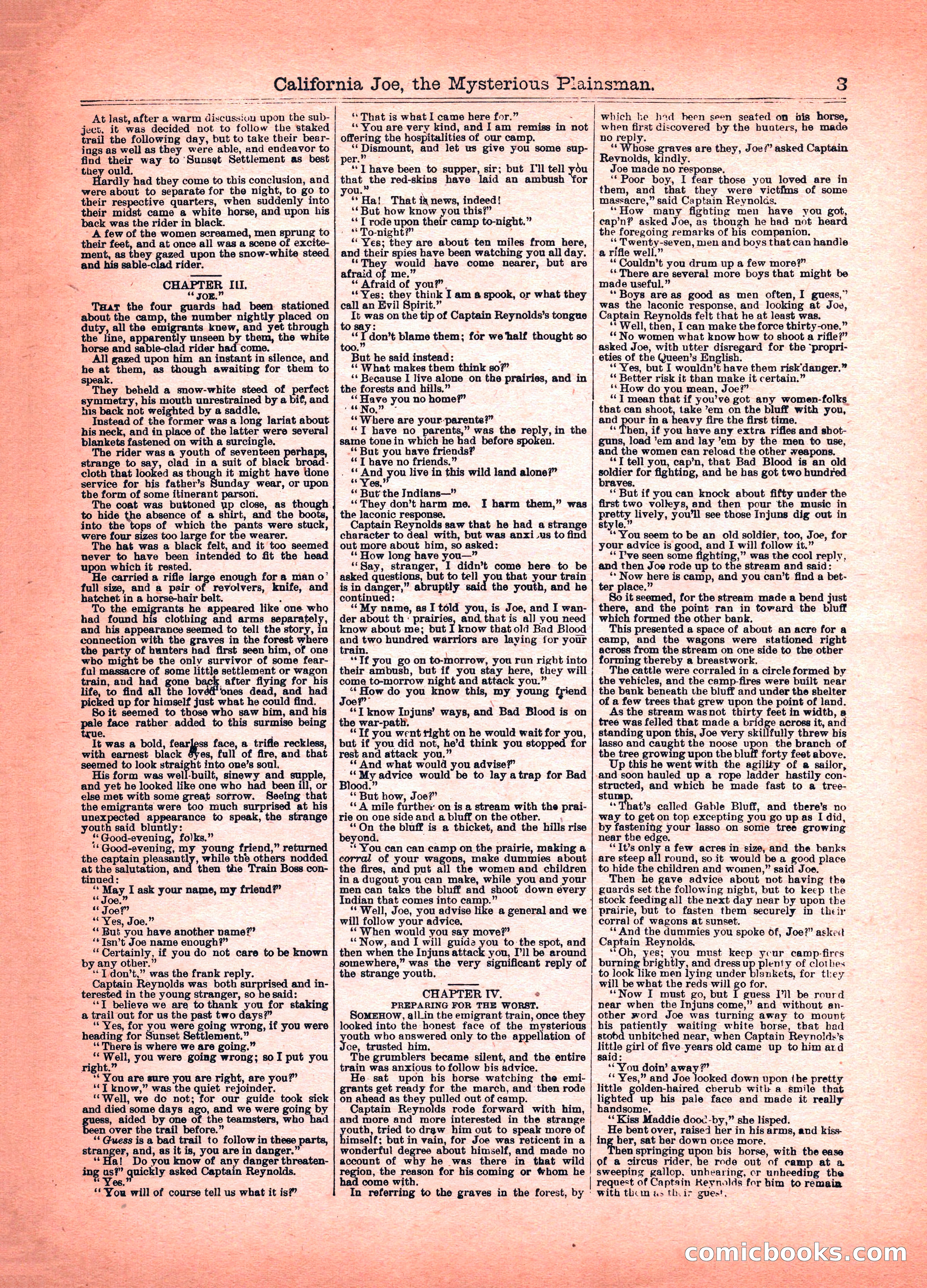
A restored page from Pulp Fiction, 1882. Page through the whole issue in the reader above.
📄 Transcribed text from this page (OCR, searchable)
Machine-transcribed from the original scan — historical spelling and the odd misread are preserved.
q with earnest black At last, after a warm discussion upon the sub- ject, it was decided not to follow the staked trail the following day, but to take their bear- ings as well as they were able, and endeavor to find their way to Sunset Settlement as best ‘they ould. Hardly had they come to this conclusion, and were about to separate for the night, to go to their respective quarters, when suddenly into their midst came a white horse, and upon his back was the rider in black. - A few of the women screamed, men sprung to their feet, and at once all was a scene of excite- ment, as they gazed upon the snow-white steed and his sable-clad rider. : CHAPTER III. “* JOE.” Taat the four guards had been stationed about the camp, the number nightly placed on duty, all the emigrants knew, and yet through the line, apparently unseen by them, the white horse and sabie-clad rider had come. All gazed upon him an instant in silence, and he at them, as though awaiting for them to speak. They beheld a snow-white steed of perfect symmetry, his mouth unrestrained by a bit, and his back not weighted by a saddle, : Instead of the former was a long lariat about. his neck, and in place of the latter were several blankets fastened on with a surcingle. The rider was a youth of seventeen pechnre, strange to say, clad in a suit of black broad- cloth that looked as ayenen it might have done service for his father’s Sunday wear, or upon the form of some itinerant parson. The coat was buttoned yp close, as though to hide the absence of a shirt, and the boots, into the tops of which the pants were stuck, were four sizes too large for the wearer. The hat was a black felt, and it too seemed never to have been intended to fit the head upon which it rested. : He carried a rifle large enough for a mano’ full size, and a pair of revolvers, knife, and hatchet in a horse-hair belt. - To the emigrants he appeared like one who had found clothing and arms separately, and his appearance seemed to tell the story, in connection with the graves in the forest where the y of hunters had first seen him, of one who might be the only survivor of some fear- ful massacre of some little settlement or wagon train, aud had gone back after flying for his life, to find all the lovééf'‘ones dead, and had picked up for himself just what he could find. | So it seemed to those who saw him, and his le face rather added to this surmise being e. It was a bold, fearless face, a trifle reckless, es, full of fire, and that seemed to look straight into one’s soul. His form was well-built, sinewy and supple, and yet he looked like one who had been ill, or else met with some great sorrow. Seeing that the emigrants were too much surprised at his unexpected appearance to speak, the strange youth said bluntly: “ Good-evening, folks,” ‘“Good-evening, my young friend,” returned the captain pleasantly, while the others nodded at the salutation, and then the Train Boss con- tinued: ‘* May I ask your name, my friend?” 4c Joe ”n ‘* Joe?” “Yes, Joe.” “‘ But you have another name?” ‘‘Isn’t Joe name enough?” “Certainly, if you do not care to be known by any other.” ‘‘T don’t,” was the frank reply. Captain Reynolds was both surprised and in- terested in the young stranger, so he said: ‘‘T believe we are to thank you for staking a trail out for us the past two days?” ‘Yes, for you were going wrong, if you were heading for Sunset Settlement.” ‘There is where we are going.” . Well, you were going wrong; sol put you right.’ ‘You are sure you are right, are you?’ ‘T know,” was the quiet rejoinder. “Well, we do not; for our guide took sick and died some days ago, and we were going by goes, aided by one of the teamsters, who had n over the trail before.” “* Guess is a bad trail to followin these parts, stranger, and, as it is, you are in danger.” ‘Ha! Do you know of any danger threaten- ing us?” quickly asked Captain Reynolds. © Yes, ‘You will of course tell us what it is?” California Joe, the Mysterious Plainsman. 3 ‘That is what I came here for.” ‘* You are very kind, and I am remiss in not offering the hospitalities of our camp. os Dismount, and let ws give you some sup- er.” pe I have been to supper, sir; but I'll tell you that whe red-skins have laid an ambush for ou. : ‘*Ha!l That ix news, indeed! ‘* But how know you this?” ‘*T rode upon their camp to-night.” ' “Tonight?” ‘* Yes; they are about ten miles from here, and their spies have been watching you all day. ‘‘They would have come nearer, but are afraid of me.” * Afraid of you?” , ‘“Yes: they think I am a spook, or what they call an Evil Spirit.” It was on the tip of Captain Reynolds’s tongue to say: she id don’t blame them; for we half thought so too. But he said instead: . ‘¢ What makes them think so?” ‘* Because I live alone on the prairies, and in the forests and hills,” ‘Have you no home?” » 66 No.” id ‘‘Where are your-parente?” ‘‘T have no parents,” was the reply, in the same tone in which he had before spoken. ‘“‘But you have friends? ‘“‘T have no friends.” . © And you live in this wild land alone?” 66 Yes 3 “ But the Jndians—” “They don’t harm me. I harm them,” was the laconic response. Captain Reynolds saw that he had a strange character to deal with, but was anxi.us to find out more about him, so asked: ‘‘ How long have you—” ‘‘Say, stranger, I didn’t come here to be asked questions, but to tell yes that your train is in danger,” abruptly said the youth, and he continued: es ‘‘My name, asI todld you, is Joe, and I wan- der about th: prairies, and that is all you need know about me; but I know that old Bad Blood and two hundred warriors are laying for your train. “Tf you goon to-morrow, you run right into their ambush, but if you stay here, they will come to-morrow night and attack you.” 5 sow do you know this, my young friend 0e , ‘¢‘T know Injuns’ ways, and Bad Blood is on the war-path. “Tf you went right on he would wait for you, but if you did not, he’d think you stopped for rest and attack you.” ‘‘ And what would you advise?” ‘‘My advice would be to lay atrap for Bad Blood.” “But how, Joe?” . ‘* A mile further on is a stream with the prai- rie on one side and a bluff on the other. __, ‘‘On the bluff is a thicket, and the hills rise beyond. oe ‘** You can can camp on the prairie, making a corral of your wagons, make dummies about the fires, and put all the women and children in a dugout you can make, while you and your men can take the bluff and shoot down every Indian that comes into eotee: 2 ‘* Well, Joe, you advise like a general and we will follow your advice, ‘“ When would you say move?” ‘Now, and I will guida you to the spot, and then when the Injuns attack you, Ill be around somewhere,” was the very significant reply of the strange youth. CHAPTER IV. . PREPARING FOR THE WORST. SOMEHOW, alLin the emigrant train, once they looked into the honest face of the mysterious outh who answered only to the appellation of ce, trusted him. : The grumblers became silent, and the entire train was anxious to follow bis advice. He. sat upon his horse watching the emi- grants get ready for the march, and then rode on ahead as they pulled out of =o Captain Reynolds rode forward with him, and more and more interested in the strange "Fe tried to draw him out to speak more of imself ; but in vain, for Joe was reticent in a wonderful degree about himself, and made no account of why he was there in that wild region, the reason for his coming or #hom he had come with. In referring to the graves in the forest, by | which ke hod heen seen seated on nis horse, when first discovered by the buaters, he made no tis “‘ Whose graves are they, Joe!” asked Captain Reynolds, kindly. Joe made no response. ‘‘ Poor boy, I fear those you loved are in them, and that they were victims of some massacre,” said Captain Reynolas, “How many fighting men have you got, cap’n? asked Joe, as though he had not heard the foregoing remarks of his companion. ‘Twenty-seven, men and boys that can handle a@ rifle well.” “‘Couldn’t you drum up a few more?” ‘“There are several more boys that might be made useful.” ‘* Boys are as good as men often, I guess,” was the laconic response, and looking at Jove, Captain Reynolds felt that he at least was. ‘* Well, then, I can make the force thirty-one.” ‘*No women what know how to shoot a rifle?” asked Joe, with utter disregard for the ‘propri- eties of the Queen’s English. ** Yes, but I wouldn’t have them risk’danger.” “‘ Better risk it than make it certain.” ‘* How do you mean, Joe?” ‘‘T mean th that can shoot, take ’em on the bluff with you, and pour ina heavy fire the first time. | guns, load ’em and lay ’em by the men to use, and the women can reload the other weapons. **T tell you, cap’n, that Bad Blood is an old soldier for fighting, and he has got two hundred braves. ‘* But if you can knock about fifty under the first two volleys, and then pour the music in pretty, lively, you'll see those Injuns dig out in style. ‘*’'You seem to be an old soldier, too, Joe, for your advice is good, and I will follow it.” ‘‘T’ve seen some fighting,” was the cool reply, and then Joe rode up to the stream and said: ‘* Now here is camp, and you can’t find a bet- ter place,” So it seemed, for the stream made a bend just there, and the point ran in toward the bluff which formed the other bank. This presented a space of about an acre for a camp, and the wagons were stationed right across from the stream on one side to the other forming thereby a breastwork. The cattle were corraled in a circle formed by the vehicles, and the camp-fires were built near the bank beneath the bluff and under the shelter of a few trees that grew upon the point of land. As the stream wasnot thirty feet in width, a tree was felled that made a bridge across it, and standing upon this, Joe very skillfully threw his lasso and caught the noose upon the branch of the tree growing upon the bluff forty feet above. Up this he went with the agility of a sailor, and soon hauled up a rope ladder hastily con- structed, and which he made fast to a tree- stunap. ‘““That’s called Gable Bluff, and there’s no way to get on top excepting you go up as I did, by fastening your lasso on some tree growing near the edge. “It’s one a few acres in size, and the banks are steep all round, soit would be a good place to hide the children and women,” said Joe. Then he gave advice about not having the guards set the following night, but to keep the stock feeding all the next day near by upon the prairie, but to fasten them securely in their corral of wagons at sunset. ‘‘ And the dummies you spoke of, Joe?” askect Captain Reynolds. ‘**Oh, yes; you must keep yeur camp-fires burning brightly, and dress up plenty of clothes to look like men lying under blankets, for they will be what the reds will go for. ‘*Now I must go, but I guess Ill be rourd near when the Injuns come,” and without an- other word Joe was turning away to mount his patiently waiting white borse, that had stood unhitched near, when Captain Reynolds's little said: ‘You doin’ away?’ ‘* Yes,” and Joe Jooked down upon the pretty little golden-haired cberub witb a smile that lighted up his pale face and made it really handsome, ‘* Kiss Maddie dooc-by,” she lisped. He bent over, raisei her in his arms, and kiss- ane her, sat her down once more. hen springing upon bis horse, with the ease of a circus rider, be rede out of camp at a sweeping gallop, unhearing, or unheeding the request of Captain Reynolds for him to remain ‘ with thcm us th.ir guest, girl of five years old came up to him ard at if you’vée got any women-folks ‘Then, if you have any extra rifles and shot- Cc m S ‘Comicboo oO