
A complete issue · 36 pages · 1929
Judge — June 8, 1929
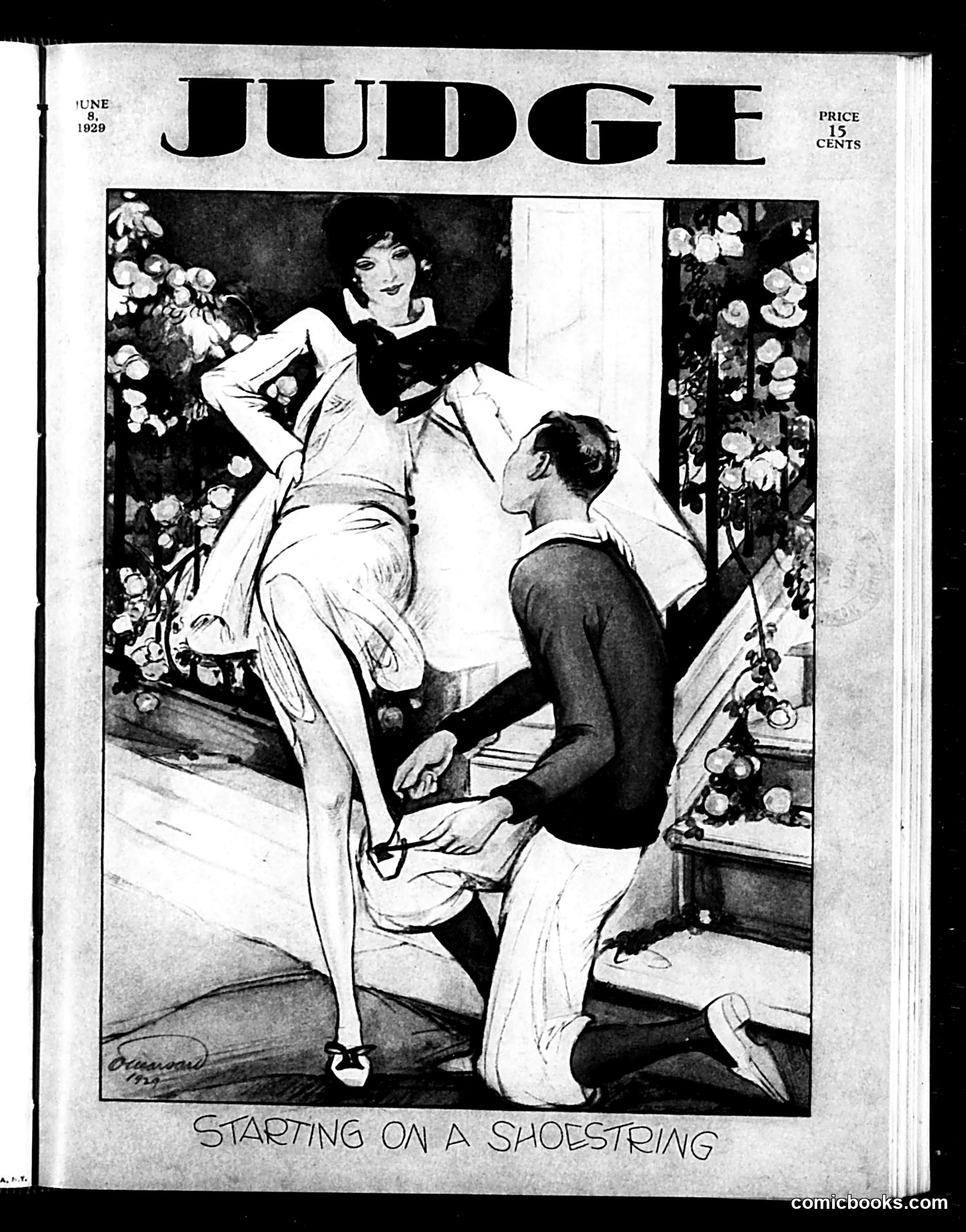
This is a risqué illustration titled "Starting on a Shoestring," depicting a man kneeling before a woman in an intimate pose. The "shoestring" reference appears to be a double entendre—the man is literally adjusting her shoe while the composition suggests flirtation or seduction. The cartoon reflects 1920s attitudes toward courtship and gender dynamics during the Jazz Age. The woman's confident, reclined posture and the man's deferential position suggest role-playing or playful romantic pursuit. The decorative floral background adds to the romantic staging. Published shortly before the 1929 stock market crash, this humor reflects the era's relative prosperity and permissive social attitudes toward romantic/sexual content in mainstream magazines—material that would have been considered scandalous in earlier decades.
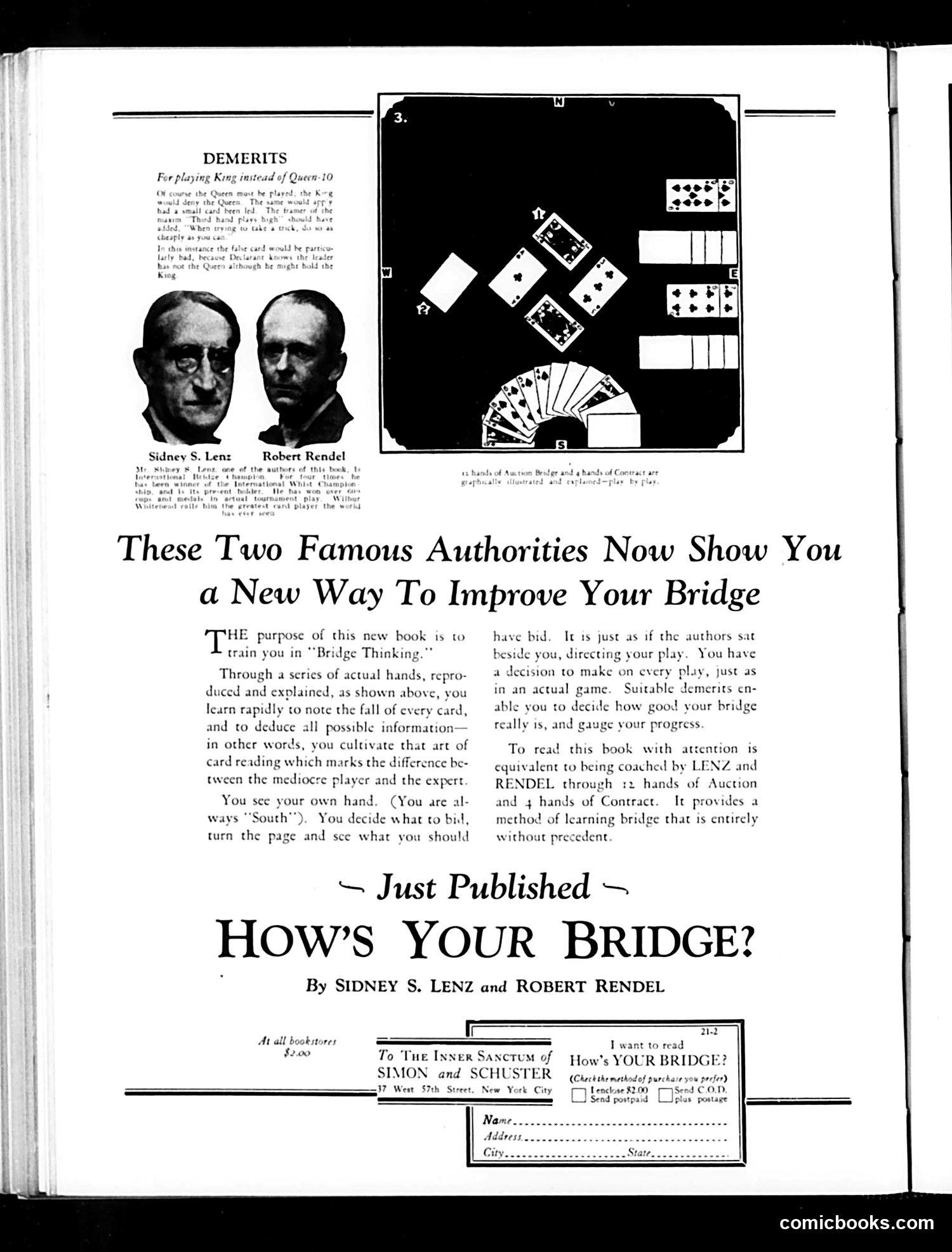
This page is **primarily advertising**, not political satire. It promotes a bridge instruction book titled "How's Your Bridge?" by Sidney S. Lenz and Robert Rendel, two famous bridge players of the era. The content positions these authorities as expert coaches who will teach "Bridge Thinking" through analyzed hands. The advertisement emphasizes that reading their book is equivalent to personal coaching from these champions. The only potentially satirical element is the heading "Demerits" at top left, which appears to critique common bridge errors—suggesting the book will help readers avoid such mistakes. The cartoon diagram shows an actual bridge hand layout with cards and scoring boxes, illustrating the instructional method. This is fundamentally a how-to guide marketed through Judge's pages.
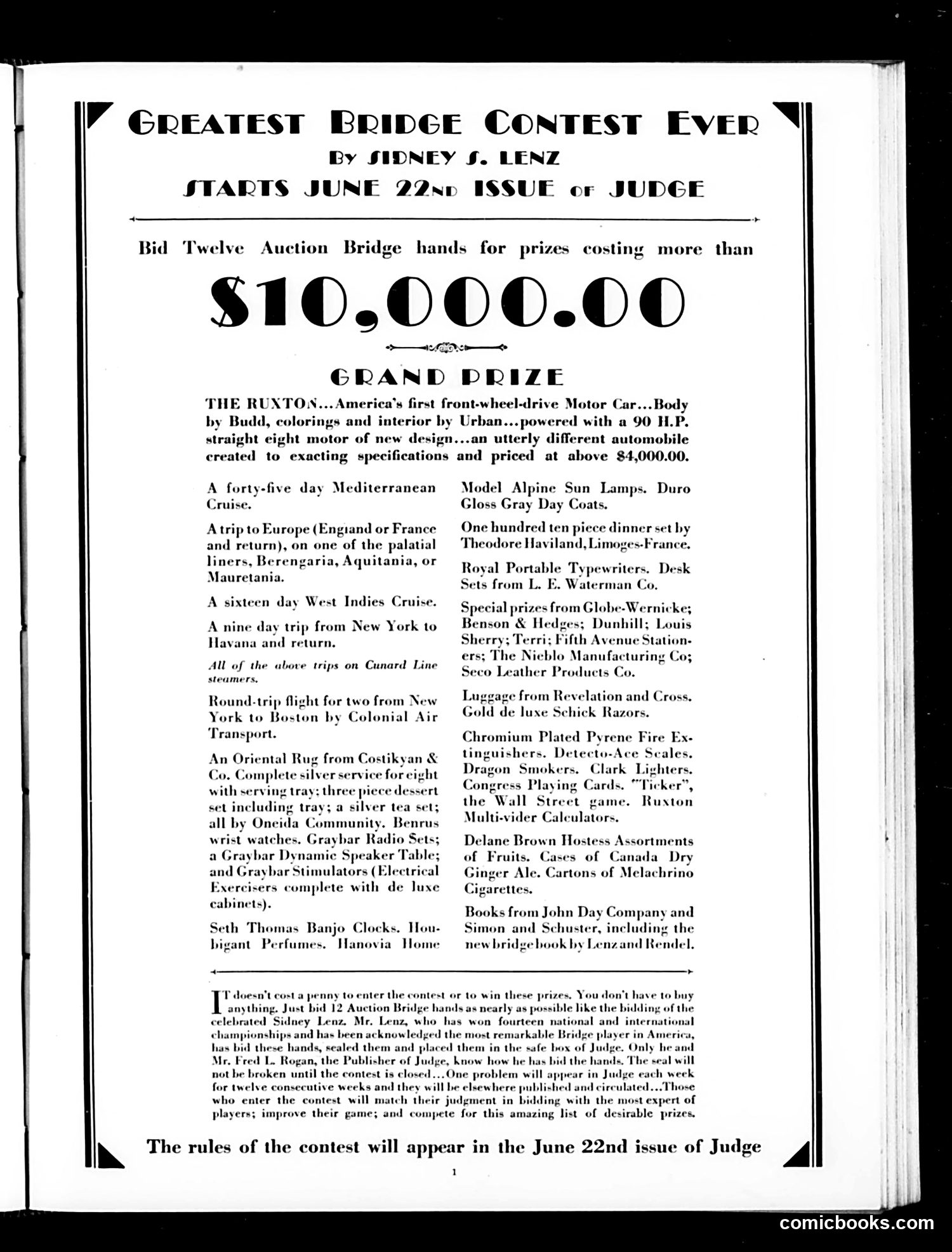
This page is primarily **advertising content**, not political satire or editorial cartoon. It announces "The Greatest Bridge Contest Ever" by Sidney S. Lenz, a renowned bridge player, running in Judge magazine starting June 22nd. The contest invites readers to bid twelve auction bridge hands for prizes exceeding $10,000, with the grand prize being a Ruxton automobile (valued at $4,000) plus numerous luxury items: Mediterranean cruises, European trips, oriental rugs, typewriters, and other consumer goods. The appeal targets Judge's educated, affluent readership who would recognize bridge as a sophisticated card game and appreciate such prizes. This represents early 20th-century magazine monetization through reader contests—blending entertainment with commerce.
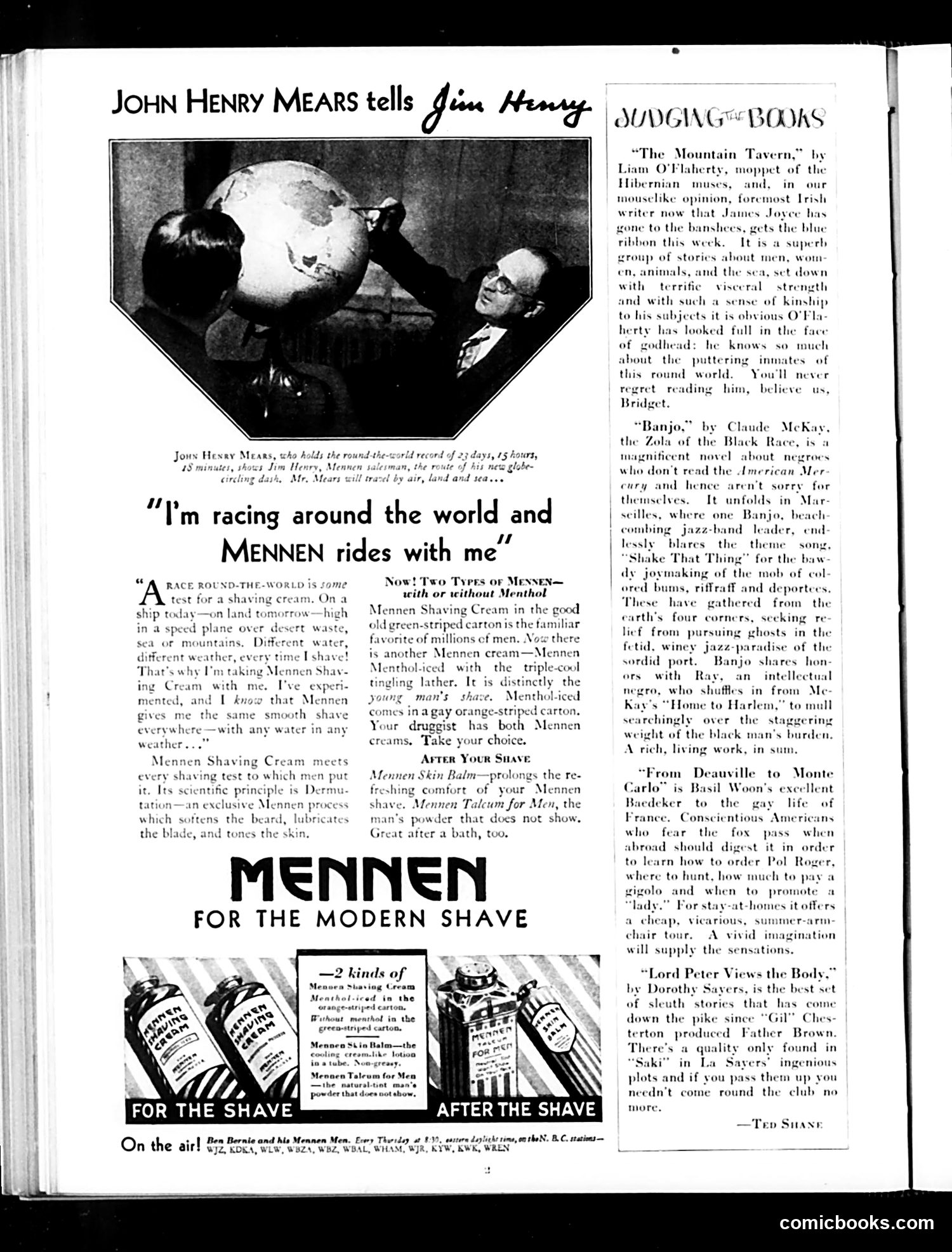
This page is primarily **advertising content**, not political satire. The main feature is a Mennen shaving cream advertisement starring John Henry Mears, an actual adventurer who held the world record for fastest around-the-world travel (23 days, 15 hours, 48 minutes, as stated in the caption). The "joke" is a play on his achievement: "I'm racing around the world and Mennen rides with me." The ad promotes two Mennen products—shaving cream (with/without menthol) and talcum powder—positioning them as essential travel companions. The right column contains book reviews unrelated to the advertisement. This represents Judge magazine functioning as a commercial vehicle, blending celebrity endorsement with travel-adventure appeal rather than political commentary.
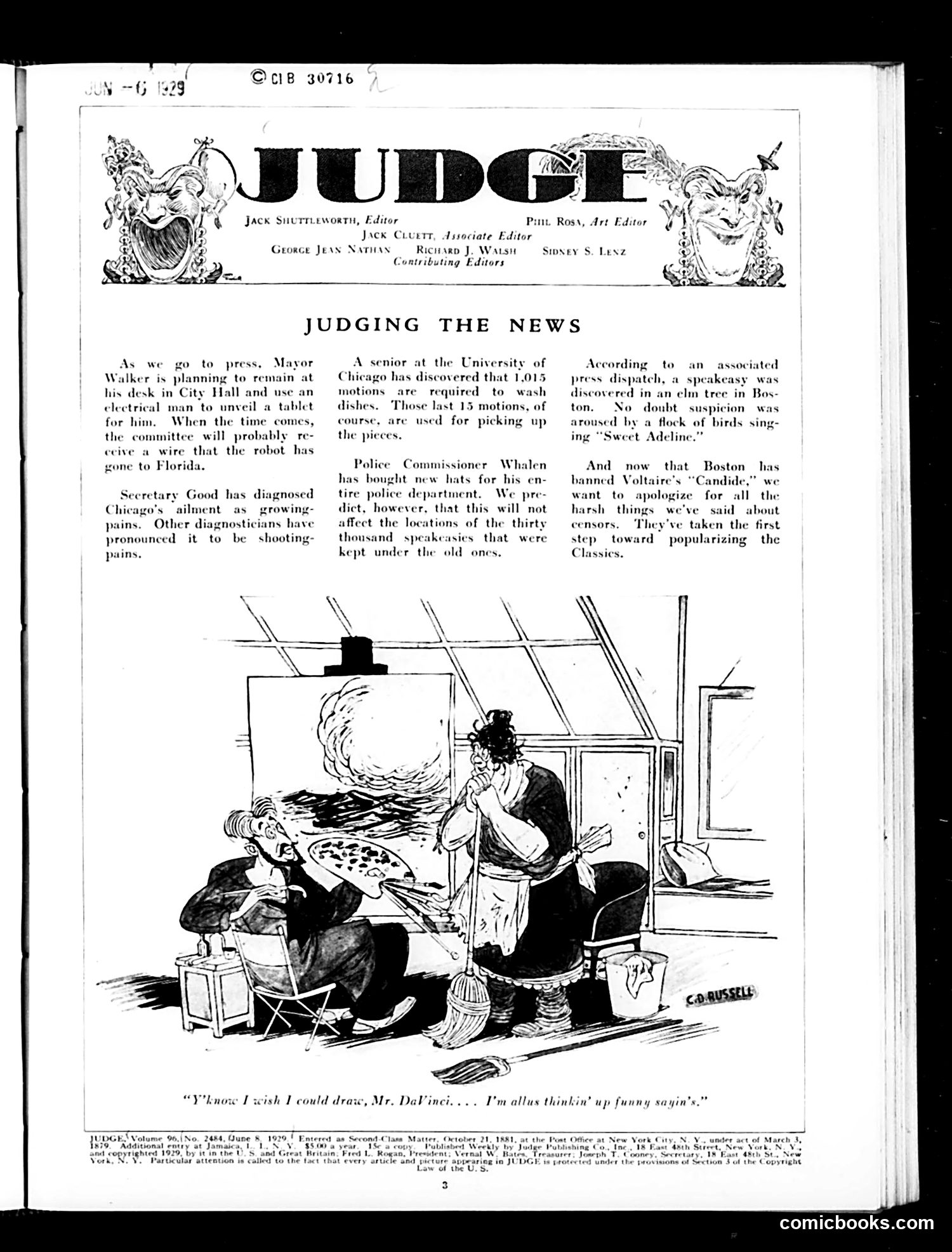
This 1929 cartoon satirizes artistic pretension. Two figures in what appears to be an artist's studio—one sketching, one posing as a model—depict the cliché of struggling artists. The caption reads: "Y'know, I wish I could draw, Mr. DaVinci.... I'm alias thinkin' up funny sayin's." The joke mocks the inverse relationship between artistic skill and comedic writing ability. One character invokes Leonardo da Vinci (history's supreme artist) while admitting inability to draw, then claims talent only for witty remarks. It's satirizing the common expectation that creative people should excel across multiple disciplines—and the reality that specialized talent is just that: specialized. The cartoon targets the pretensions of both failed artists and comedy writers.
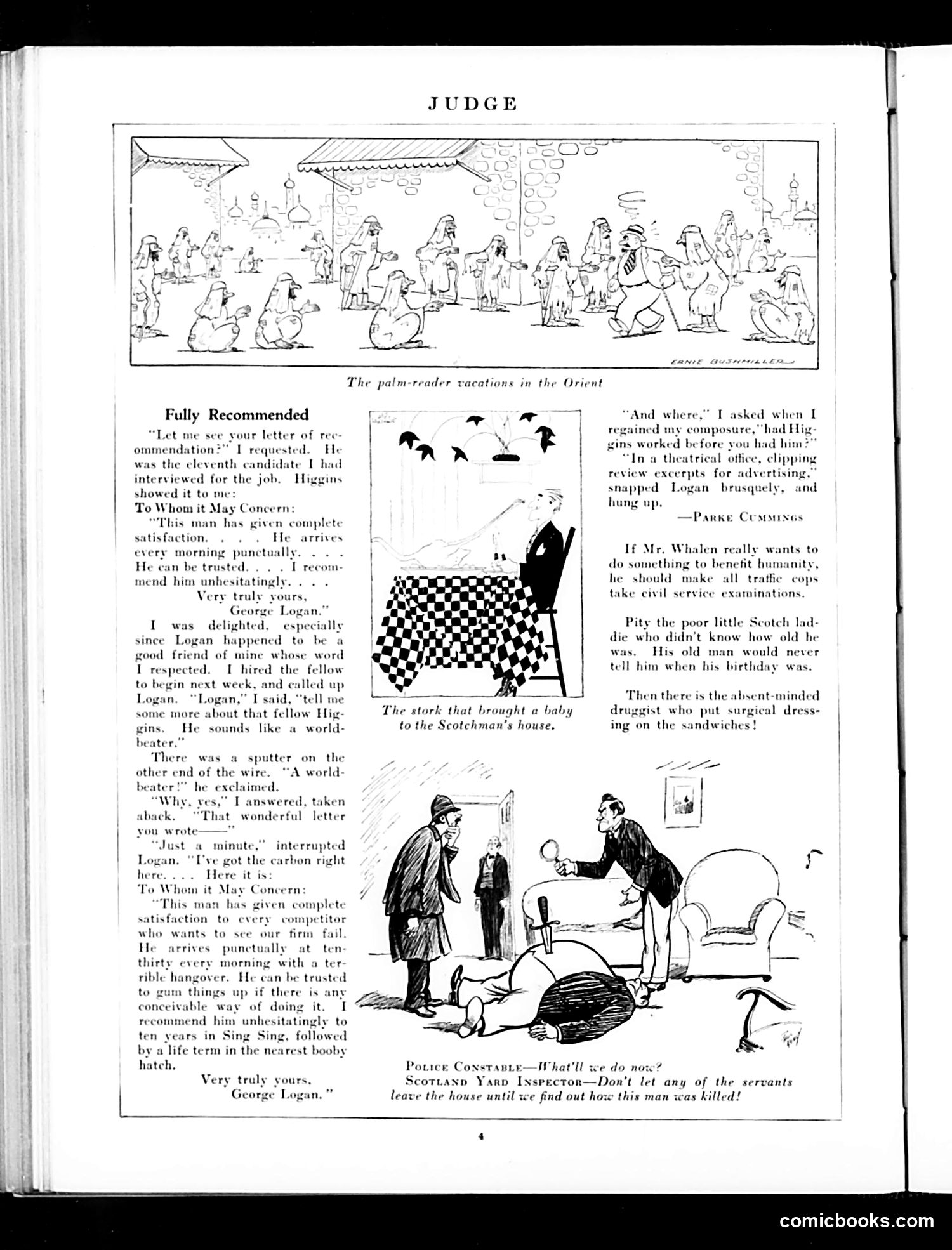
This page contains humorous anecdotes and illustrations rather than political cartoons. The top illustration shows "palm-reader vacations in the Orient"—a visual gag about fortune tellers. The main content consists of reader letters and satirical commentary. One section titled "Fully Recommended" presents a mock letter of recommendation for an employee named Logan, humorously praising his dubious qualities (he's a "world-beater" but unreliable). The two illustrated jokes below mock specific occupations: one shows a stork delivering a baby to a Scotsman's house, and another depicts a crime scene where a Police Constable and Scotland Yard Inspector discuss a body. Overall, this represents Judge's typical format of social satire through anecdotes and workplace humor, targeting working-class characters and occupational stereotypes rather than specific political figures.
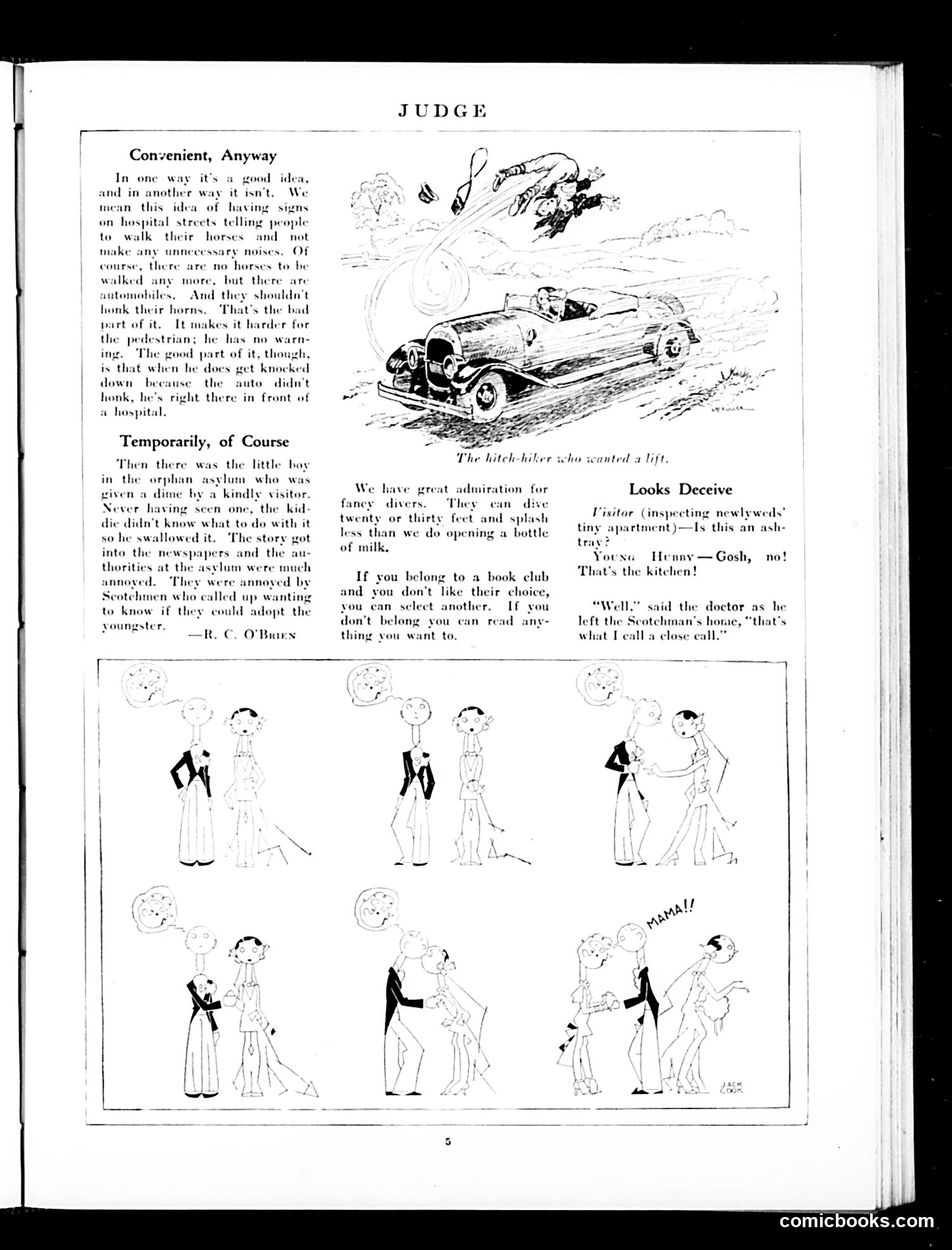
This page contains three unrelated humor pieces: 1. **"Convenient, Anyway"**: Satirizes hospital street signs telling pedestrians not to honk horns. The joke: while such signs reduce noise pollution, they're useless because drivers ignore them anyway—they honk regardless and end up in front of the hospital. 2. **"The hitch-hiker who wanted a lift"**: An illustration showing a convertible with occupants appearing to eject upward, suggesting reckless driving. 3. **"Looks Deceive"**: A brief comic exchange where a visitor mistakes an ashcan for a kitchen, and a doctor jokes it's "what I call a close call"—implying the apartment/kitchen is dangerously filthy or inadequate. The bottom panel shows a sequential comic depicting romantic/physical comedy between two figures, with escalating physical interaction.
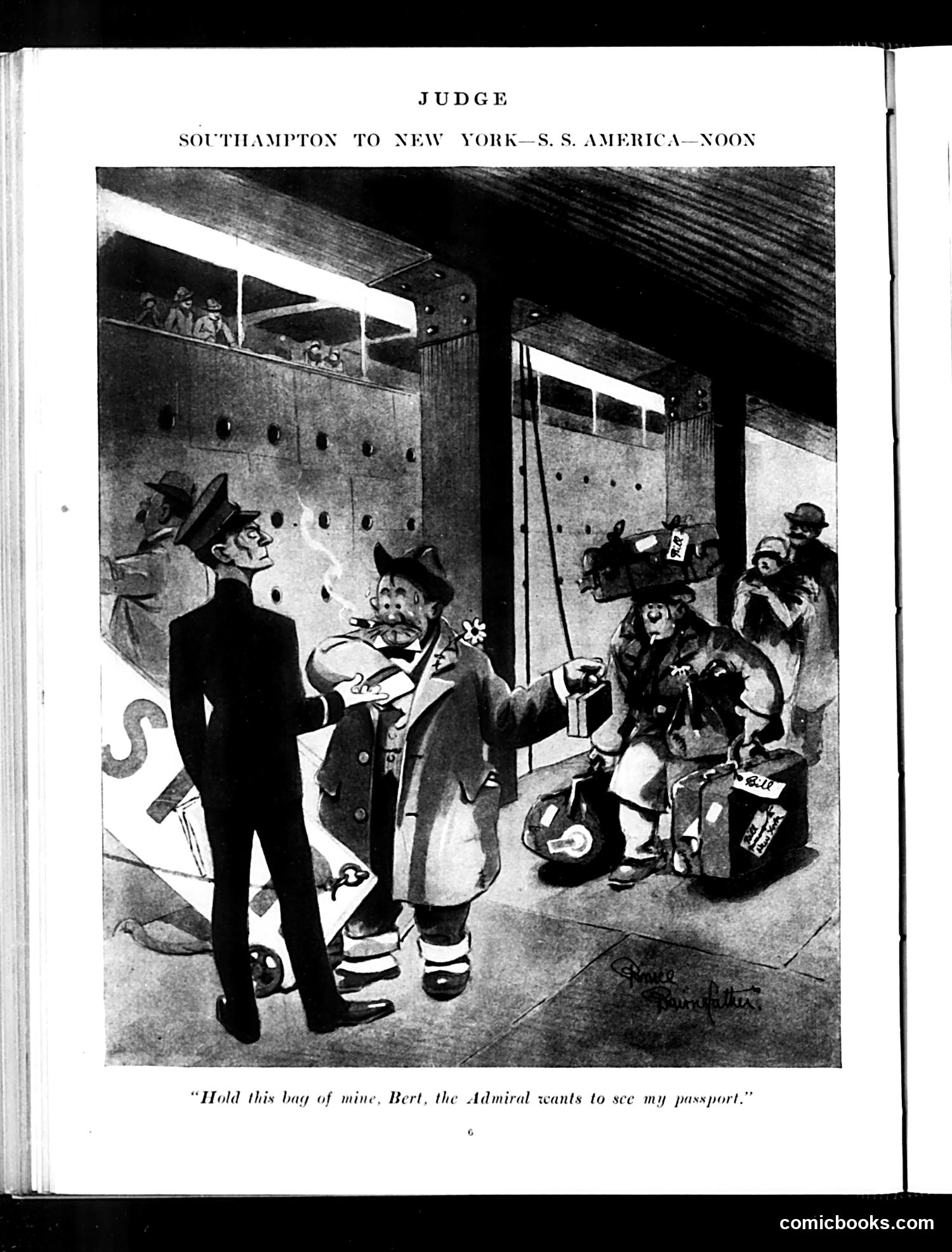
This is a satirical cartoon from *Judge* magazine about transatlantic travel. The heading indicates it concerns the S.S. America, a ship running the Southampton-to-New York route. The cartoon depicts a ship's deck scene where a well-dressed man (appearing to be a ship's official or "Admiral") is inspecting passengers' documents. The caption reads: "Hold this bag of mine, Bert, the Admiral wants to see my passport." The satire appears to target bureaucratic inconvenience and the formalities of international travel—specifically, the absurdity of having to surrender one's belongings to officials while producing documentation. The caricatured anthropomorphic figures (appearing as animals or exaggerated types) suggest the cartoon mocks both passengers' compliance and officials' officious behavior during the immigration inspection process.
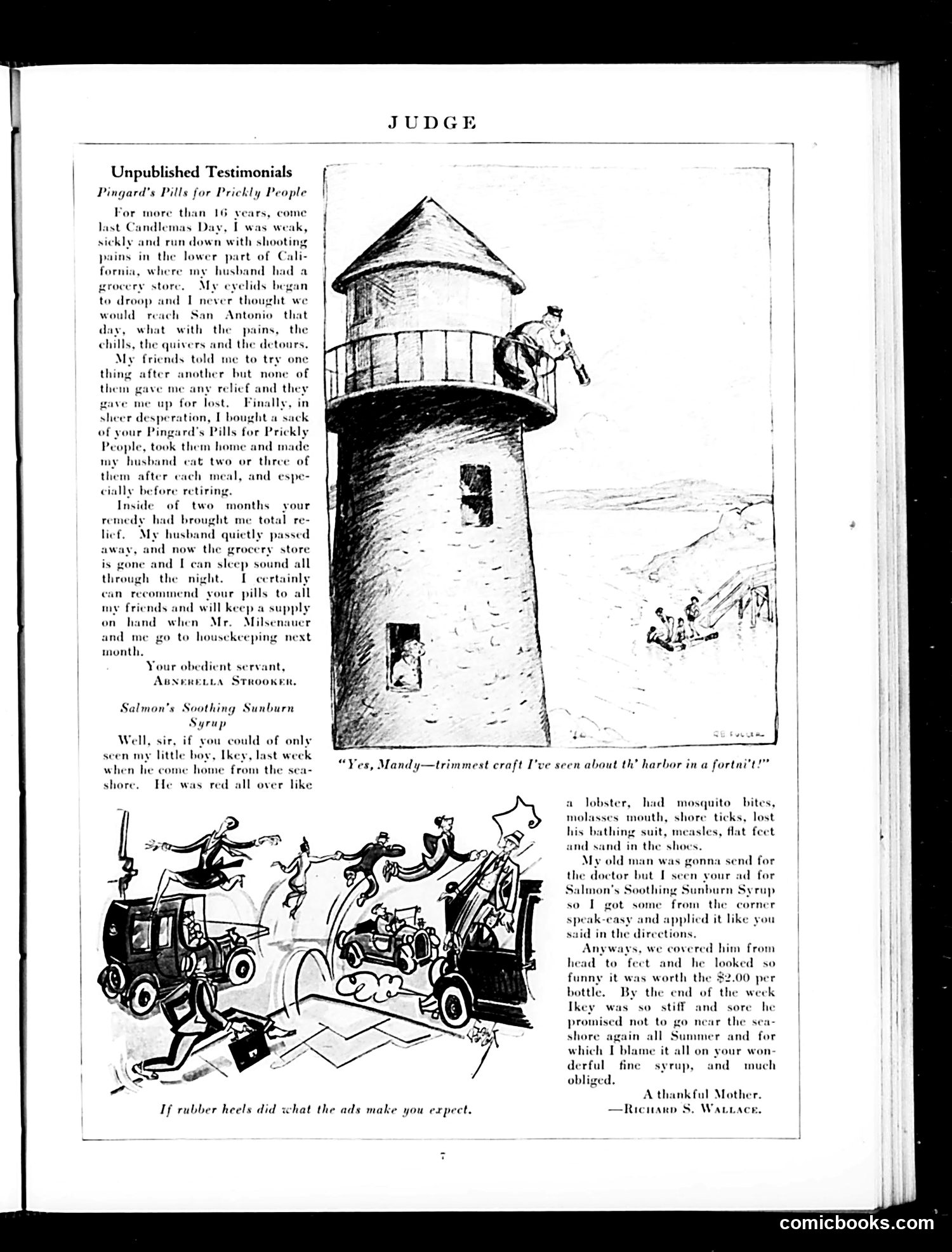
This page parodies patent medicine testimonials—a common advertising format of the early 20th century. The fake "unpublished testimonials" mock the absurd cure-all claims these products made. **The satire:** - "Pingard's Pills for Prickly People" supposedly cure vague ailments (shooting pains, weakness) in California, yet the testimonial hilariously admits the husband "quietly passed away"—the pills killed him—yet the writer recommends them anyway. - "Salmon's Soothing Sunburn Syrup" allegedly treats a child's serious conditions (lobster-red skin, measles, lost bathing suit) so effectively he becomes immobilized ("stiff and sore"), which is presented as a success. The bottom cartoon shows people in vehicles crashing chaotically, captioned "If rubber heels did what the ads make you expect"—further mocking false advertising claims. **The point:** Judge ridicules the patent medicine industry's deceptive marketing and consumers' desperate faith in bogus remedies, despite obvious failures presented as triumphs.
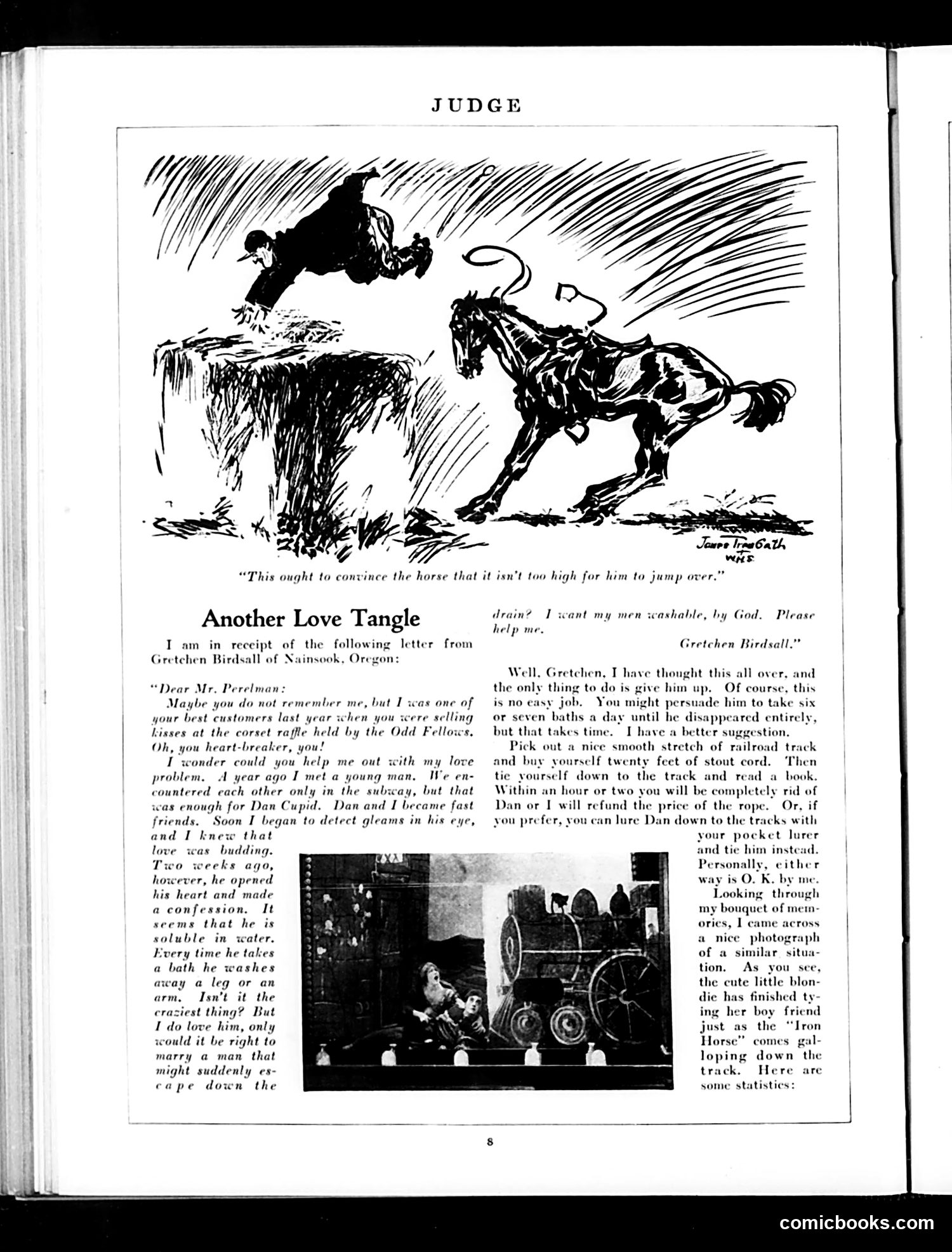
This page contains two distinct pieces: **The Cartoon (top):** A judge on horseback leaps over a high fence/wall while a man watches. The caption suggests using this as proof the horse can clear the jump—a visual joke about using flawed logic or misdirection to convince someone of something false. **"Another Love Tangle" (main content):** A humorous advice column parody. A woman named Gretchen writes asking advice about a boyfriend who literally dissolves in water (he "washes away a leg or an arm" each bath). The male advice columnist responds with deadpan absurdist humor, suggesting she either dump the man or—in a dark joke—lure him to railroad tracks with a lure and tie him there before a train arrives, referencing a photograph of a similar scenario. The humor relies on: - The surreal, impossible premise (a dissolving man) - Mock-serious advice treating fantasy as reality - Dark gallows humor about suicide/death by train (common in era satire) - The juxtaposition of romantic advice columns with grotesque scenarios This is vintage early-20th-century satirical magazine humor, where absurdism and morbid jokes were considered witty.
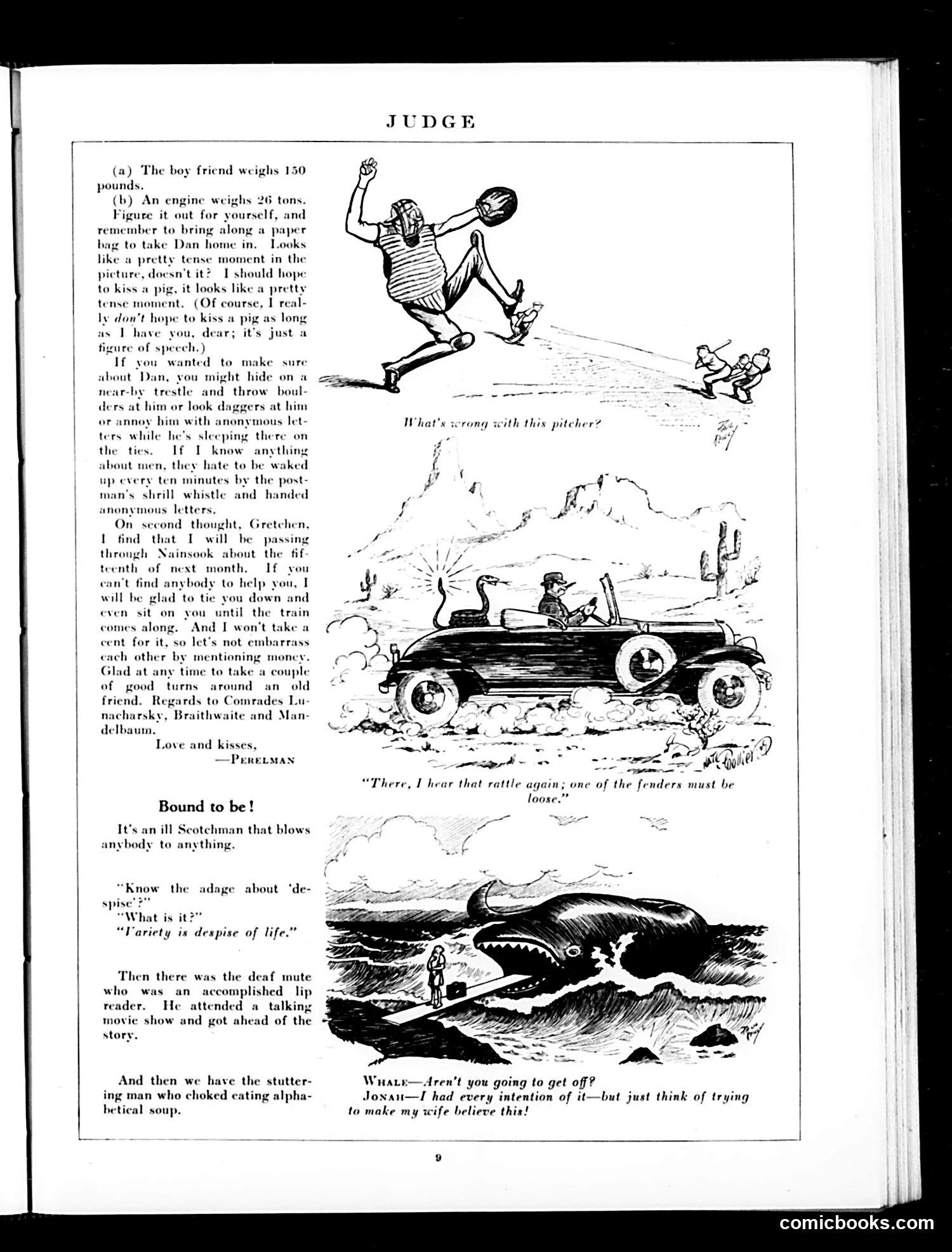
This page from the satirical magazine *Judge* contains several brief humorous pieces typical of early-to-mid 20th century American humor: **Top cartoon**: A slapstick scene where a large baseball pitcher has lost control, with the caption "What's wrong with this pitcher?" The humor plays on the double meaning—a person versus a container. **Middle cartoon**: A desert scene with a broken-down automobile and a whale, illustrating an absurd situation where a man named Jonah claims he can't escape because his wife won't believe the story. This references the Biblical Jonah and the whale, turning it into domestic comedy. **Text jokes**: Brief one-liners about Scottish stinginess ("It's an ill Scotchman that blows anybody to anything"), a deaf lip-reader confused by a talking movie, and a stuttering man choking on alphabetical soup. The page's opening section contains playful romantic banter about a boyfriend's weight relative to an engine's weight—suggesting he's heavy and would need transport home. The overall tone is light, domestic, and pun-based—typical of *Judge's* approach to American humor.
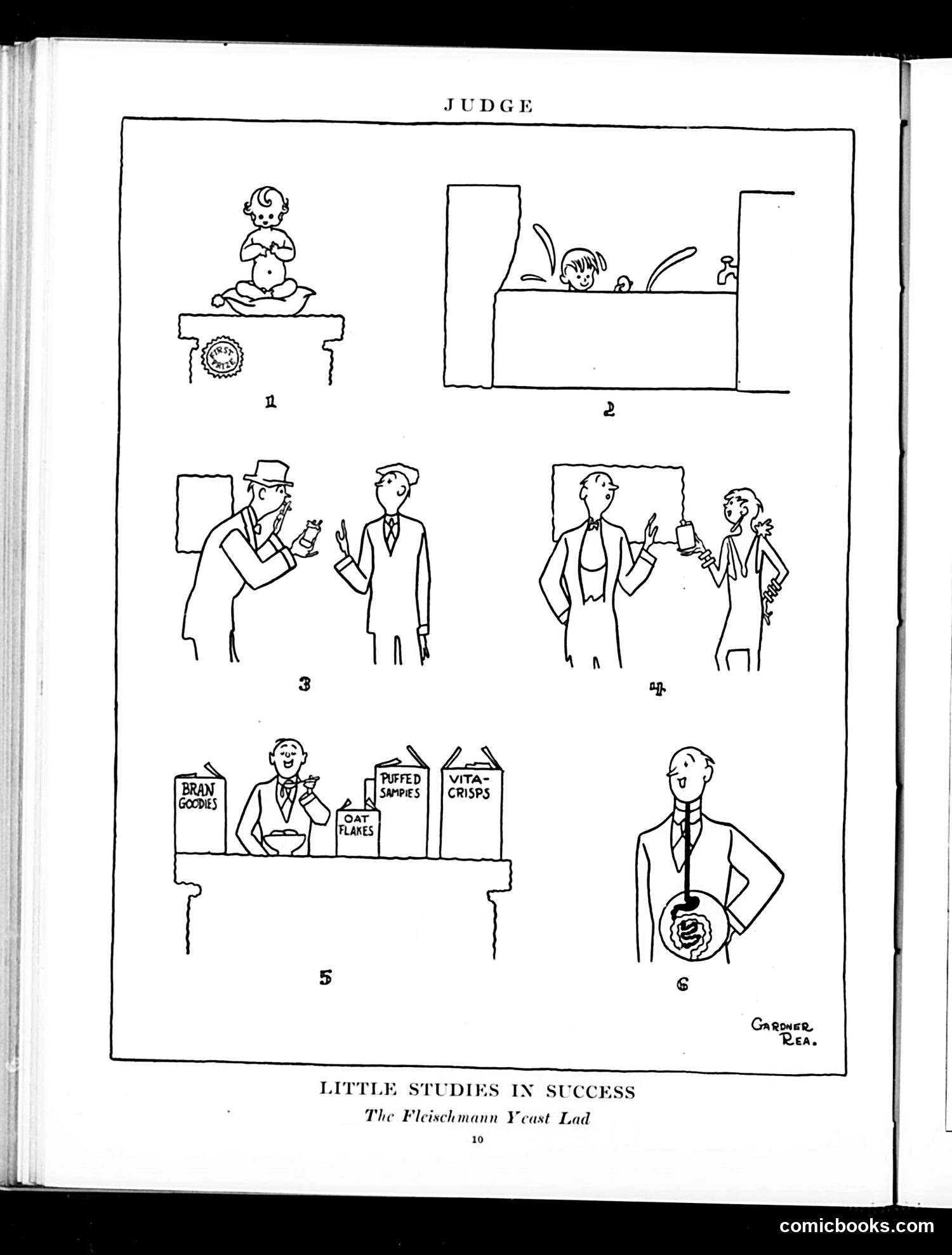
This is an advertisement disguised as satirical cartoon, promoting Fleischmann's Yeast. The six panels depict a young man's rise to success through consuming the product. Panel 1 shows him as an infant on a pedestal; Panel 2 depicts childhood mischief in a bathtub. Panels 3-4 show him as a businessman in various social/professional situations. Panel 5 reveals him as a successful entrepreneur surrounded by breakfast cereals and grain products. Panel 6 shows his ultimate triumph—he's become wealthy enough to literally *wear* money. The satire mocks the era's widespread health claims about yeast products, which were heavily marketed as cure-alls and success-promoters. By tracing absurd causation from infancy to riches, the cartoonist—Gardner Rea—humorously exaggerates Fleischmann's advertising promises that their yeast guaranteed prosperity and health.
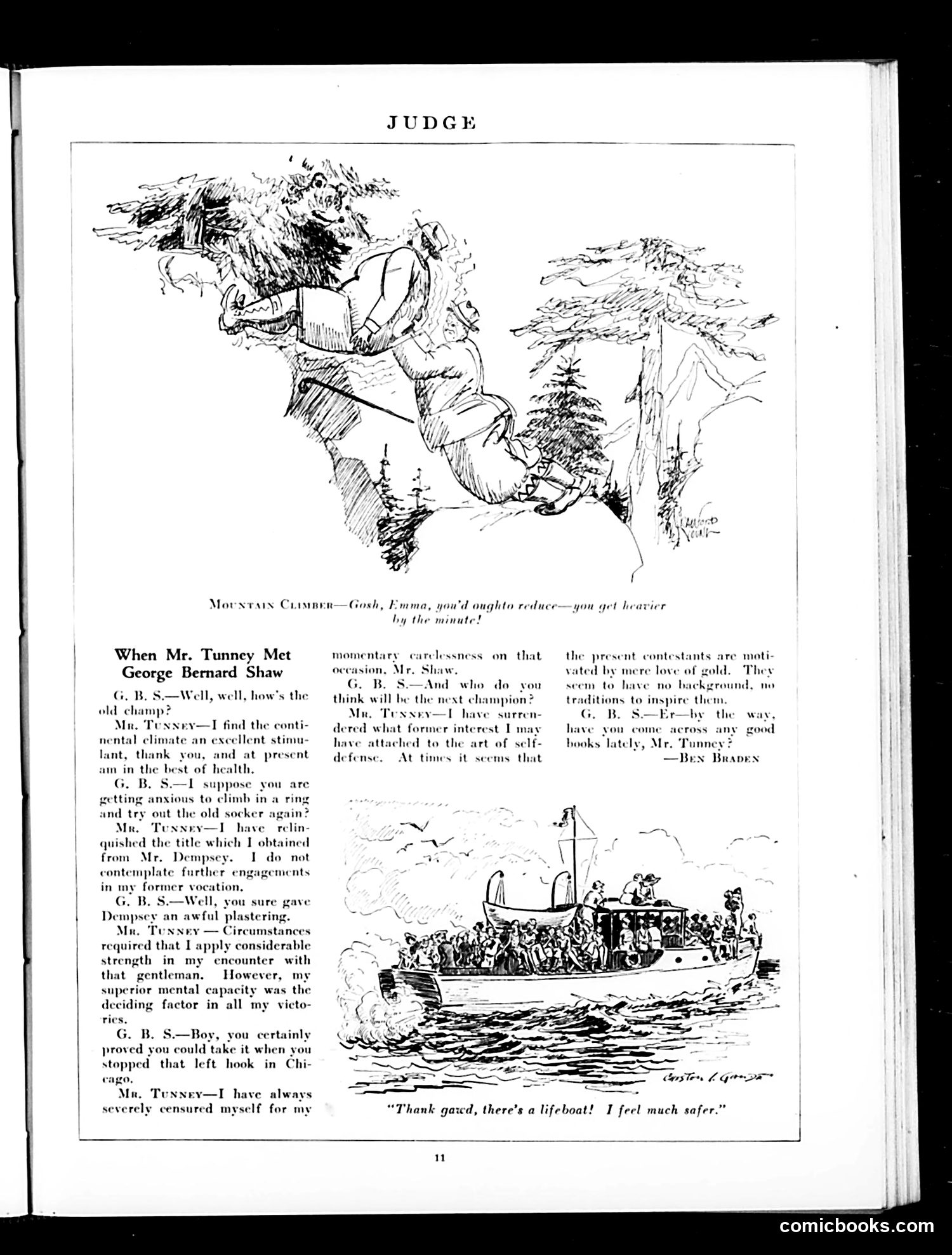
This page satirizes boxer Gene Tunney's encounter with playwright George Bernard Shaw. The dialogue presents Tunney as an unexpectedly eloquent, cultured fighter who has retired from boxing and now speaks in refined language about "mental capacity" and "self-defense as an art." Shaw, represented as intellectual and somewhat condescending, is portrayed as surprised by Tunney's sophistication. The humor lies in the contrast between Tunney's tough boxer persona and his articulate, almost pretentious speech. The top cartoon mocks this incongruity—showing a brutish fighter carrying a woman, captioned about weight reduction—undermining the "refined gentleman" Tunney presents himself as being during his conversation with Shaw. The bottom cartoon, featuring a lifeboat caption, appears unrelated satirical commentary on contemporary events or social conditions.
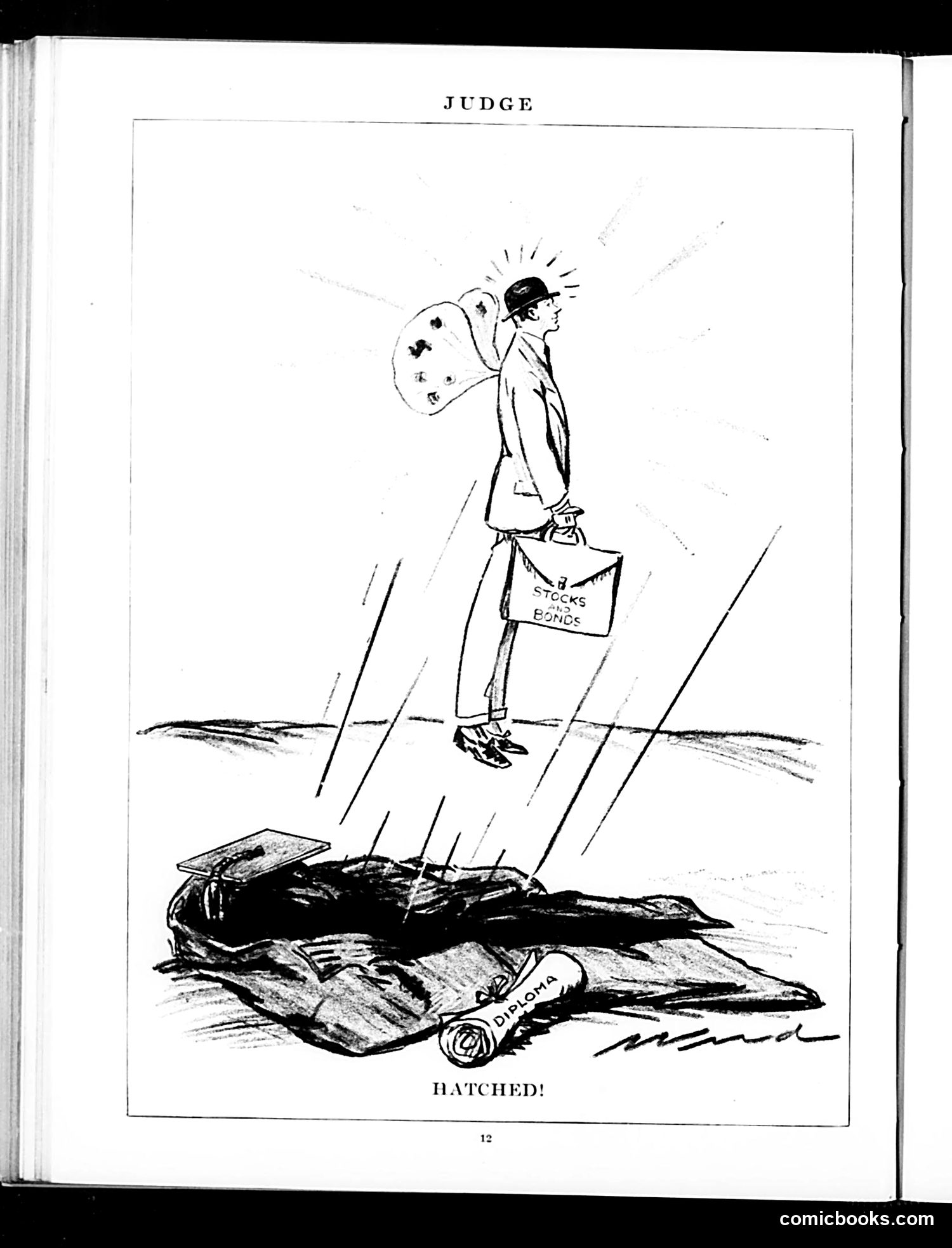
This political cartoon depicts a figure labeled "Judge" (the magazine's personification) standing above a dead bird or creature marked with a "DIPLOMA." The Judge holds a briefcase labeled "STOCKS & BONDS" and carries a palette labeled with suit symbols, suggesting financial interests. Rain or arrows fall around the scene. The satire appears to criticize the judicial system or the Judge magazine itself as prioritizing financial gain ("stocks & bonds") over justice or education (the fallen "diploma"). The dead creature may represent idealism, merit, or rule of law being destroyed by commercial interests. The cartoon's title, "Hatched!" likely puns on both egg-hatching and scheming/plotting, suggesting corrupt machinations have come to fruition. Without clearer historical context, the specific event referenced remains unclear.
This page contains two satirical pieces critiquing American social trends circa the Prohibition era. **"A Languishing Sport"** dismisses concerns about college baseball players turning professional before graduation, arguing college baseball itself is dying anyway because students prefer golf and tennis to "vicarious exercise." **"The New Threat Against Liberty"** is the sharper satire. It mocks Henry Ford's statement that clergy should teach people what to eat, using it to warn against expanding moral prohibition beyond alcohol. The author argues that while overeating does cause harm (unlike moderate drinking), the *temperance movement's logic* is dangerously expansionist—if clergy successfully prohibited alcohol through religious dogma, they'll next target food, then other pleasures. The satire warns that Prohibition set a precedent for government-enforced morality that won't stop with alcohol; it could eventually regulate all personal choices. This reflects early 1920s anxieties that Prohibition represented creeping government control over individual liberty.
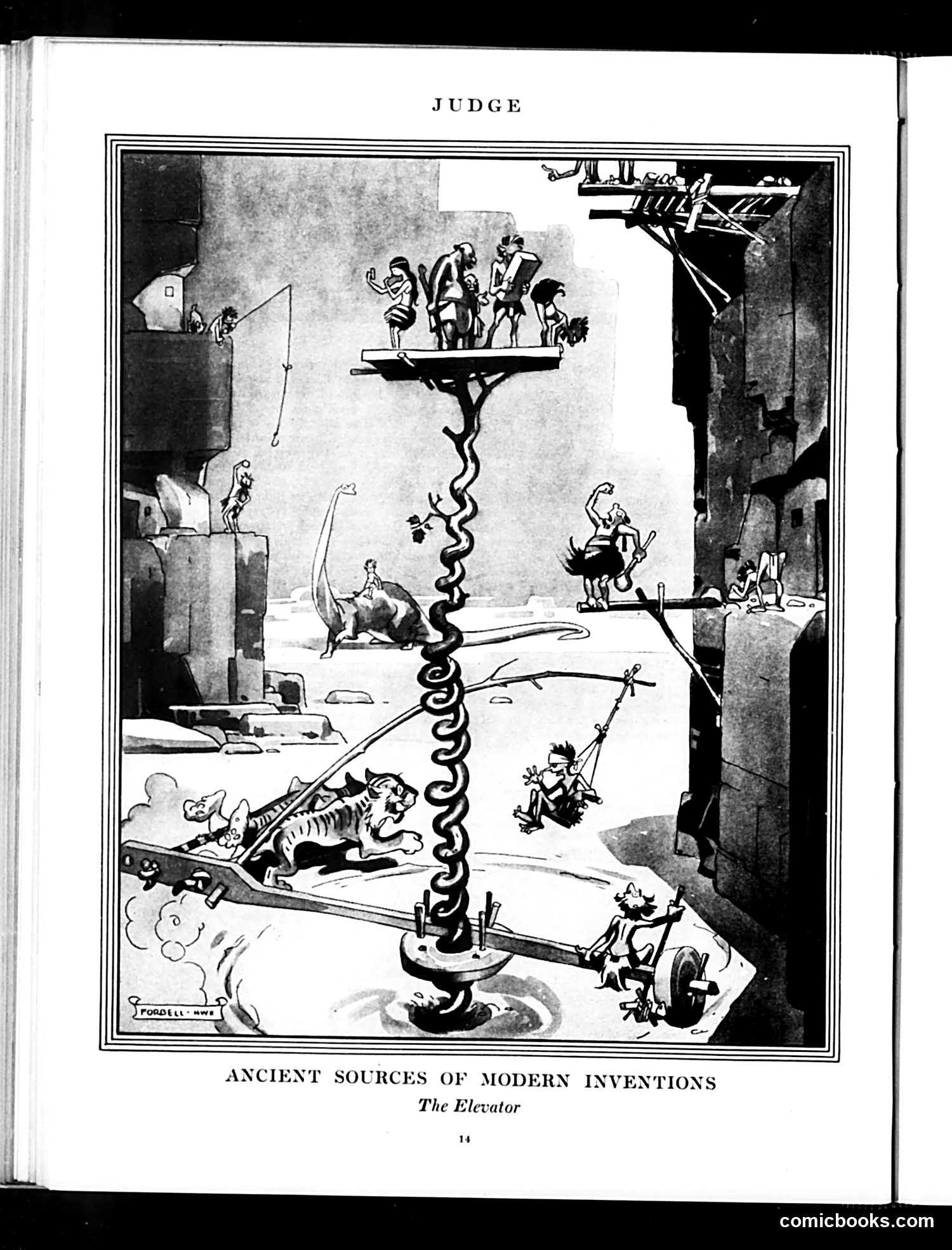
This satirical cartoon humorously traces the elevator's origins to ancient times. The central image shows a massive serpent or rope mechanism stretching vertically through a classical architectural setting, with figures at various levels operating the system. The joke appears to be that what we consider modern technological innovations actually have absurdly primitive ancient precedents. Here, people are manually operating a crude pulley-and-serpent contraption to move others between levels—a comically literal, labor-intensive predecessor to the modern electric elevator. The cartoon satirizes both our tendency to overestimate modern innovation and the absurdity of imagining ancients achieving similar results through simple mechanical means. It's gentle satire on technological progress and human ingenuity across time periods.
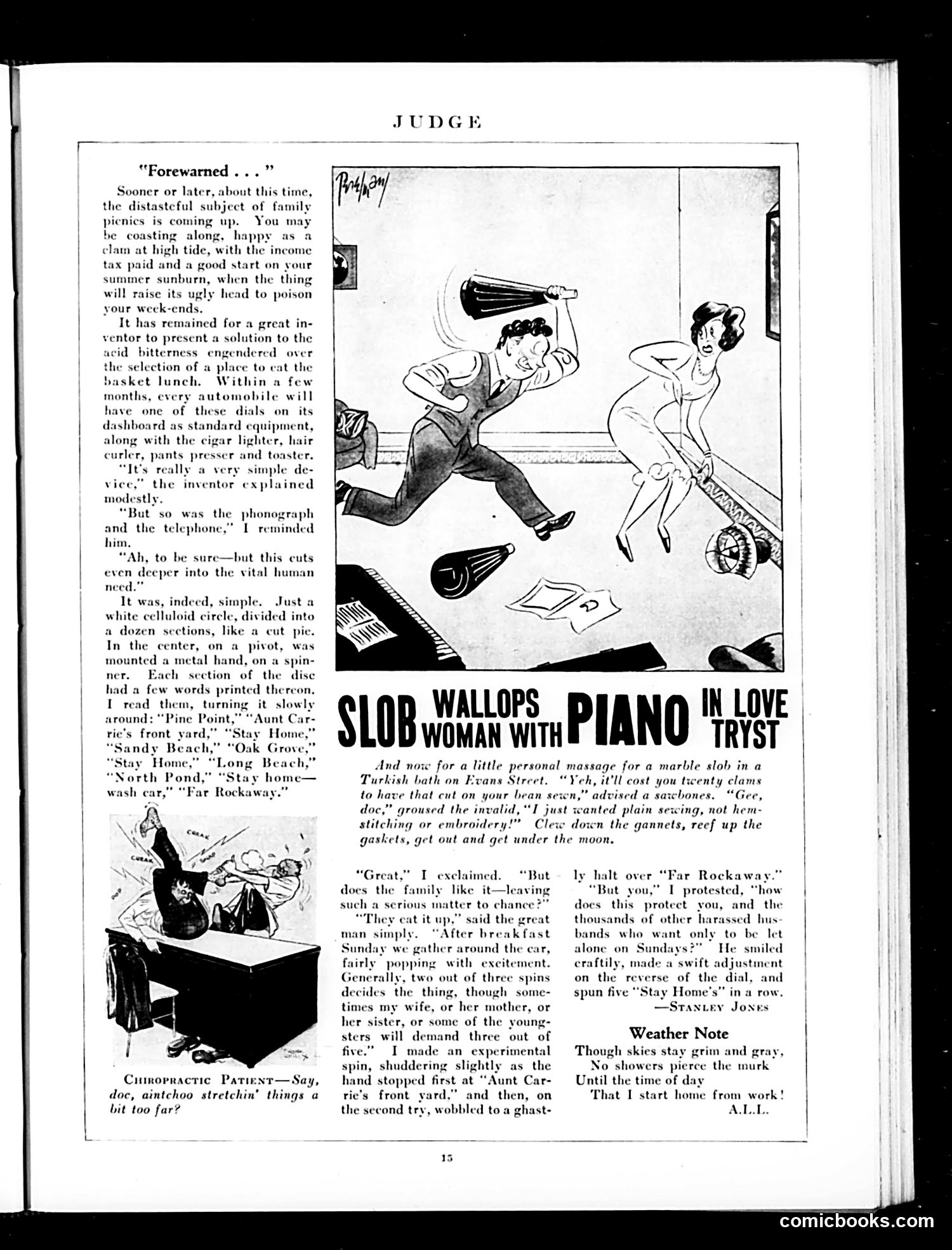
This page satirizes the American family picnic tradition and marital discord over leisure activities. The main cartoon depicts a husband's invented "picnic spinner"—a dashboard dial with destination options like "Pine Point" and "Aunt Carrie's Front Yard"—designed to remove decision-making from family discussion, thereby avoiding arguments. The satire targets: - **1920s suburban culture**: The anxiety around mandatory family outings and their logistical burden - **Male authority**: The husband's attempt to control outcomes through deception (his rigged dial favoring "Stay Home") - **Gender dynamics**: The implicit complaint that wives, mothers, and children demand input on leisure time The device parodies technological "solutions" to social problems. The inventor's claim it addresses "vital human need" mockingly suggests picnic planning generates genuine domestic stress—likely relatable to Judge's affluent, car-owning readership dealing with newly accessible weekend excursions. The "Weather Note" at bottom makes a related joke: only work prevents the speaker from being trapped at home.
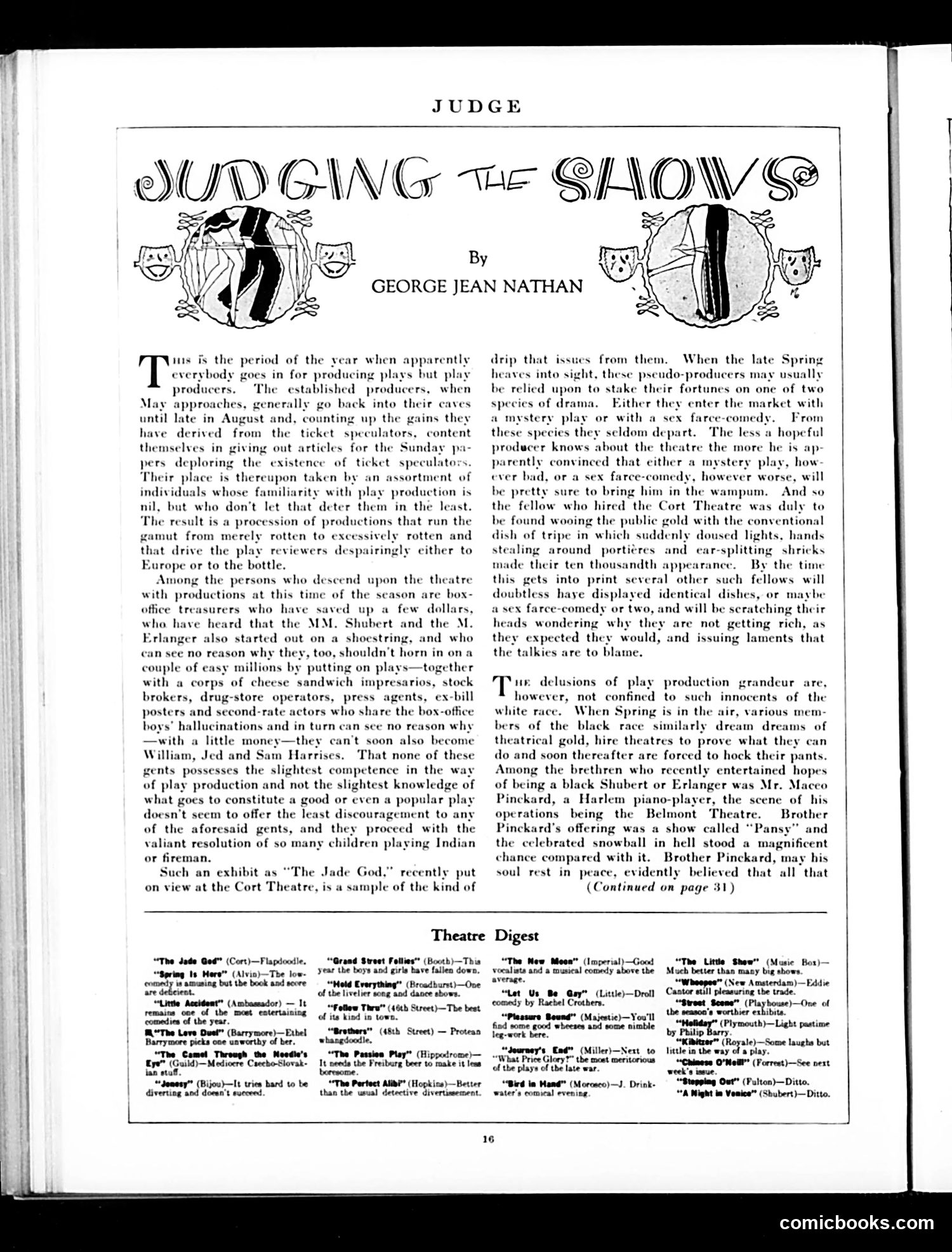
This article satirizes the annual spring flood of amateur theatrical productions in New York. Nathan mocks "pseudo-producers"—box-office treasurers, drug-store operators, and other financial amateurs who, inspired by the Shubert and Erlanger theatrical empires' success, attempt to produce plays with no theatrical knowledge or experience. The satire targets their predictable formulas: either "mystery plays" or "sex farce comedies," staged with cheap tricks (sudden lights, hands stealing around curtains) designed to impress audiences. Nathan specifically mentions Mace Pinckard, a Harlem piano-player who, dreaming of theatrical wealth like successful producers, hired the Cort Theatre and produced "The Jade God"—exemplifying the aspirational incompetence Nathan ridicules. The piece argues these productions drive legitimate theatre reviewers to despair, forcing them toward "Europe or to the bottle."
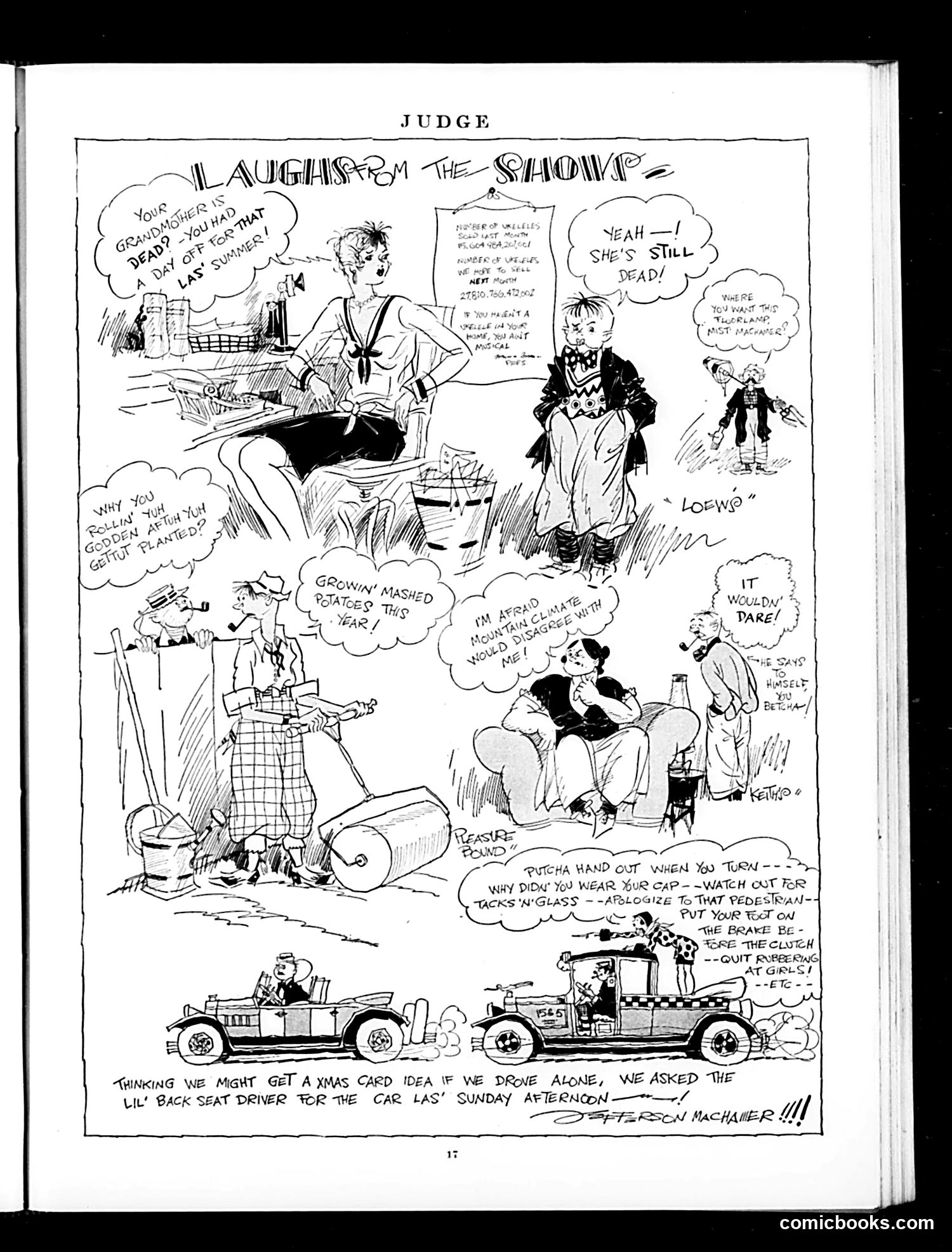
This Judge magazine page satirizes **parenting and automobile safety** through multiple domestic scenes. The central joke involves a woman teaching driving basics to an increasingly exasperated male driver, while various family members offer unsolicited advice from the backseat. The satire targets the "backseat driver" phenomenon—passengers giving constant, annoying instructions ("watch out for tacks 'n' glass," "apologize to that pedestrian," obsessing over brake usage). The cartoonist mocks both nagging instruction and male drivers' irritation at female guidance. The final caption suggests getting a Christmas card photo opportunity by having the "lil' back seat driver" operate the car during Sunday driving—a joke playing on 1920s-era family portrait customs and the absurdity of child drivers. The overall point: humorously dramatizes family vehicle dynamics and the universal annoyance of backseat passenger commentary.
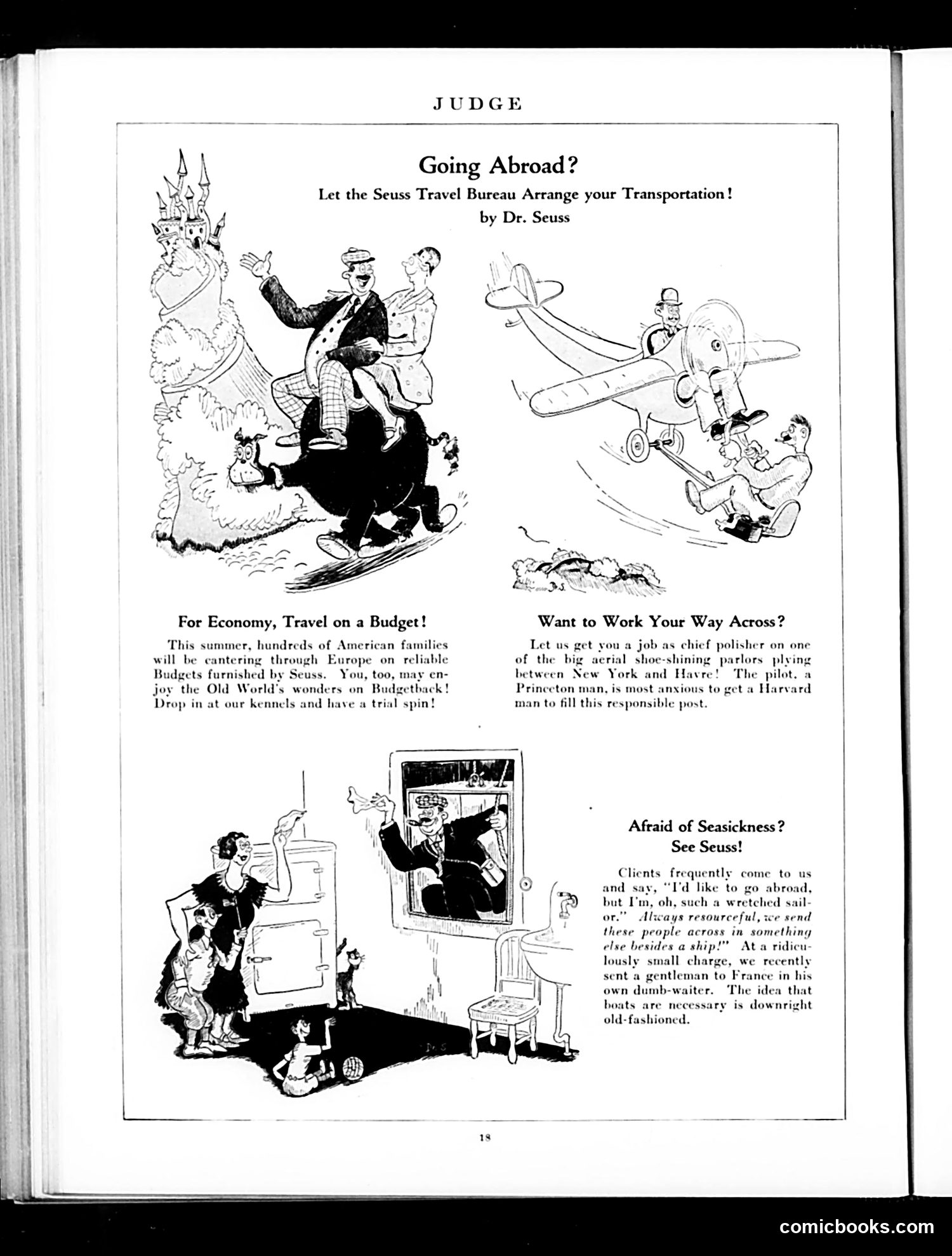
This is a humorous early Dr. Seuss advertisement for a fictional "Seuss Travel Bureau" spoofing 1920s-30s travel services. The satire works on multiple levels: **The jokes:** - "Budgetback" travel uses absurd creatures (a fantastical beast) instead of normal transportation - "Aerial shoe-shining parlors" between New York and France is nonsensical—a ridiculous job for working one's passage - The seasickness solution involves sending travelers in bizarre contraptions (a "dumb-waiter") instead of ships **The context:** This mocks both the growing trend of middle-class European tourism and the pretensions of travel agencies marketing "economy" trips to ordinary Americans. The Ivy League reference (Princeton/Harvard) gently satirizes class distinctions. **The appeal:** For 1920s-30s readers, this playfully captured the excitement and expense of international travel while poking fun at the marketing hype surrounding it. Seuss's characteristic whimsy transforms real travel anxieties (seasickness, cost, finding work) into absurdist solutions.
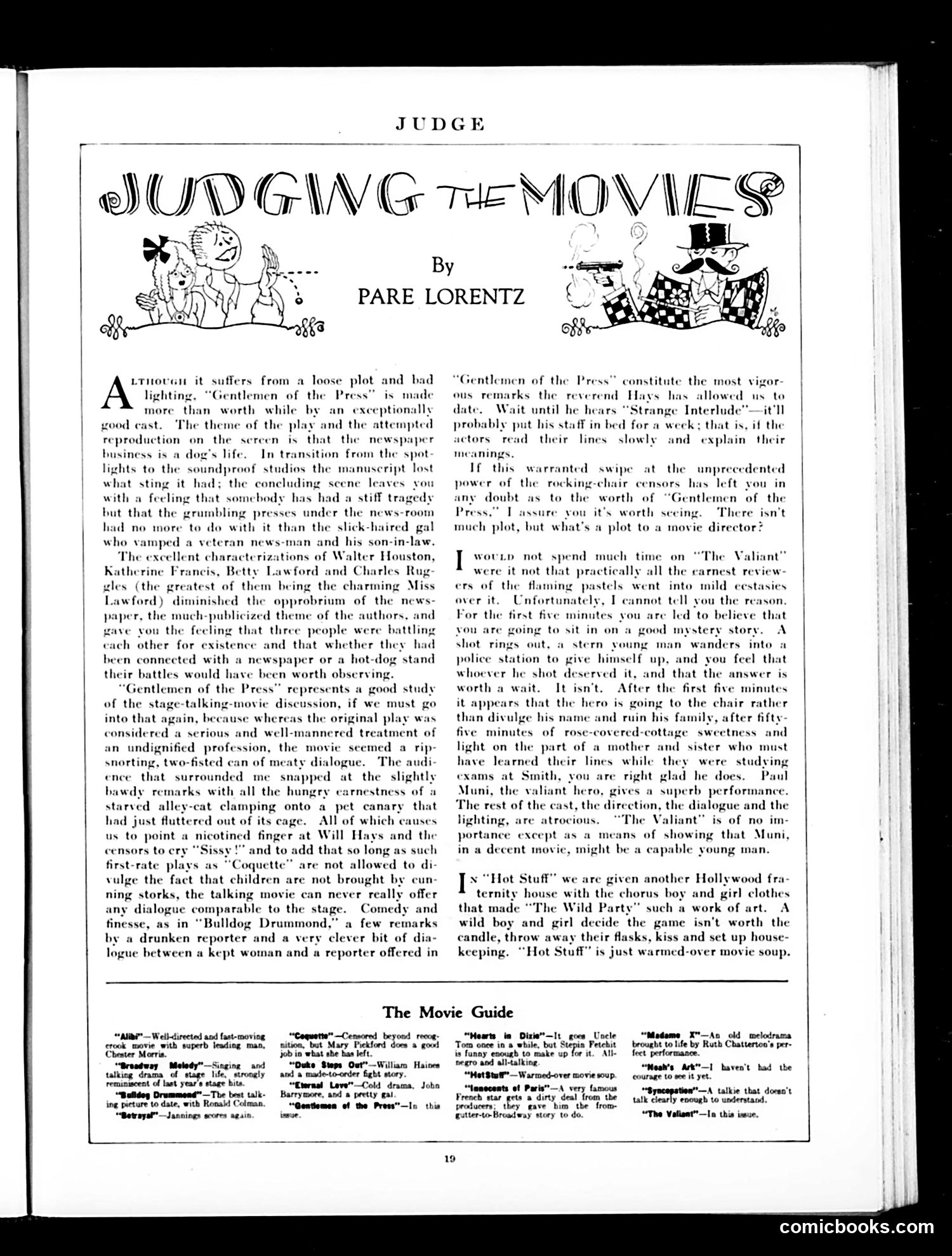
This is a film review column, not a political cartoon. Lorentz critiques contemporary "talking pictures" (early sound films), focusing on three movies: "Gentlemen of the Press," "The Valiant," and "Hot Stuff." The satire targets **Will Hays and the film censorship board**—Lorentz mockingly credits them for allowing the "bawdy remarks" in "Gentlemen of the Press," sarcastically suggesting the censors should brace themselves for Eugene O'Neill's "Strange Interlude." He critiques the censorship system for preventing realistic dialogue about childhood and human relationships while permitting coarser content. The reviews themselves praise strong performances (Walter Huston, Paul Muni) while faulting weak plots and direction. This reflects early sound cinema's growing pains: stage actors struggling with the new medium, and scripts losing dramatic power in transition from theater to film.
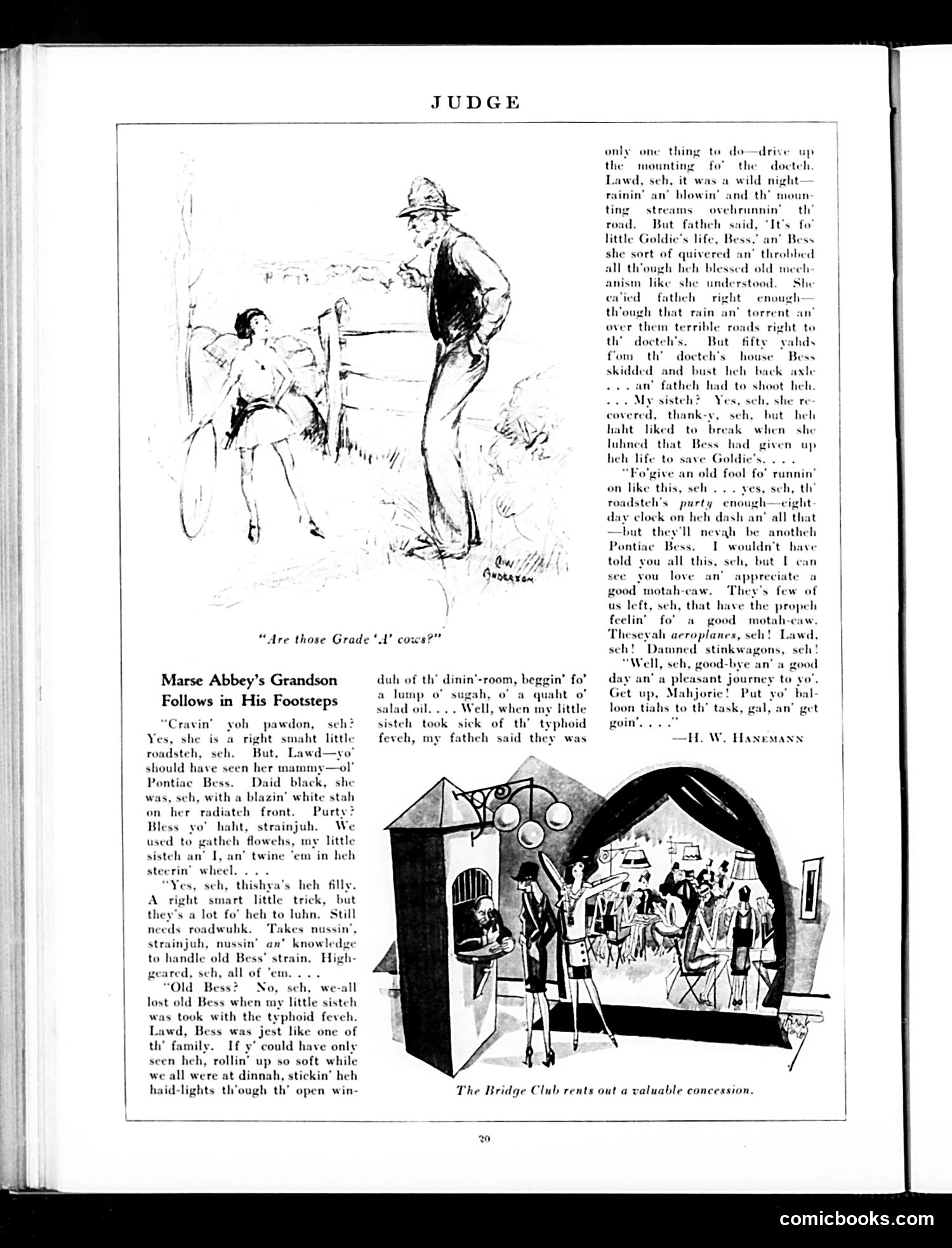
This page presents a sentimental story about an old automobile named Pontiac Bess, told in exaggerated Southern dialect. A nostalgic narrator reminisces about his sister's beloved car—a "Grade 'A'" vehicle that heroically transported their sick sister to a doctor during a storm, then collapsed and had to be shot, sacrificing itself to save the child's life. The satire targets **anthropomorphization of automobiles** and the romantic attachment people develop to cars. By treating a Pontiac with quasi-religious reverence (the car "understood," chose to help), Judge mocks both the automobile industry's marketing and Americans' sentimental over-investment in machines during the early automotive era. The heavy dialect and rural setting likely amplify the humor—contrasting rustic simplicity with modern technology. The closing dismissal of "stinkwagons" (modern cars) suggests nostalgia for older, "better" vehicles, poking fun at how quickly automotive preferences shift.
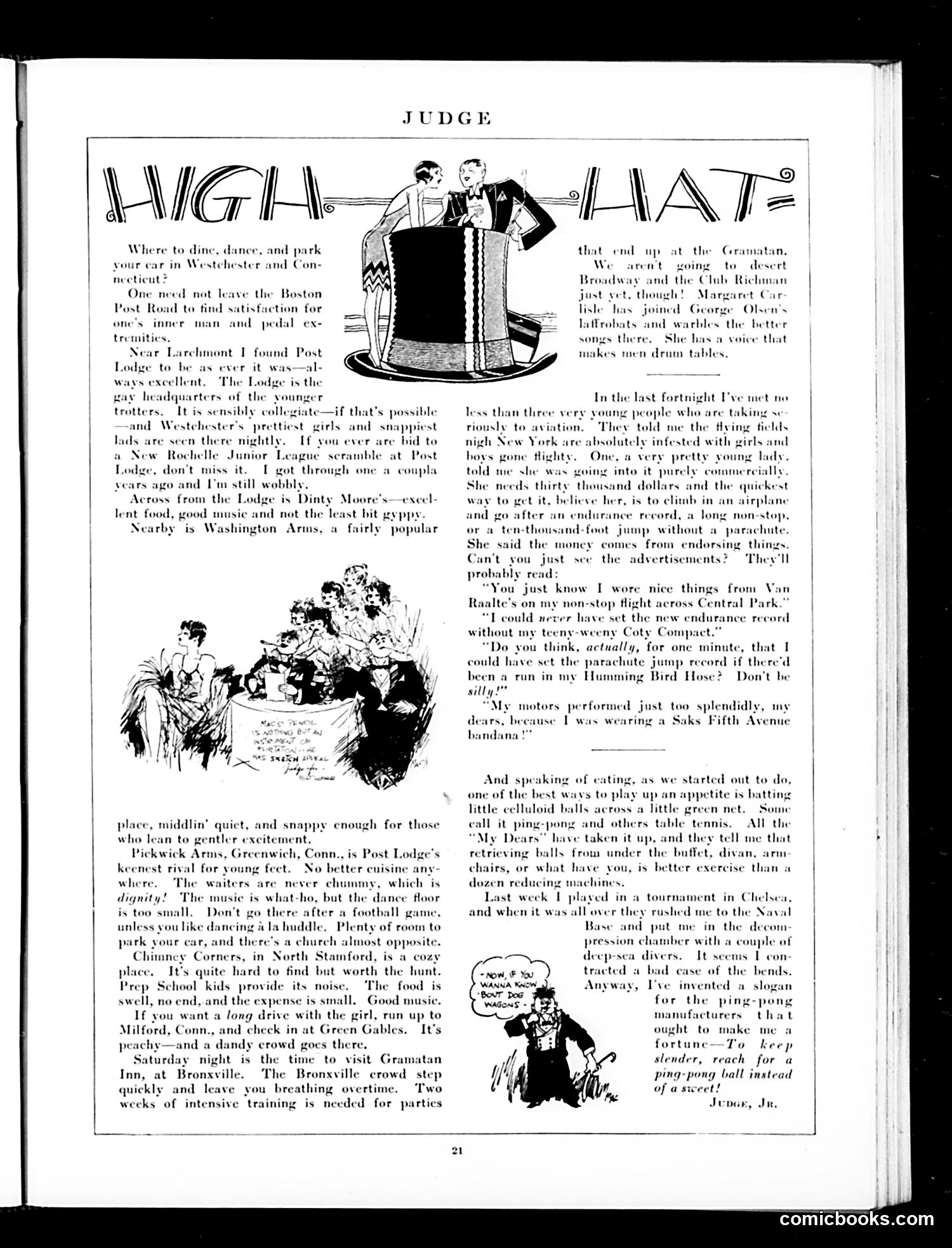
This is a satirical lifestyle column titled "High Hat" addressing young, affluent Connecticut and Westchester residents. The author recommends fashionable restaurants and nightclubs along the Boston Post Road, praising establishments like Post Lodge and Dinty Moore's. The satire targets wealthy youth culture and consumerism. A notable section mocks young women taking up aviation not from genuine interest but to secure sponsorship deals. The author sarcastically imagines endorsement advertisements: "I could never have set the new endurance record without my teeny-weeny Coty Compact." Another section jokes about ping-pong's popularity among "My Dears" (society women), suggesting they contract "the bends" (decompression sickness) from the activity and proposing a slogan: reach for ping-pong balls instead of candy. The overall tone ridicules the shallow materialism and fad-chasing of the Jazz Age leisure class—their obsession with fashionable venues, endorsement culture, and trendy activities treated as status symbols rather than genuine pursuits.
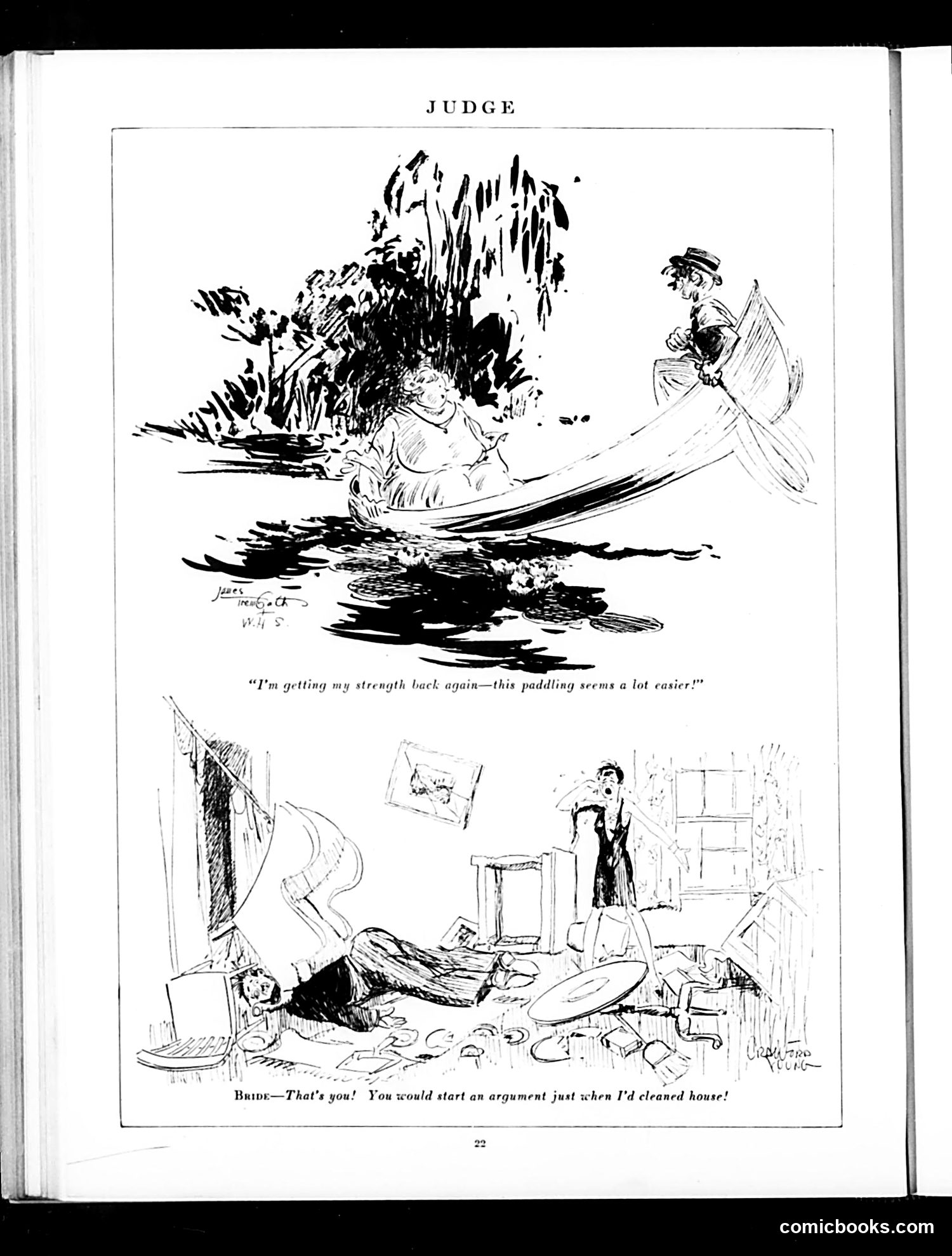
This page contains two separate cartoons satirizing domestic life. **Top cartoon**: A person in a boat regains strength while paddling, suggesting physical recovery or renewed vigor through activity. **Bottom cartoon**: Depicts a messy interior with scattered objects and furniture. A man lies on the floor while a woman (labeled "Bride") stands nearby, exasperated. She complains he's starting an argument "just when I'd cleaned house." The satire targets the tension between newlyweds—specifically, the husband's tendency to create domestic conflict at inconvenient moments, disrupting the wife's housekeeping efforts. This reflects early 20th-century gender dynamics where household cleanliness was considered the wife's domain and responsibility, making her frustration at disorder particularly acute. The cartoon mocks both marital discord and implied masculine inconsiderateness.
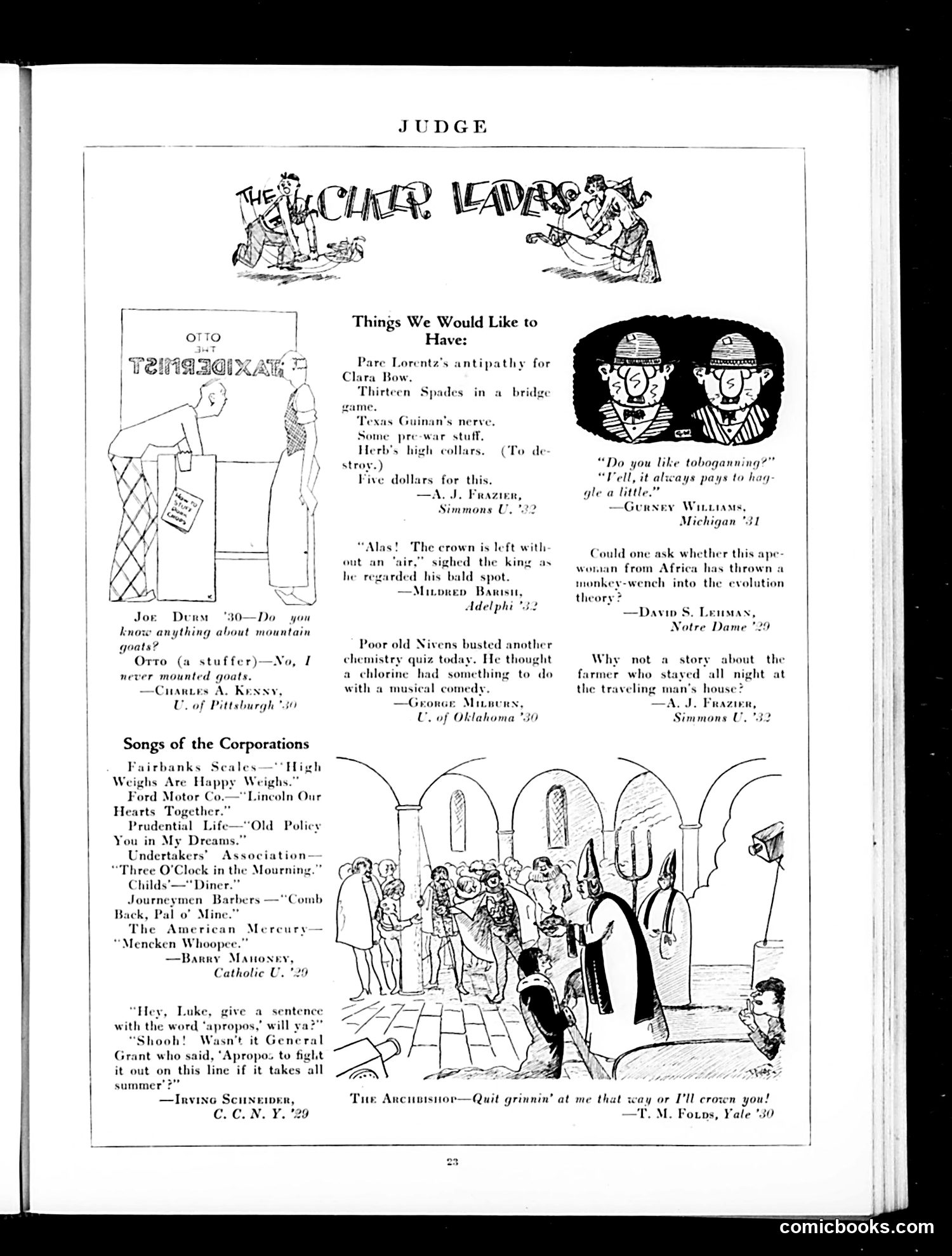
This page from Judge (a 1920s-era satirical magazine) contains humor targeting college students, contemporary figures, and corporate culture. **"The Scholar Leader"** section features student jokes mocking academic life—chemistry quizzes, bridge games, toboganning. The cartoon of "Joe Drum" ridicules someone who "never mounted goats," playing on absurdist humor. **"Things We Would Like to Have"** satirizes contemporary figures and issues: references to Pare Lorentz (filmmaker), Clara Bow (silent film actress), and "Herb's high collars" (unclear figure). One joke dismisses evolution theory as nonsense. **"Songs of the Corporations"** parodies advertising slogans by matching companies (Ford Motor Co., Prudential Life, Journeymen Barbers) with ironic song titles—corporate messaging portrayed as superficial. **The final cartoon** depicts Satan/the Devil ("Archbisop") in Hell, threatening to "crown" someone—likely satirizing a contemporary political or social figure in a hell-themed setting. The overall tone reflects 1920s collegiate humor and anti-corporate sentiment typical of Judge's satirical approach.
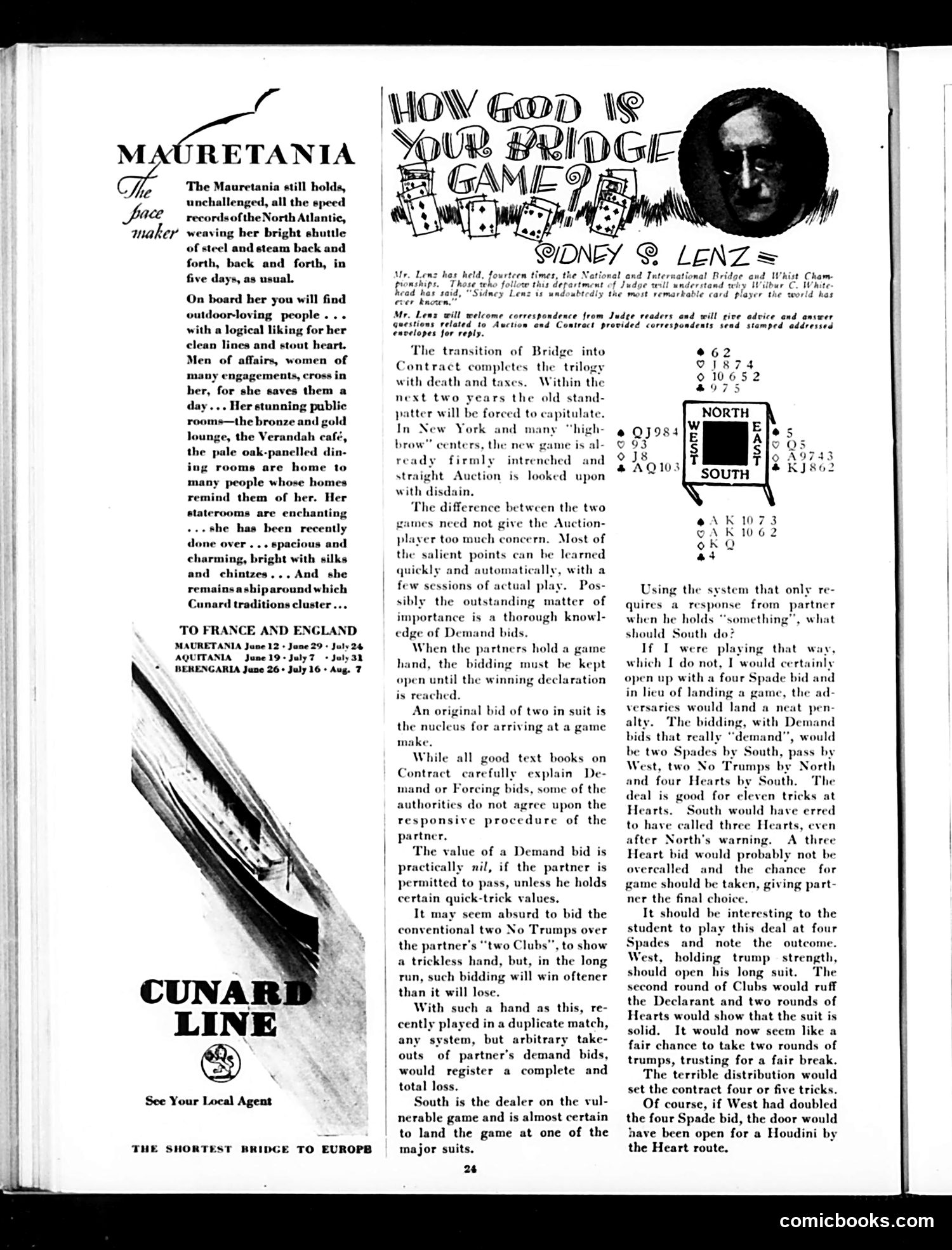
This page combines **advertisements** with a **bridge card game column**. The top-left advertises the Cunard Line's *Mauretania* ocean liner, emphasizing its speed, luxury, and transatlantic service—typical 1920s-30s travel marketing highlighting modern elegance and efficiency. The center-right cartoon titled "HOW GOOD IS YOUR BRIDGE GAME?" features **Sidney Lenz**, identified in the caption as a bridge authority. The cartoon mocks bridge players, showing Lenz's face emerging from playing cards—a visual pun on obsession with the game. **The main column discusses Contract Bridge vs. Auction Bridge**, explaining that Contract is replacing the older game. Lenz provides technical bidding advice for card players, treating bridge strategy seriously for readers learning the "new" rules. **Context for modern readers**: Contract Bridge was indeed revolutionizing card gaming in this era (1920s-30s). The satire gently pokes fun at how seriously competitive players took bridge strategy, while Lenz's prominent placement suggests he was a recognized expert offering legitimate instruction alongside the joke.
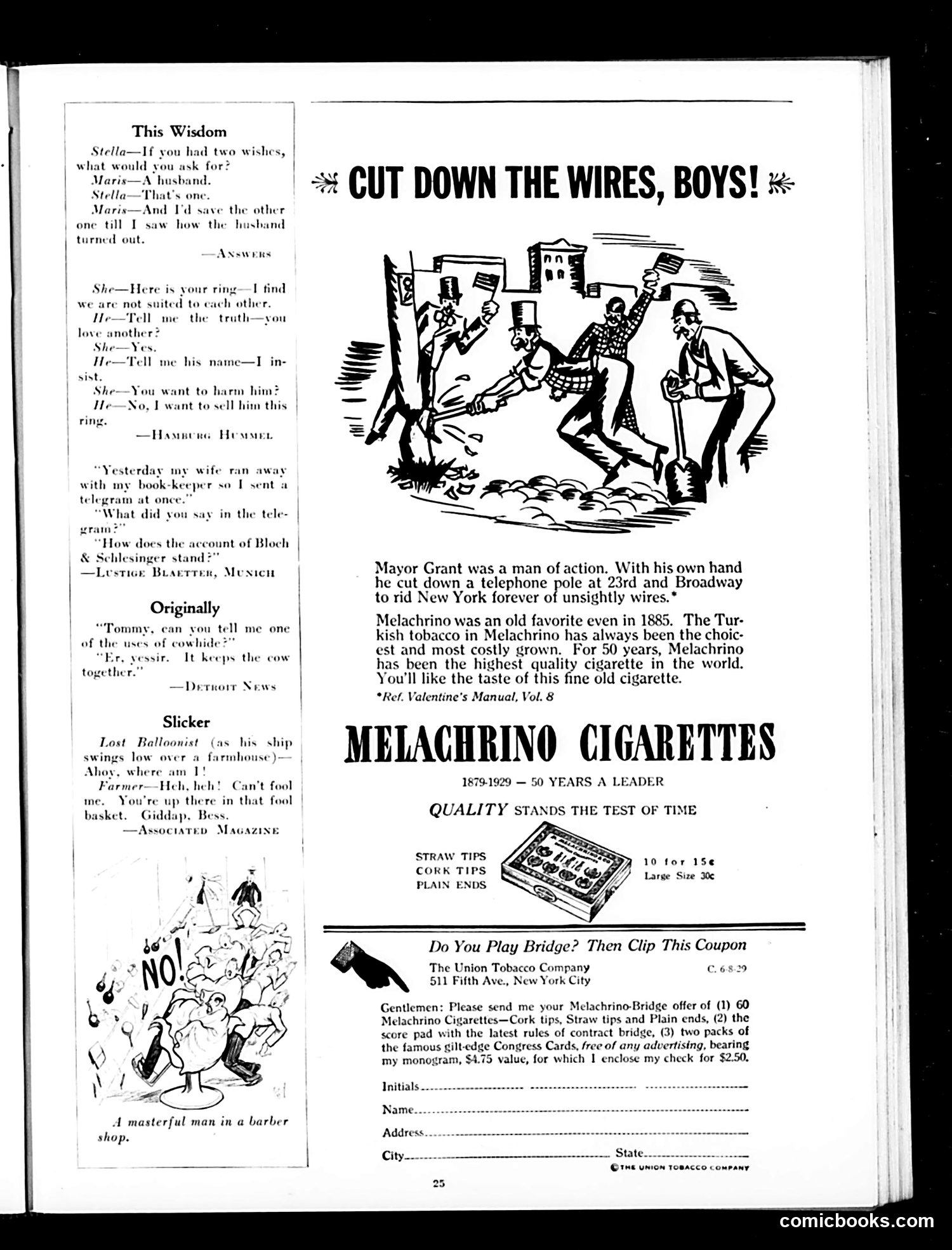
The main cartoon depicts Mayor Grant (likely New York Mayor Edward M. Grant, early 1900s) heroically cutting down a telephone pole at 23rd and Broadway. The satire celebrates his direct action against "unsightly wires"—the tangled mess of overhead telephone and electrical lines that plagued American cities during the telephone era's rapid expansion. The exaggerated, celebratory illustration mocks both the chaotic urban infrastructure problem and Grant's somewhat theatrical solution. The page also includes unrelated humor ("This Wisdom," "Originally," "Slicker") and a Melachrino Cigarettes advertisement offering a bridge-scoring pad coupon—typical magazine filler content. For modern readers: the "wires problem" was a genuine civic complaint in early 20th-century cities before underground utilities became standard.
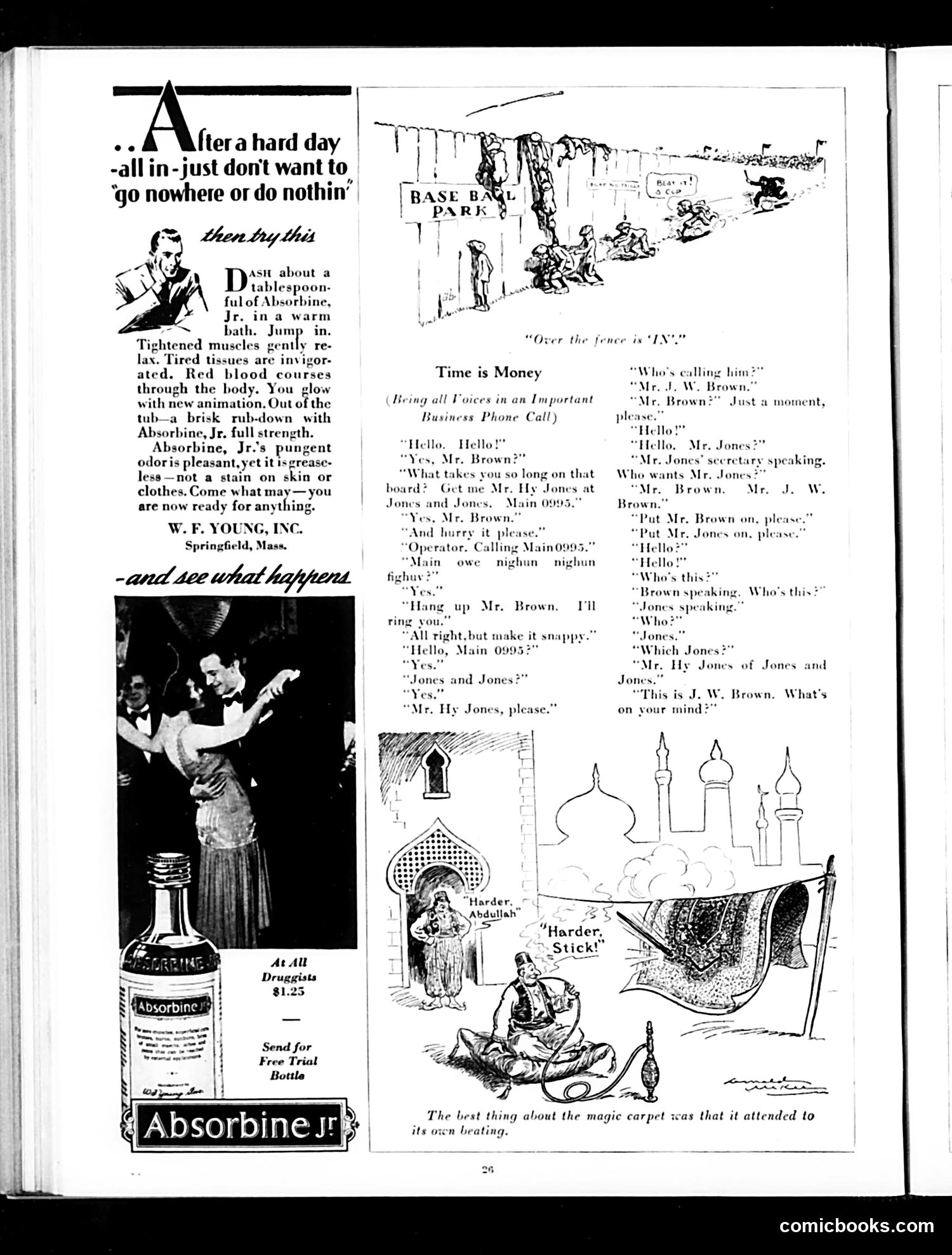
This page combines advertising and humor typical of Judge magazine. The left side promotes **Absorbine Jr.**, a patent medicine liniment marketed as a cure-all for tired muscles and fatigue—common snake-oil remedies of the early 20th century. The right side's cartoon "Time is Money" satirizes **modern business inefficiency**, specifically the frustration of telephone communication. The repeated dialogue shows a businessman (J.W. Brown) struggling to reach someone through multiple operators, secretaries, and transferred calls—a relatable complaint about the era's emerging telephone infrastructure. Each person asks him to repeat his name and purpose, wasting the "money" of his time. The bottom cartoon about a "magic carpet" is a brief joke about exotic foreign customs (likely mocking orientalism), suggesting even magical objects require mundane maintenance. Together, these pieces reflect early-20th-century anxieties: patent-medicine solutions to modern exhaustion, and frustration with new technology's bureaucratic complications.
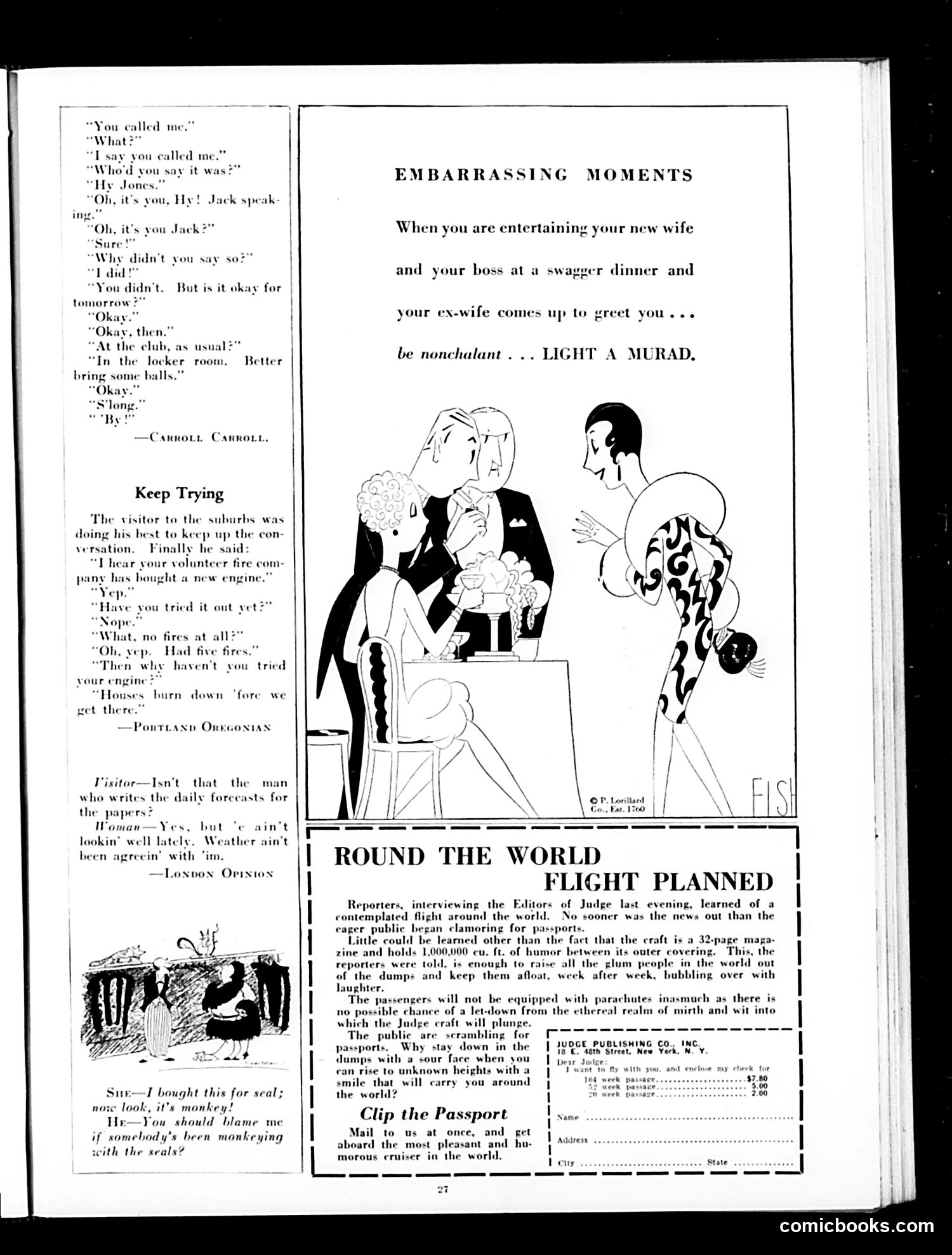
This page contains three unrelated humor pieces typical of Judge magazine's satirical format: **"Embarrassing Moments"** (center): A cartoon illustrating social awkwardness—specifically when a man entertaining his new wife and boss at dinner encounters his ex-wife. The suggested solution: light a Murad cigarette (an advertisement) to appear nonchalant. The humor derives from the obvious discomfort such a situation would create. **Left column anecdotes**: Brief jokes about suburban life, including a volunteer fire company that hasn't tested its new engine, and a weather forecaster who looks poorly because "the weather ain't been agreeing with him"—wordplay on his profession. **"Round the World Flight Planned"** (bottom): An advertisement framed as editorial content, promoting Judge's fictional "around-the-world humor flight." It satirizes the contemporary fascination with aviation records while selling magazine subscriptions via a coupon ("Clip the Passport"). The page reflects early-20th-century concerns: marriage anxieties, suburban social performance, and public enthusiasm for aviation achievements.
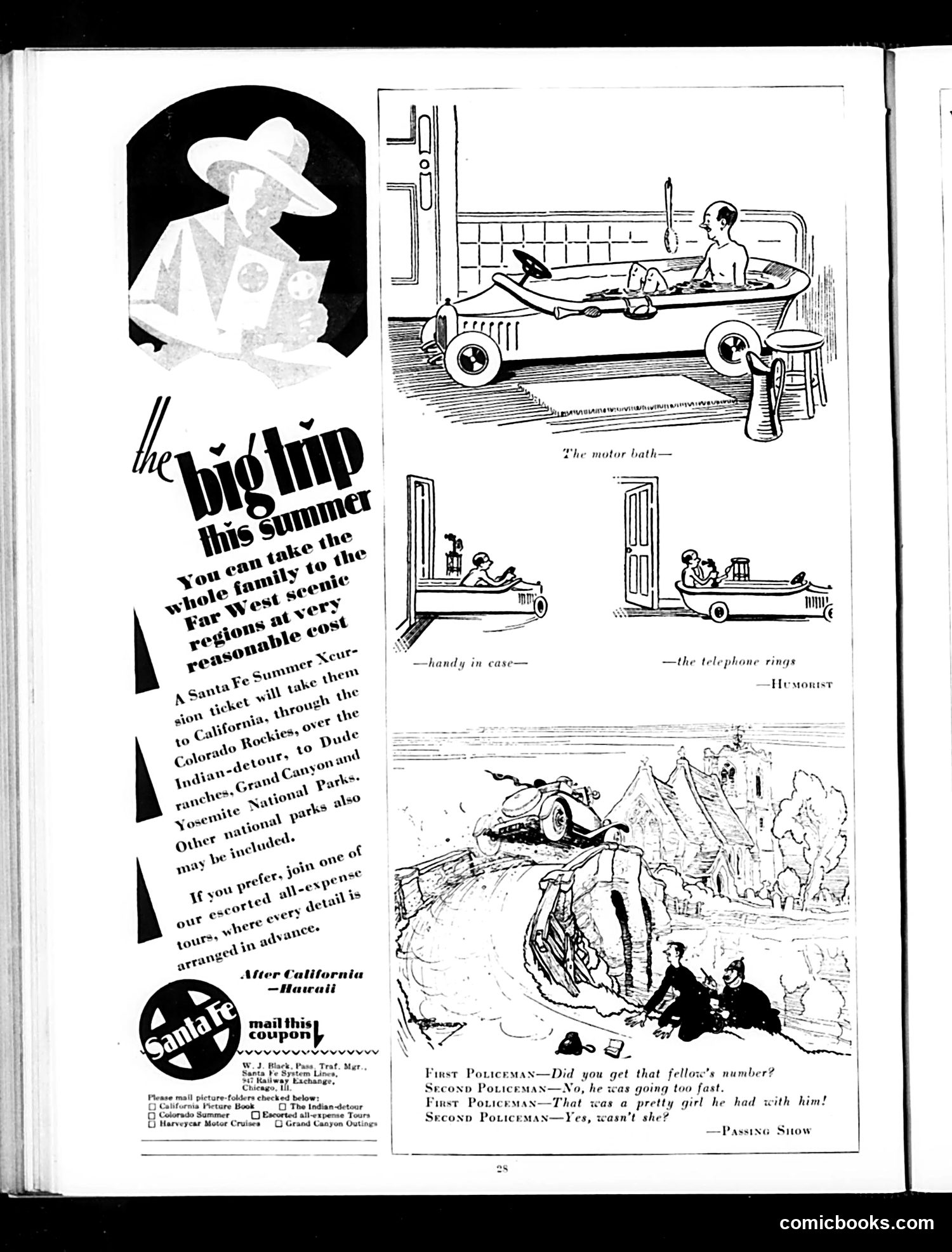
This page combines a Santa Fe Railway advertisement with humorous cartoon vignettes about automobile travel. **The Advertisement** (left): "The Big Trip This Summer" promotes discounted Santa Fe train tickets for family vacations to California, Colorado, and national parks, with options for customized itineraries. **The Cartoons** (right): Three satirical illustrations mock early automotive tourism: 1. **"The Motor Bath"**: A car converted into a bathtub, poking fun at impractical vehicle modifications. 2. **"Handy in Case"**: A motorist prepared for every contingency with excessive equipment. 3. **"The Telephone Rings"**: Two policemen discussing a speeding car with a young woman passenger, making a flirtatious joke about her appearance. **The Bottom Cartoon**: "Passing Show" depicts a car accident in a scenic location, with officers unable to get the speeding driver's license number—satirizing reckless motorists endangering both themselves and others on newly popular scenic drives. The humor criticizes dangerous driving habits among tourists.
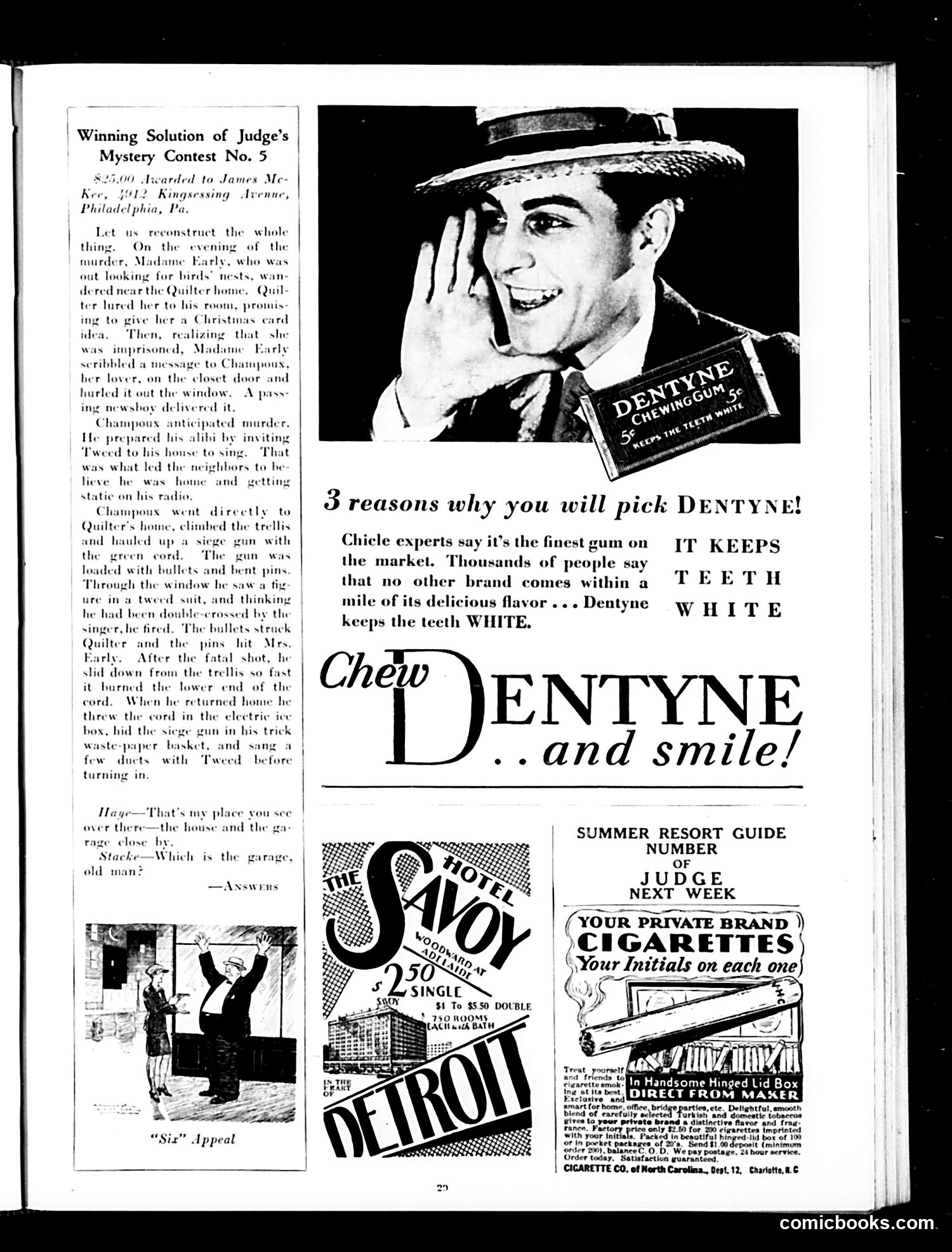
This page contains **two separate elements**: a mystery contest solution and advertisements. The **mystery contest** (left column) is a parody of detective fiction. It presents an absurdly convoluted murder solution involving Madame Early, Quilter, Champoux, and Tweed, with impossible plot mechanics (a siege gun, a burning cord, a "tweed suit" mistaken identity). The humor lies in its overcomplicated logic and ridiculous details—typical of pulp mystery stories of the era that Judge was satirizing. The **Dentyne gum advertisement** (center-right) uses a young man's photograph and three promotional reasons to buy the product (it's "finest," has "delicious flavor," keeps teeth white). This is standard product advertising of the period. Below are advertisements for a Detroit hotel, personalized cigarettes, and Judge's upcoming Summer Resort Guide edition. The page is primarily **advertising and contest content rather than political satire**—it reflects consumer culture and entertainment of 1920s America.
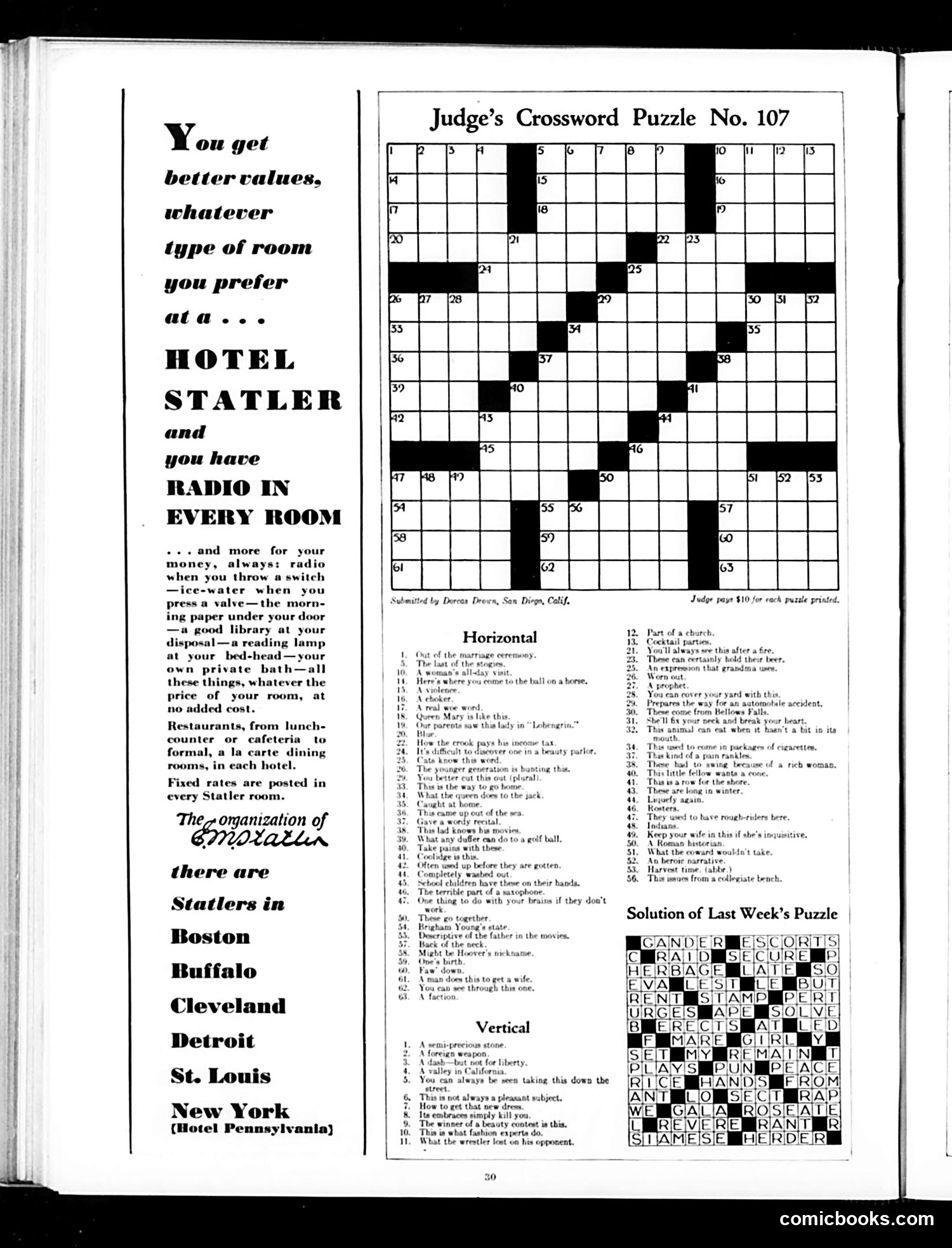
This page is primarily **advertising content**, not political satire or editorial cartoon. It features a substantial advertisement for Hotel Statler, a major American hotel chain of the era. The ad emphasizes modern amenities that would appeal to mid-20th-century travelers: radios in every room, ice-water on demand, morning newspapers delivered to rooms, libraries, reading lamps, and private baths—all included "at no added cost" regardless of room price. This positioning suggests luxury features were becoming expected standards. The page also lists Statler locations (Boston, Buffalo, Cleveland, Detroit, St. Louis, New York), indicating the chain's geographic reach. Below the ad is a crossword puzzle ("Judge's Crossword Puzzle No. 107") with its solution from the previous week's puzzle visible. The advertising reflects 1930s-1940s consumer culture and how hotels marketed technological conveniences as selling points to business travelers and tourists.
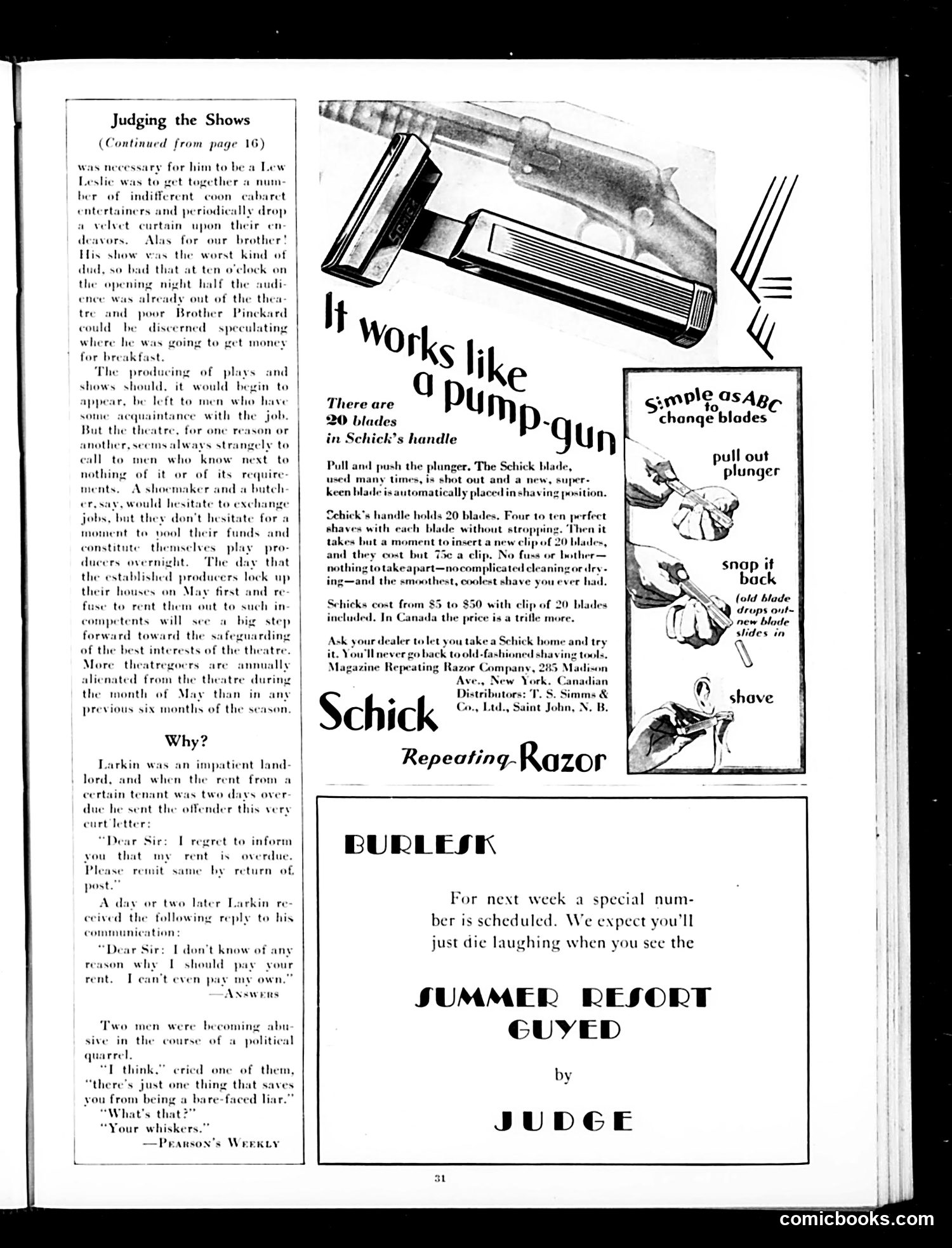
This page combines theater criticism with advertising. The main article critiques theatrical producers who lack expertise—specifically mentioning someone named Larkin whose show failed so badly that audiences left halfway through opening night. The satirical point: Broadway was plagued by incompetent producers who treated theater as a get-rich-quick scheme, much like a shoemaker or butcher randomly trying each other's trades. The author argues established theaters should refuse renting to such amateurs. The page also includes unrelated humor (a landlord-tenant exchange about overdue rent) and a prominent **Schick Repeating Razor advertisement**—a commercial product designed to hold 20 interchangeable blades. The ad emphasizes convenience and cost-efficiency. At bottom, *Judge* magazine announces an upcoming "Summer Resort Guyed" feature satirizing vacation destinations—typical satirical magazine fare of the era.
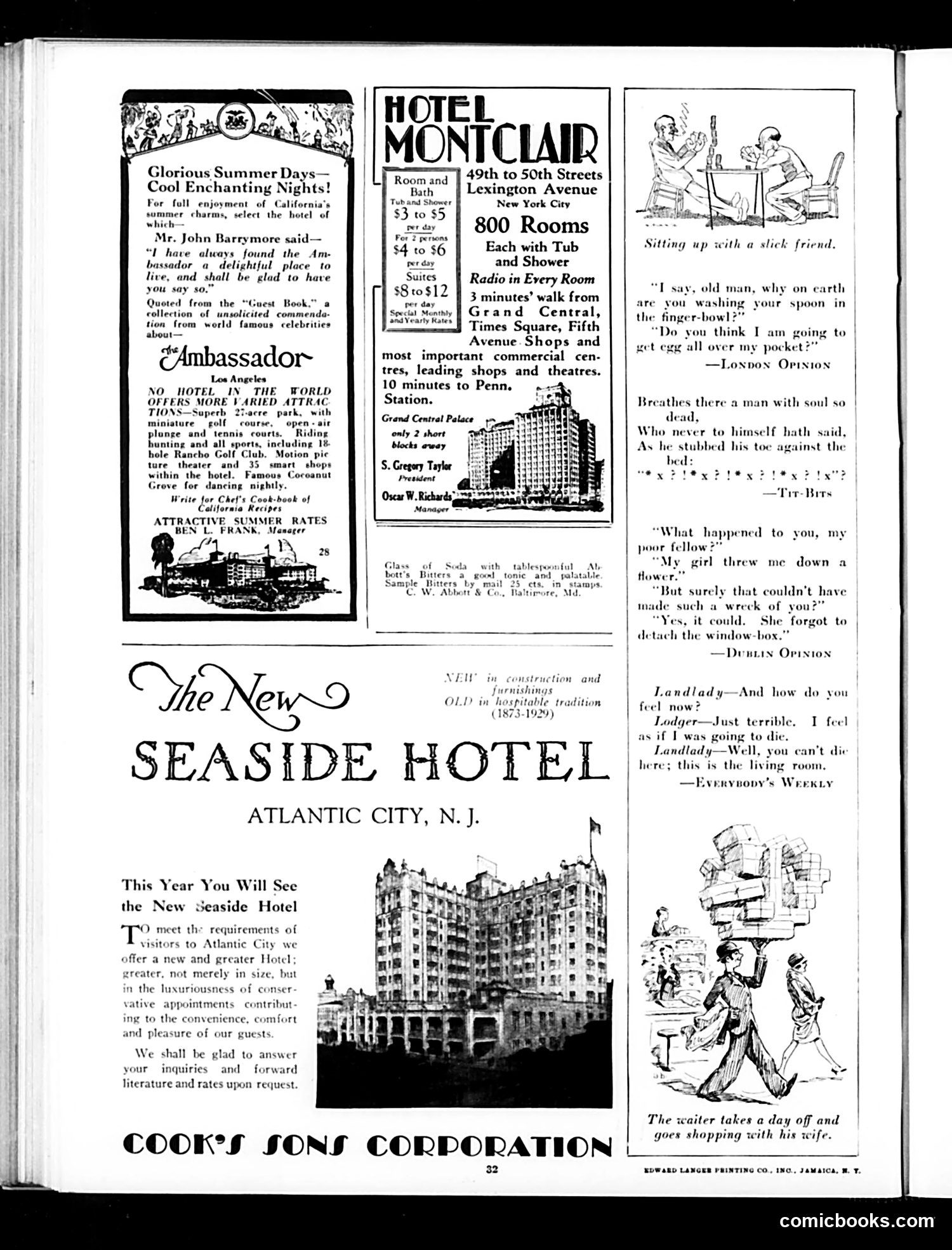
This page is primarily **hotel and travel advertising** with minimal satirical content. The ads feature luxury accommodations from the 1920s: the Ambassador in Los Angeles, Hotel Montclair in New York City, and the new Seaside Hotel in Atlantic City. The few cartoon elements are **light social humor** rather than political satire: - "Sitting up with a slick friend" depicts a gentleman washing his spoon in a finger bowl—a joke about social awkwardness or pretension - "Breathes there a man with soul so dead" plays on romantic poetry, applying it to the mundane act of stubbing one's toe - The remaining jokes concern romantic misunderstandings and a waiter shopping with his wife These are gentle, domestic humor pieces typical of Judge magazine's lighter fare. There are **no political figures, caricatures, or sharp satire** visible. The page essentially functions as a vehicles for advertisements interspersed with genteel comedy aimed at the magazine's middle-to-upper-class readership.
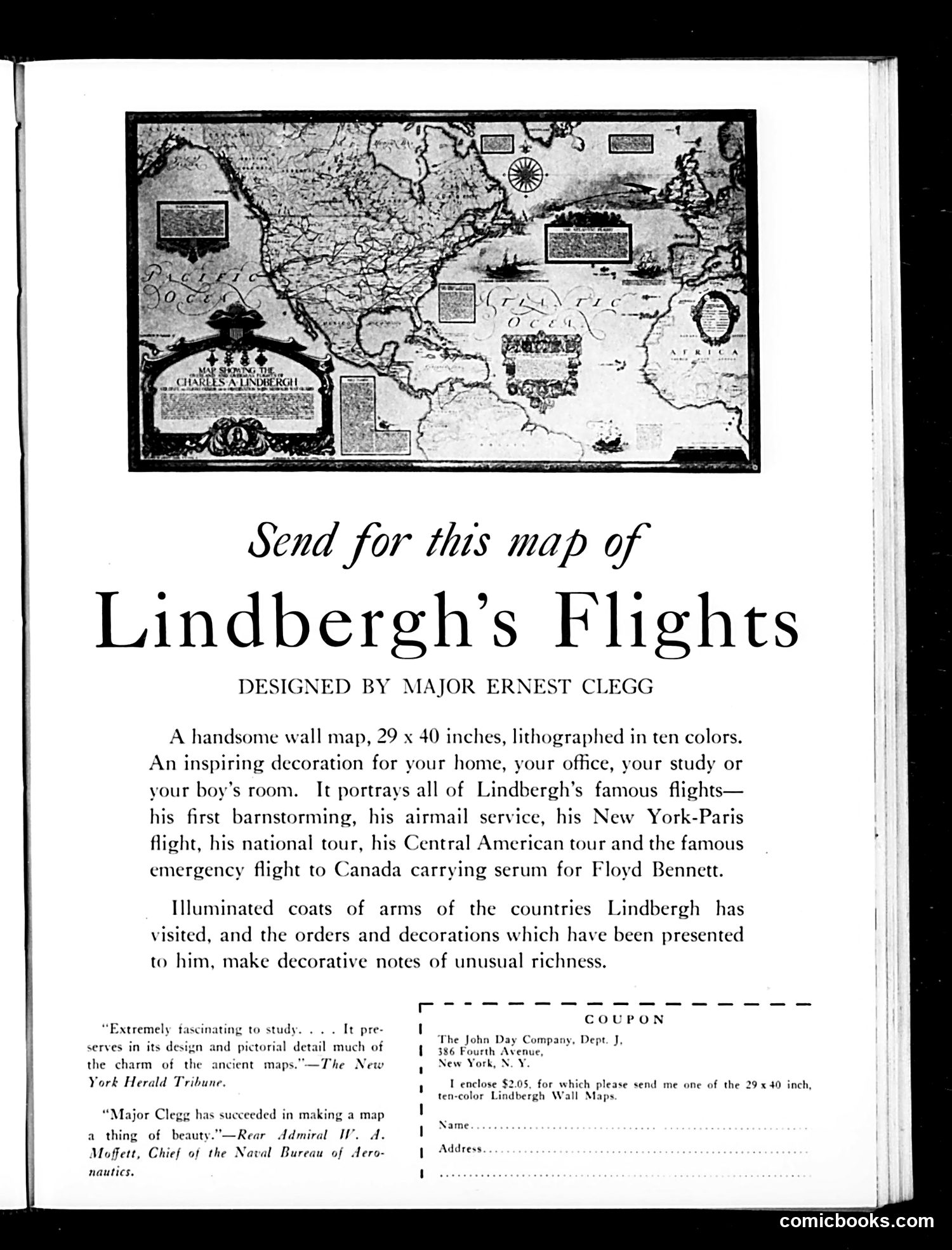
This is a **product advertisement**, not a political cartoon or satire. It promotes a wall map of Charles Lindbergh's flights, designed by Major Ernest Clegg and sold by The John Day Company. The page capitalizes on Lindbergh's celebrity following his famous 1927 transatlantic New York-to-Paris flight. It lists his various aviation achievements—barnstorming, airmail service, national tours, and a mercy flight to Canada—to appeal to consumers. The quoted endorsements from *The New York Herald Tribune* and Rear Admiral W.A. Moffett (a real naval official) lend credibility. The map itself appears at top, showing Lindbergh's routes across North America, the Atlantic, and Europe, decorated with coats of arms and national honors. The coupon at bottom invites readers to purchase the 29×40 inch, ten-color lithograph for $2.05—positioned as inspirational decor for homes, offices, and children's rooms. This reflects 1920s-30s enthusiasm for aviation and hero-worship of Lindbergh.
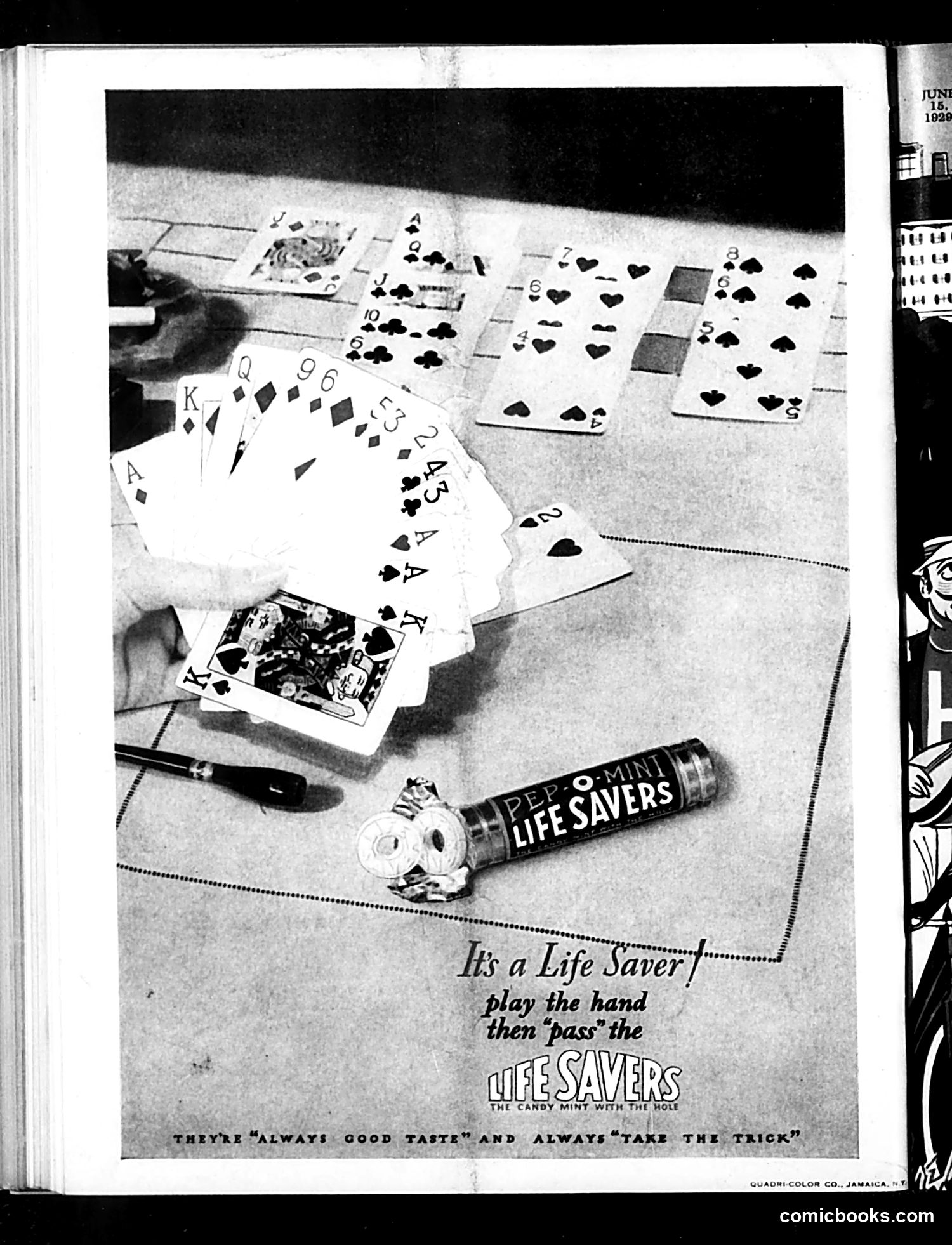
This is a **Life Savers candy advertisement** from Judge magazine (dated June 15, 1928, visible in top corner). It's not political satire but rather a commercial ad using a card-game metaphor. The image shows playing cards spread across a surface with a roll of Pep-O-Mint Life Savers candies and a pipe. The headline reads "It's a Life Saver! play the hand then 'pass' the Life Savers." The tagline—"They're 'Always Good Taste' and Always 'Take the Trick'"—uses poker/card-game language as a pun: "taking the trick" means both winning at cards and the candies being impressive/winning in social situations. The ad cleverly positions Life Savers as a social essential during leisure activities, marketing the mints' pleasant flavor and their appeal to share among friends during recreation.