
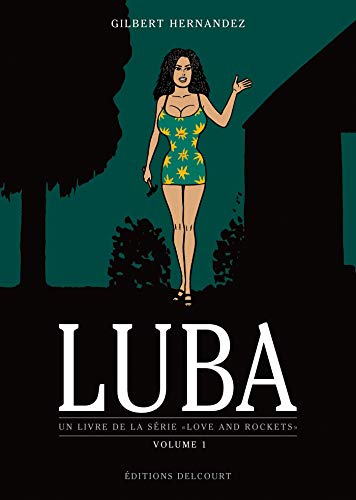
Luba #1
This volume collects the first part of Gilbert Hernandez's acclaimed 'Luba' storyline, originally serialized in 'Love and Rockets' and later in the 'Luba' comics series. It follows the complex life of Luba, a strong-willed matriarch, as she navigates family secrets, political turmoil, and personal desires in the fictional Central American town of Palomar. Published by Delcourt in French, this edition presents Hernandez's intricate, character-driven narrative in a collected format.
"El Show de Doralis" kicks off with Luba navigating a tense, quiet moment after helping an old man back to his hotel, only to find herself drawn into a fragile conversation with a woman who claims ignorance about past threats tied to her family. As the evening unfolds, the old man vanishes without a trace, leaving Luba alone with growing unease. Written by Gilbert Hernandez and Vincent Bernière, and illustrated with sharp, deliberate precision by Hernandez himself—his inks and lettering by Éric Brocherie—this first issue of Luba (2010, Delcourt) sets a deliberate, atmospheric tone. The cover, also by Hernandez, captures the story’s mood with a striking, enigmatic image.
In "Qui se soucie de l'amour ?", Venus finds herself tangled in a quiet web of longing, convinced she’s in love with Carlos, the comic book store clerk—only to discover he’s involved with Petra. When Venus witnesses Carlos and Kat together, her heart sinks, but the fallout is just beginning, as Petra’s fury erupts in a storm of shattered shelves and broken trust.
In the quiet, sun-drenched memory of a family vacation at a nude resort, Jo finds herself caught between the warmth of shared moments and the quiet unease of a missing family good luck charm. When Mitch, the resort attendant, is accused by Maria and Fritz of taking it, the tension lingers—until the charm mysteriously returns, delivered in a letter after Mitch wins the lottery.
In "Déesse de l'amour," Petra navigates the quiet unraveling of her marriage to David Vasquez, moving from the warmth of their wedding day to the strained present, where a shocking revelation about their son Rogelio forces her to confront painful truths. Through intimate, fleeting moments, the story captures the weight of family, loyalty, and the fragile line between love and control, culminating in a bittersweet outdoor picnic where Petra begins to reclaim her independence.
In "Show Super Mega Sensationnel de Doralis," Doralis takes the stage to honor her sister Casimira, turning her television broadcast into a heartfelt tribute by revealing the worn prosthetic arm Casimira has carried for years—a quiet emblem of resilience and identity.
In "null," Fritz and Petra arrive to visit Luba, bringing with them "The Family Thing"—a cherished good luck charm they believe she needs to help bring her husband into the country. The quiet weight of their visit settles into the space between words, where hope and uncertainty drift like dust in the air.
In "Luba en Amérique," Luba finds herself caught in a quiet but tense moment when she helps an old man back to his hotel after he collapses. Seeking answers about her family’s past and possible threats tied to old political or criminal ties, she meets with a woman who claims ignorance—leaving Luba with more questions than answers. When she returns to the room, the old man is gone, vanished without a trace.
In "Comme tu le sais," Jo, a therapist, finds herself caught in a web of personal and professional tension when her sister Petra asks to be her patient—only for Jo to refuse, citing their family bond. As Jo navigates her own shifting relationships, including a fragile reunion with Jerome, she’s thrust into a moment of quiet crisis when a patient—a cop—hides in her closet, unraveling in silence.
In "Chaud et moite," Petra, running late to deliver the costumed Venus to an appointment, feels unwell and takes medication before stopping at a takeout burger place. Her nausea worsens, leading to an abrupt and messy incident that leaves her shaken and the situation increasingly tense.
In "Le style du vieil homme," the Old Man sits in silence, waiting—his mind sharp, his resolve quiet—as he contemplates what comes next, trapped in a room with no escape in sight. Written and drawn with quiet intensity, this single-page story unfolds entirely from his perspective, a tense meditation on choice and presence.
In "Souvenirs d'une douce jeunesse," Luba finds herself caught between worlds as Fritz and Petra take her to a provocative gallery opening and other events in a city where she doesn’t understand a word of English. Through quiet moments and vivid flashbacks, the story unfolds with warmth and tension, tracing the wild, uninhibited years of Petra and Fritz’s youth.
In "Venus nous donne des tuyaux !", Venus reflects on her mother Petra, her father Bobby, and the complicated web of relationships that include Fritz and Luba, all seen through her introspective, often wry perspective. Flashing back to the night of her conception, the story unfolds with quiet intimacy, weaving memory and emotion into a layered portrait of family and identity.
In "Socorro...", Jo and Luba make a journey north to an interview at a special school, where Socorro’s brilliance quickly earns her a place at an even more prestigious institution. The story captures a quiet, poignant moment of transition, full of hope and the weight of first steps into a new world.
In "Le livre d'Ofelia," Jo writes a book about her life with Luba, caught between her desire for independence and the quiet demands of caring for Luba’s children on her only day off. When she and the kids venture into The Crying—a forest where the distant sound of a baby’s wail echoes through the trees—something in the stillness begins to unsettle her.
In "Comme un escargot," Luba’s children, Socorro and Joselito, set off on a reckless adventure when they steal their neighbor’s car to follow their mother one night. Stranded in the countryside after a crash, they must rely on a stranger—Hector—to get them back to town, racing against time to return home before Luba notices their absence.
Find on ebay
Where to buy
Sell my copy
Have this issue — or a whole collection? Get a fair offer from us, skip the marketplace fees and the hassle.
We Buy Collections ▸Full credits
Reprints
↩ Reprints New Love #1 (1996), New Love #2 (1996), New Love #3 (1997), New Love #4 (1997), New Love #5 (1997), New Love #6 (1997), Luba #1 (1998), Luba #2 (1998), Luba #3 (1998), Measles #1 (1998), Luba #4 (2000), Luba's Comics and Stories #1 (2000), Luba #5 (2000), The Complete Love & Rockets #[19] (2001), Luba #6 (2002), Luba's Comics and Stories #3 (2002), Luba #[nn] (2009)
Reviews
Reader reviews
No reader reviews yet.