
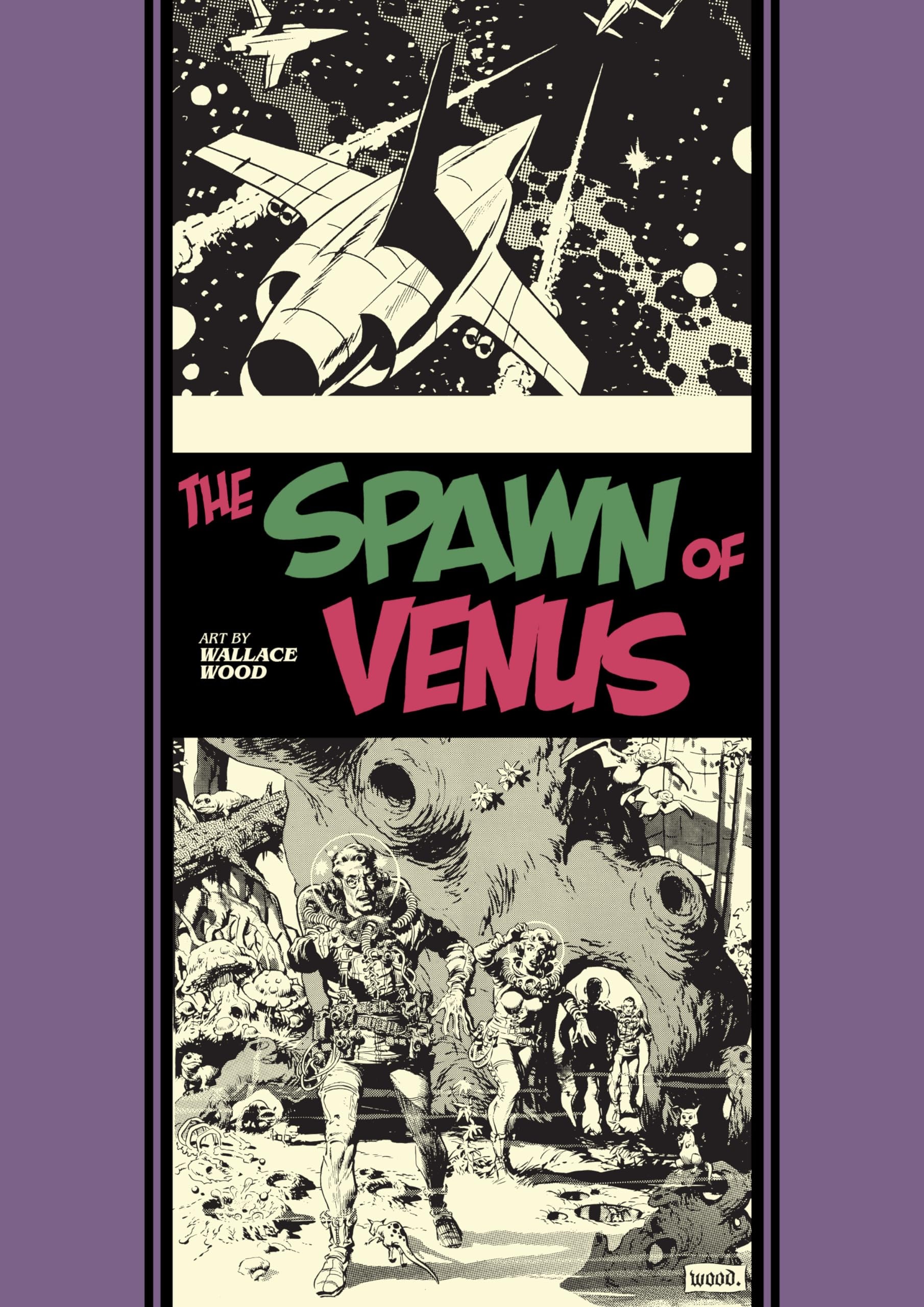
The Fantagraphics EC Artists' Library #38
☆ Be the first to review + Add to your collection — Join free"You, Rocket" Restored Page" is a haunting, visually striking tale from the EC Artists' Library series, spotlighting the legendary creative team of Bill Gaines, Al Feldstein, and Wally Wood. Set in the distant future of 2963, it follows Jerome Kraft, a lone explorer stranded on a primitive planet who becomes a revered figure through his scientific kindness—only to be challenged by the very faith he inspires. The restored page, rendered with Wood’s precise, expressive art and lettered by Jim Wroten, captures a powerful moment of moral tension, while the cover by Wally Wood perfectly frames its enduring, almost mythic weight.
In the year 2963, Jerome Kraft arrives on a distant planet with a mission to catalog life forms and four years of supplies—only to find himself stranded when his return rocket is destroyed and all records of his presence erased. As he uses his advanced knowledge to heal the sick and feed the hungry, the local people begin to revere him as a divine savior, a belief that puts him at odds with the high priest, who sees such miracles as heresy. When the priest demands Jerome limit his aid to the wealthy, he refuses, setting in motion a legacy that will endure for thousands of years—until a new generation of explorers arrives to find a civilization shaped by the memory of a man who walked among them.
In a future where Earth’s mammals have gone sterile after a radioactive comet, two elderly scientists make a desperate bid to save humanity by sending a time wave back to the past. They activate a time field at Grand Central Station, only to be puzzled when only men begin arriving from the past—drawn, it turns out, by the field’s accidental placement in front of the men’s washroom.
In a near-future where space travel is routine, a young boy’s wish for his father to finally come home to stay takes an unexpected turn when a falling star streaks across the sky—only to reveal a shocking truth about his father’s long absence. With quiet emotion and striking visuals, this poignant science fiction tale explores the weight of distance, the power of a child’s hope, and the fragile line between myth and reality.
In "There'll Be Some Changes Made!", a space-faring crew lands on the mysterious planet Gastropodia, where the inhabitants live in shell-like igloos and move with a slow, deliberate grace. Commander Morrison finds himself drawn to the graceful Luwana, and as the others prepare to return to Earth, he faces a choice that will change everything—especially when he learns the truth about the planet’s unique, hermaphroditic snail-like people.
In a quirky twist of cosmic irony, EC Comics editors Bill Gaines and Al Feldstein seek out an "expert" to lend authenticity to their next sci-fi tale—only to discover their source is no Earthling at all. As the man’s wild claims about Mars grow more outlandish, the editors’ skepticism gives way to stunned disbelief when the truth finally lands.
In "The Martians!", a team of Earth explorers lands on a lifeless Mars, only to uncover a buried city beneath the sands. Inside ancient ruins, they encounter a hologram showing an Earthman battling a Martian—only to later realize they’re trapped in a forgotten movie theater, where the roles of hero and monster are far from what they seem.
In "Down To Earth," a scientist's bold theory that alien forces are sabotaging human aviation to stifle our progress becomes terrifyingly real when the extraterrestrials respond—directly and violently. With skies now forbidden and trust in science crumbling, the line between paranoia and truth blurs in a story that turns a nation's fear into a quiet, urgent reckoning.
In "Plucked!", a quiet suburban morning takes a bizarre turn when a young woman suddenly vanishes—only to reappear days later, unharmed but haunted by fragmented memories. The aliens return every few centuries, abducting humans in secret, erasing them from history with a hypnotic pulse. But this time, something feels different.
In "There Will Come Soft Rains...", a silent, functioning house carries on its daily routines long after its human inhabitants are gone—reduced to faint outlines on the walls, their lives erased by a nuclear holocaust. The story unfolds through the house’s automated rituals, a haunting echo of routine in a world that no longer needs it.
In the year 4152, where eternal youth is maintained by injections, Martin—a 550-year-old man long worn thin by endless life—meets Jean, another immortal burdened by centuries of existence. Drawn together by shared weariness, their unexpected connection reignites something long buried. When they’re sent to a remote colony planet without the means to prolong life, they face the prospect of aging for the first time in millennia, discovering in the fleeting passage of years a new reason to live.
In "The Loathsome!", a deformed girl raised in an orphanage becomes an outcast due to her unsettling appearance and the fear she inspires. When a younger nurse discovers her secretly hiding notes in tree hollows, the women of the orphanage confront her, driving her to flee—only for a tragic fall to end her story. The final note, found in the aftermath, carries a quiet, heartbreaking confession: "To whoever finds this note - I love you."
In "EC Confidential!", the editor of Fables Publishing Company begins to suspect that the eerie tales in Weird Science might be more than fiction—especially when a sudden alien attack on the office reveals a shocking truth: the editor, Bill Gaines, Al Feldstein, and the entire staff are actually survivors from Venus, fleeing the Martian massacre. The story unfolds with a mix of pulp intrigue and cosmic mystery, blurring the line between fiction and reality in a way that’s both clever and unsettling.
In "My World," the narrator recounts the boundless power to conjure any reality—scenes of alien encounters, human triumphs, and the stark contrast of life and death—each drawn with vivid, deliberate artistry. The story unfolds as a meta-moment of creation, revealing that the entire narrative is being rendered by Wally Wood.
In a distant colony where newborns are taken from their mothers under the guise of proper upbringing, Ellen Greyson and David Greyson join a growing resistance as tensions boil over. When the truth emerges that the children are born with mutations due to the planet’s harsh environment, the mothers—led by Ellen and others—face a harrowing choice: accept the government’s control or risk everything to reclaim their children. The story unfolds with quiet intensity, exploring the bond between parent and child in a world that fears what it doesn’t understand.
In "Flying Saucer Report," a writer who's spent years exposing government cover-ups about alien craft reveals a stunning secret to a journalist: he’s not human at all, but a Martian in disguise, sent to Earth to warn humanity of an impending arrival from his dying planet. The story unfolds with a quiet intensity, blending paranoia and revelation as the truth of the flying saucers takes on a deeply personal, otherworldly weight.
In "Adaptability," Captain John Oxton leads his crew on a generations-long journey to a distant planet, only to find that arrival brings a new kind of challenge: the ship’s inhabitants, raised in artificial conditions, are unprepared for life beyond its walls. With Olivia Oxton by his side, John must confront the limits of their planning—and the resilience of the human spirit—when the world outside demands a different kind of survival.
In "The Inferiors," a crew of Earth spacemen ventures through the cosmos, uncovering a chilling pattern: every Earth-like planet they visit bears the ruins of a once-thriving civilization, erased by its own humanoid reptile inhabitants. As they piece together the mystery, they confront a disturbing truth about self-destruction, identity, and the fear of returning to a darker past.
In "The Chosen One," two celestial beings descend upon Earth and make their way to a man’s home, sparking his fear that they’ve come for his son—whom he’s long suspected of being something otherworldly. But the truth is far stranger: the beings aren’t after the boy at all, but the family dog, whose extraordinary intellect has drawn their attention across the stars.
In "Clean Start," two amoeba-like aliens from the Solar Federation arrive on Earth with a radical mission: to save humanity by wiping it clean and starting anew. Disguised as humans, they seek a pair to preserve, but when the female captures a man and returns to the ship, she’s stunned to realize—through a twist of fate and identity—that the man she abducted was her own mate in human form.
In "You, Rocket," a disembodied brain—once that of a rocket engineer—becomes the sole guidance system for a deep-space mission, its mind conditioned for precision but unprepared for the isolation and terror of interstellar travel. As the rocket leaves Earth behind, the brain’s training begins to unravel, trapped in a bodyless mind with only the stars for company.
In "Has-Been," a young rocket captain grapples with the harsh reality of being forced to retire at the age of 15 during an interplanetary war, where youth is prized above all. The story captures the bittersweet weight of being deemed too old for duty in a world that values only the young, even as the captain’s experience and courage remain undeniable.
In "Big Moment," a sudden meteor storm unleashes radiation that reshapes the world: humans shrink while animals and plants grow to monstrous sizes, turning the familiar into a terrifying, towering landscape. Now hunted by creatures once small and harmless, a young woman and her dog must navigate a world where every shadow could be a threat—and their own bodies are the smallest things left.
ComicBooks.com Value
Find on ebay
Where to buy
Read it digitally
Sell my copy
Have this issue — or a whole collection? Get a fair offer from us, skip the marketplace fees and the hassle.
We Buy Collections ▸Full credits
Reprints
↩ Reprints Weird Fantasy #13 (1952), Weird Science #13 (1952), Weird Fantasy #14 (1952), Weird Science #14 (1952), Weird Science #15 (1952), Weird Science #16 (1952), Weird Fantasy #17 (1953), Weird Science #17 (1953), Weird Science #18 (1953), Weird Science #19 (1953), Weird Science #20 (1953), Weird Science #21 (1953), Weird Science #22 (1953), Weird Science-Fantasy #23 (1954), Weird Science-Fantasy #24 (1954), Weird Science-Fantasy #25 (1954), Weird Science-Fantasy #27 (1955), Weird Science-Fantasy #28 (1955), Weird Science-Fantasy #29 (1955), Incredible Science Fiction #30 (1955), Incredible Science Fiction #31 (1955), Incredible Science Fiction #33 (1956), Witzend #6 (1969), The Fantagraphics EC Artists' Library #1 (2012), The Fantagraphics EC Artists' Library #2 (2012), The Fantagraphics EC Artists' Library #33 (2023)
Reviews
Reader reviews
No reader reviews yet.