
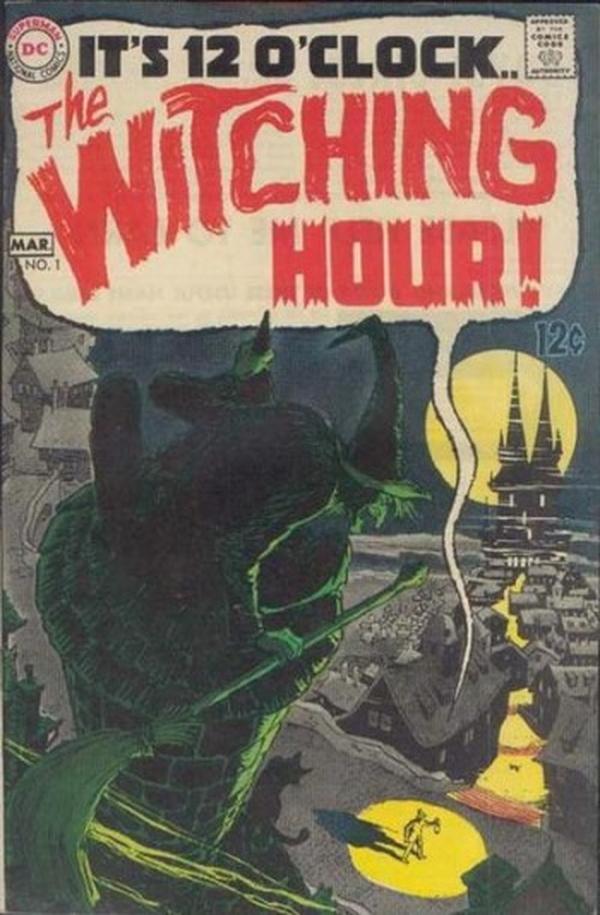
The Witching Hour #1
The Witching Hour #1 launched DC's first purpose-built horror anthology title of the late Silver Age — unlike the contemporaneous House of Mystery or The Unexpected, this was a brand-new series conceived from scratch for the revived mystery-comics format, giving it a distinct identity from its inception. The issue's most durable contribution is the debut of the three witch hosts — the crone Mordred, the motherly Mildred, and the youthful Cynthia — who collectively constitute the first appearance of the characters DC later canonized as the Hecatae/Kindly Ones. That trio went on to become pivotal figures in Neil Gaiman's The Sandman, elevated from horror hostesses into elemental Triple Goddess archetypes whose confrontation with Morpheus drives one of that series' most consequential story arcs. The issue therefore sits at the origin point of a character lineage that stretches across three decades of DC continuity and into the Netflix adaptation of Sandman.
In "Save the Last Dance for Me!", a quiet tragedy unfolds in a sleepy town where a lonely boy named Terwit is mocked for his size, retreating into a clock tower that stops at midnight. Years later, the grown men who once tormented him return to the tower—only to vanish in terror, their screams echoing through the silence. Written and illustrated by Alex Toth, this haunting tale blends melancholy and mystery in a story that lingers long after the final page. The cover by Nick Cardy captures the eerie stillness of the moment, a 12-cent glimpse into a haunting legacy.
In "Save the Last Dance for Me!" from The Witching Hour #1 (1969), millionaire magnate Thurgood "Tin Toes" Trapley, fueled by greed and a taste for spectacle, activates a machine that pulls him into a future Earth—100 years ahead, or possibly a thousand, depending on who you ask. With Clot O'Neil and Dicky caught in the chaos, the story unfolds as Trapley’s grand plans for personal gain collide with something far stranger and more unsettling than he ever imagined.
In a quiet town where mockery echoes louder than kindness, Terwit—small in stature but not in spirit—fades into the shadows of a clock tower, leaving the hands frozen at midnight. Years later, the grown men who once tormented him return, drawn by curiosity or guilt, only to vanish into the silence, their screams swallowed by the stillness. What waits in the tower, and why does time itself seem to hold its breath?
Stanley, a surfing maniac utterly consumed by his quest for the perfect wave, barely notices Carol at his side as he pushes himself to the limit. When a chance to ride a legendary wave under the cover of night presents itself, his obsession takes a strange turn—especially when an old hag and a pair of other surfers enter the mix. What happens when the ocean itself seems to answer his call?
ComicBooks.com Value
Show all 18 grades ▾
This exact issue on ebay
CGC 8.5 ▾ $500–$590 3 listings
CGC 6.5 ▾ $259–$315 2 listings
Raw / ungraded ▾ $4.24–$191 8 listings
Read it digitally
Sell my copy
Have this issue — or a whole collection? Get a fair offer from us, skip the marketplace fees and the hassle.
We Buy Collections ▸History
Editor Dick Giordano conceived and shepherded the series, making it one of the flagship projects of his tenure at DC before he was replaced by Murray Boltinoff with issue #14. Alex Toth both designed the three witch characters and handled the bulk of the framing sequence pages — a five-page prologue — while Neal Adams contributed the closing two epilogue pages, a division of labor that was initially misattributed entirely to Toth before being corrected through research citing Adams's own website. Writer Denny O'Neil contributed story scripts alongside Toth, and the cover was painted by Nick Cardy, who would go on to be the series' primary cover artist for the vast majority of its 85-issue run. The book was published under the National Periodical Publications indicia with a cover date of February–March 1969, though the on-sale date was in late 1968.
Trivia · 8 facts
- First appearance of Cynthia, Mildred, and Mordred — the three witch hosts collectively designated 'The Hecatae' — who are the same characters later reimagined by Neil Gaiman as the Kindly Ones/Triple Goddess in The Sandman.
- Premiere issue of The Witching Hour (Volume 1), DC's first all-new horror anthology title of the era, distinct from the contemporaneous mystery-reformat titles House of Mystery and The Unexpected.
- Alex Toth designed the three witch characters and drew the opening five-page framing sequence; Neal Adams drew the closing two epilogue pages — a split credit that was long misattributed solely to Toth.
- Cover date: February–March 1969; cover by Nick Cardy, who served as the primary cover artist for the majority of the series' 85-issue run (1969–1978).
- Dick Giordano edited the issue and the series from its launch; Denny O'Neil contributed scripts to the interior anthology stories alongside Toth and artists including Pat Boyette and Jack Sparling.
- The three witches also include a fourth recurring character introduced here: Egor, their bumbling zombie servant.
- Stories from this issue were reprinted in The Witching Hour #38 (1974) and collected in Showcase Presents: The Witching Hour Vol. 1 (DC, May 2011), which gathered issues #1–19 in a 544-page black-and-white volume.
- After the series was cancelled as a result of the 'DC Implosion,' the three witch characters were transferred to The Unexpected, and were later revived in The Sandman #2 (1989), where Gaiman established them as aspects of a single immortal deity.
Cast · 3 characters
Full credits
Reprints
↩ Reprints House of Mystery #13 (1953)
Reprinted in The Witching Hour #38 (1974), Haunted Tales #19 (1976), Weird Mystery Tales #35 (1978), Il Est Minuit... l'Heure des Sorcières #1 (1978), Showcase Presents: The Witching Hour #1 (2011)
Reviews
Reader reviews
No reader reviews yet.