
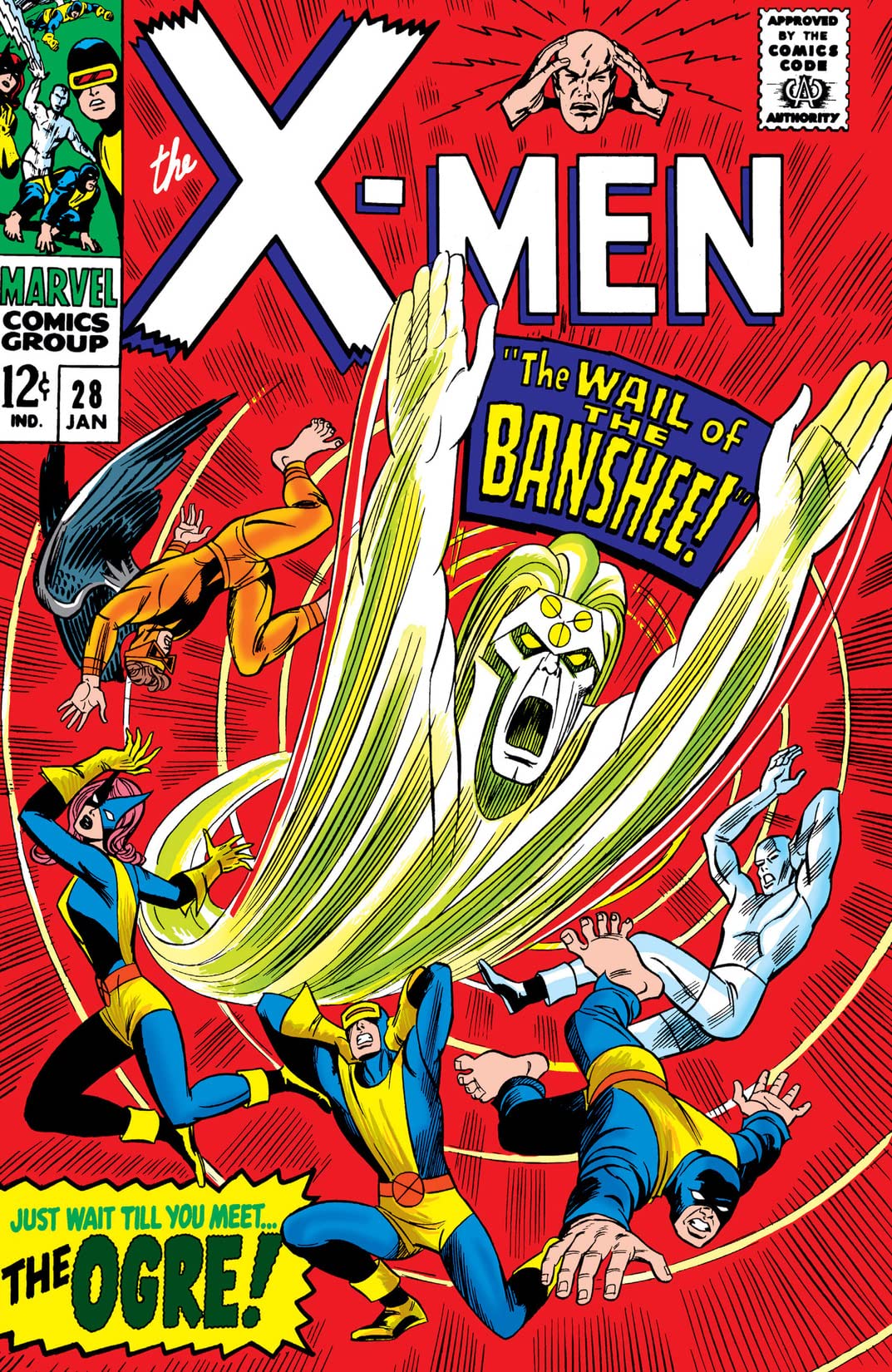
The X-Men #28
The X-Men #28 (January 1967) is the debut issue of Banshee (Sean Cassidy) and the Ogre (Brian Dunlap), marking the first appearances of two characters who would both become fixtures — and one of them an enduring fan favorite — across decades of X-Men storytelling. The issue simultaneously delivers the very first mention of Factor Three, launching one of the earliest sustained multi-issue story arcs in the series' history, running through X-Men #39. Banshee in particular proved significant enough to join the celebrated 'All-New, All-Different' roster in Giant-Size X-Men #1 (1975) and later headline the Generation X spin-off title in the 1990s, cementing this issue's place in the broader architecture of the X-Men franchise.
ComicBooks.com Value
Show all 22 grades ▾
This exact issue on ebay
CGC 9.8 ▾ $59.99–$69.99 2 listings
CGC 8 ▾ $480–$1,535 2 listings
CGC 7.5 ▾ $345–$495 2 listings
CGC 6.5 ▾ $245–$345 2 listings
CGC 6 ▾ $180–$250 2 listings
CGC 5.5 ▾ $210–$275 2 listings
CGC 5 ▾ $160–$185 3 listings
CGC 3 ▾ $132–$145 2 listings
Raw — MINT ▾ $2.5–$9.99 2 listings
Raw — VF ▾ $4.5–$340 5 listings
Raw — VG+ ▾ $57.95–$132 2 listings
Raw — VG ▾ $74.99–$198 9 listings
Raw / ungraded ▾ $3.19–$250 45 listings
- Samurai Comics · 4 locations4 on eBay ↗
- JAF Comics · Bethlehem, PA2 on eBay ↗
- Arcane Comics · Shoreline, WA1 on eBay ↗
- CollegeComix.com · Athens, GA1 on eBay ↗
Read it digitally
Sell my copy
Have this issue — or a whole collection? Get a fair offer from us, skip the marketplace fees and the hassle.
We Buy Collections ▸History
The issue was written by Roy Thomas, penciled by Werner Roth, and inked by Dick Ayers, with Stan Lee editing — the same creative core that drove the title through its mid-Silver Age run. Thomas originally conceived Banshee as a female character, but an editorial decision by Stan Lee changed the character to male, reportedly because Lee felt it was poor optics to have an entire team gang up on a woman villain. Thomas has also noted in retrospect that the fictional espionage syndicate Factor Three was directly inspired by the alphabet-soup spy organizations prominent in early James Bond films and the then-popular spy-fiction genre. A now-notorious scripting error — Thomas accidentally typed 'pliers' instead of 'screwdriver' in a panel where Jean Grey hands Beast a tool, prompting Beast's condescending response — generated reader mail and became a small piece of X-Men production lore.
Trivia · 8 facts
- First appearance of Banshee (Sean Cassidy), an Irish mutant with a sonic scream, created by writer Roy Thomas and penciler Werner Roth (January 1967).
- First appearance of the Ogre (Brian Dunlap), a tech-equipped operative of the villainous Factor Three organization.
- First appearance and first mention of Factor Three, a secret world-domination organization Roy Thomas modeled after the spy-fiction groups of the James Bond era; the Factor Three storyline ran as the book's overarching plot from this issue through X-Men #39.
- Story title: 'The Wail of the Banshee!' — Banshee is introduced as a coerced operative, forced to work for Factor Three via a bomb hidden in his headband; Professor X telepathically disables the device, clearing Banshee of wrongdoing by issue's end.
- Issue serves as the second chapter of a three-issue arc (X-Men #27–29) spotlighting the Mimic (Calvin Rankin) as the team's deputy leader, a status that ends the following issue when Xavier expels him.
- Banshee was originally designed by Roy Thomas as a female character, but the gender was changed to male by editor Stan Lee before publication.
- Reprinted in X-Men #76 (June 1972) with a new cover by Gil Kane, and also issued as a 1994 JC Penney mail-order reprint (identifiable by a Stridex advertisement on the back cover).
- Banshee's debut here preceded his role in the landmark Giant-Size X-Men #1 (1975) and his later turn as co-headmaster of Generation X; the character was portrayed by Caleb Landry Jones in the 2011 film X-Men: First Class.
Cast · 11 characters
Full credits
Reprints
Reprinted in HIP Comics #1947 (1968), Fantastic! #52 (1968), Fantastic! #53 (1968), Fantastic! #54 (1968), Hit Comics #47 (1968), Strange #28 (1972), The X-Men #76 (1972), X-Men Pocket Book #23 (1982), Spidey #44 (1983), The Official Marvel Index to the X-Men #2 (1987), X-Men #28 [JC Penney Marvel Vintage Pack] #[nn] (1994), Marvel Milestone Edition: X-Men #28 #[nn] (1994), Marvel Special #12 (1997), Marvel Masterworks: The X-Men #[3] (2002), Marvel Klassik #13 (2002), Essential Classic X-Men #2 (2006), The X-Men Omnibus #1 (2009), Marvel Masterworks: The X-Men #3 (2011), Marvel Masterworks: The X-Men #3 (31) (2011), X-Men Epic Collection #2 (2016), L'ère des Comics Marvel 1961-1978 #[nn] (2017), X-Men: Children of the Atom #[2] (2019), Mighty Marvel Masterworks: The X-Men #3 (2023), Mighty Marvel Masterworks: The X-Men #3 (27) (2023) + 3 more
Key issues in The X-Men
Variants (1)
Reviews
Reader reviews
No reader reviews yet.