
Life, 1928-12-21 · page 26 of 36
Life — December 21, 1928 — page 26: what you’re looking at
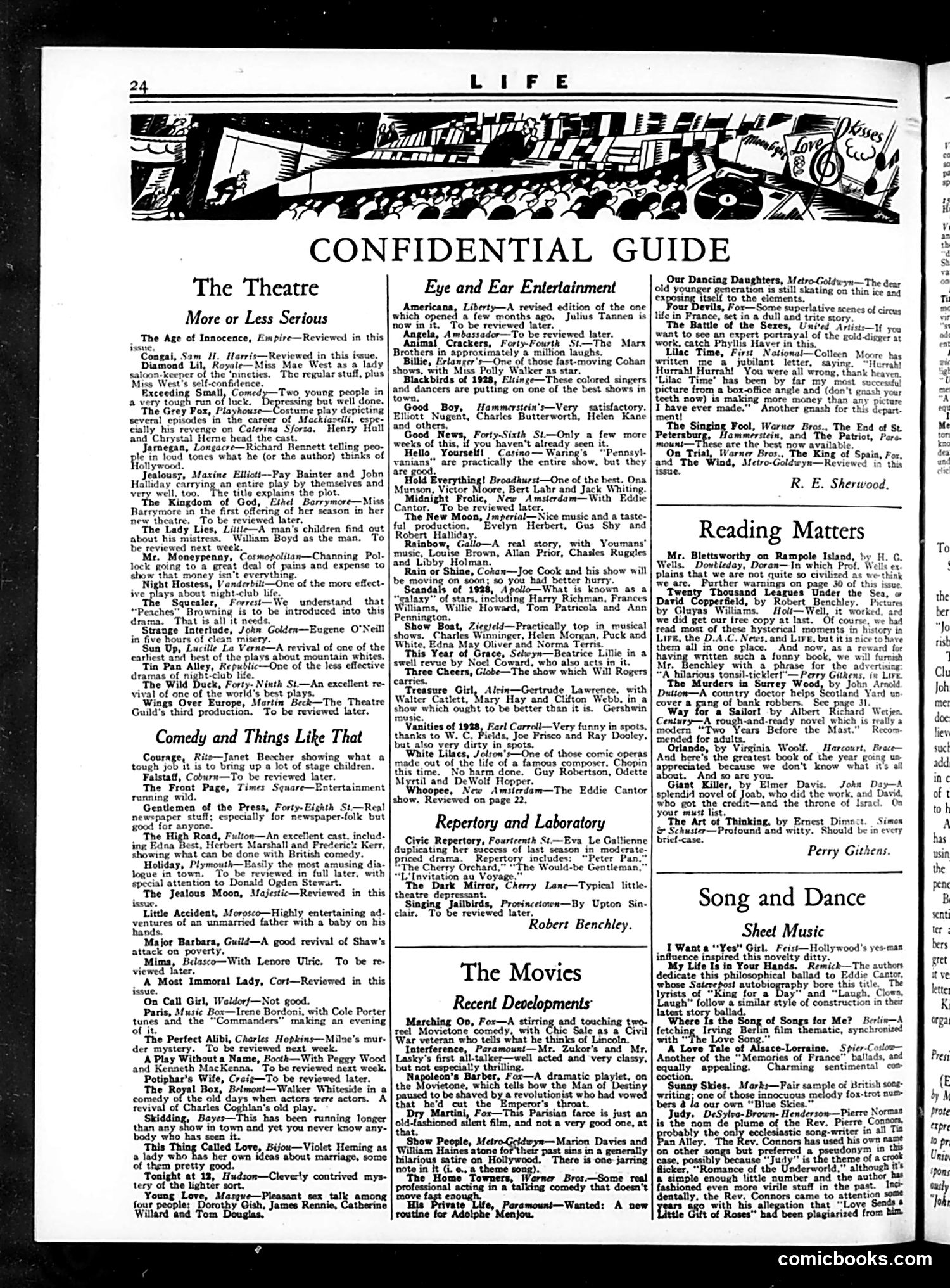
What you’re looking at
This is a **theater and entertainment review page**, not a political cartoon. The page presents a "Confidential Guide" to Broadway shows and movies currently running, organized by category: serious dramas, comedies, movies, and reading recommendations. The content reflects 1920s theatrical culture, featuring reviews of plays by prominent playwrights like Eugene O'Neill (*Strange Interlude*) and George Bernard Shaw (*Major Barbara*), along with star-studded casts including Ethel Barrymore and Irene Bordoni. Notable references include "Peaches" Browning (a scandal-era socialite) and mentions of Hollywood's growing influence on theater. The snide, gossipy tone ("you never know anybody who has seen it," regarding *Skidding*) is characteristic of Life's satirical style—mocking both theatrical pretension and audience taste rather than targeting specific political figures.
📄 Transcribed text from this page (OCR, searchable)
Machine-transcribed from the original scan — historical spelling and the odd misread are preserved.
CONFIDENTIAL GUIDE The Theatre More or Less Serious _ The Age of Innocence, Empire—Reviewed in this wed in this issue. e West as a lady be regular stuff, plus Congai, Sam H. Harris—Rev Diamond Lil, Royale—Miss 3 - keener of the ‘nineties. TI Exceeding Small, Comed»—Two. young people in a very tough run of luck. Depressing but well done. The Grey For, Playhouse—Costume play depicting several episodes’ in the carcer of Mackiazelli, espe- cially his revenge on Caterina Sforsa. Henry Hull and Chrystal Heme head the cast. . Jamegan, Longacre—Richard Bennett telling peo- 1é in loud ‘tones what he (or the author) thinks of Hollywood. ; Jealouss, Maxine Elliott—Pay Bainter and Jobn Halliday carrying an entire play by themselves and very well, too. The title explains the plot. The Kingdom of God, Ethel Barrymore—Miss Barrymore in the first offering of her season in her new theatre. To be reviewed later, The Lady Lies, Liitl—A man’s children find out about his mistress. William Boyd as the man. To be reviewed next week, . Mr. Moneypenny, Cosmopolitan—Channing Pol- lock going to a great deal of pains and expense to show that money isn't evervthing. ight Hostess, Venderbili—One of the more effect- lays about night-club life. ¢ Squealer, Forrest—We understand that “Peaches” Browning is to be introduced into this drama. That is all it needs. . trange Interlude, John Golden—Eugene O'Neill in five hours of clean misery. . Sun Up, Lucille La Verne—A revival of one of the earliest and best of the plays about mountain whites. Tin Pan Alley, Republic—One of the less effective dramas of night-clab life. The Wild Duck, Forty- Ninth St—An excellent re- vival of one of the world’s best plays. Wings Over Europe, Martin Beck—The Theatre Guild's third production. To be reviewed later. Comedy and Things Like That Courage, Rits—Janet Beccher showing what a tough job it is to bring up a lot of stage children. Falstaff, Coburn—To be reviewed later. The Front Page, Times Square—Entertainment running wild. Gentlemen of the Press, Forty-Eighth St—Real newspaper stuff; especially for newspaper-folk but good for anyone. The High Road, Fulton—An excellent cast, includ- ing Edna Best, Herbert Marshall and Predenc’s Kerr, showing what can be done with British comedy. Holiday, Plymouth—Easily the most amusing dia- logue in town. To be reviewed in full later, with special attention to Donald Ogden Stewart. _ The Jealous Moon, Majestic—Reviewed in this issue. Little Accident, Morosco—Highly entertaining ad- mee of an unmarried father with a baby on his s. Major Barbara, Guild—A good revival of Shaw's attack on poverty. Mima, Belasco—With Lenore Ulric. To be re- viewed later. A Most Immoral Lady, Cor!—Reviewed in this issue. On Call Girl, Waldorf—Not good. Paris, Music Box—Irene Bordoni, with Cole Porter tunes and the “Commanders” making an evening of it. The Perfect Alibi, Charles Hopkins—Milne’s mur- der mystery. To be reviewed next week. A Play Without a Name, Booth—With Peggy Wood and Kenneth MacKenna, ‘To be reviewed next week. Potiphar’s Wife, Craig—To be reviewed later. The Royal Box, Belmont—Walker Whiteside in a comedy of the old days when actors were actors. A revival of Charles Coghlan’s old play. Skidding, Boyes—This has been running longer than any show in town and yet you never know any- body who has seen it. This Thing Called Love, Bijow—Violet Heming as a lady who has her own ideas about marriage, some of them pretty good. Tonight at 12, Hudson—Cleverty contrived mys- tery of the lighter sort, ‘oung Love, Masque—Pleasant sex tal four people: Dorothy Gish, James Rennic, Willard and Tom Douglas. ive among therine Eye and Ear Entertainment Americana, Liberty—A revised edition of the one which opened a few months ago. Julius Tannen is now in it. To be reviewed later. Angela, Ambassador —To be reviewed later. Animal Crackers, Forty-Fourth St—The Marx Brothers in approximately a miltion laughs. Billie, Erlanger's—One of those fast-moving Cohan shows, with Miss Polly Walker as star. Blackbirds of 1928, Ellinge—These colored sinxers and dancers are putting on one of the best shows in town. Good Boy, Hammcrstein's—Very satisfactory. Elliott Nugent, Charles Butterworth, Helen Kane and others. Good News, Forty-Sixth St—Only a few more weeks of this, If you haven't already seen it. Hello, Yourself! Casino— Waring’s “Pennsy! vanians” are practically the entire show, but they are good. : fold Everything! Broadhurst—One of the best. Ona Munson, Victor Moore, Bert Labr and Jack Whiting. Midnight Frolic, New Amsterdam—With Eddie To be revie ter. ‘Moon, Imperial—Nice music and a taste- tion. "Evelyn Herbert, Gus Shy and vallo—A real story, with Youmans’ . Loulse Brown, Allan Prior, Chasles Ruggles and Libby Holman. Rain or Shine, Cohan—Joe Cook and his show will be moving on soon; so you had better hurry. Scandals of 1928, Apollo—What is known as a “galaxy” of stars, incloding Harry Richman, Frances Williams, Willie Howaed, Tom Patricola and Ann Pennington. . . . Show Boat, Ziegseld—Practically top in musical shows. Charles Winninger, Helen Morgan, Puck and White, Edna Mai This Y race, S swell revue by Noel Coward, who also acts in it. ‘Three Cheers, Globe—The show which Will Rogers carries. Treasure Girl, Alcin—Gertrude Lawrence, with Walter Catlett, Mary Hay and Clifton Webb, in a show which ought to be better than it is. Gershwin music. Vanities of 1928, Earl Carroll—Very funny in spots, thanks to W. C. Pields, Joe Prisco and Ray Dooley, but also very dirty in spots. White Lilacs, Jolson's—One of those comic operas made out of the life of a famous composer, Chopin this time. No harm done. Guy Robertson, Odette Myrtil and DeWolf Hopper. oopee, New Amsterdam—The Eddie Cantor show. Reviewed on page 22. Repertory and Laboratory Civic Repertory, Fourteenth St-—Eva Le Gallienne duplicating her success of last season in moderate- priced drama. Repertory includ Peter P. The Cherry Orchard,” “The Would-be Gentleman,” “L'Invitation au Voyage. , The Dark Mirror, Cherry Lane—Typical little- theatre depressant. Singing Jailbirds, Provincetown—By Upton Sin- clair, To be reviewed later. Robert Benchley. The Movies Recent Developments Marching On, For—A stirring and touching two- reel Movietone ‘comedy, with Chie Sale as a Civil War veteran who tells what he thinks of Lincoln. Interference, Paramount—Mr. Zukor's and Mr. Lasky's first all-talker—well acted and very classy, especially thrilling. jeon’s Barber, Fox—A dramatic playlet, on lovietone, which tells bow the Man of Destiny paused to be shaved by a revolutionist who had vowed that he'd cut the Emperor's throat. Dry Martini, For—This Parisian farce is just an old-fashioned sllent film, and not a very good one, at ‘Show People, M ‘Marion Davies and William Haines atone fof their past sins in a generally hilarious satire on Hollywood. There is one jarring note in it (i. 0., a theme song). The Home’ Towners, Warner Bros—Some real professional acting in a talking comedy that doesn't {‘Srivate ‘Lite, Paramount—Wanted: A routine fer Adotohs’ Menion: beseanrid ta tal Our Dancing Daughters, Mtro-Goldwy—The d old younger generation is still skating oa apes exposing itself to the elements, Sco thin ke aa _ Pour Devils, For—Some superlative scenes of circus life in Prance, set in a dull and trite story, wecite Battle of the Sexes, Untied Artif you see an cx tray: the di work, cateh Phyllis Haver in this, 's S™¢<i#ReF at ilac Time, First National—Colleen Moore has written ‘me a jubilant letter, saying, “Ilurmht Hurrah! Hurrah! "You were all wrong, thank haven, Lilac Time” has been by far my most succeaiel picture from a box-office angle and (don't gaash yosr teeth now) is making more money than any" picts Thave ever made.” Another gnash for this depart ment! ‘The Singing Fool, Warner Bros.. The End Petersburge Hammerstein, and The Patios Post mount—These are the, best now available, 2 ‘arner Bros., ing of ‘Spain, and ‘The Wind, ‘Metro-Goldwyn—Reviewed is the issue. R. E. Sherwood. Reading Matters Mr. Blettsworthy on Rampole Island, hy H. 6. Wells. Dontleday, Doran— 10 which Prof. Wells ex. plains that we are not quite so civilized as we- thi Further warnings on page 30 of this issue, Thousand Leagues Under the Sea, o Da rfield, ‘obert_ Benchley. Pictures by Gluyas Williams. Holi—Well, it worked, ard we did get our tree copy at last. Of course. we hat read most of these hysterical moments in history ia Live, the D.A.C. News, and Live, but it is nice to have them all in“one place. And now, as a reward for having written such a funny book, we will furnish Mr. Benchley with a phrase for ‘the advertising “A hilarious tonsil-tickler!”— Perry Githens, in Live Tho Murders in Surrey Wood, by John Arnold Dution—A country doctor helps Scotland Yard up cover a gang of bank robbers. | See page 31. Way for a Sailor! by Albert Richard Wetjer. Century—A rough-and-ready novel which is really a modern “Two Years Before the Mast.” Recom- mended for adults. Orlando, by Virginia Woolf. And here's the greatest book of the y appreciated because we don't know what about. And so are you. Giant Killer, by Elmer Davis. Joke Day—A splendid novel of Joab, who did the work, and David, who got the credit—ard the throne of Isracl. Os your must list. The Simos in every ie Thinking, by Ernest Dimn & Schuster—Profound and witty. Should brief-case. Perry Githens. Song and Dance Sheet Music Yes" Girl. Feist—Hol inspired this novelty ditty. wood's yes-man My Life Is in Your Hands. Remick—The authors dedicate this philosophical ballad to Eddie Cantor, autobiography bore this title. Tbe for a Day” and “Laugh, Clowa, similar style of construction in ther ball Is the Song of Songs for Me? Berlin—A Irving Berlin film thematic, synchronized he Love Song.” ‘A Love Tale of Alsace-Lorraine. Spier-Coslow— Another of the “Memories of France” ballads, and equally appealing. ing sentimental | com coction. . Sunny Skies. Marks—Pair sample of British sore- writing; one of innocuous melody fox-trot num bers @ /e our own “Blue Skies.” ; . _ Judy. DeSylea-Brown- Henderson—Pierre Normss is the nom So'pinme of the Rev. Pierre Consors, robably the ecclesiastic song-writer in all Tis an Alley. The Rev. Connors has used his own nant on other songs but preferred a \donym in case, possibly because “Judy” is the theme of a crool flicker, “Romance of the Underworld,” although it’s ‘a simple enough little number and the author y ‘even more virile stuff in the past. Incr dentally, the Rev. Hors came to attention some ith his allegation that “Love Sends # Little Gift of Roses” had been plagiarized from Bim. comicbooks.com