
Pulp Fiction, 1916 · page 96 of 220
The Argosy, April 1916 — page 96: what you’re looking at
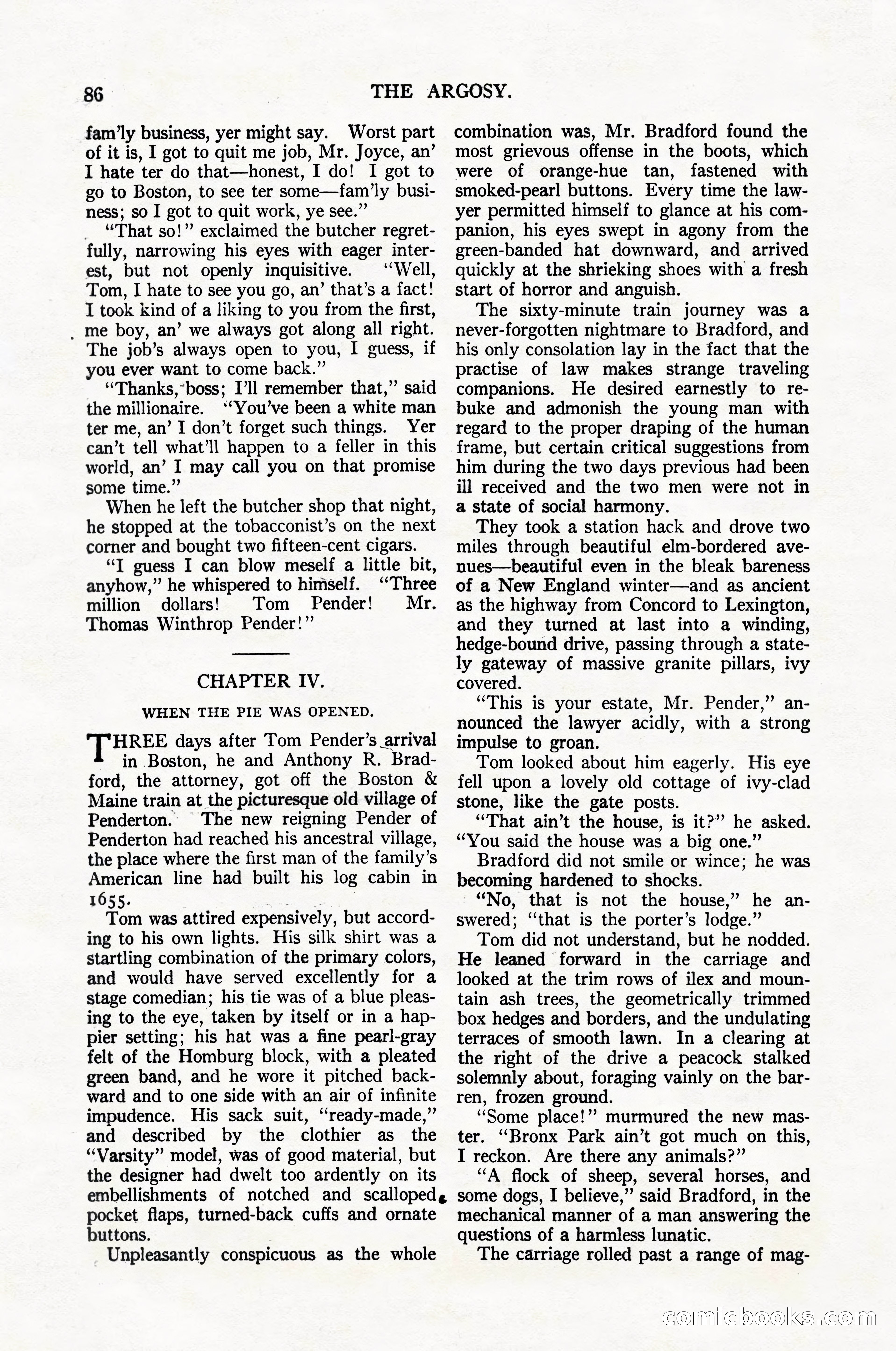
A restored page from Pulp Fiction, 1916. Page through the whole issue in the reader above.
📄 Transcribed text from this page (OCR, searchable)
Machine-transcribed from the original scan — historical spelling and the odd misread are preserved.
86 fam’ly business, yer might say. Worst part of it is, I got to quit me job, Mr. Joyce, an’ I hate ter do that—honest, I do! I got to go to Boston, to see ter some—fam'ly busi- ness; so I got to quit work, ye see.” _ “That so!” exclaimed the butcher regret- fully, narrowing his eyes with eager inter- est, but not openly inquisitive. ‘‘Well, Tom, I hate to see you go, an’ that’s a fact! I took kind of a liking to you from the first, _ me boy, an’ we always got along all right. The job’s always open to you, I guess, if you ever want to come back.” “Thanks,“boss; I’ll remember that,” said the millionaire. ‘‘You’ve been a white man ter me, an’ I don’t forget such things. Yer can’t tell what'll happen to a feller in this world, an’ I may call you on that promise some time.” When he left the butcher shop that night, he stopped at the tobacconist’s on the next corner and bought two fifteen-cent cigars. “T guess I can blow meself.a little bit, anyhow,” he whispered to himself. ‘Three million dollars! Tom Pender! Mr. Thomas Winthrop Pender!” CHAPTER IV. WHEN THE PIE WAS OPENED. “THREE days after Tom Pender’s arrival in Boston, he and Anthony R. Brad- ford, the attorney, got off the Boston & Maine train at the picturesque old village of Penderton.. The new reigning Pender of Penderton had reached his ancestral village, the place where the first man of the family’s American line had built his log cabin in 1655. eo ae Tom was attired expensively, but accord- ing to his own lights. His silk shirt was a startling combination of the primary colors, and would have served excellently for a stage comedian; his tie was of a blue pleas- ing to the eye, taken by itself or in a hap- pier setting; his hat was a fine pearl-gray felt of the Homburg block, with a pleated green band, and he wore it pitched back- ward and to one side with an air of infinite impudence. His sack suit, “ready-made,” and described by the clothier as_ the “Varsity” model, was of good material, but the designer had dwelt too ardently on its embellishments of notched and scalloped, pocket flaps, turned-back cuffs and ornate buttons. 3 Unpleasantly conspicuous as the whole THE ARGOSY. combination was, Mr. Bradford found the most grievous offense in the boots, which were of orange-hue tan, fastened with smoked-pearl buttons. Every time the law- yer permitted himself to glance at his com- panion, his eyes swept in agony from the green-banded hat downward, and arrived quickly at the shrieking shoes with a fresh start of horror and anguish. The sixty-minute train journey was a never-forgotten nightmare to Bradford, and his only consolation lay in the fact that the practise of law makes strange traveling companions. He desired earnestly to re- buke and admonish the young man with regard to the proper draping of the human frame, but certain critical suggestions from him during the two days previous had been ill received and the two men were not in a state of social harmony. They took a station hack and drove two miles through beautiful elm-bordered ave- nues—beautiful even in the bleak bareness of a New England winter—and as ancient as the highway from Concord to Lexington, and they turned at last into a winding, hedge-bound drive, passing through a state- ly gateway of massive granite pillars, ivy covered. “This is your estate, Mr. Pender,” an- nounced the lawyer acidly, with a strong impulse to groan. Tom looked about him eagerly. His eye fell upon a lovely old cottage of ivy-clad stone, like the gate posts. “That ain’t the house, is it?” he asked. “You said the house was a big one.” Bradford did not smile or wince; he was becoming hardened to shocks. ' “No, that is not the house,” he an- swered; ‘“‘that is the porter’s lodge.” Tom did not understand, but he nodded. He leaned forward in the carriage and looked at the trim rows of ilex and moun- tain ash trees, the geometrically trimmed box hedges and borders, and the undulating terraces of smooth lawn. In a clearing at the right of the drive a peacock stalked solemnly about, foraging vainly on the bar- ren, frozen ground. ‘Some place!” murmured the new mas- ter. ‘Bronx Park ain’t got much on this, I reckon. Are there any animals?”’ “A flock of sheep, several horses, and some dogs, I believe,” said Bradford, in the mechanical manner of a man answering the questions of a harmless lunatic. The carriage rolled past a range of mag- COMmicloo SS C©