
A complete issue · 36 pages · 1929
Judge — April 20, 1929
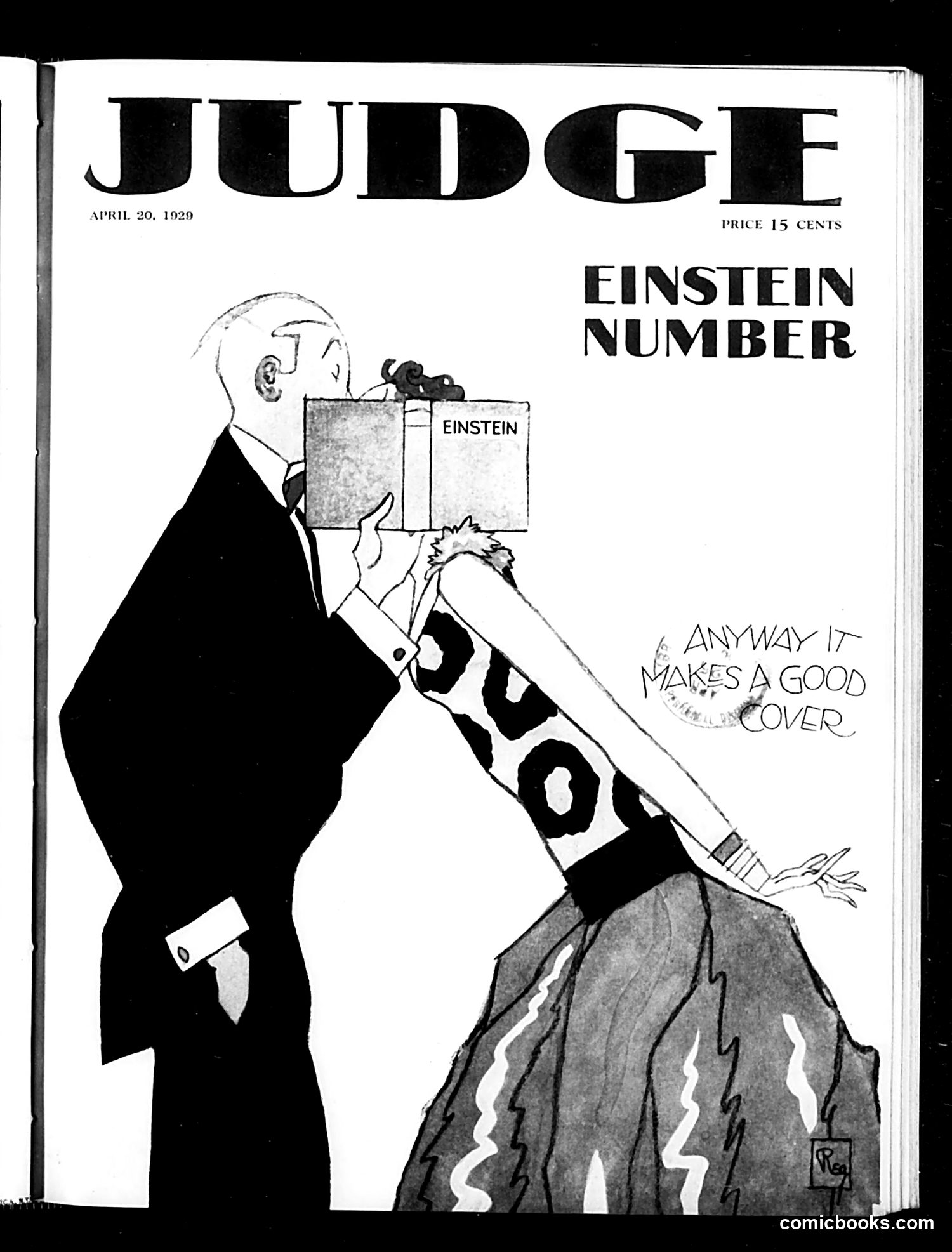
This is the cover of Judge's special "Einstein Number." The cartoon depicts a man in formal attire holding up a large book labeled "EINSTEIN" to a woman whose head appears to be exploding or radiating outward with jagged lines—suggesting her mind is being overwhelmed or shattered by Einstein's theories. The caption reads "ANYWAY IT MAKES A GOOD COVER," which is self-aware satire: the magazine is acknowledging that Einstein's popularity and mystique make him commercially viable for a special issue, regardless of whether readers actually understand his revolutionary physics theories. The joke satirizes public fascination with Einstein as a celebrity intellectual rather than genuine comprehension of relativity.
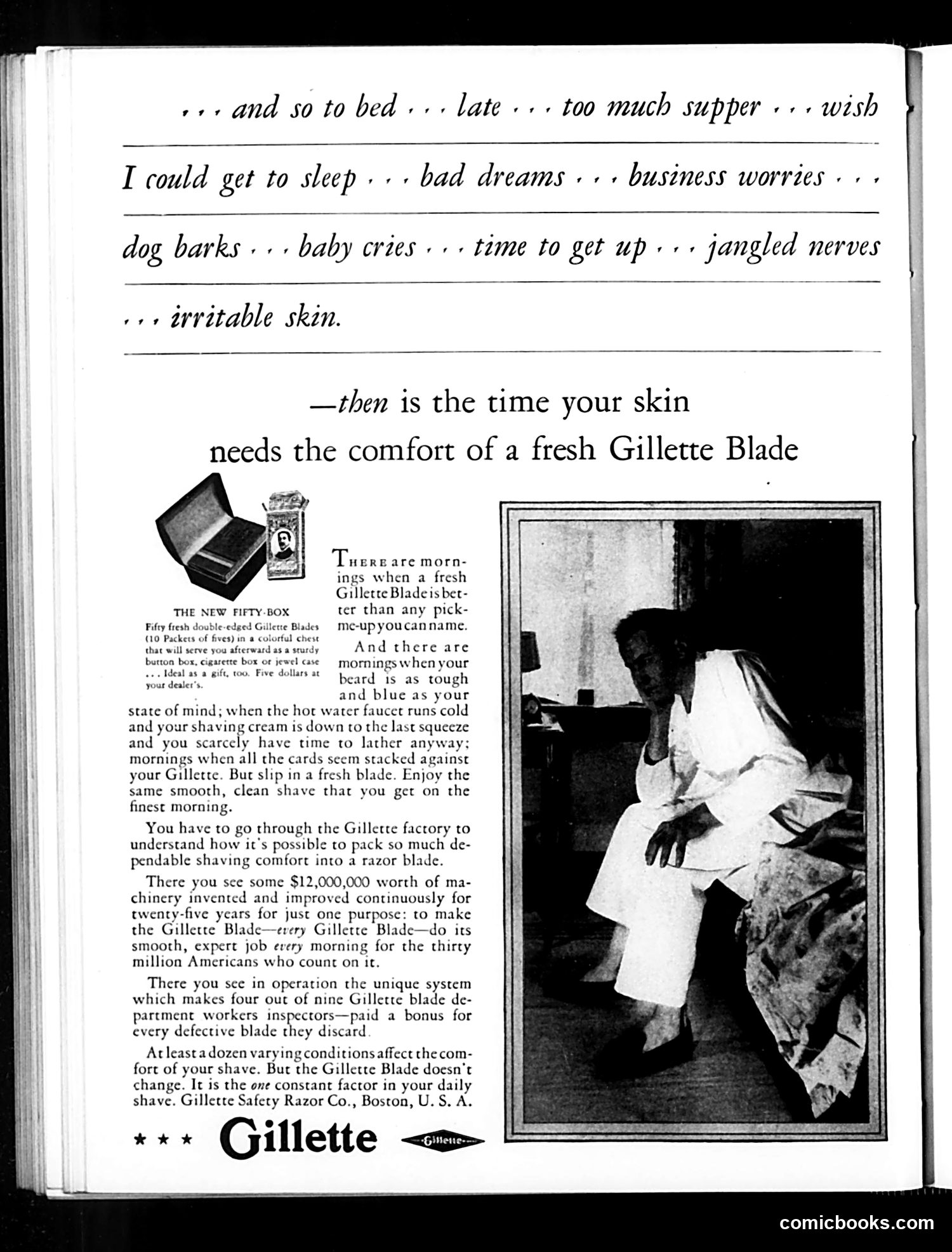
This page is primarily a **Gillette razor blade advertisement**, not satire or political commentary. The ad appeared in *Judge*, a satirical magazine, but this particular content is commercial. The advertisement depicts a stressed man unable to sleep due to life's anxieties—business worries, dogs barking, babies crying, jangled nerves, and irritable skin. The copy argues that a fresh Gillette blade provides comfort and relief during difficult mornings when a man's beard is "tough and blue" and he lacks time to lather properly. The photograph shows a man in bed appearing exhausted or distressed, illustrating the problem the product claims to solve. The ad emphasizes Gillette's manufacturing precision and quality control, positioning the razor blade as a reliable constant in an unpredictable daily life.
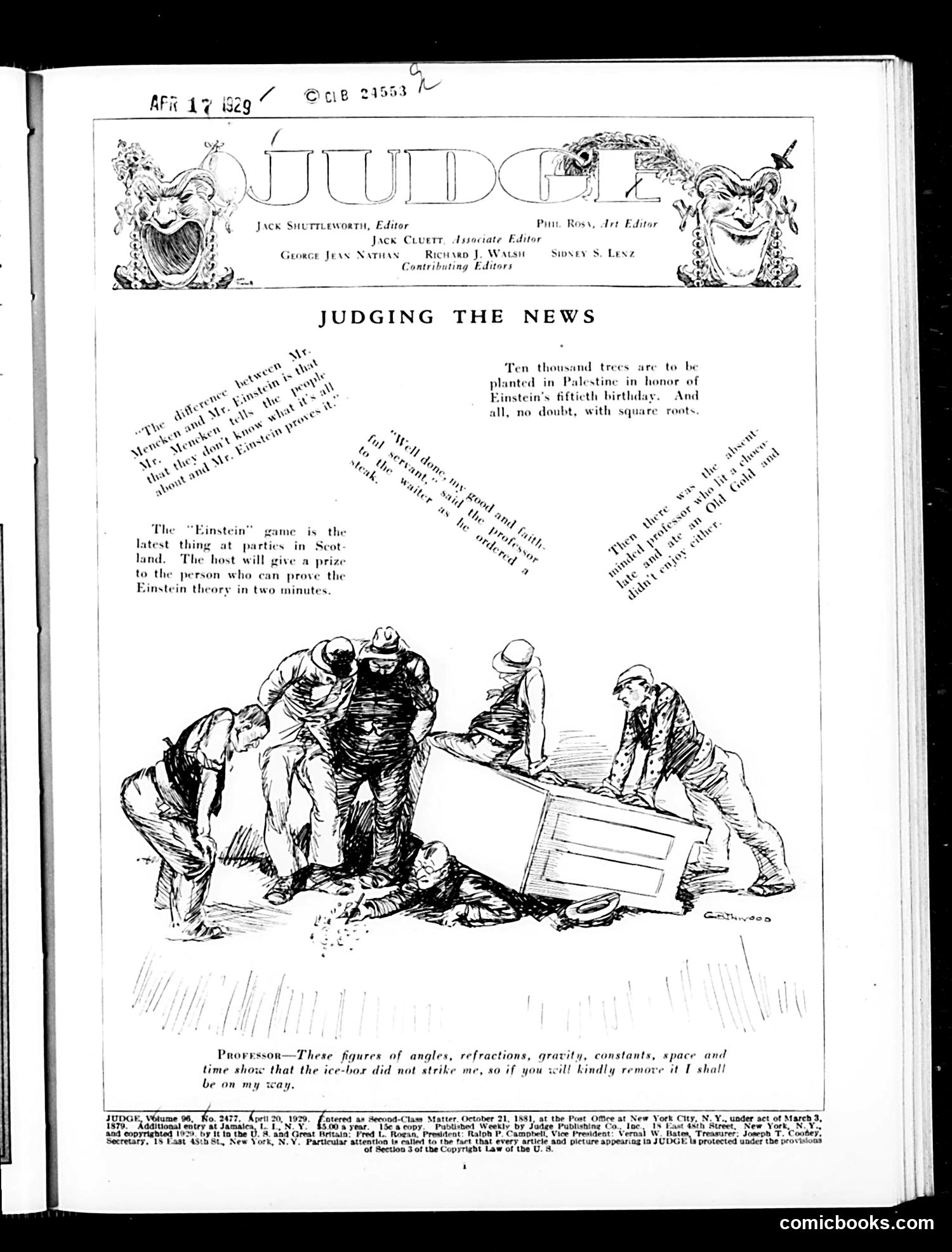
This page from Judge (April 17, 1929) contains three separate news-commentary pieces: 1. **Einstein's birthday trees**: A quip about planting 10,000 trees in Palestine to honor Einstein's 50th birthday, joking they'll have "square roots." 2. **The "Einstein game"**: A Scottish party game where guests must prove Einstein's relativity theory in two minutes to win a prize—obvious satire of the theory's perceived incomprehensibility. 3. **Main cartoon**: Shows men examining a fallen figure with an overturned box, captioned about angles, refraction, gravity, and an ice-box striking. This appears to be slapstick humor about a mishap involving falling ice or cargo—a common visual gag format. The page satirizes Einstein's celebrity status and public fascination with his theories, treating complex physics as fodder for popular amusement and physical comedy.
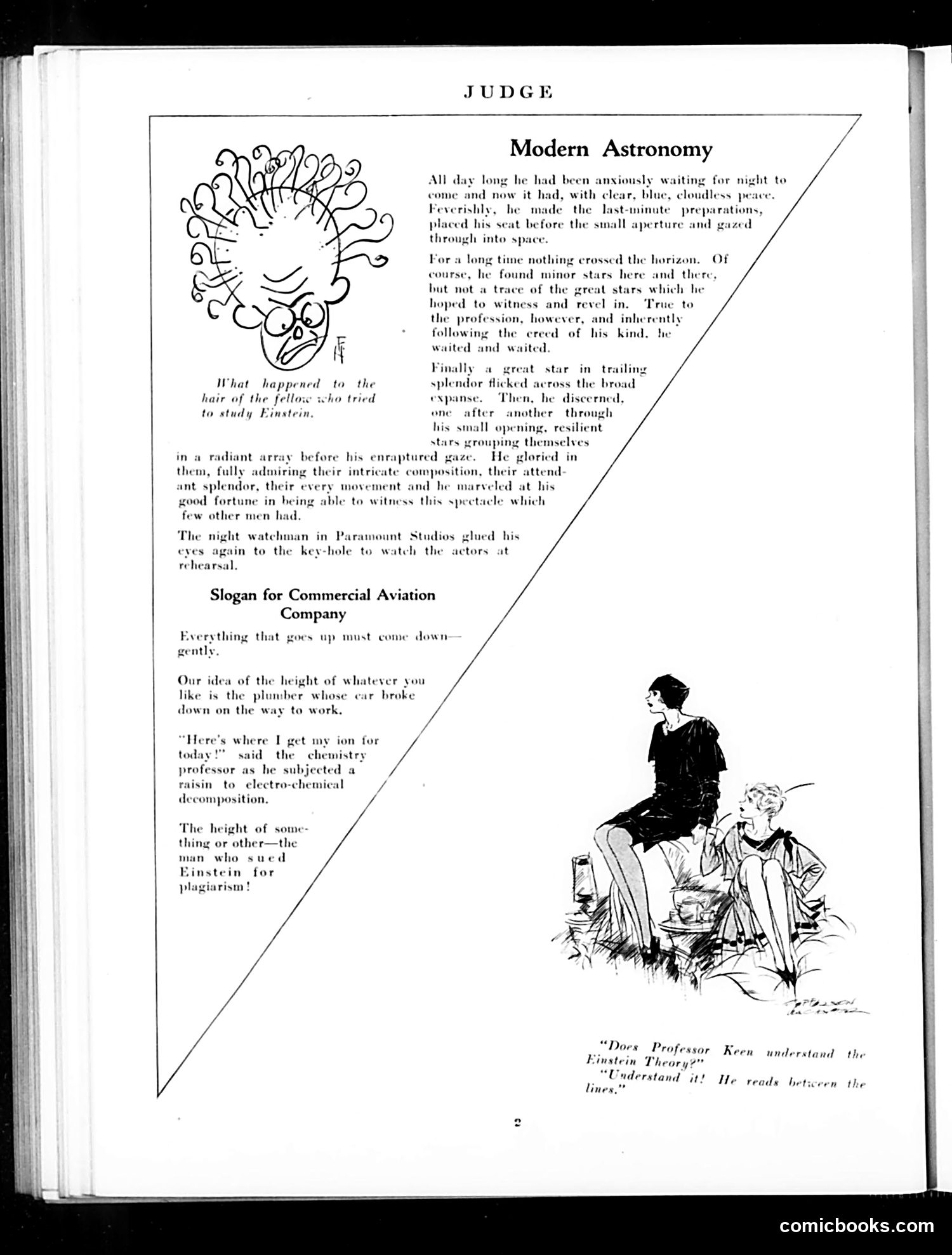
This page contains two satirical pieces: **"Modern Astronomy"** mocks a fellow attempting to study stars through a telescope, only to observe minor stars instead of major constellations. The joke appears to satirize someone (possibly a public figure) pursuing grand intellectual ambitions but achieving mediocre results—a common theme in academic or scientific pretension. **"Slogan for Commercial Aviation Company"** is briefer satire about a plumber whose car breaks down, with a chemistry professor subjected to electrochemical decomposition. The bottom illustration references Einstein's theory, suggesting the piece mocks those who invoke Einstein without understanding his work—poking fun at intellectual posturing and the trendy misuse of scientific concepts in everyday contexts.
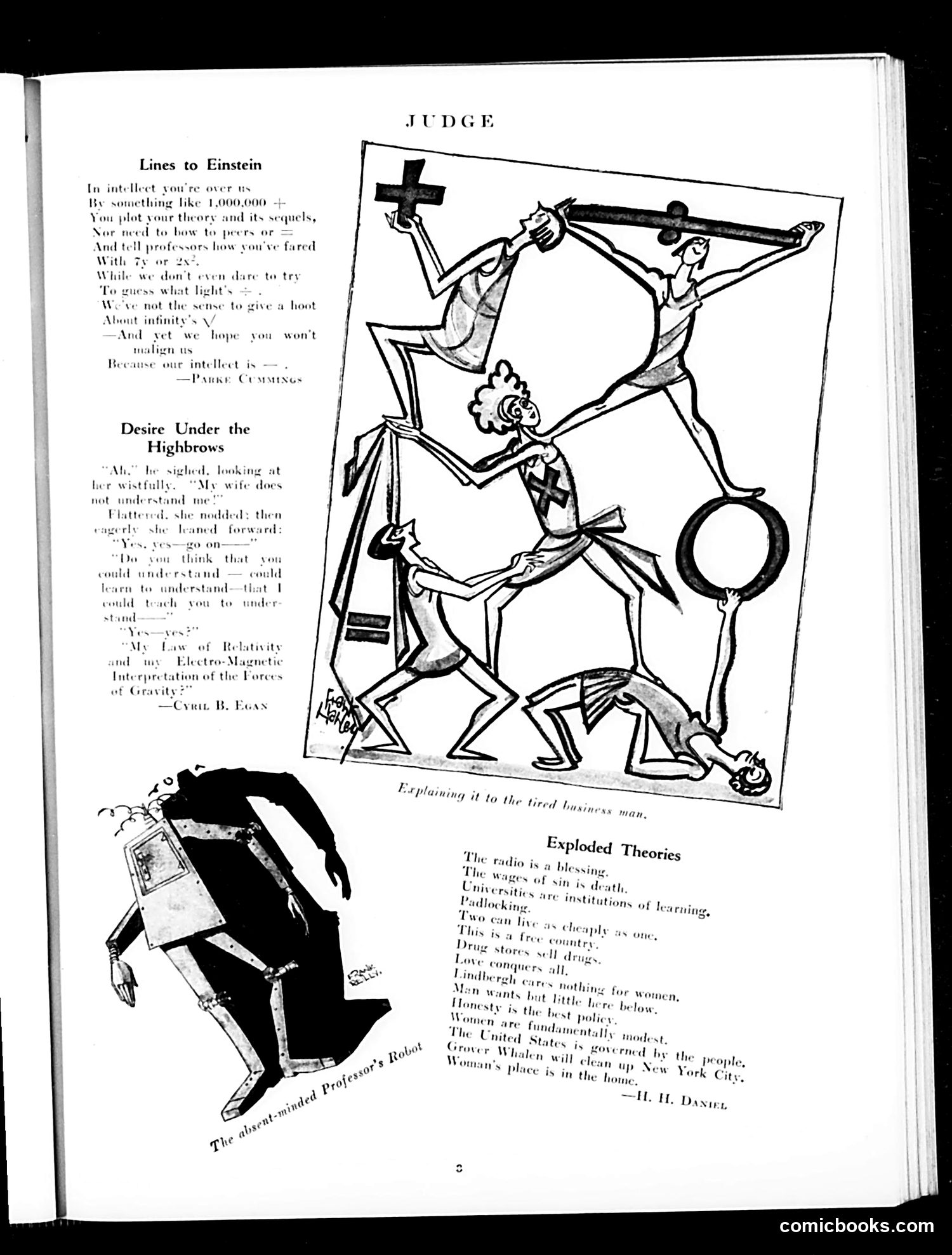
The main cartoon titled "Judge" depicts figures struggling to explain Einstein's theory of relativity to a bewildered businessman. Multiple caricatured men (appearing to represent scientists or intellectuals) hold scientific instruments and geometric shapes while a confused everyman figure sits below, labeled "Explaining it to the tired business man." This satirizes the public's difficulty understanding Einstein's revolutionary 1920s physics. The accompanying poems mock both scientific complexity and social pretensions—one critiques intellectuals' arrogance, another ("Exploded Theories") ridicules various social assumptions about women, religion, and economics. The cartoon's humor derives from the gap between expert knowledge and ordinary comprehension, reflecting 1920s anxieties about modernity outpacing public understanding.
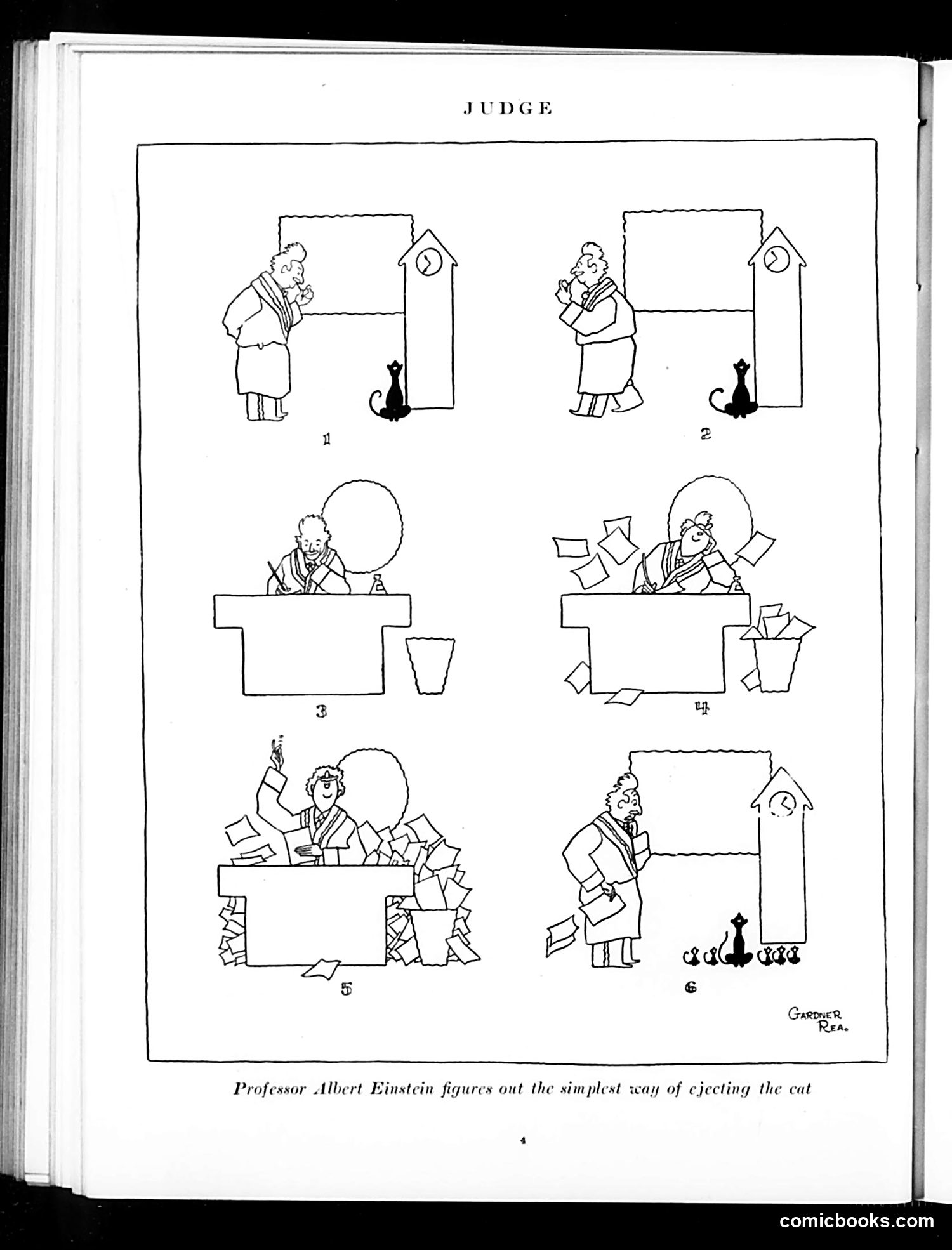
This cartoon satirizes Albert Einstein through a six-panel sequence titled "Professor Albert Einstein figures out the simplest way of ejecting the cat." The panels show escalating chaos: Einstein sits at a desk contemplating the problem (panels 1-2), then becomes increasingly frazzled as papers fly around him (panels 3-5), finally appearing disheveled surrounded by chess pieces (panel 6). The satire mocks Einstein's reputation for theoretical complexity by suggesting that even a simple, practical task—removing a cat—would inspire him to overcomplicate matters through abstract reasoning. The humor plays on the contrast between Einstein's intellectual genius and his apparent inability to handle an everyday domestic problem directly. The chess pieces in the final panel reinforce the idea of strategic overthinking.
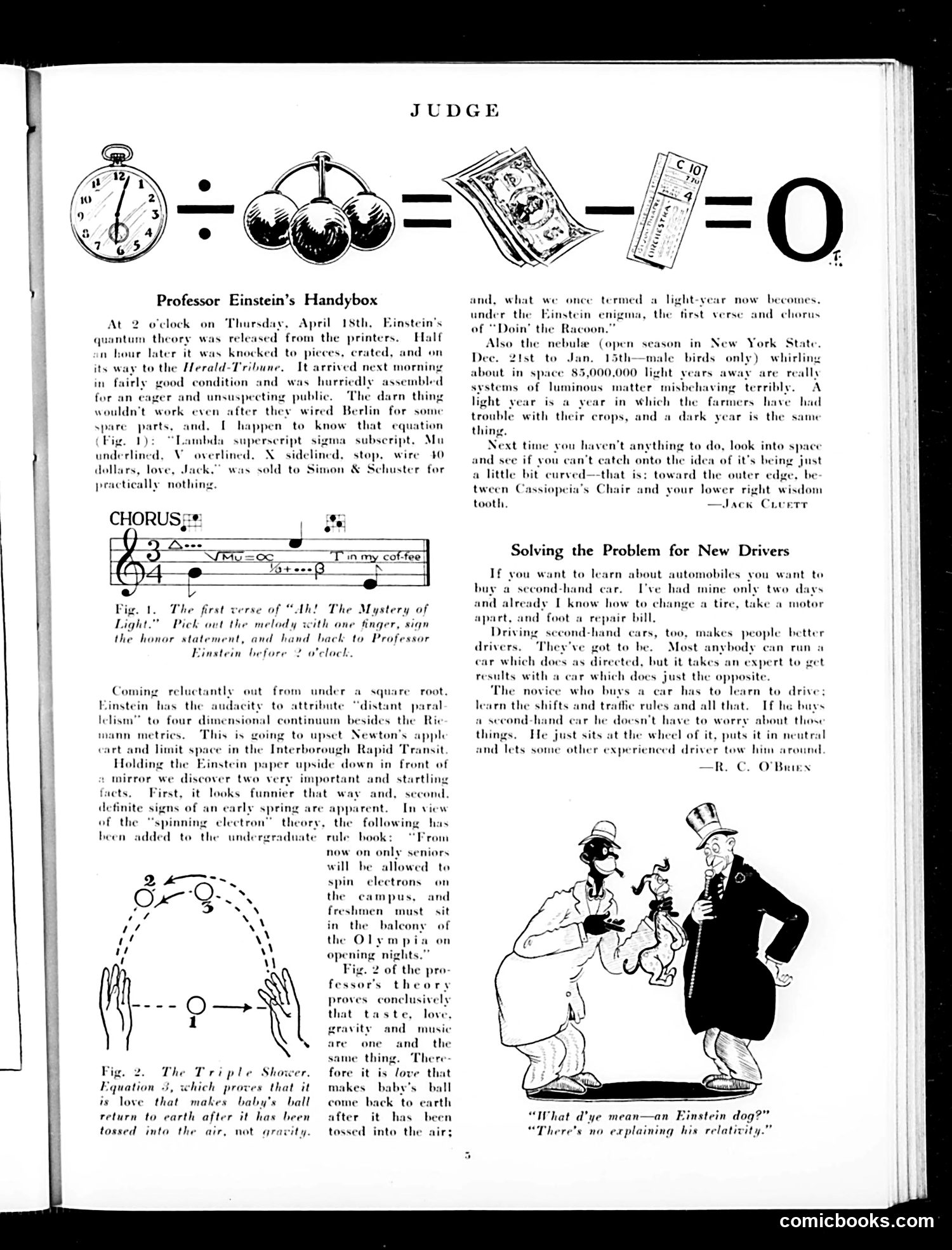
This page satirizes **Einstein's relativity theory**, released to press on April 18th. The top equation humorously reduces Einstein's complex physics to absurdity: a pocket watch, three spheres, papers, and a ticket equal zero—suggesting the theory's practical value is worthless to ordinary people. The "Professor Einstein's Handbook" section mocks the theory's incomprehensibility, noting even Berlin newspapers couldn't explain it. A chorus invites readers to sing "Ah! The Mystery of Light" to Einstein before 9 o'clock. The bottom section, "Solving the Problem for New Drivers," shifts to practical automobile advice—a humorous contrast suggesting that while Einstein puzzles over theoretical physics, average people need basic driving lessons. The cartoon ridicules the gap between abstract science and everyday reality.
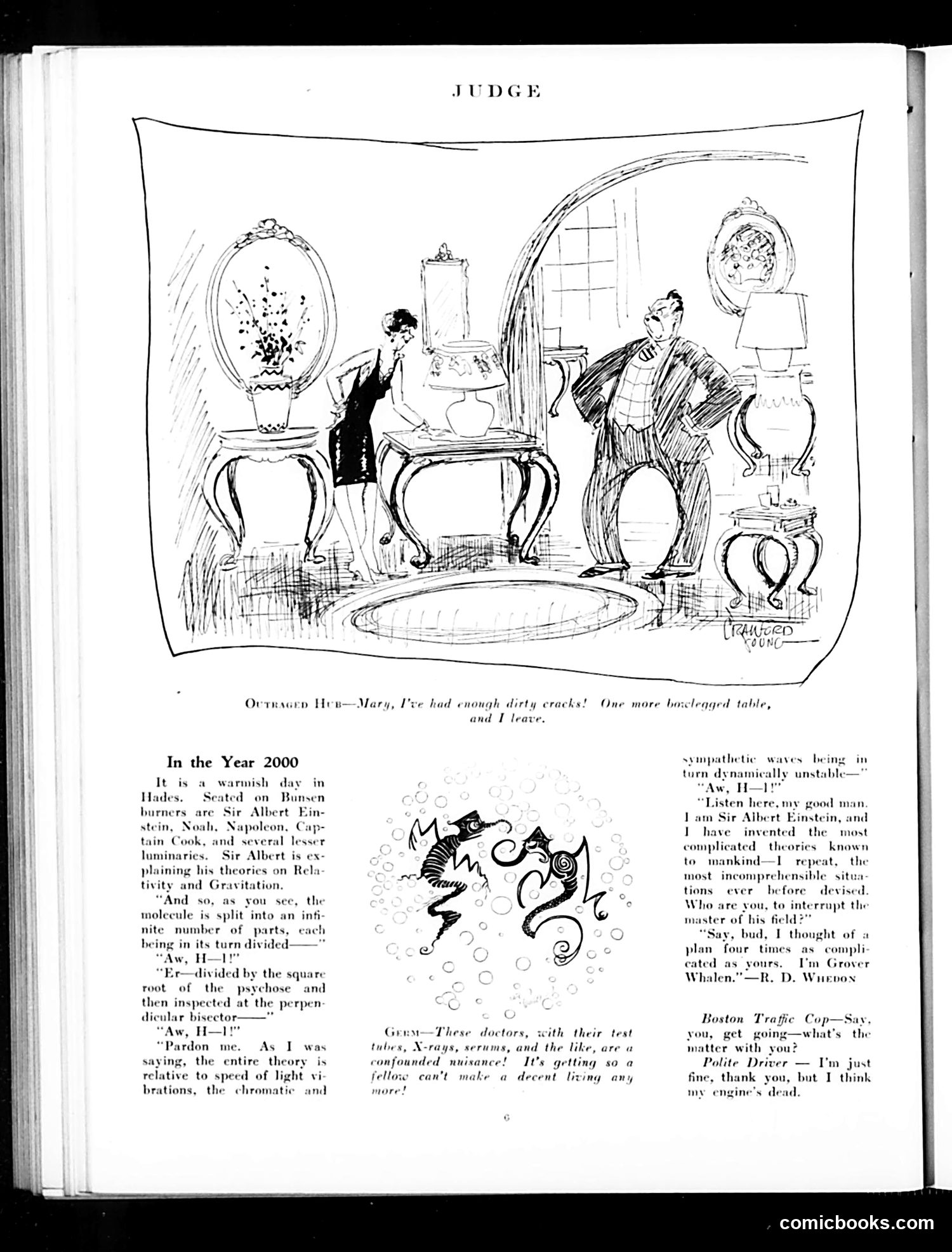
This page contains a cartoon and humorous text pieces from *Judge* magazine. The top cartoon depicts an affluent interior with elegant furniture. A woman tells a man: "Outworn Her—Mary, I've had enough dirty cracks! One more lovejagged table, and I leave." The satire targets wealthy couples' domestic disputes over interior decoration and furnishings—a concern of the leisured class. Below, the text "In the Year 2000" presents a fictional scenario where Sir Albert Einstein explains complex physics theories to an uncomprehending listener. The humor mocks both Einstein's impenetrability and the fantasy of predicting far-future science. The accompanying illustrations of whimsical creatures reinforce the absurdist tone. Other brief comic snippets address Boston traffic and a police officer's engine trouble.
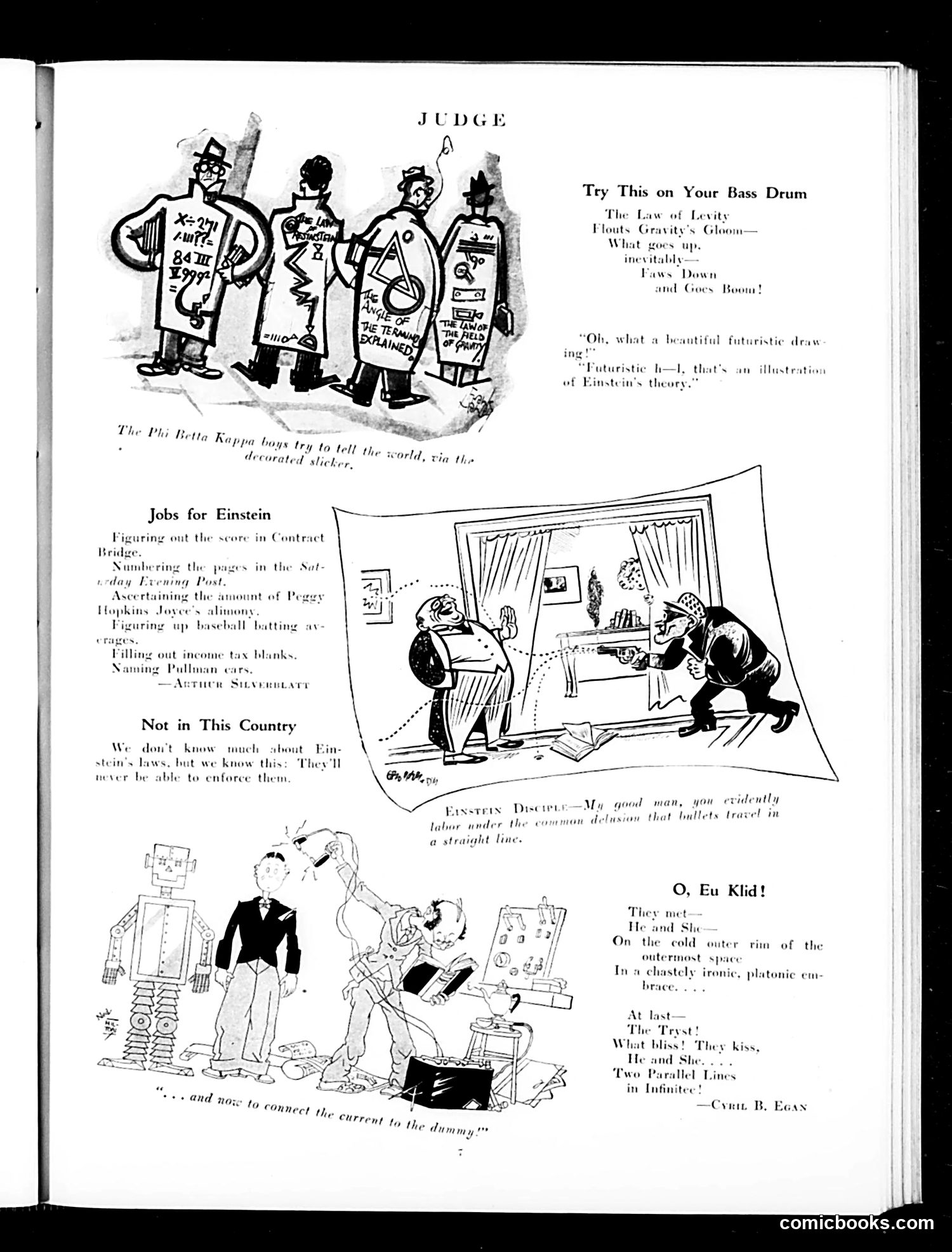
This page contains multiple cartoons mocking **Einstein and his scientific theories** during the early 20th century. The top section shows Phi Beta Kappa fraternity members wearing formulas on their robes, attempting to explain Einstein's physics to the public—satirizing how his complex theories were being popularized and misunderstood. **"Jobs for Einstein"** humorously lists mundane tasks unsuitable for the genius physicist, from accounting to naming railroad cars, suggesting Einstein's revolutionary mind is wasted on ordinary work. **"Not in This Country"** jokes that while Americans don't understand Einstein's laws of physics, they won't enforce them anyway—mocking both scientific illiteracy and American attitudes toward regulation. The final cartoons play on **geometry concepts**: one depicts someone misunderstanding that "bullets travel in straight lines" (confusing physics with geometry), while "O, Eu Klid!" features a romantic poem about two lovers meeting "on the outer rim of the outermost space" who remain "two parallel lines in infinite"—a geometric joke about romance and infinity.
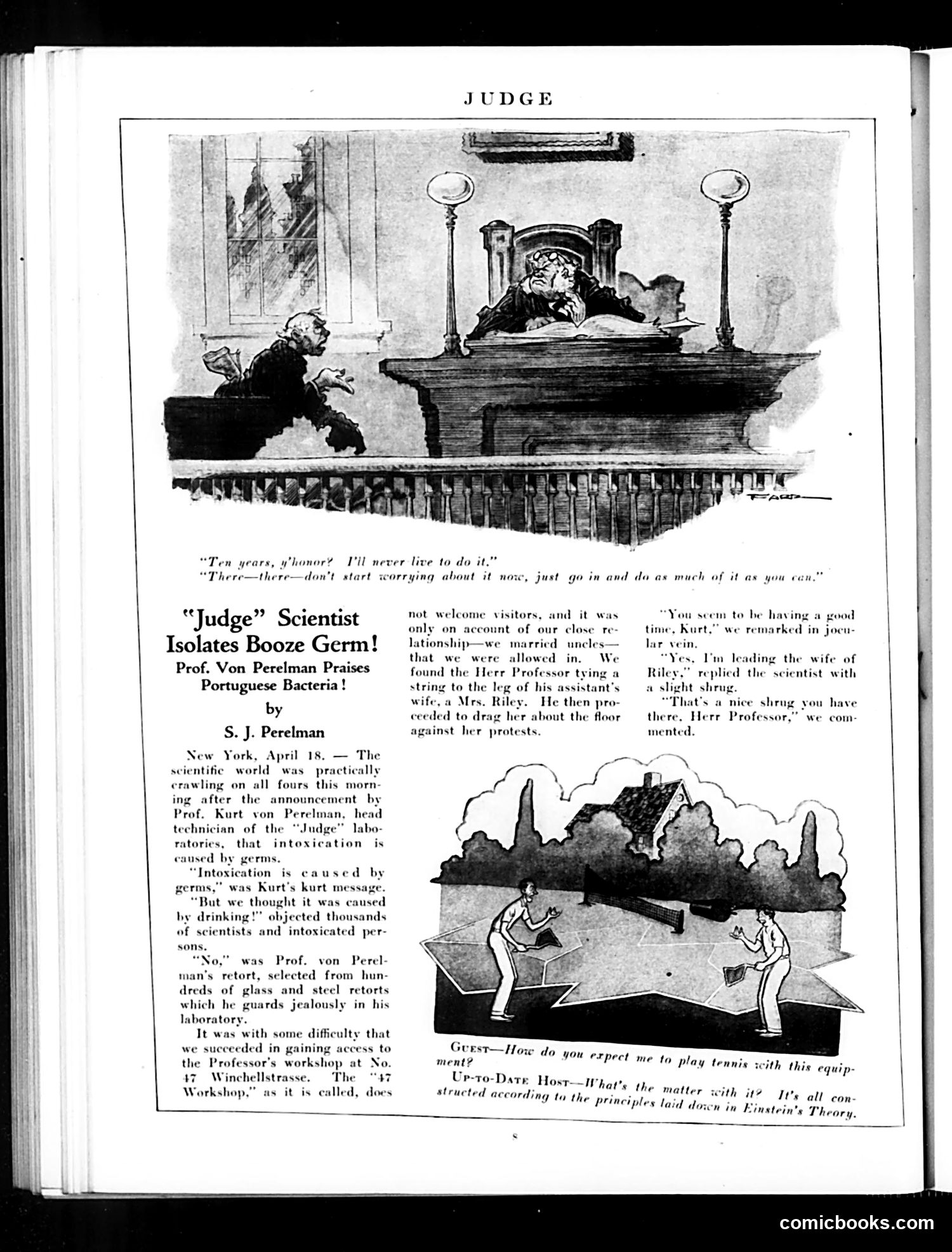
This page contains two satirical pieces by S.J. Perelman mocking scientific pretension. **Upper Cartoon**: A courtroom scene where a judge lectures a defendant about honor and living decently. The satire targets judicial hypocrisy—the judge ironically dismisses the defendant's concerns while embodying moral laxity himself. **Main Article "Judge Scientist Isolates Booze Germ"**: Perelman satirizes Prof. Von Perelman (a fictional character sharing the author's name) as an absurdly self-important scientist who claims germs—not alcohol consumption—cause intoxication. The humor lies in the ridiculous inversion of obvious cause-and-effect, mocking pseudoscientific posturing and academics who overstate their discoveries. The anecdote about tying string to his assistant's wife's leg suggests eccentric, questionable behavior masked by scientific authority. **Lower Cartoon**: Two tennis players discuss court strategy using pseudo-scientific language ("Einstein's Theory"), mocking how people mindlessly invoke scientific concepts to sound intelligent. The satire targets scientific pomposity and the era's tendency to attribute all problems to newly-discovered germs.
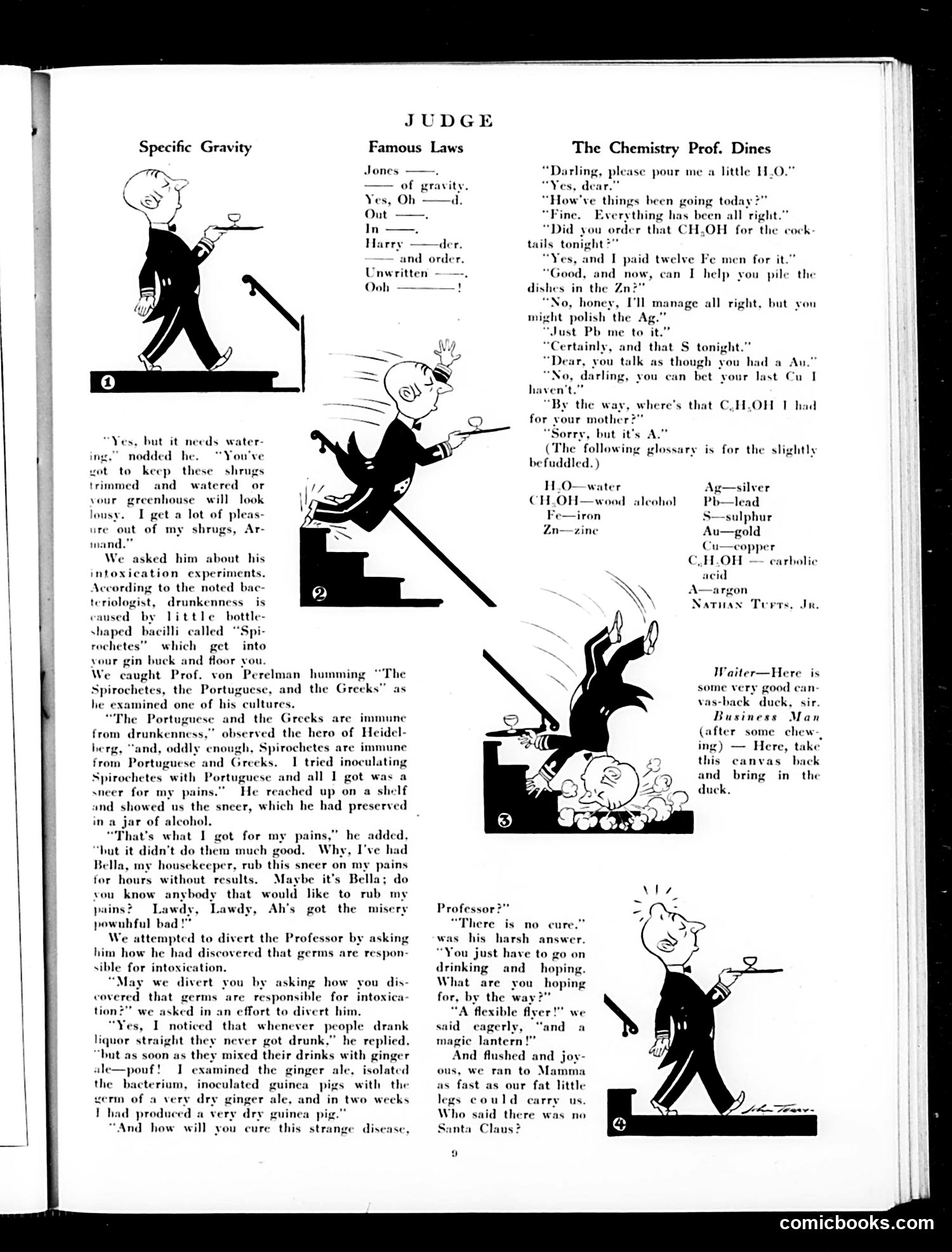
This page contains two separate satirical pieces: **Left side ("Specific Gravity"):** A mock-scientific interview with "Prof. von Perelman," a fictional bacteriologist who claims to have discovered that drunkenness is caused by "spirochetes" (bottle-shaped bacteria) in gin. The satire mocks pseudo-scientific explanations for alcoholism popular in the early 20th century. The professor's absurd claims—that he preserved a "sneer" in alcohol, that ginger ale causes intoxication—ridicule both scientific pretension and temperance movement rhetoric blaming germs rather than personal choice for drinking problems. **Right side ("The Chemistry Prof. Dines"):** A domestic comedy where a chemistry professor and his wife speak entirely in chemical symbols and abbreviations (H₂O for water, Fe for iron, Au for gold, etc.). The joke plays on academic pedantry—the professor is so consumed by his discipline he cannot have normal conversation, turning dinner chat into a chemistry lesson. A glossary helps readers decode the dialogue. Both pieces satirize academic pretension and overspecialization.
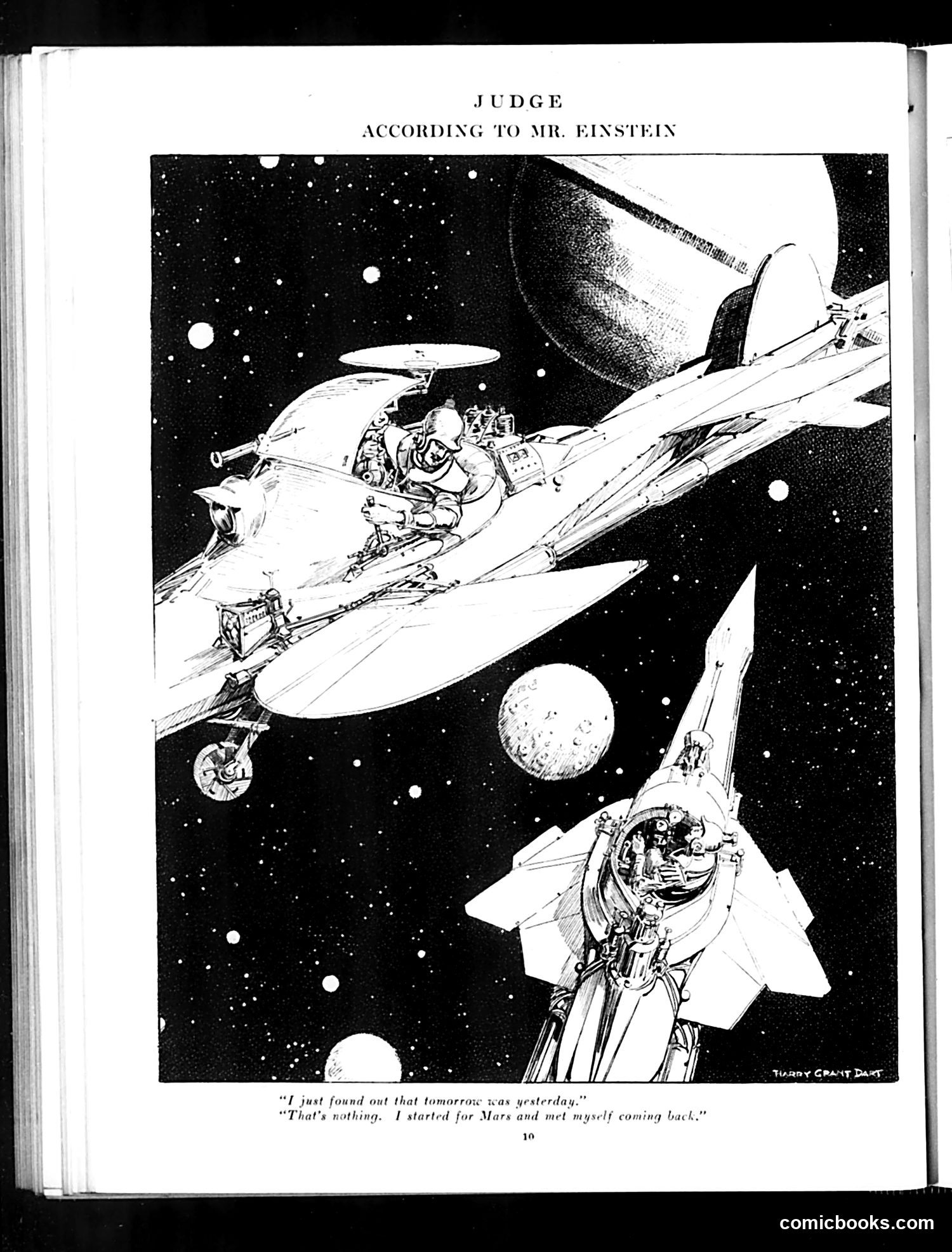
This satirical illustration by Harry Grant Dart mocks Einstein's theory of relativity. The cartoon depicts futuristic space travelers in rocket ships encountering paradoxical situations—one discovers "tomorrow was yesterday," the other started for Mars and "met myself coming back." The humor targets public confusion and skepticism about Einstein's then-revolutionary concepts of time relativity and spacetime. The title "According to Mr. Einstein" frames these absurd scenarios as logical consequences of his theories. By showing time-travel impossibilities presented matter-of-factly, the cartoonist suggests Einstein's ideas are so counterintuitive they border on nonsense. This reflects early-twentieth-century popular bewilderment with relativity theory—many Americans found it incomprehensible and mocked it as pseudoscience. The cartoon ridicules both Einstein's theories and those who accept them uncritically.
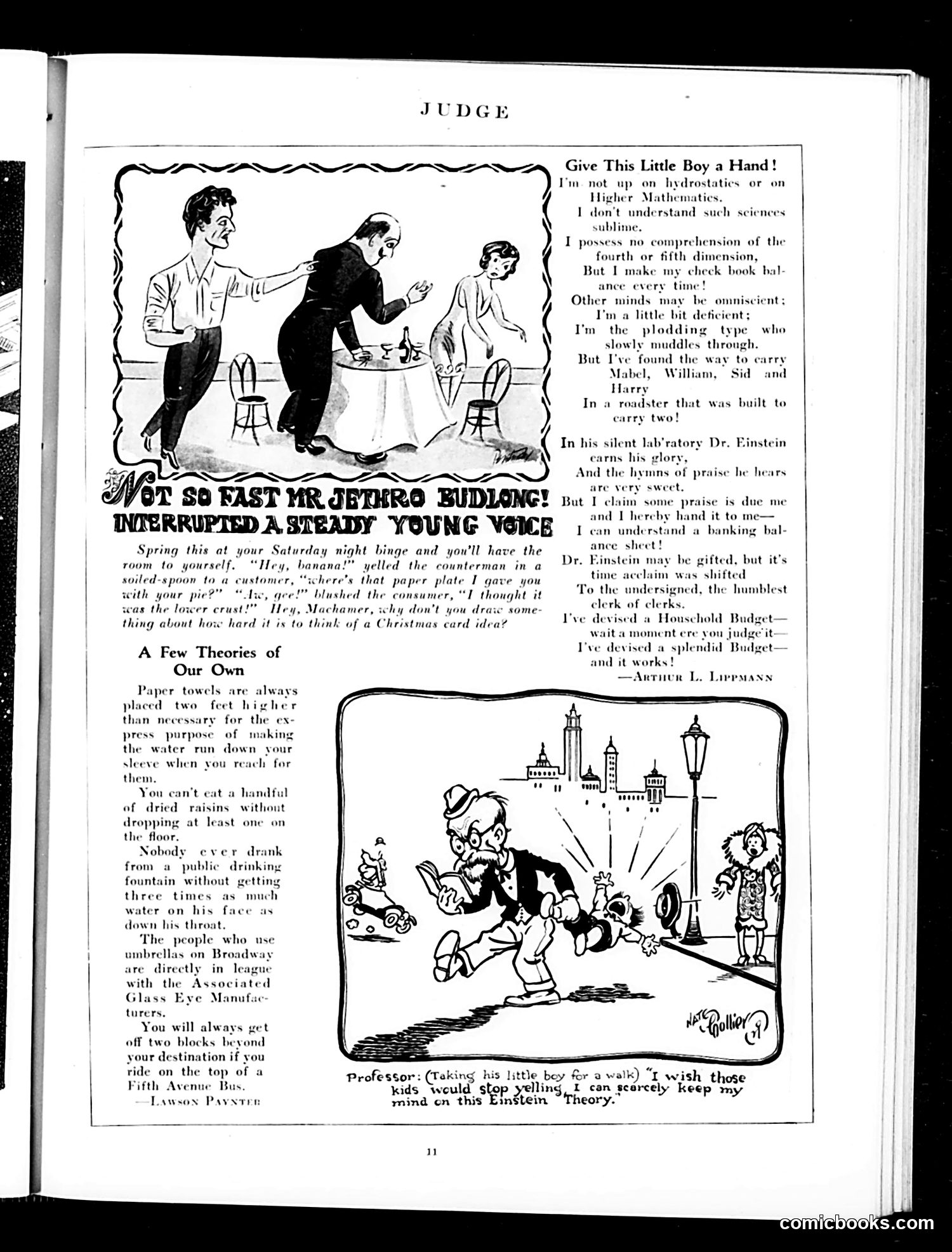
This Judge magazine page contains three satirical pieces mocking early 20th-century intellectual pretension and everyday absurdities. **Top cartoon**: "Not So Fast Mr. Jethro Budlong" depicts a man being corrected during dinner conversation, satirizing people who speak confidently about things they don't understand—a recurring social annoyance. **Middle section**: "A Few Theories of Our Own" humorously catalogs everyday frustrations (paper towels placed too high, raisins dropping, umbrella users blocking sidewalks). The satire mocks pseudo-intellectual attempts to explain mundane inconveniences through grand theories. **Bottom cartoon & poem**: The Professor character, presumably referencing Einstein's fame for complex physics, is humorously contrasted with an ordinary office worker who boasts about understanding a "banking balance sheet." The satire celebrates modest, practical competence over celebrated but incomprehensible genius—suggesting the average person's useful skills deserve equal recognition to Einstein's theoretical brilliance. Overall, the page satirizes both pretentiousness and the gap between intellectual celebrity and everyday value.
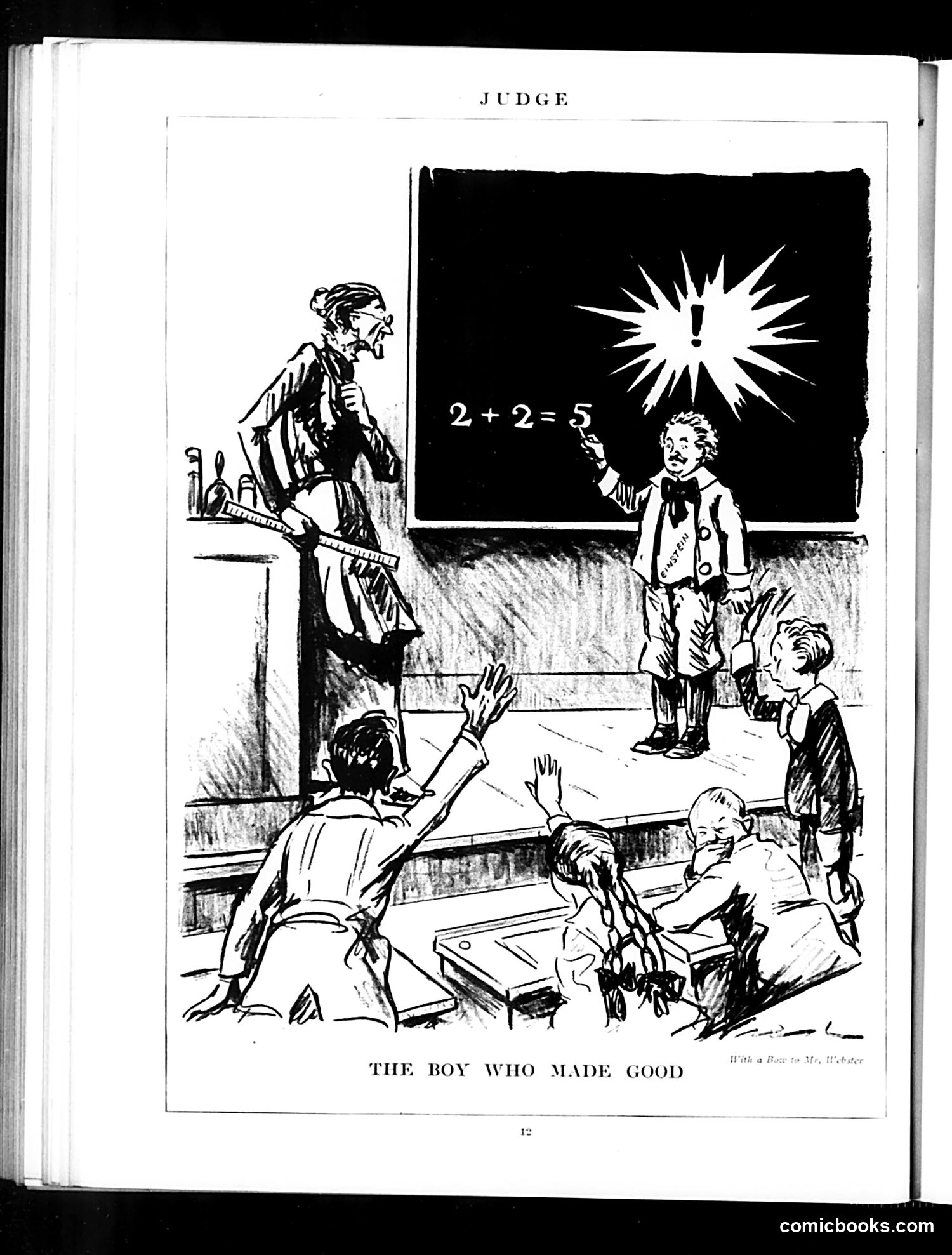
This cartoon satirizes corporal punishment in schools. A stern judge-like teacher stands elevated on a platform, pointing to a blackboard displaying the obviously incorrect equation "2 + 2 = 5" with an exclamation point. Below, several schoolchildren react with shock and raised hands. The satire appears to mock authoritarian teaching methods: the teacher presents false information with absolute certainty, expecting students to accept it without question. The children's expressions suggest bewilderment at being asked to affirm something mathematically absurd. The title "The Boy Who Made Good" likely refers ironically to a student who succeeded by uncritically accepting the teacher's wrong answer—a critique of obedience-based education that prioritizes compliance over critical thinking or mathematical truth.
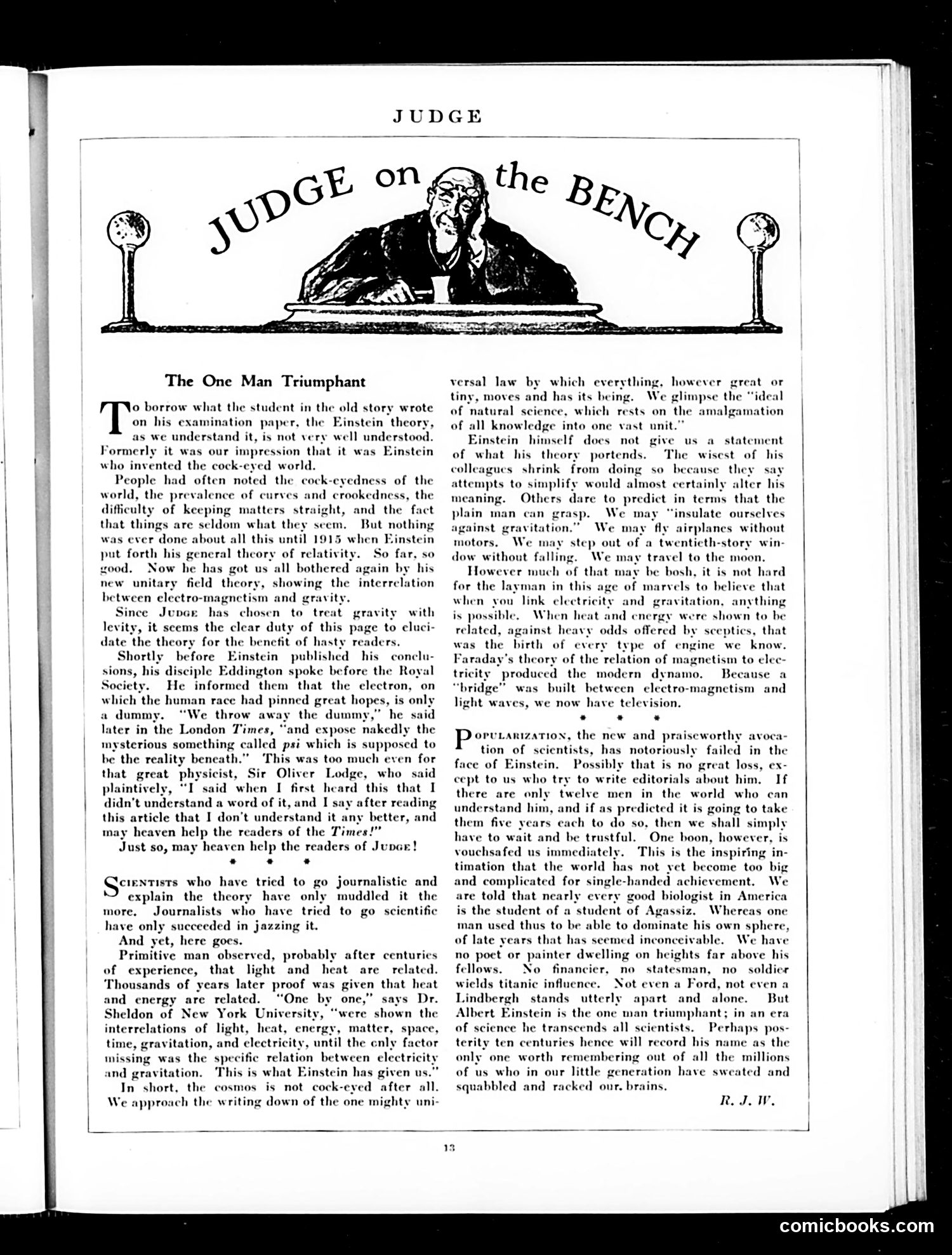
This article, titled "The One Man Triumphant," satirizes public confusion over Einstein's theories of relativity and his newer unitary field theory. The cartoon's judge represents rational skepticism facing incomprehensible scientific claims. The satire targets both Einstein's complexity and the pretense of journalists attempting to explain it. The writer quotes physicist Sir Oliver Lodge admitting he understands nothing, then asks heaven to help *Judge* magazine's readers—a self-deprecating joke suggesting the publication itself cannot adequately explain the theory. The piece mocks breathless popularization: predictions about motorless airplanes, stepping from twentieth-story windows safely, and moon travel are presented as either "bosh" or at least unverifiable. The final section notes that even "popularization" (explaining science to laypeople) has "notoriously failed" with Einstein—acknowledging the futility of the very article being read. The underlying joke: Einstein has become so influential that admitting incomprehension is universal and acceptable.
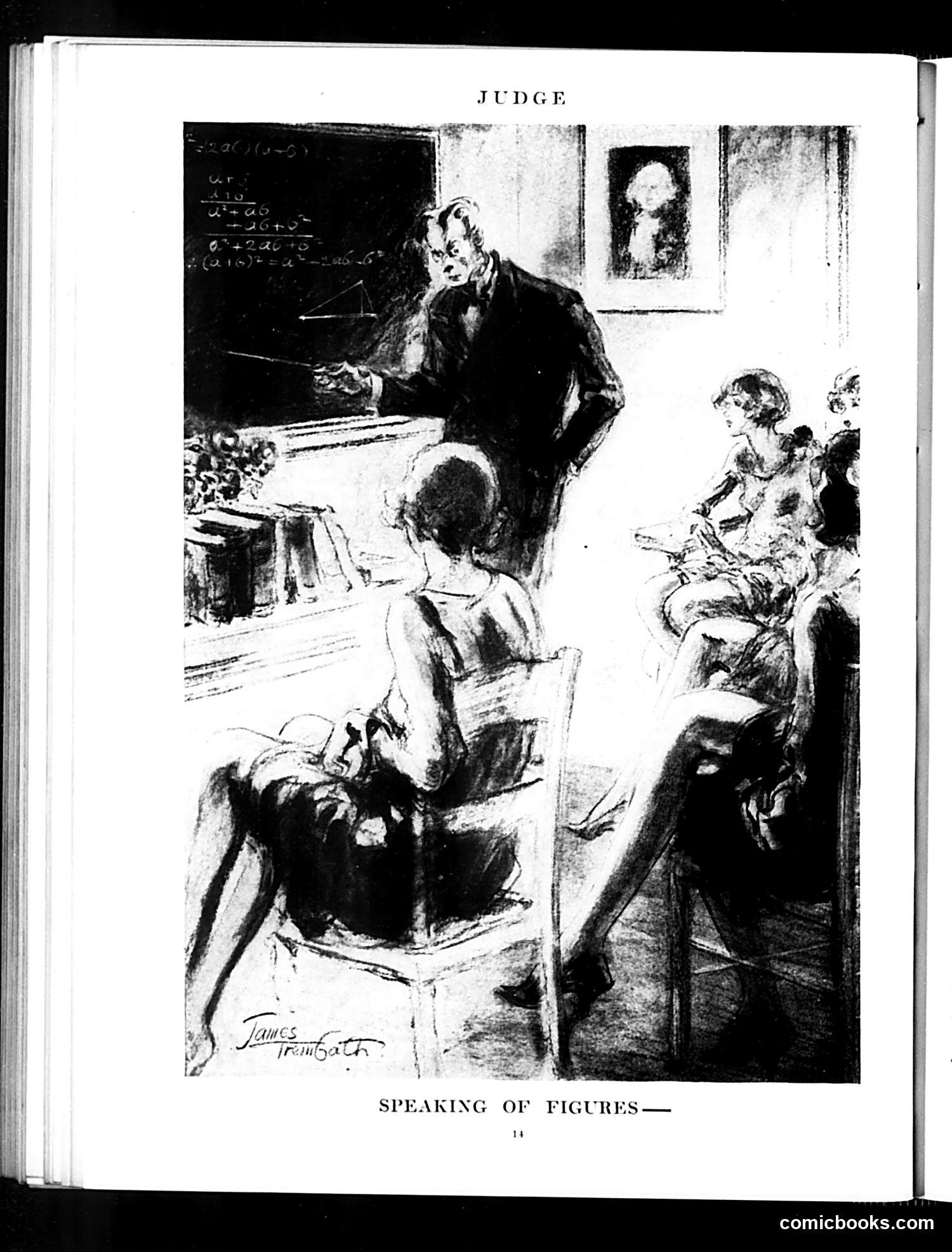
This Judge cartoon depicts a classroom scene where a stern male teacher (appearing to be an older authority figure) points at mathematical equations on a blackboard while instructing students. The title "Speaking of Figures" is a pun—it plays on the double meaning of "figures" as both mathematical numbers and human bodies/forms. The satire likely mocks either: the disconnect between abstract classroom instruction and student attention, or comments on how teachers (particularly male instructors) might be distracted by attractive female students rather than focusing on their pedagogical duties. The composition deliberately positions the female students prominently in the foreground, reinforcing the visual joke about where attention is actually directed versus where it should be.
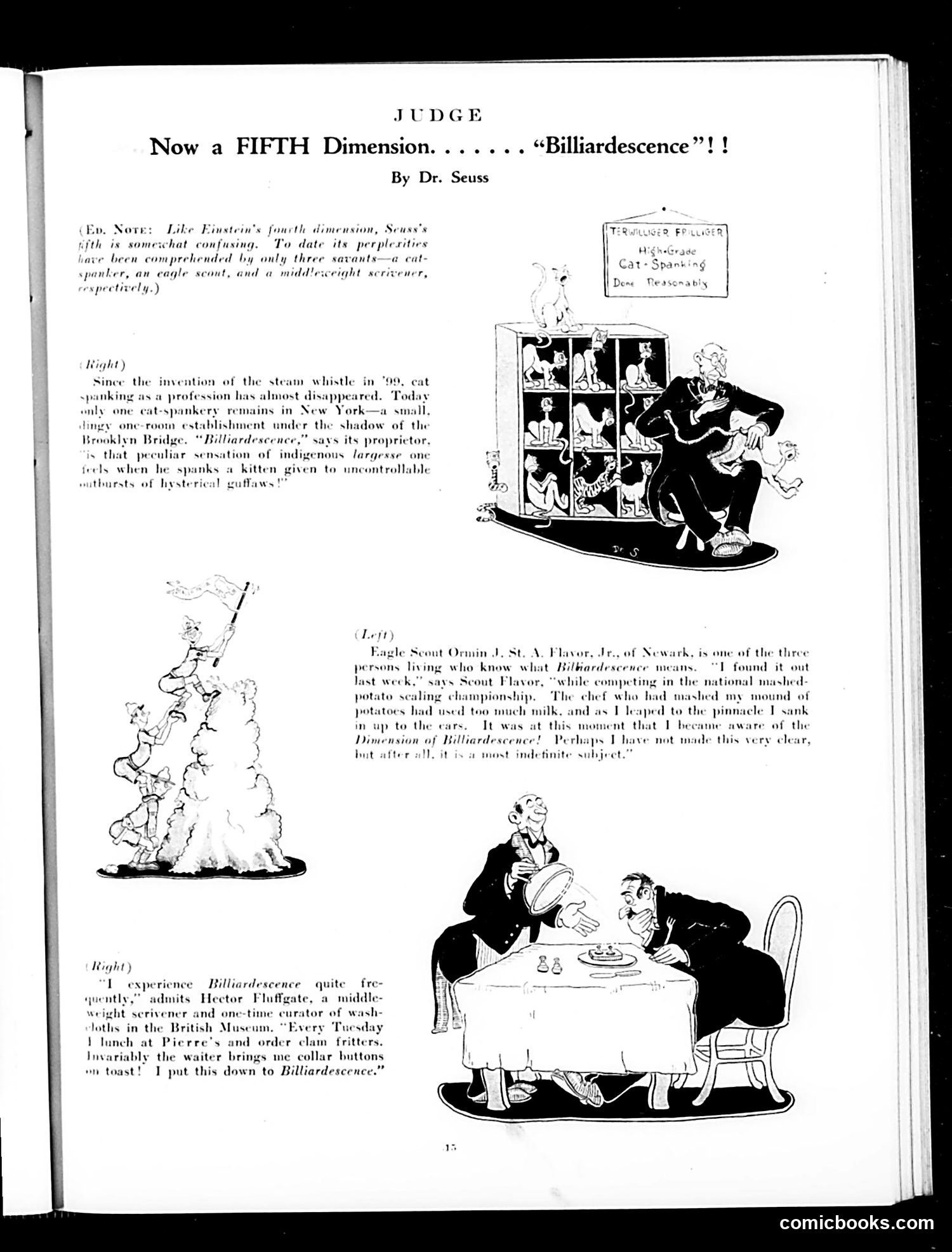
This is a Dr. Seuss satire in *Judge* magazine mocking pseudo-intellectual jargon and absurdist explanations for everyday mishaps. The invented term "Billiardescence" is the joke—it's meaningless but sounds scientific and sophisticated. Three "experts" offer ridiculous personal anecdotes attributed to this fake phenomenon: a cat-spanker who claims it explains a kitten's laughter, an Eagle Scout who blames too-much-milk mashed potatoes on it, and a museum official who attributes collar buttons appearing on his toast to it. The editorial note jokes that only these three "savants" understand this "fifth dimension" (mocking Einstein's then-recent relativity theories). The satire targets how people invoke pseudo-scientific or overly complex explanations to rationalize mundane accidents and coincidences—blaming vague forces rather than simple incompetence or bad luck. It's absurdist humor about intellectual pretension.
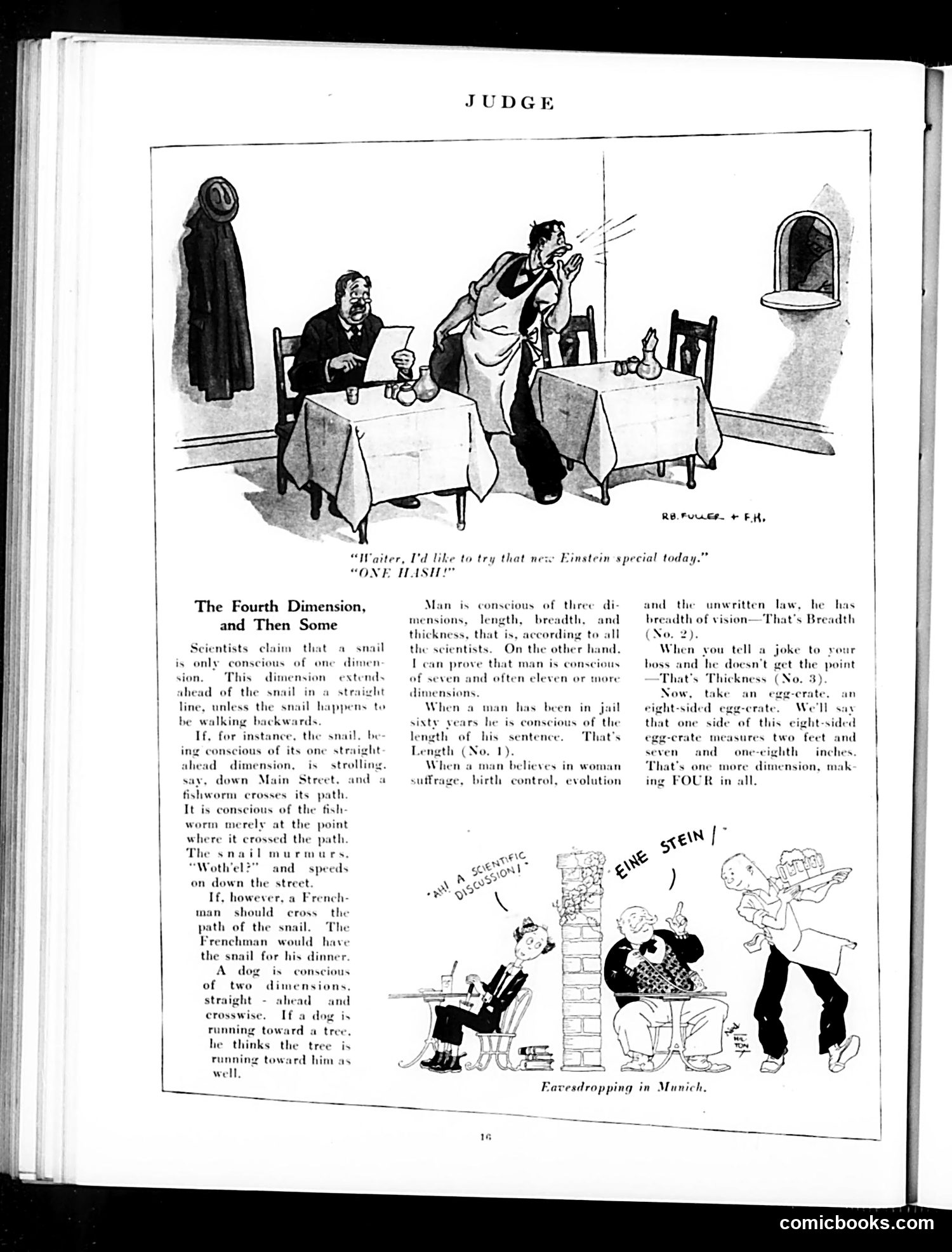
This page satirizes the scientific theory of dimensions popularized by Einstein's relativity. The top cartoon depicts a restaurant scene where a waiter offers an "Einstein special"—the joke being that "one hash" (a simple dish) represents the absurdity of applying dimensional theory to everyday life. The accompanying text humorously "proves" humans experience far more than three dimensions by listing absurd examples: a jailbird's consciousness of sentence-length, a boss's inability to "get" a joke (thickness of understanding), and a woman's awareness of multiple social constraints (suffrage, birth control, evolution, unwritten social law). The lower cartoon, "Eavesdropping in Munich," appears to reference Einstein discussions in post-WWI Germany, showing figures discussing scientific concepts. The satire targets how popularized science—particularly Einstein's revolutionary theory—was being misapplied to explain human experience, reducing complex social realities to pseudo-scientific "dimensions." It mocks both scientific pretension and the public's enthusiasm for fashionable intellectual trends.
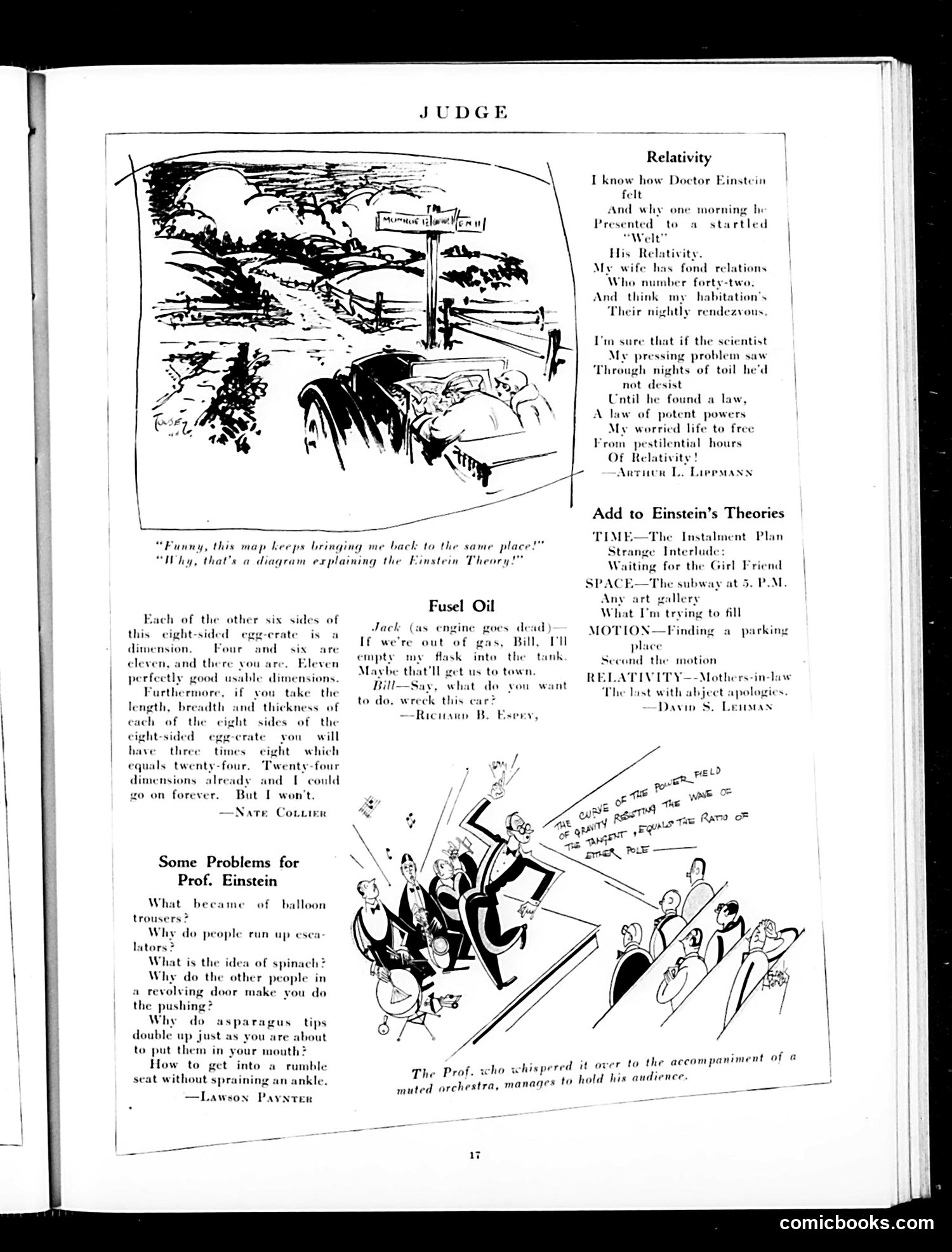
This page satirizes Albert Einstein's theory of relativity, which had recently captivated public imagination. The humor works by treating relativity as a universal explanation for everyday annoyances. **Main cartoons:** 1. **Top cartoon**: A lost couple with a map—the joke is that Einstein's theory explains why they keep returning to the same place (relativity of motion/space). 2. **"Relativity" poem**: The author humorously claims to understand Einstein because he also has a "relative" problem—his wife's forty-two visiting relatives treating his home as their nightly gathering spot. He suggests Einstein should apply his genius to solving this domestic plague instead. 3. **Eight-sided egg-crate diagram**: Mocks how people were struggling to understand relativity by creating absurdly complicated dimensional explanations that spiral into meaninglessness. 4. **"Add to Einstein's Theories"**: Lists mundane modern frustrations (subway crowds, finding parking, in-laws) as if they too require Einstein-level scientific explanation. The satire reflects 1920s public bewilderment over a complex new theory that became cultural shorthand for explaining anything confusing or baffling.
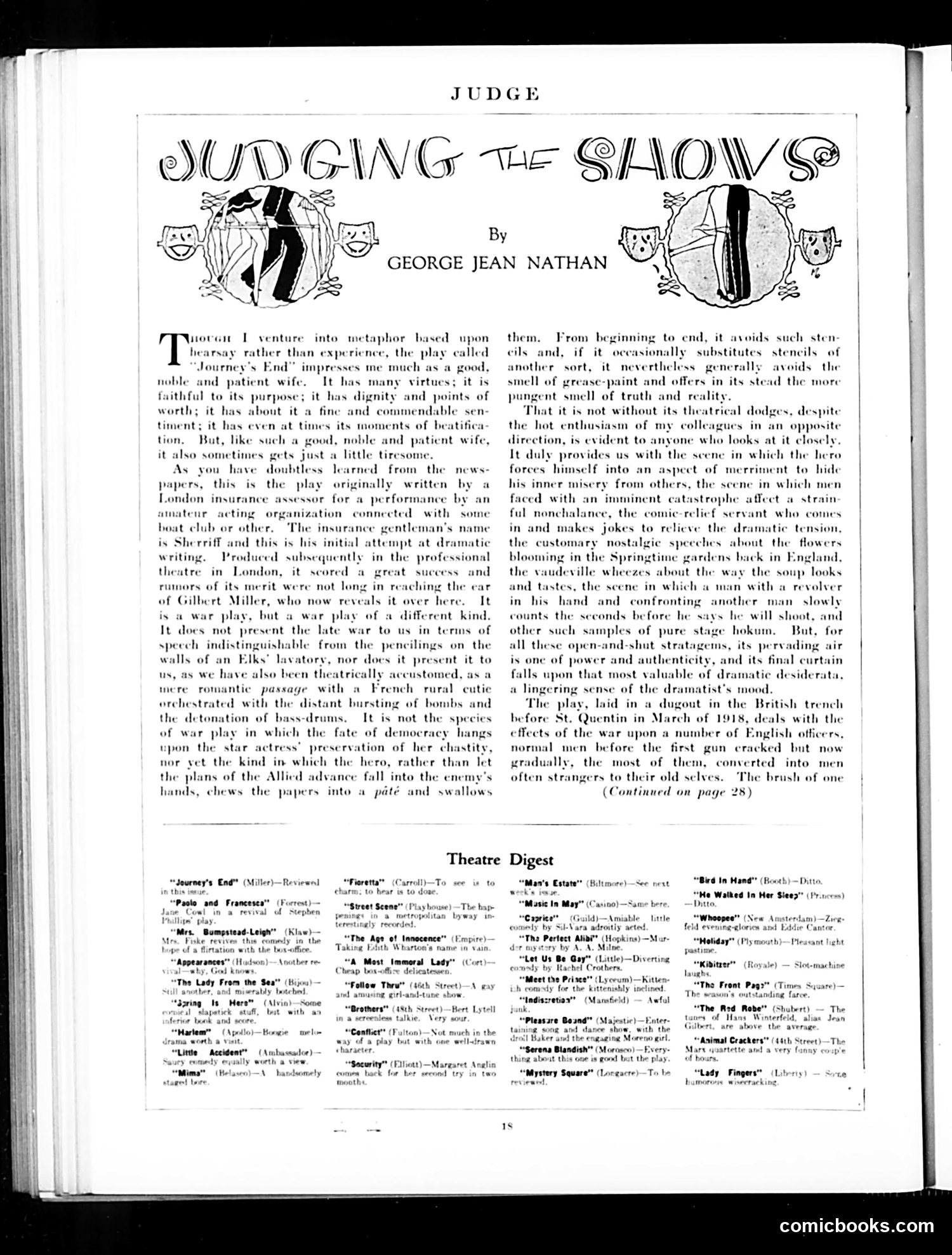
This is a theater review column, not a political cartoon. George Jean Nathan critiques the play *Journey's End*, a WWI drama written by R.C. Sherriff about British officers in a trench before the St. Quentin offensive in March 1918. Nathan praises the play's authenticity and emotional power while gently mocking its use of theatrical clichés—nostalgic speeches about English gardens, comic relief servants, the scene where a soldier counts seconds before shooting. He compares the play to "a good, noble and patient wife"—virtuous but sometimes tedious. The review celebrates that *Journey's End* avoids the overwrought melodrama typical of WWI plays: it doesn't rely on actresses' virtue plots, exaggerated sound effects, or crude soldier dialogue. Instead, it captures how men facing catastrophe mask despair with false cheerfulness—depicting genuine human psychology rather than stage hokum. The page also lists other current Broadway productions briefly reviewed.
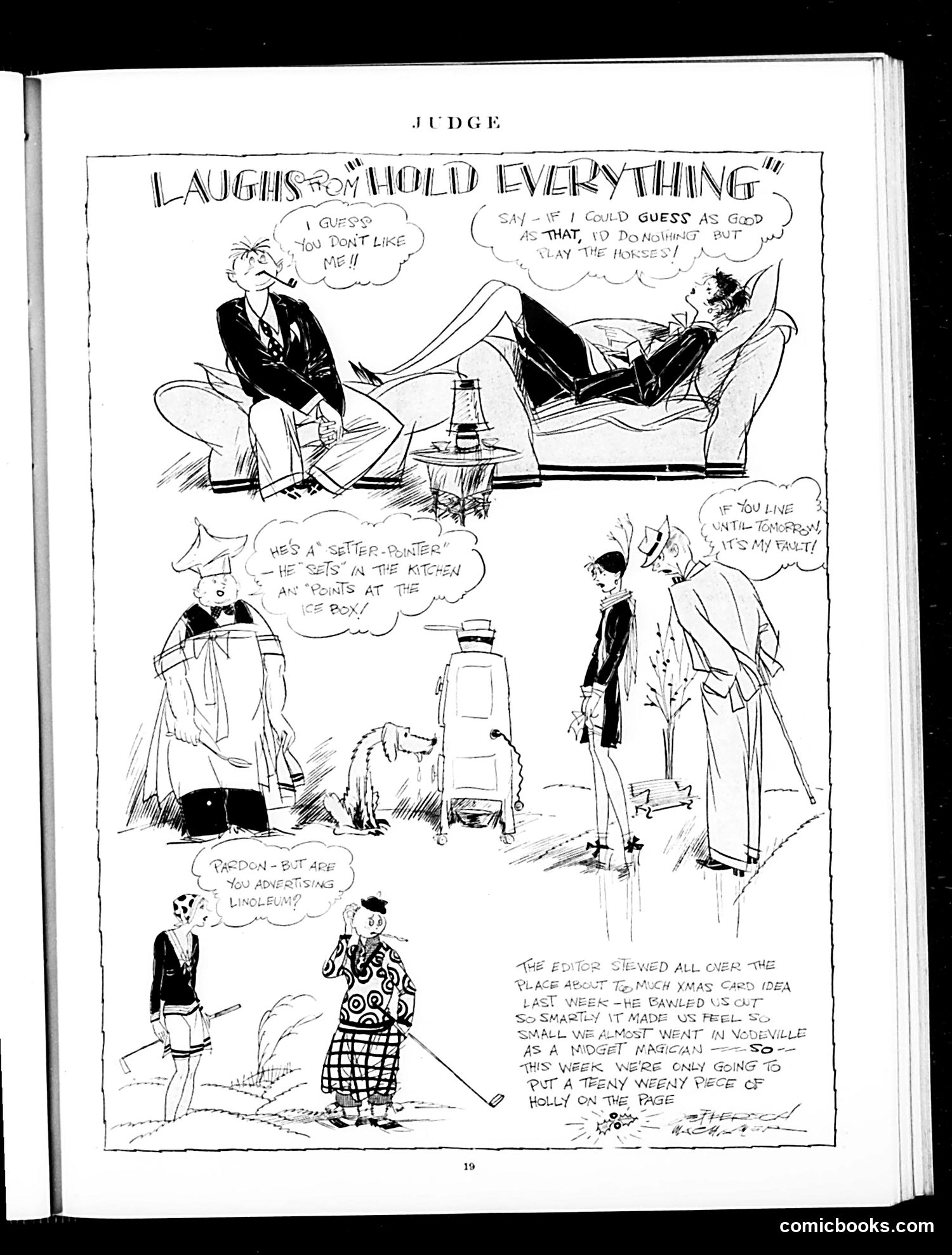
This Judge cartoon satirizes wealthy socialites and their domestic pretensions. The comic shows various scenarios of upper-class people boasting about their servants and possessions: - A man claims his servant is a "setter-pointer" who works in the kitchen and "points at the ice box" - Someone jokes about lying "until tomorrow"—implying their spouse will discover the falsehood - A woman references a "Lincolnism" (unclear reference) The humor targets the snobbish affectations of the wealthy who exaggerate their staff's qualifications and abilities. The bottom text mentions Christmas cards and a Vaudeville act, suggesting the editor is planning holiday content. The overall satire mocks the pretentiousness of the wealthy during what appears to be the Jazz Age era.
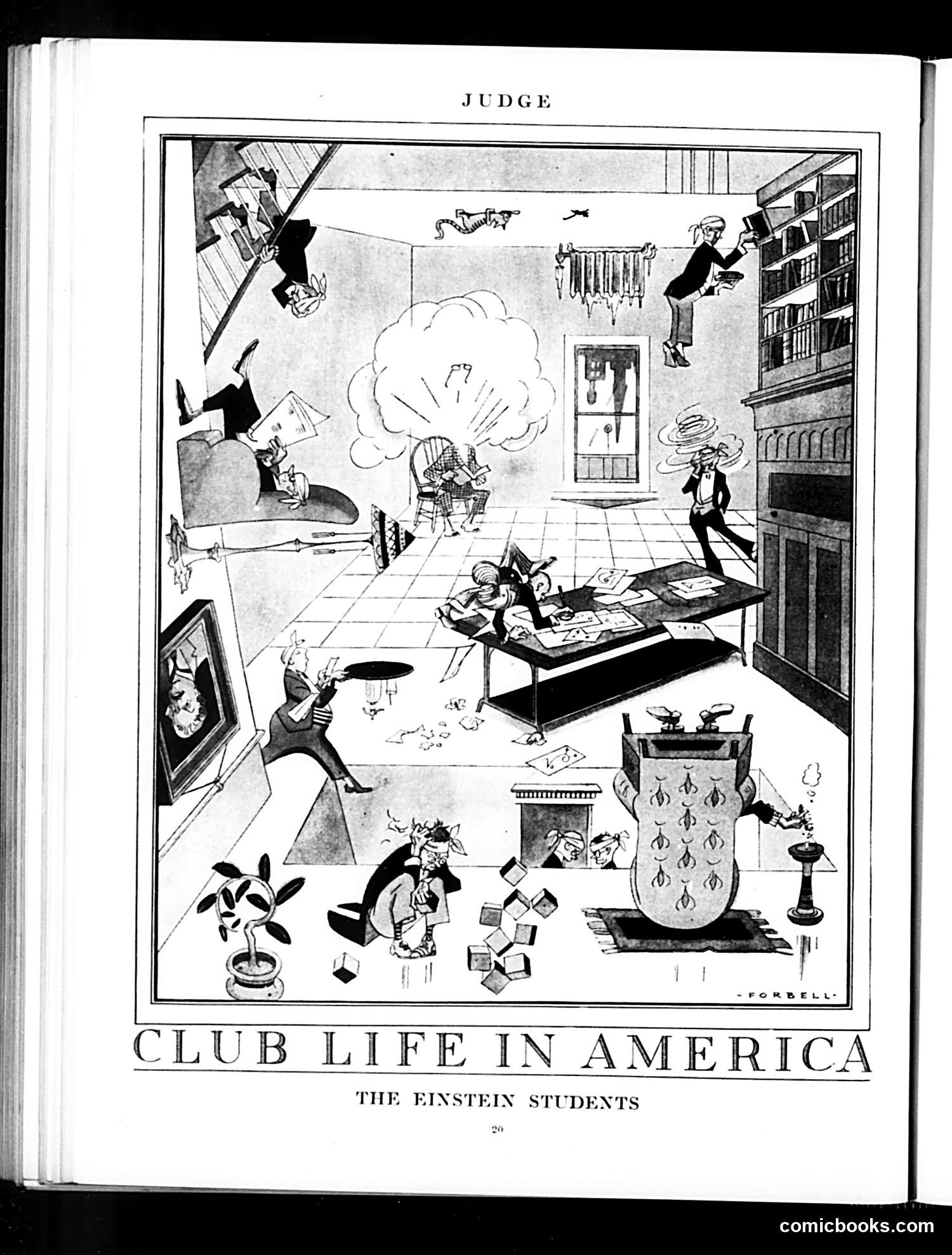
This satirical illustration depicts chaos in what appears to be an intellectual or academic club setting. The cartoon mocks "Einstein Students"—likely referring to people who adopt or pretend to understand Einstein's revolutionary physics theories (published 1905-1915) without genuine comprehension. The scene shows utter pandemonium: figures falling through ceilings, papers flying, explosions, and general destruction. The satire suggests these students create havoc rather than enlightenment, treating Einstein's ideas as fashionable pretense rather than serious study. The "Einstein" reference capitalizes on early-20th-century fascination with relativity theory—complex ideas that became trendy topics in American clubs and salons, often discussed by people who barely understood them. The cartoon ridicules this intellectual posturing and dilettantism among club members.
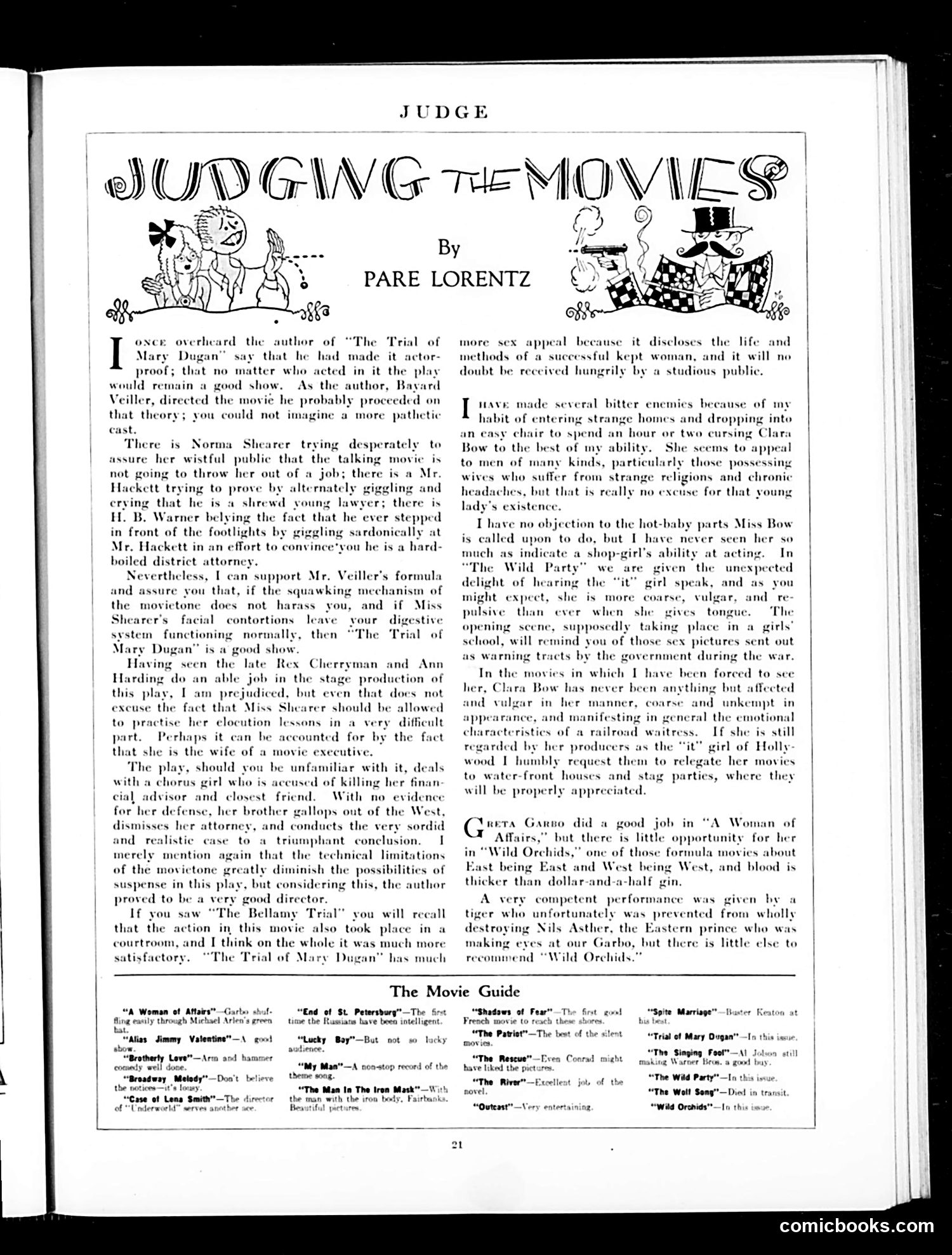
This is a film review column critiquing early "talkies" (sound films). The reviewer harshly assesses *The Trial of Mary Dugan* (1929), a courtroom drama about a chorus girl accused of murder. While acknowledging the play itself is solid, Lorentz attacks the film's cast—particularly Norma Shearer, whom he suggests is miscast and only retained because she's married to a studio executive. He also notes H.B. Warner and other performers undermine the material. The piece includes pointed attacks on Clara Bow, the famous "It" girl, mocking her acting abilities and vulgar manner in *The Wild Party*. Lorentz dismisses her as coarse and unsuitable for serious roles, sarcastically suggesting her films belong in "water-front houses and stag parties." The review reflects 1920s attitudes toward early sound cinema and Hollywood nepotism, while Lorentz's obsessive criticism of Bow suggests personal animus toward her public persona.
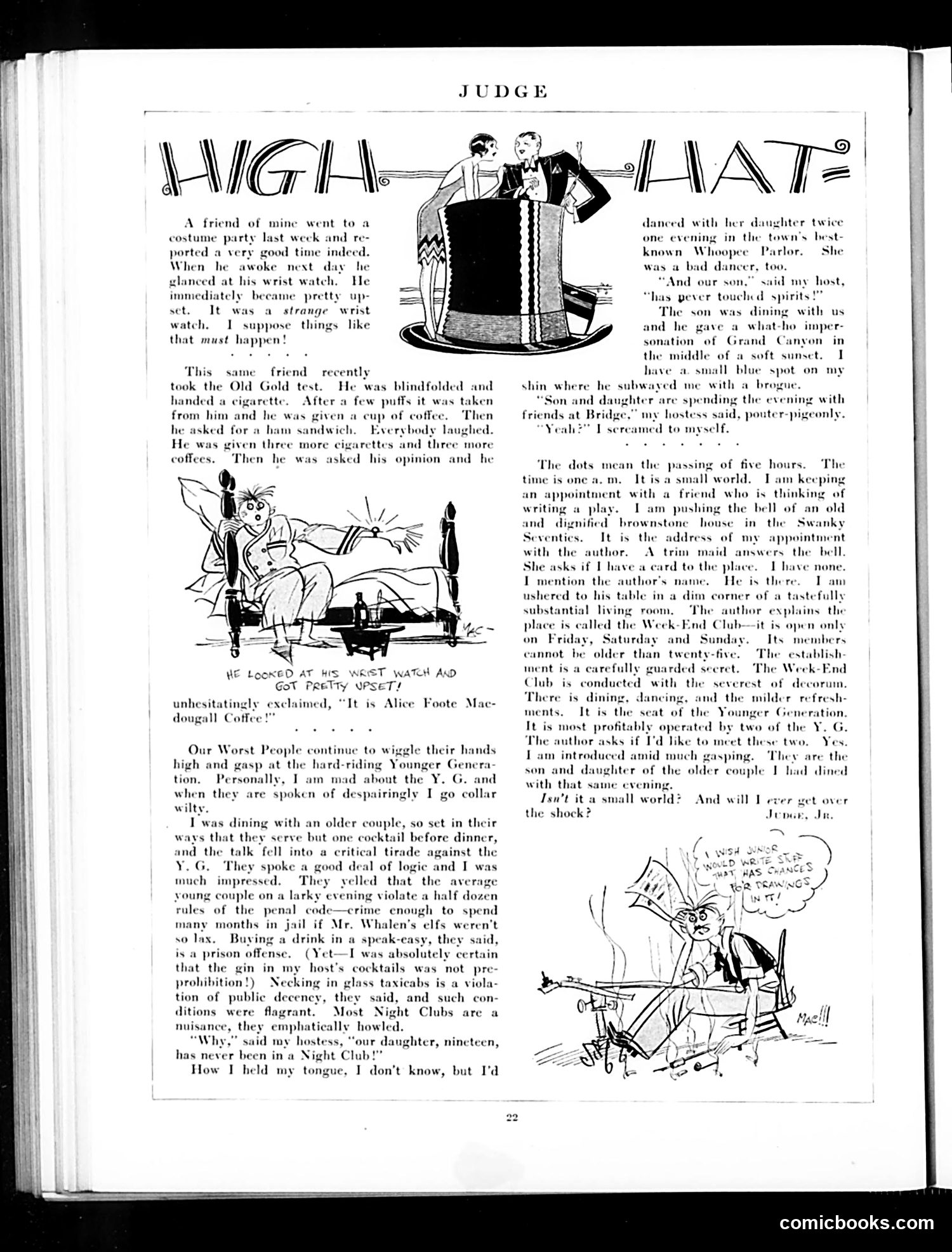
This page satirizes generational hypocrisy and the "Younger Generation" (Y.G.) of the 1920s Jazz Age. **The Main Joke:** An older couple lectures the narrator about how irresponsible young people are—claiming their own children have never visited nightclubs or touched alcohol. The narrator, who actually *saw* their daughter dancing poorly at a nightclub and witnessed their son drunk, says nothing. Hours later, he discovers these very same "innocent" children are actually running an exclusive speakeasy-style club called the "Week-End Club" in a brownstone. **The Satire:** Older generations sanctimoniously condemn youth for violating Prohibition laws and moral codes, while their own children secretly engage in exactly that behavior. The parents are willfully blind or deliberately dishonest about their children's activities. **Historical Context:** This reflects 1920s Prohibition-era tensions between conservative older Americans and rebellious youth openly defying alcohol bans and sexual norms. The "Younger Generation" was notorious for flouting their parents' values. **The Cartoons:** Illustrate the absurdity—one shows the friend with a mysterious wrist watch from a party; another depicts the outraged narrator's reaction to discovering the deception.
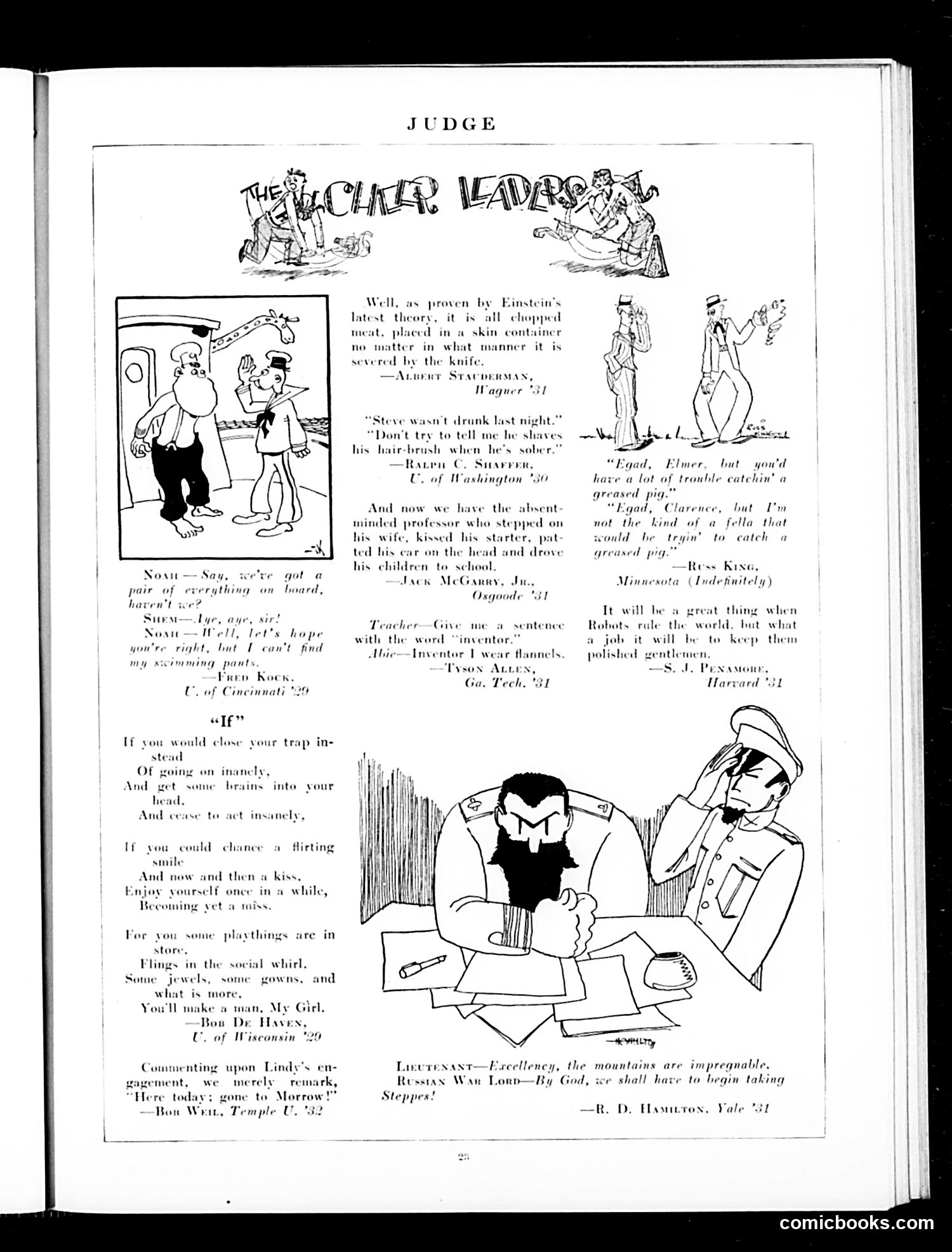
This page collects humorous student quotes and observations, likely from a college humor section. The main cartoons satirize: **Top cartoon**: Einstein's theory of relativity, mocking how the same outcome (chopped meat in a container) results regardless of how it's severed—a joke about the theory's deterministic nature. **Large cartoon (bottom)**: A military or official figure receiving bad news, likely referencing World War I or contemporary military incompetence. The caption about "Russian War Lord" and "mountains are impregnable" suggests satire of military overconfidence or failed strategy, possibly referencing Russian military operations. **Student quotes**: Humor based on absent-minded professors, mistranslations, romantic misadventures, and social observations typical of 1920s-30s college life (robot servants, greased pig catching contests). The overall tone satirizes contemporary academia, military matters, and youthful social dynamics without requiring specific historical knowledge to land the jokes.
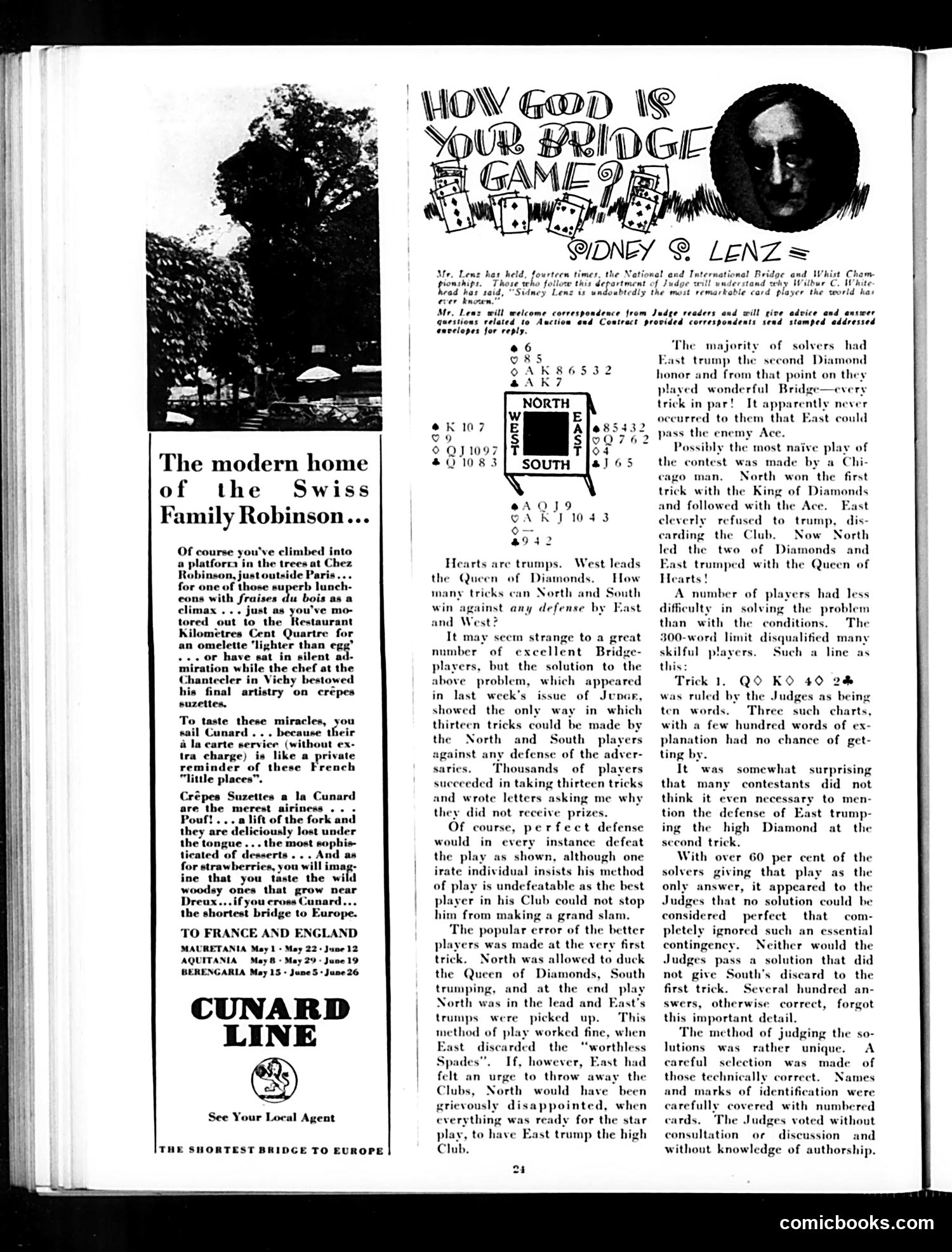
This page combines advertising with a bridge column by Sidney Lenz, a famous card player of the era. The cartoon at top left shows a Swiss Family Robinson-style treehouse, illustrating a Cunard Line advertisement romanticizing European travel and French cuisine. The main content is Lenz's bridge instructional column, titled "How Good Is Your Bridge Game?" Lenz was apparently a celebrated bridge champion (the text notes he held fourteen national and international titles). The column presents a bridge problem and critiques readers' solutions, explaining common errors in play strategy. The joke—if there is one—is gentle: Lenz chides solvers for misunderstanding the puzzle's elegant solution, notes that some players got confused by the rules, and mentions that overly-lengthy explanations were rejected. It's primarily instructional rather than satirical, reflecting Judge's inclusion of puzzle and game content alongside humor and social commentary.
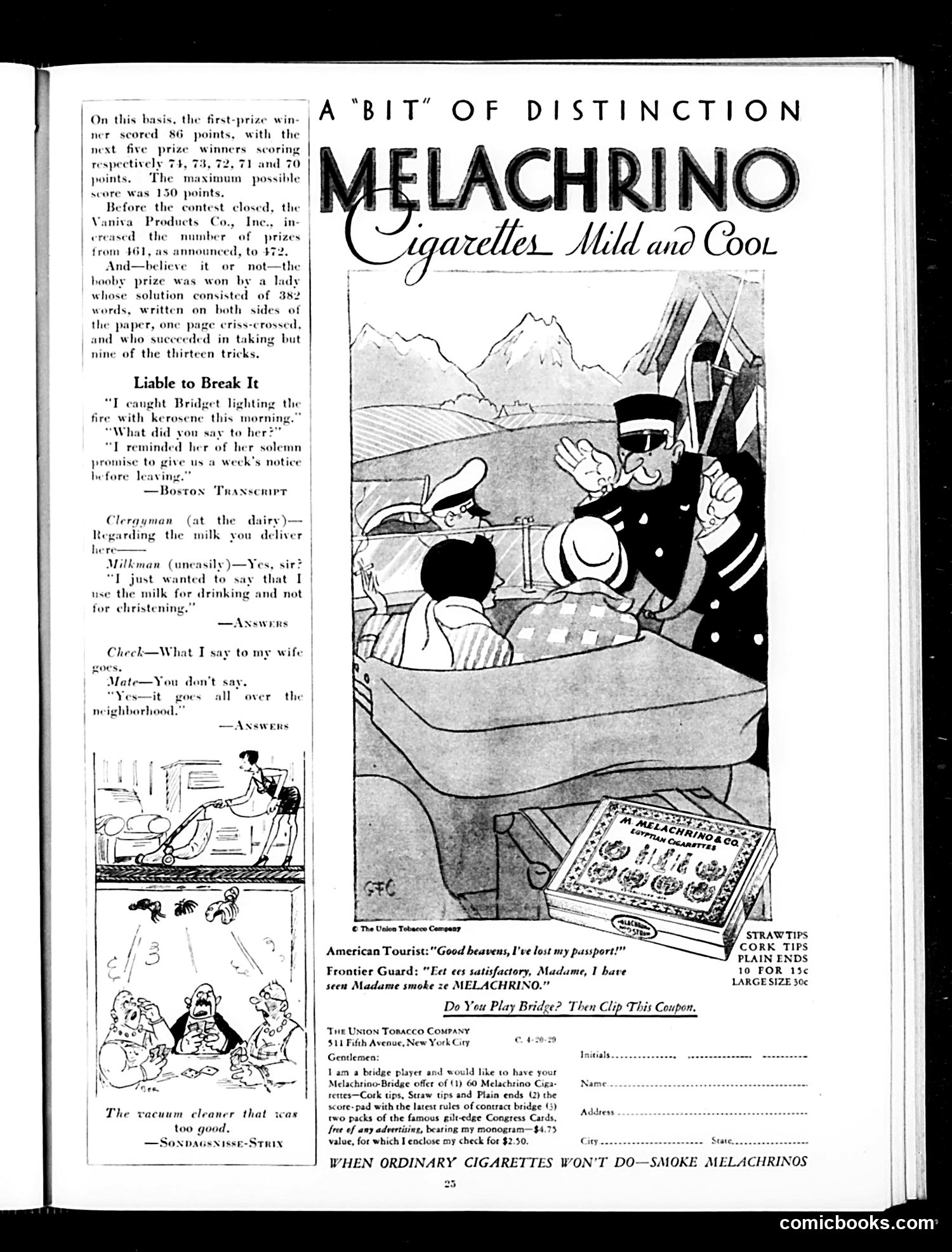
This is primarily a **cigarette advertisement** for Melachrino brand, positioned as a luxury product ("Mild and Cool"). The page includes several elements: **Main Ad:** Shows a well-dressed sailor or porter cheerfully assisting tourists with luggage, establishing Melachrino as a sophisticated, cosmopolitan brand. **Cartoon Humor:** Small jokes about domestic life and class differences—a clergyman correcting a milkman about milk's proper use, a husband's quiet complaint about his wife—represent typical Judge magazine comic fare mocking middle-class pretensions. **Border Anecdote:** A "frontier guard" accepts a woman's lost passport simply because she smokes Melachrino—an absurdist joke suggesting the cigarette's prestige transcends national boundaries. **Promotional Coupon:** Offers bridge players a $4.75 premium (cigarettes, score pad, playing cards) for $2.50, targeting educated leisure-class consumers. The overall message: Melachrino represents refinement and cosmopolitan taste. The humor serves mainly to entertain while marketing cigarettes as status symbols to Judge's affluent readership.
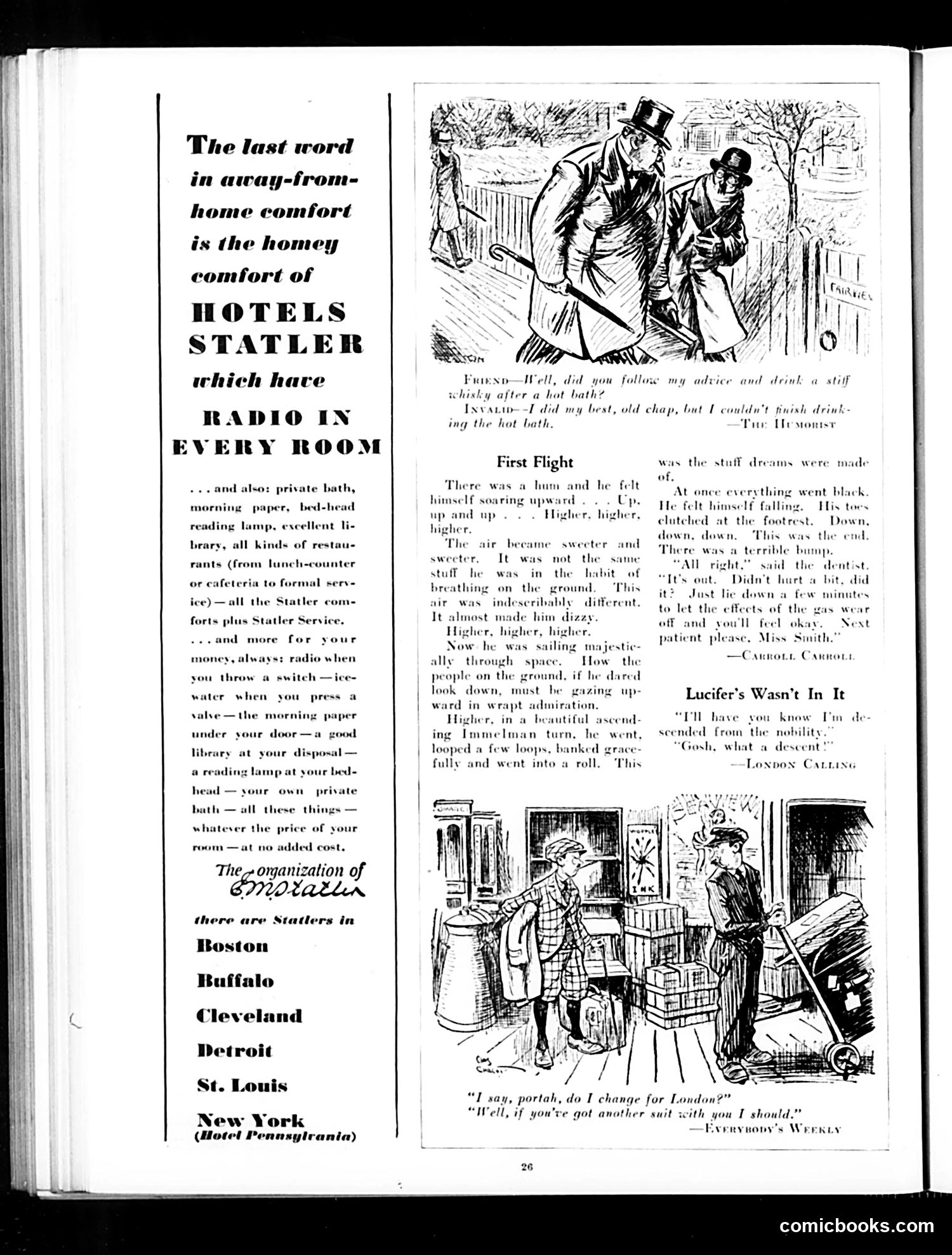
This page contains three brief comic pieces lampooning everyday situations: **"First Flight"** satirizes dental anesthesia. A patient dreams of piloting an airplane—looping and rolling through sky—only to awaken mid-extraction with a "terrible bump." The joke: the vivid dream fantasy contrasts sharply with the mundane reality of tooth removal, deflating the patient's imagined heroics. **"Lucifer's Wasn't In It"** mocks social pretension. Someone boasts of noble ancestry; the response "what a descent!" is a pun suggesting their actual social status has declined—they've fallen from that height. **The top dialogue** appears to reference bathing etiquette, with "The Humorist" joking that he couldn't finish drinking whisky after a hot bath, deflating medical advice. The page is primarily a **Statler Hotels advertisement** featuring radio and modern amenities as luxury comforts, with these humorous vignettes as filler content typical of Judge magazine's satirical approach to contemporary middle-class life.
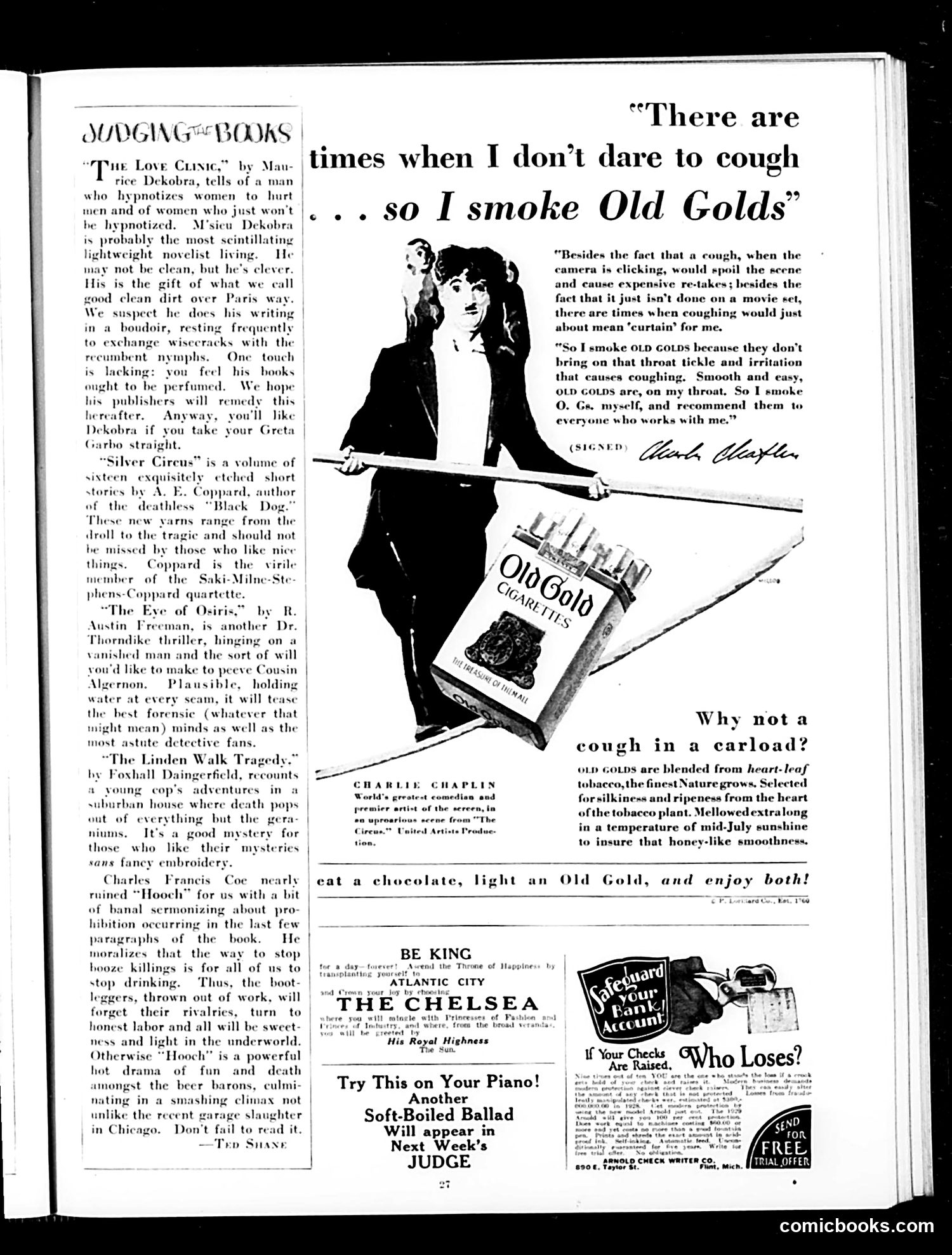
This page is primarily a **cigarette advertisement** disguised as editorial content, featuring actress **Marlene Dietrich** (identified by the signature). The ad addresses a specific concern of 1920s-30s film actors: **coughing during movie takes**. The joke/pitch works on multiple levels: 1. **The Problem**: Actors couldn't cough on set—it ruined expensive film takes and was considered unprofessional behavior. 2. **The Solution**: Smoke Old Golds cigarettes, which allegedly don't cause throat irritation or coughing (a demonstrably false claim typical of tobacco advertising of the era). 3. **The Satire**: The ad cynically exploits actors' workplace anxieties while promoting a product that actually causes coughing. The tagline "Why not a cough in a carload?" mockingly acknowledges what smokers know but won't admit. The left column contains book reviews—standard Judge magazine content—but serves mainly as filler. This represents the era when magazines freely mixed editorial and advertising without clear distinction, and when cigarette companies aggressively marketed to celebrities and professionals.
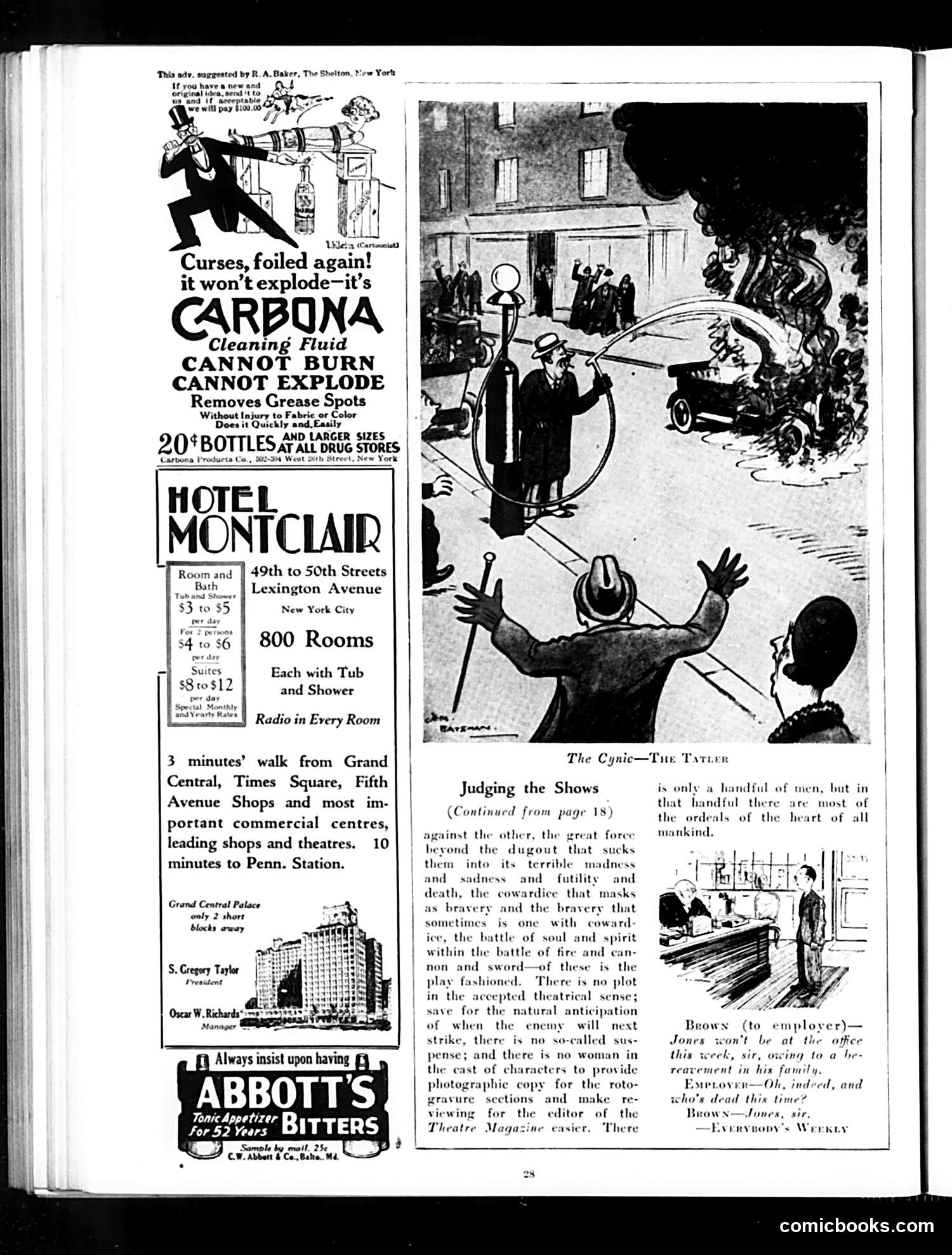
This page is primarily **advertisements** with one small cartoon joke at the bottom. The main cartoon shows an employer (Brown) telling his boss that employee Jones won't be at work due to a family bereavement. The employer's deadpan response—"who's dead this time?"—suggests Jones has claimed multiple bereavements before, implying he's a chronic liar using fake family deaths as excuses to skip work. The joke's humor relies on the dark comedy of serial dishonesty in the workplace. The bulk of the page contains vintage ads: Carbona cleaning fluid (marketed as safe because it "cannot burn" or "explode"), Hotel Montclair in Manhattan, and Abbott's Bitters tonic. These ads reflect 1920s-era consumer products and New York hospitality. The partial text about "Judging the Shows" discusses theatrical performance and drama, but is cut off and incomplete on this page.
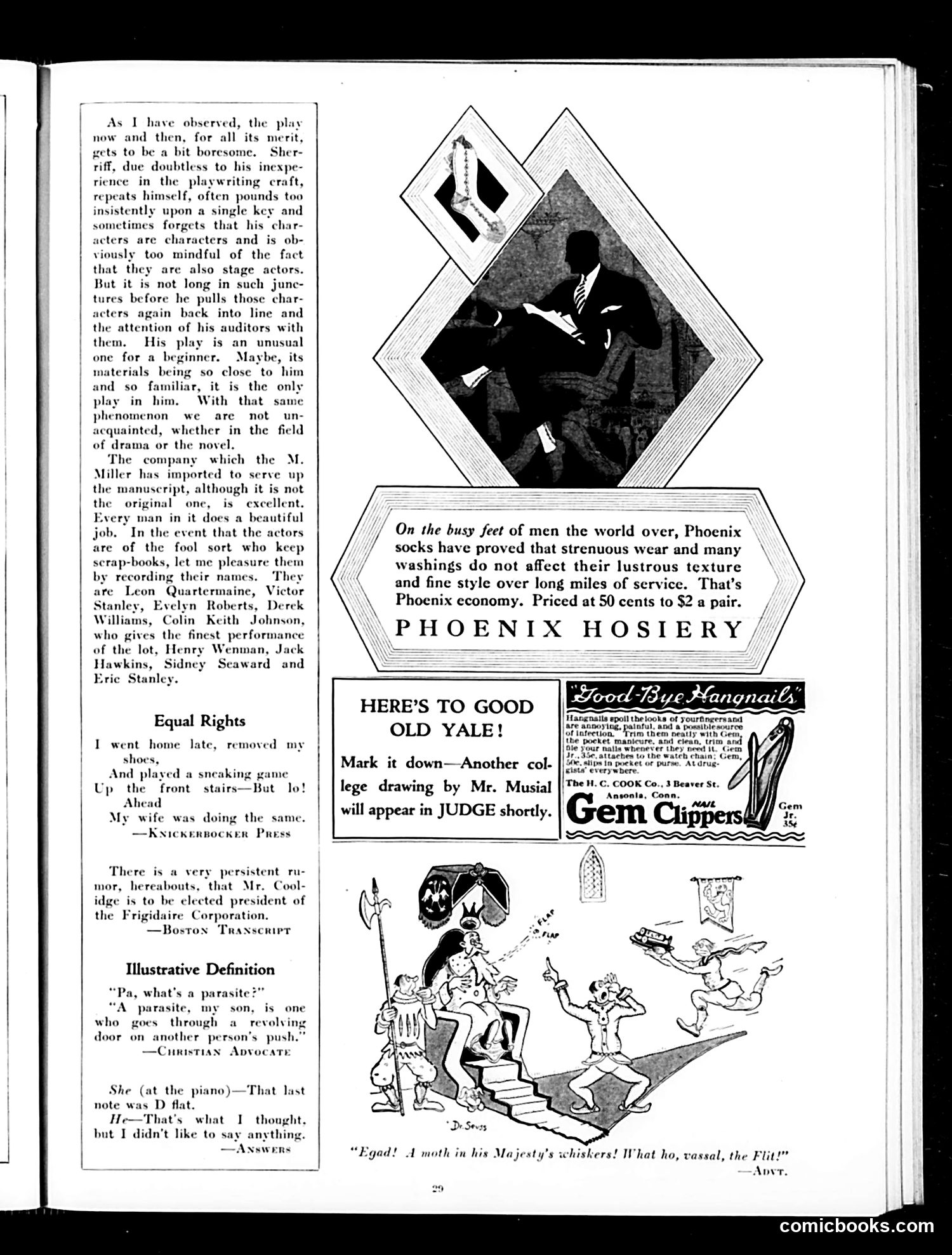
This page from *Judge* magazine contains mostly **advertisements and filler content** rather than coherent political satire. The main article discusses a theatrical production (likely R.C. Sherriff's *Journey's End*, based on context clues), praising the ensemble cast but critiquing the playwright's repetitiveness. The piece names actors like Leon Quartermaine and Victor Stanley. Below are several **light humor items**: a poem about "Equal Rights" where a husband discovers his wife sneaking upstairs the same way he just did; a joke defining "parasite"; and a music-teacher quip. The **advertisements dominate**: Phoenix Hosiery, Gem Clippers, Good Bye Hangnails, and a "Good Old Yale" teaser for another college drawing by an artist named Musial. The bottom cartoon features a courtier alerting a king to a moth in his beard, making a pun on the insecticide "Flit"—clearly an ad. This appears to be a typical mid-20th-century magazine page mixing light editorial content with commercial material, rather than sustained political commentary.
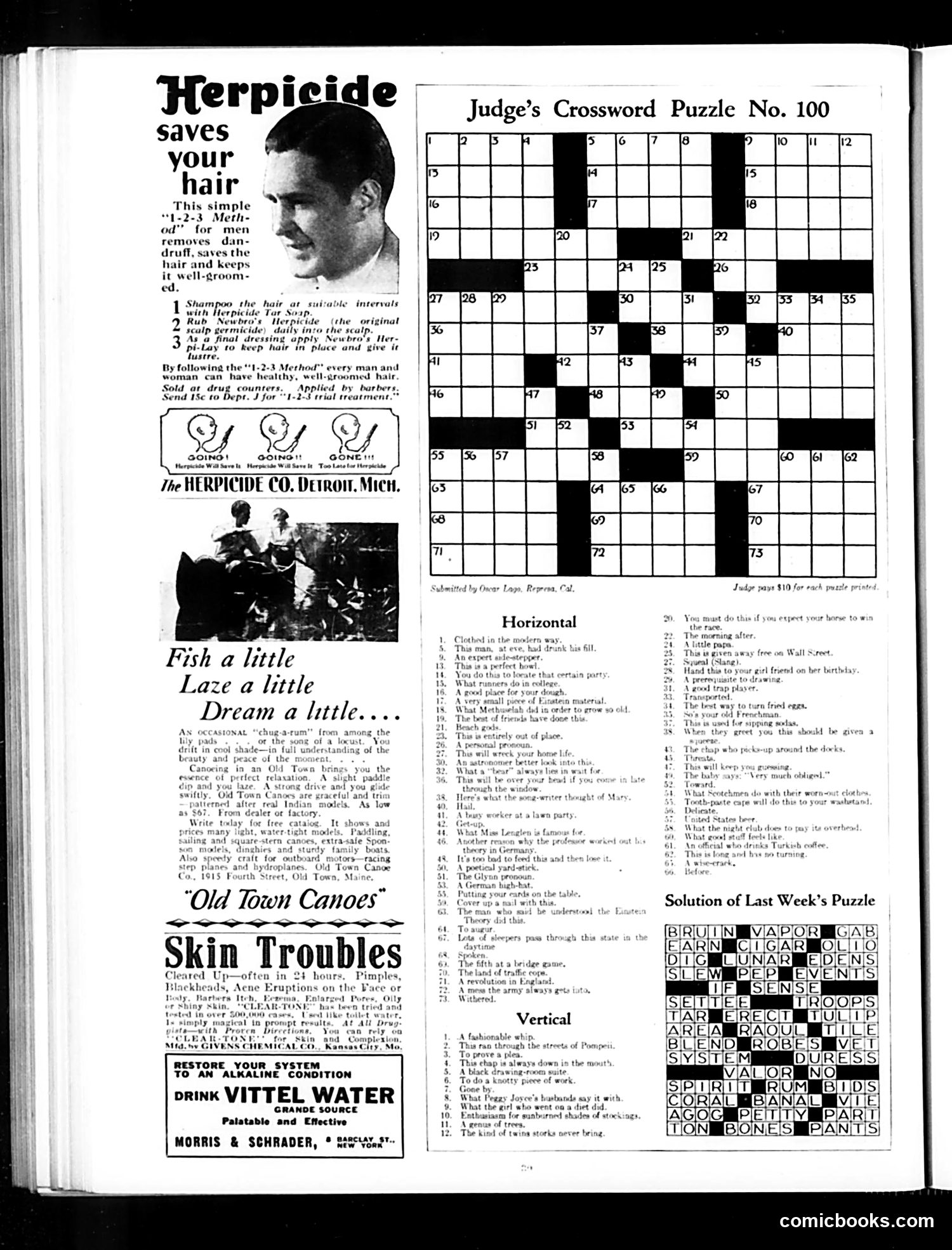
This page is primarily **advertising and puzzles**, not political satire. The main content includes: **Herpicide Advertisement**: A hair-loss treatment ad featuring the "1-2-3 Method" for dandruff removal. The three "GOING!" illustrations show a man's hair progressively returning—visual proof the product works. This reflects early-20th-century anxieties about male baldness and grooming. **"Fish a little, Laze a little, Dream a little"**: A brief lifestyle piece about recreational fishing, emphasizing leisure and relaxation—typical aspirational content for Judge's upper-middle-class readership. **Old Town Canoes & Skin Troubles Ads**: Standard period advertisements for consumer products (canoes, water treatment). **Crossword Puzzle No. 100**: A contemporary puzzle feature, likely popular with readers. The page captures early-1900s consumer culture: anxieties about appearance, leisure activities, and patent medicines. No significant political satire is evident—this is a commercial/entertainment section rather than Judge's typical satirical commentary.
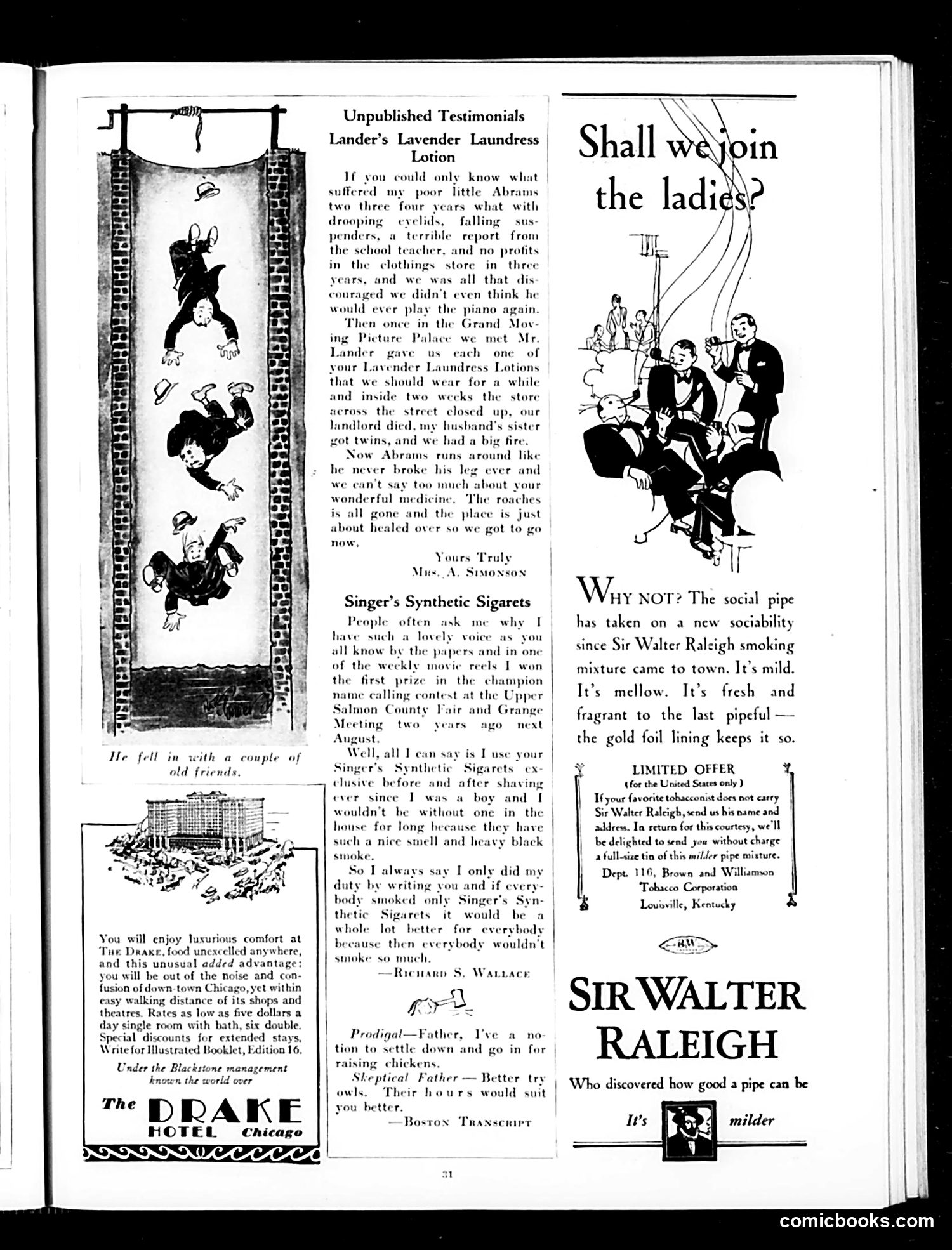
This page is primarily **advertising** disguised as editorial content—a common early 20th-century magazine practice. The "Unpublished Testimonials" are **fake endorsements** mocking absurd product claims. "Lander's Lavender Laundress Lotion" allegedly cured a boy's drooping eyelids and falling suspenders, then mysteriously caused his landlord's death and a fire (presented as positive outcomes). This satirizes the era's ridiculous patent medicine ads with testimonials featuring implausible cause-and-effect claims. Similarly, "Singer's Synthetic Cigarets" is endorsed by someone claiming they improved his singing voice—another absurd health claim typical of early advertising. The "Social Pipe" section promotes **Sir Walter Raleigh tobacco**, legitimately connecting smoking to social status and leisure (referencing the historical explorer's association with tobacco). The **cartoon** ("Shall we join the ladies?") shows men in formal dress, illustrating the social context where pipe-smoking was presented as refined, gentlemanly behavior. The entire page demonstrates how *Judge* magazine blended satire of dubious advertising with actual paid advertisements—readers couldn't always distinguish which was which.
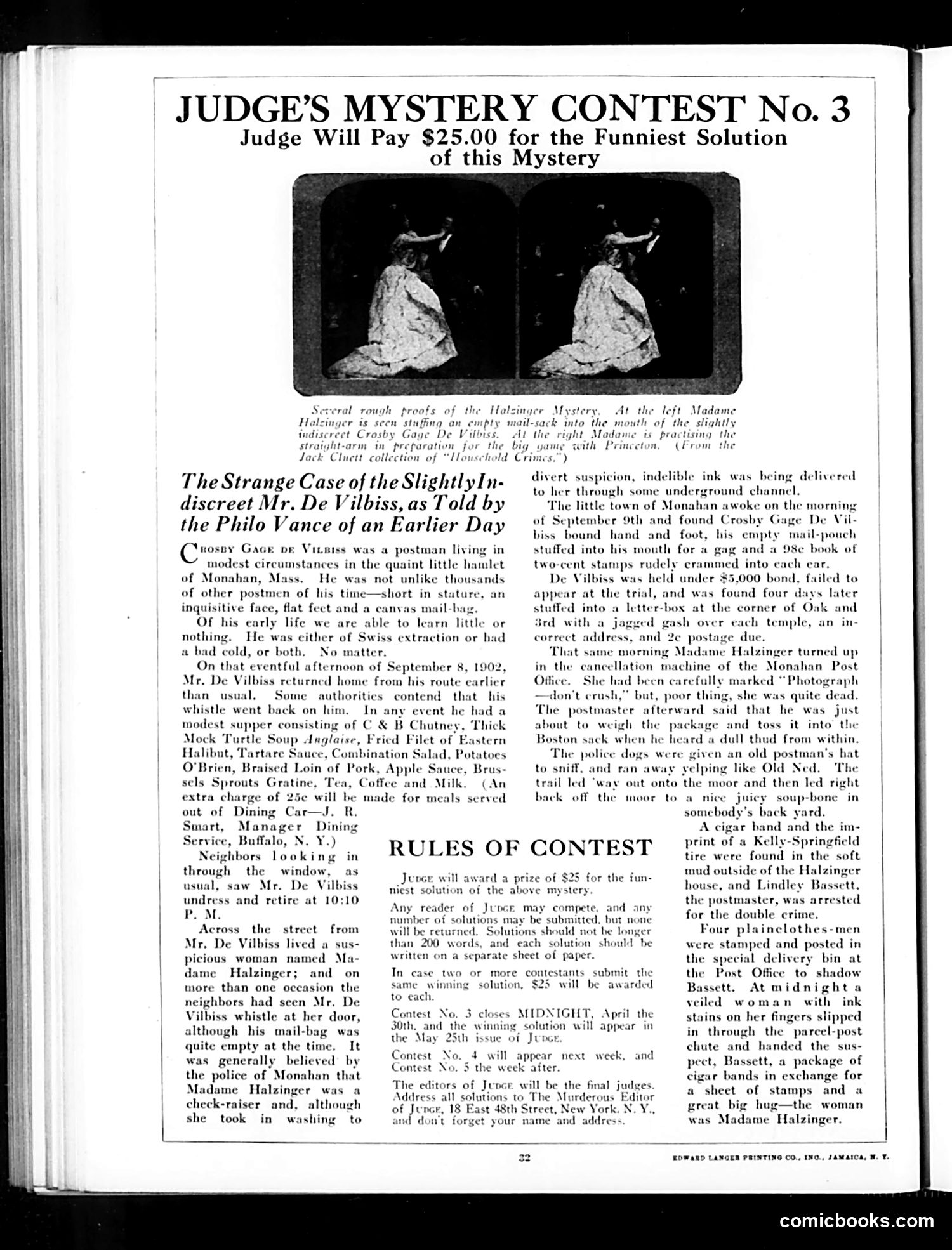
This page presents a humorous "mystery" contest—not a political cartoon, but rather a parody of detective fiction. The setup mimics the style of popular mystery stories (referencing "Philo Vance," a contemporary fictional detective), creating an absurd postal-themed crime: postman Crosby Gage De Vilbiss is found bound with mail stuffed in his mouth, and a woman named Madame Halzinger turns up dead in the post office's mail-cancellation machine. The humor lies in the ridiculous details and overwrought setup—the contrived suspicious activities (De Vilbiss whistling at Madame Halzinger's door with an empty mail-bag), the absurd evidence (tire prints, a cigar band), and the elaborate backstory about "indelible ink being delivered...through some underground channel." **Judge** is inviting readers to submit the "funniest solution" to this deliberately nonsensical mystery. The satire mocks both detective-fiction conventions and the magazine's own earlier mystery contests, offering $25 to whoever provides the cleverest or wittiest explanation for the crime.

This is a **paid advertisement**, not editorial satire. It promotes bridge instruction books by Sidney S. Lenz, described as "undoubtedly the greatest card player the world has ever seen." The page offers three volumes at a 10% discount to Judge magazine readers. The context: Bridge was enormously popular among educated, affluent Americans in the 1920s-30s. Lenz was a famous competitive bridge player; the ad emphasizes his expertise in both Auction Bridge (the dominant form then) and Contract Bridge (the newer variant gaining popularity). The three books shown are: - *Lenz on Bridge, Volumes One and Two* (379 and 450 pages respectively, with hand diagrams and problem solutions) - *Lenz on Contract Bridge* (Revised 1929 Edition, covering newer rules) This is straightforward marketing to Judge's educated readership—not satirical content. The layout and pricing information are typical magazine advertising of the era.
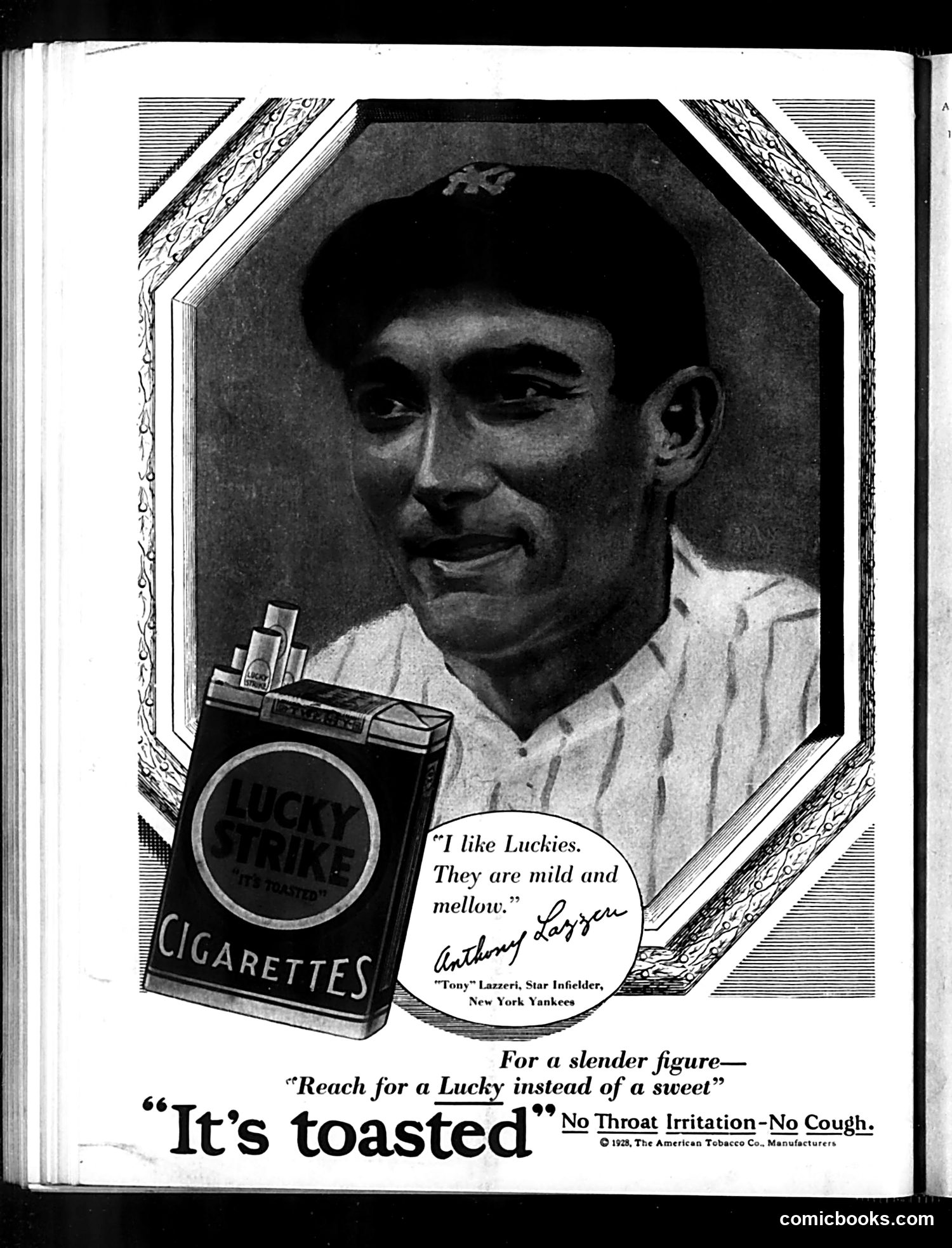
This is a Lucky Strike cigarette advertisement, not a political cartoon. It features "Tony" Lazzeri, identified as a Star Infielder for the New York Yankees, endorsing the product with a testimonial quote praising the cigarettes as "mild and mellow." The ad uses a common marketing strategy of the era: celebrity endorsement by a popular athlete. The slogan "Reach for a Lucky instead of a sweet" appeals to weight-conscious consumers, particularly women, by positioning cigarettes as a diet aid. The "It's toasted" claim and "No Throat Irritation—No Cough" assertion were typical health-related marketing messages from that period, before the dangers of smoking were widely acknowledged.