
A complete issue · 36 pages · 1929
Life — January 4, 1929
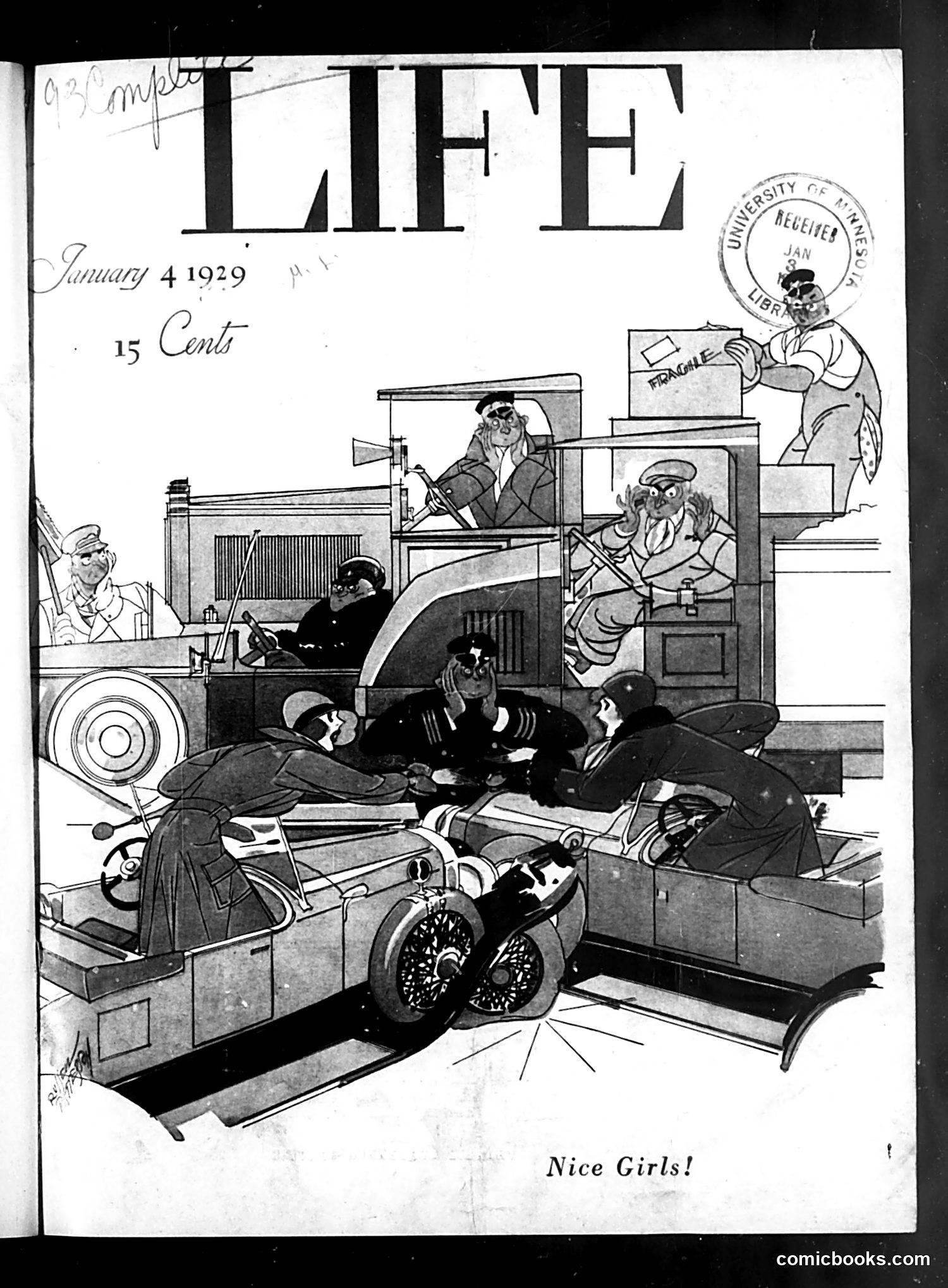
This illustration depicts a chaotic traffic scene at what appears to be a busy intersection or garage. Multiple automobiles are colliding or stacked impossibly, with drivers and pedestrians caught in the confusion. Men in suits and hats observe from an elevated platform or office overlooking the scene. The caption "Nice Girls!" suggests satirical commentary on women drivers, a common stereotype and anxiety of the 1920s automotive era. The humor appears to target either reckless driving generally or specifically plays on contemporary prejudices about female drivers as incompetent or dangerous behind the wheel. The illustration style and crowded composition emphasize chaos and collision—typical of Life's visual satire approach to modern social anxieties about the rapidly motorizing American society of the Jazz Age.
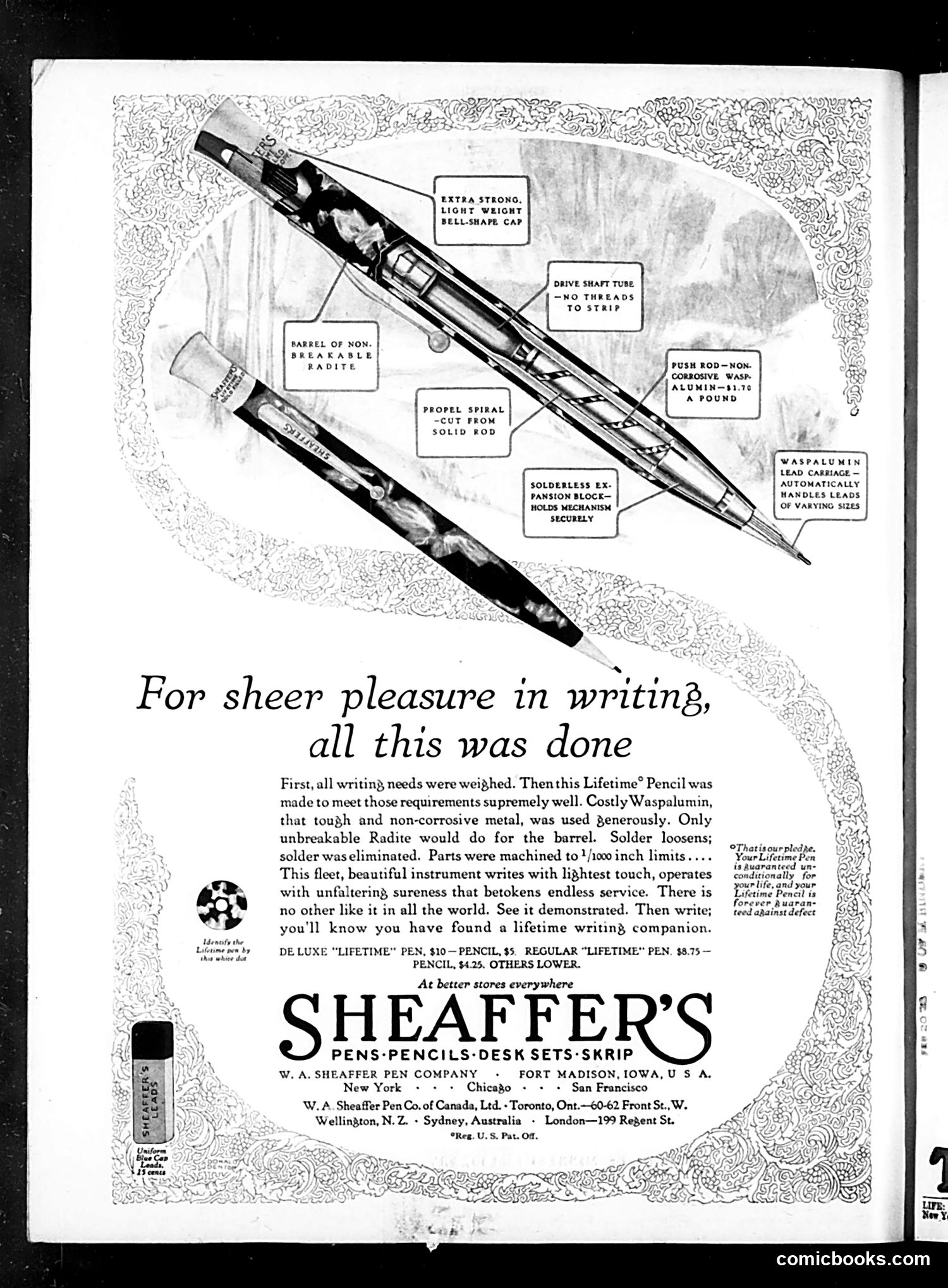
This is a **Sheaffer's pen advertisement**, not a political cartoon. The page shows a detailed technical diagram of the "Lifetime" pencil and pen, with labeled components highlighting engineering features: a non-breakable radite barrel, vaspalumin lead carriage, solderless expansion block, and drive shaft tube. The ad's tagline—"For sheer pleasure in writing, all this was done"—emphasizes that these technical innovations were designed solely for user comfort and writing quality. The copy claims the pen operates with "unflinching sureness" and requires no maintenance. This is a straightforward early-to-mid 20th century **product advertisement** promoting Sheaffer writing instruments through detailed specification claims, not satire or political commentary.
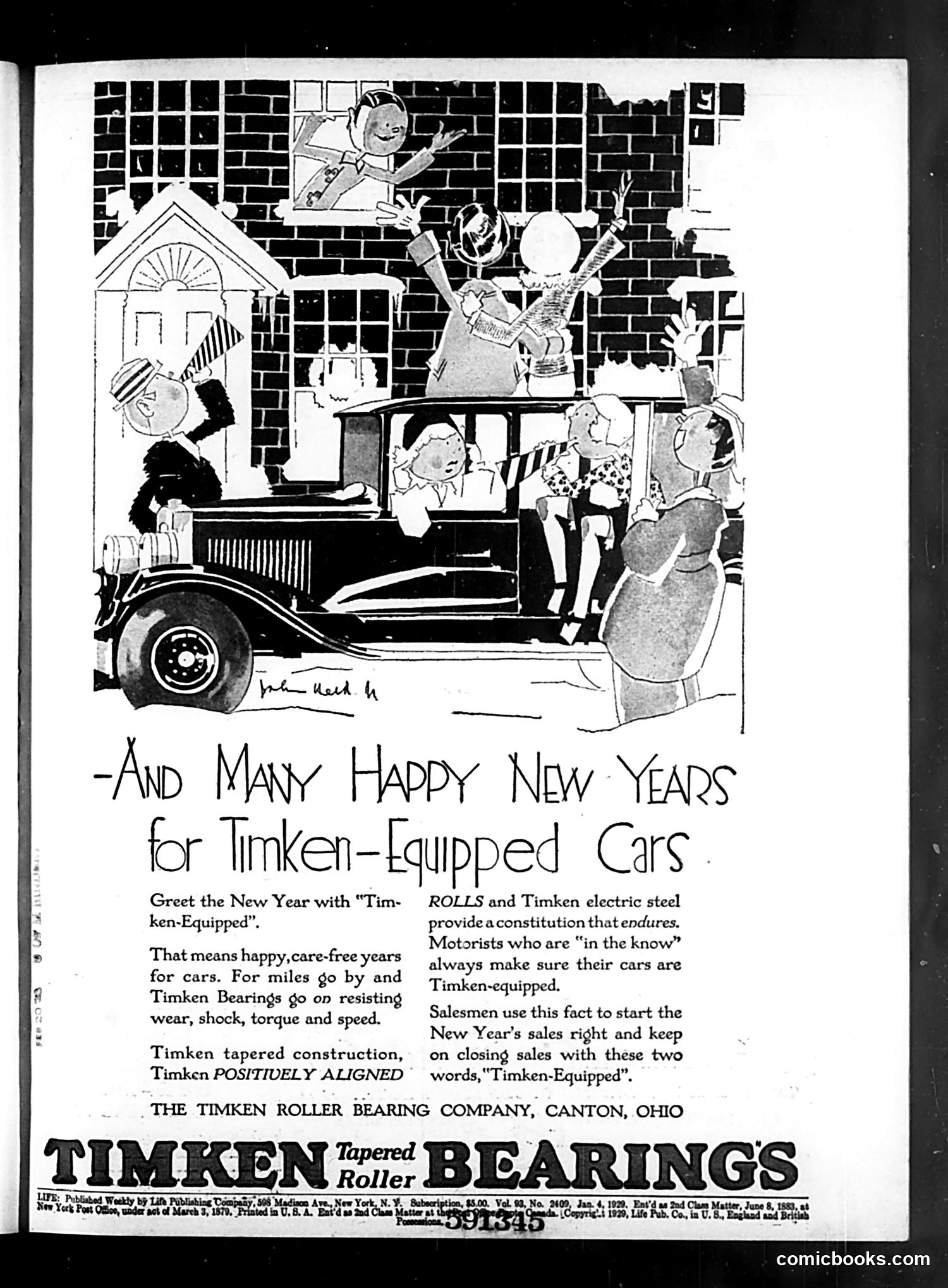
This is a **Timken Roller Bearings advertisement**, not satire or political commentary. The page celebrates New Year's with an illustration of a festive street scene featuring a car surrounded by celebrating people throwing confetti and playing instruments. The ad copy uses the holiday theme to market Timken bearings as reliable car components: "happy, care-free years for cars" promises durability that "endures." The phrase "Timken-Equipped" becomes a selling point—the ad notes that knowledgeable motorists specifically ensure their cars have Timken bearings. This reflects 1920s-30s advertising strategy: connecting product reliability to lifestyle aspirations and social status. The cheerful, crowded scene suggests cars as instruments of modern celebration and community life.
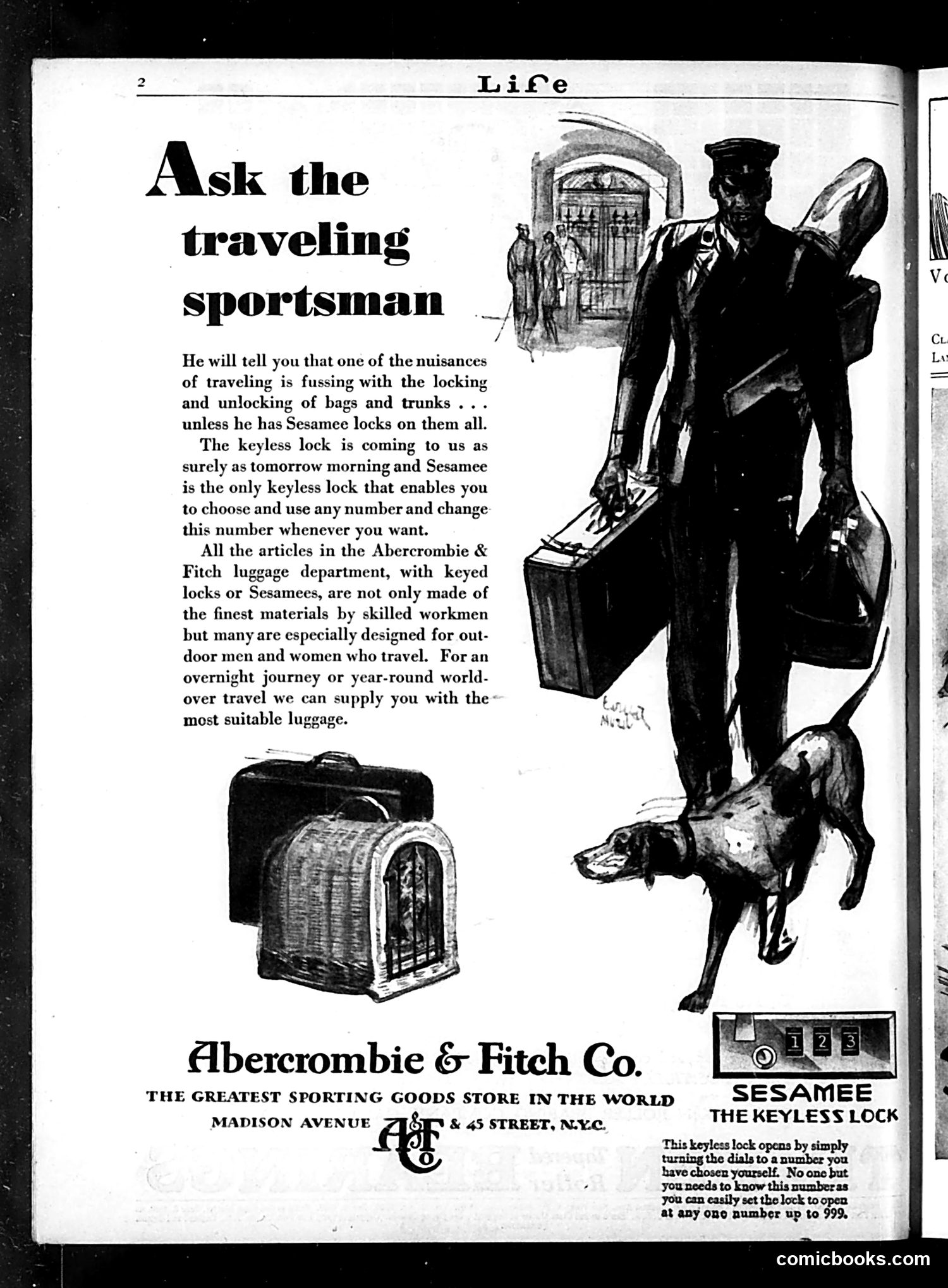
This is **advertising, not satire or political commentary**. It's a full-page ad for Abercrombie & Fitch Co., a sporting goods retailer located on Madison Avenue and 45th Street in New York City. The ad promotes Sesamee brand keyless locks for luggage. The imagery—a traveling sportsman with multiple bags and a dog—illustrates the target customer: wealthy travelers who need reliable security for their belongings during journeys. The "joke" is conversational: "Ask the traveling sportsman" about luggage problems, implying experienced travelers endorse this product. The Sesamee lock's innovation—allowing users to set and change combination numbers without keys—is presented as solving the inconvenience of traditional keyed locks. This reflects early 20th-century concerns about travel security and represents a genuine product innovation marketed to affluent consumers.
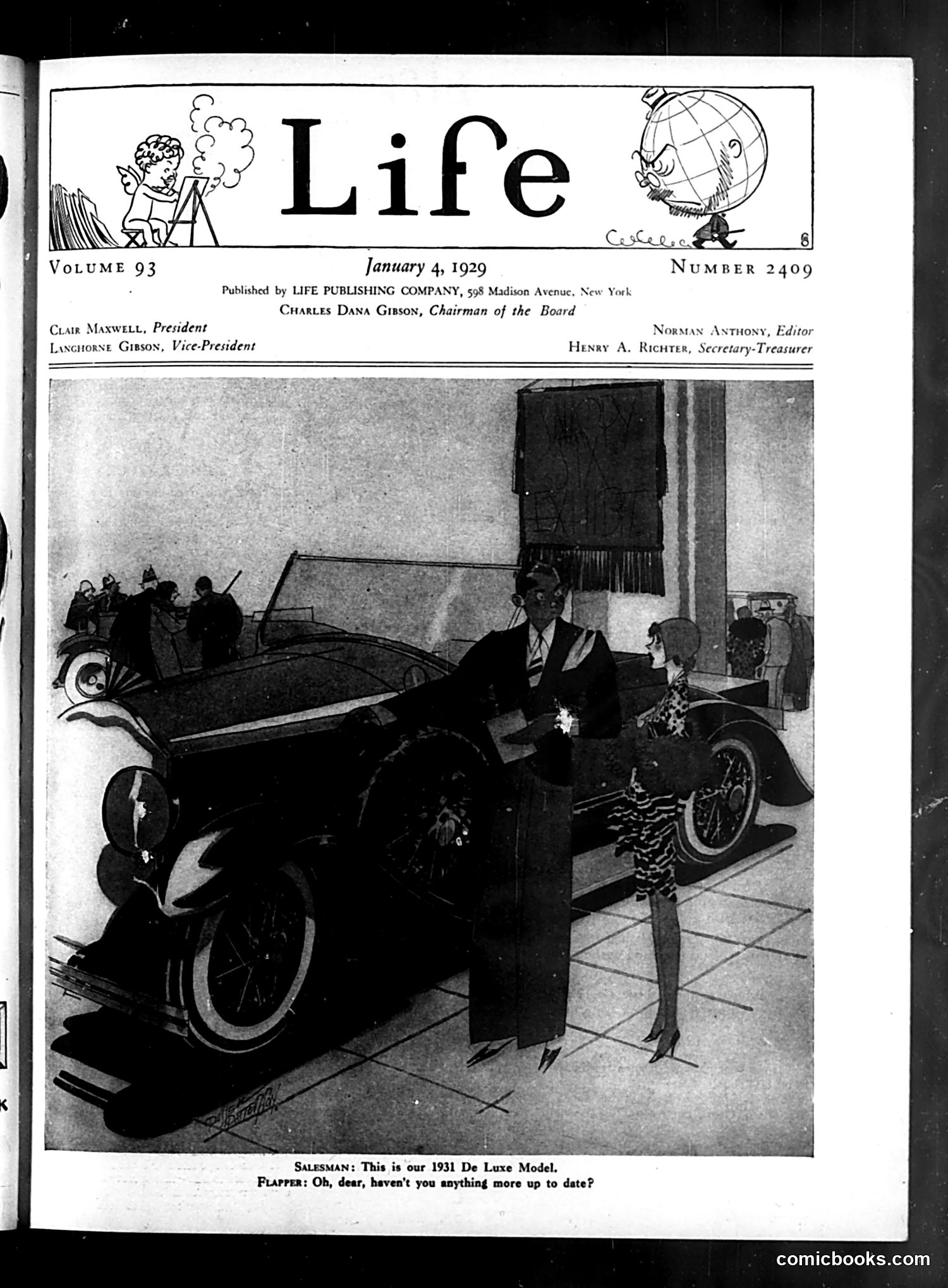
This is a 1929 *Life* magazine cover featuring a car-sales joke. A salesman presents a 1931 De Luxe automobile model to a well-dressed woman (the "flapper" referenced in the caption). The woman responds with skepticism: "Oh, dear, haven't you anything more up to date?" The humor relies on the absurdity of a car from a future year (1931) being considered already outdated. This satirizes: 1. **Consumer culture's rapid obsolescence** — the constant demand for newer models 2. **The "Flapper" era** — the modern, fashion-conscious woman of the 1920s who rejects yesterday's trends immediately 3. **Auto industry marketing** — manufacturers constantly promoting "new" models The joke captures the Jazz Age's intoxication with novelty and consumption, mocking both advertising hype and consumer excess during the prosperous 1920s, just months before the stock market crash.
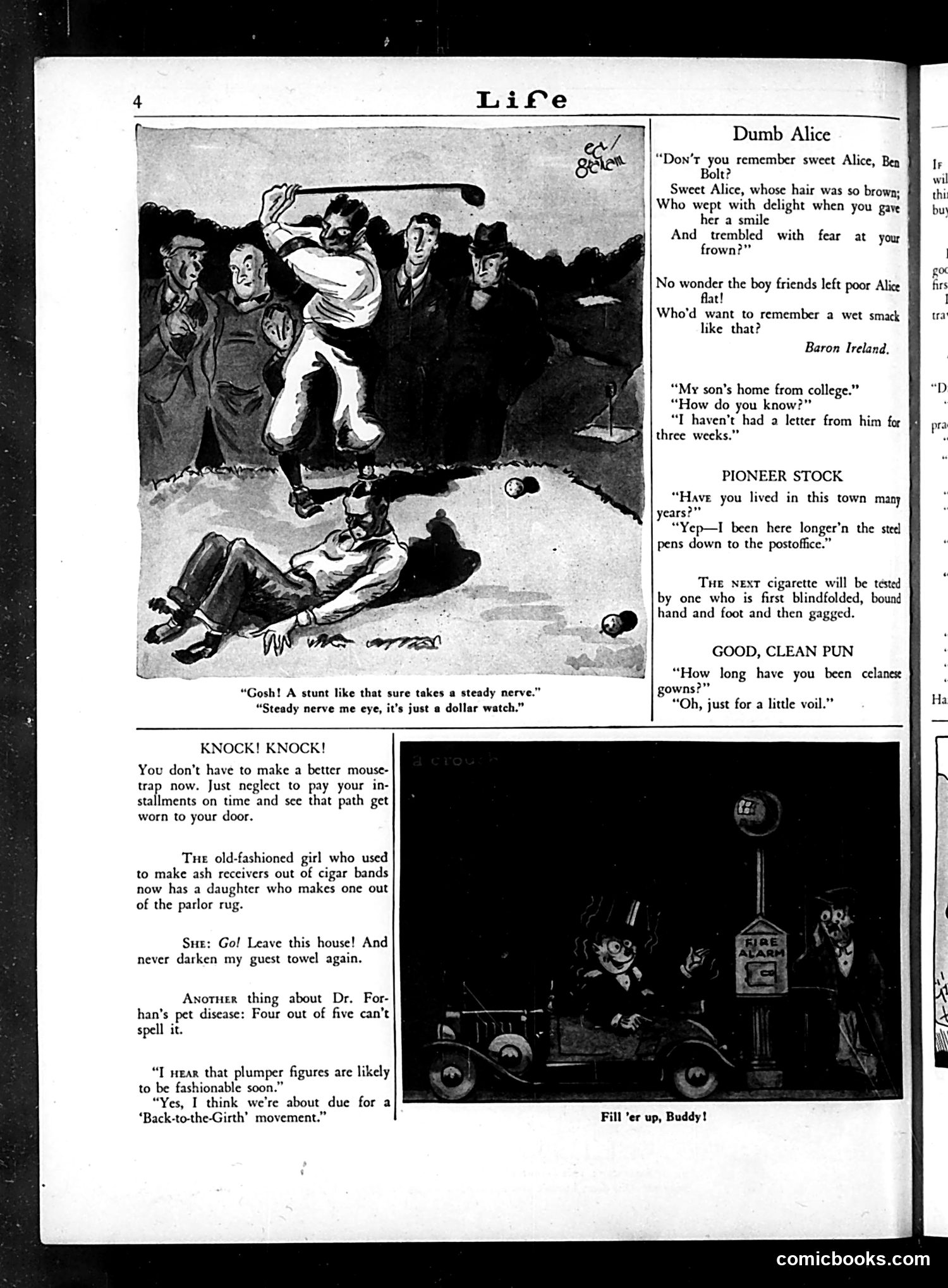
This page contains several joke sections typical of early 20th-century satirical magazines: **"Dumb Alice"** and related items are brief humorous verses poking fun at romantic misadventures and social situations—standard fare for Life's humor section. **"Knock! Knock!"** presents a series of short jokes about everyday life: debt collectors, household chores, and social pretensions. These reflect common anxieties of the era. **The main cartoon** (top left) depicts a golf stunt gone wrong, with spectators reacting in shock. The caption "Gosh! A stunt like that sure takes a steady nerve" / "Steady nerve me eye, it's just a dollar watch" satirizes both daredevil entertainment culture and cheap merchandise, suggesting the stunt performer's confidence comes from gambling with worthless equipment rather than genuine courage. The humor relies on period-specific social contexts now largely obsolete.
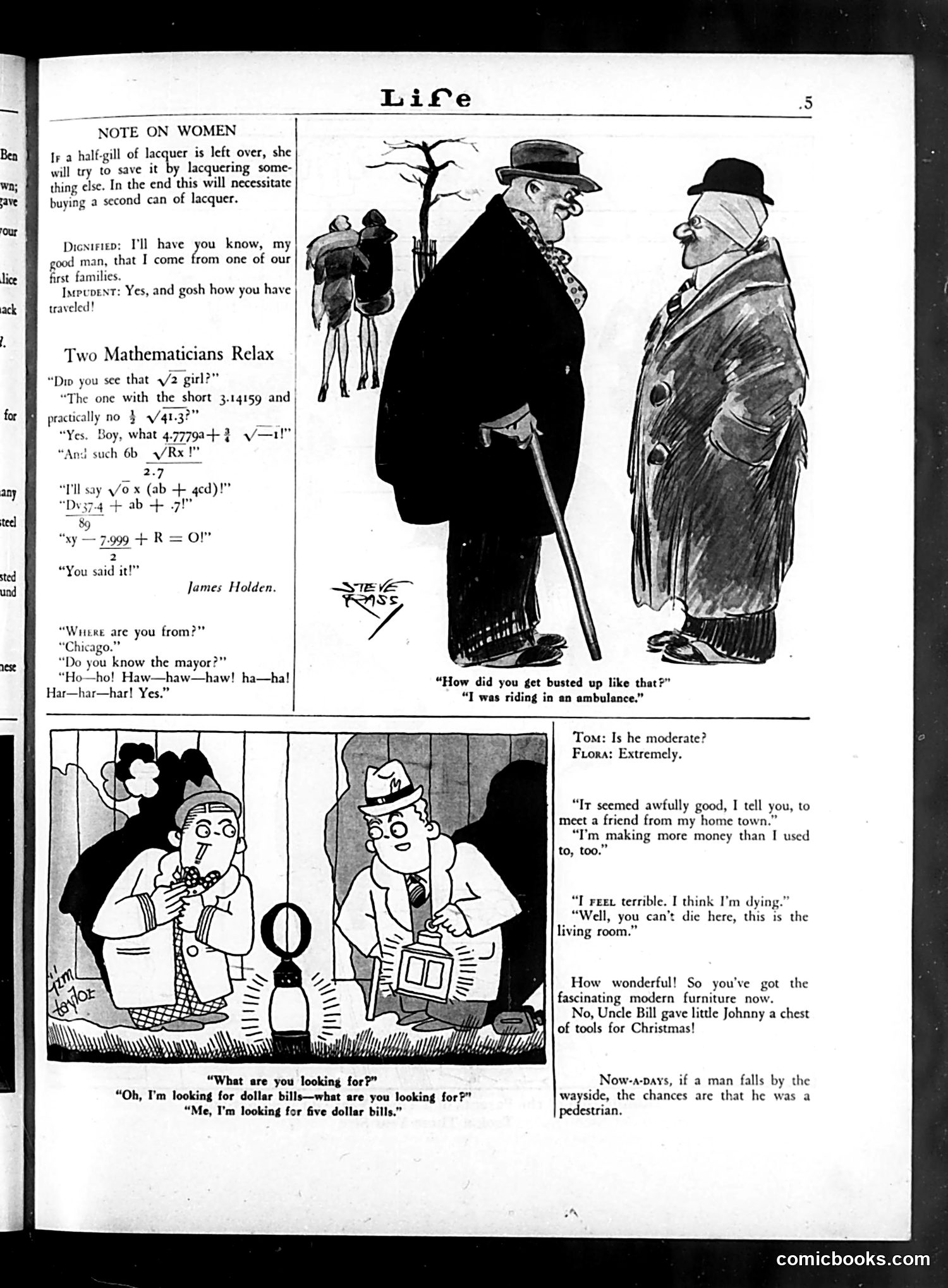
This page contains several humor pieces typical of early-20th-century Life magazine satire: **"Note on Women"** mocks women's thriftiness—the joke being that a woman will buy a second can of lacquer just to use up leftover product. **"Two Mathematicians Relax"** satirizes overly intellectual men who communicate entirely through complex mathematical equations, unable to have normal conversation. **The main cartoon** shows a well-dressed man with a cane telling another man he was "busted up" while "riding in an ambulance"—the joke being the absurdity of getting injured *while already in* an ambulance. **The bottom comic strip** depicts men searching for money ("dollar bills," "five dollar bills"), satirizing post-war economic desperation or frivolous materialism. **"Tom & Flora" dialogue** mocks social climbing and nouveau riche pretension about modern furniture and Christmas gifts. The final line suggests increased pedestrian accidents, likely referencing growing automobile traffic dangers.
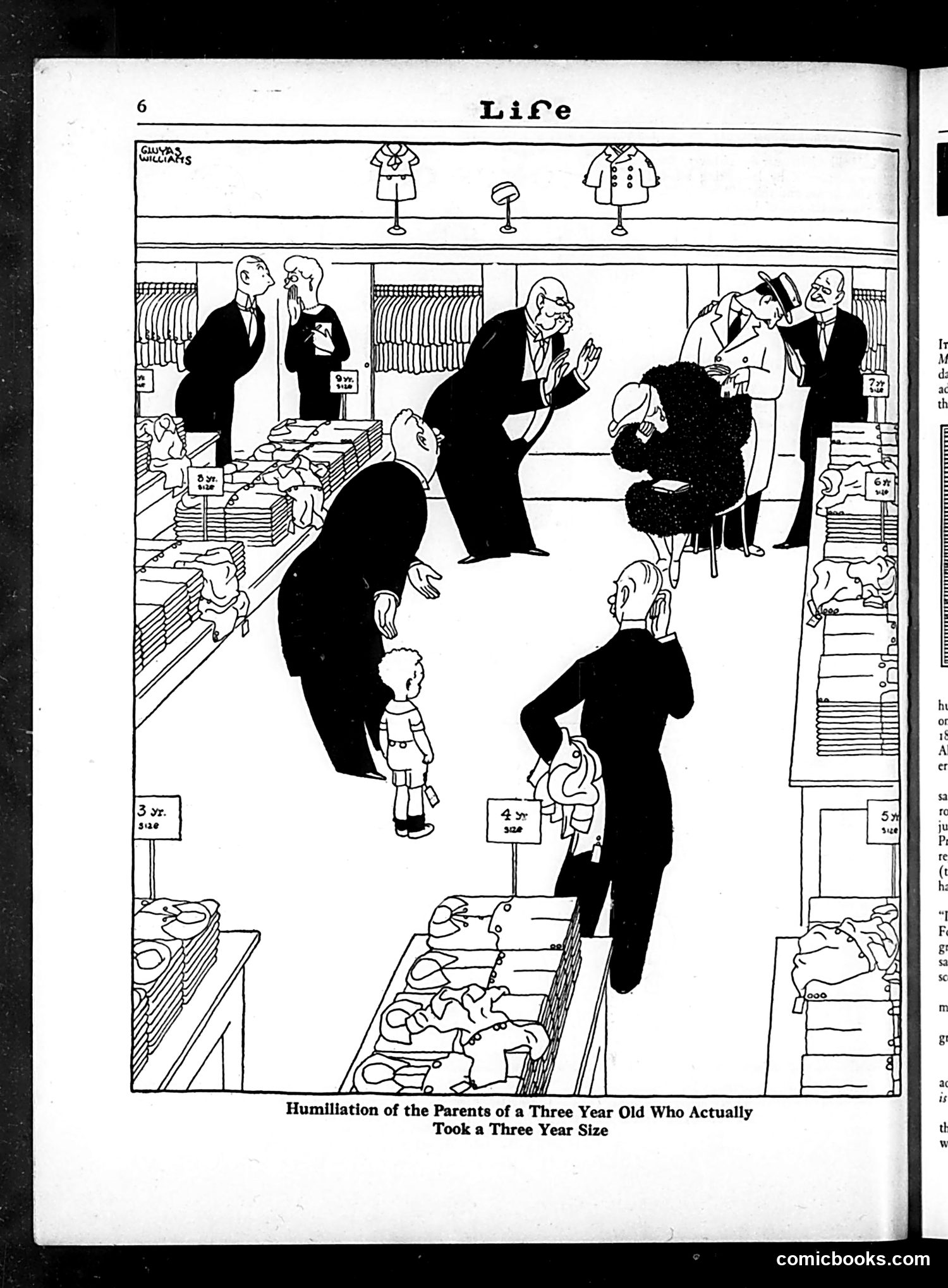
This is a humorous cartoon from Life magazine satirizing parental embarrassment in children's clothing stores. The caption reads: "Humiliation of the Parents of a Three Year Old Who Actually Took a Three Year Size." The joke targets a common parental anxiety: shopping for children's clothes. The cartoon depicts well-dressed adults (parents) in what appears to be a department store, visibly embarrassed among clothing racks while their small child stands nearby with a label marked "3 yr. size." The satire mocks the social awkwardness parents experience when their child actually fits standard sizing—implying most parents apparently buy larger sizes, making their child appear smaller than average. The exaggerated expressions of the adults and their prominent positioning emphasize the disproportionate shame they feel over this mundane shopping reality.
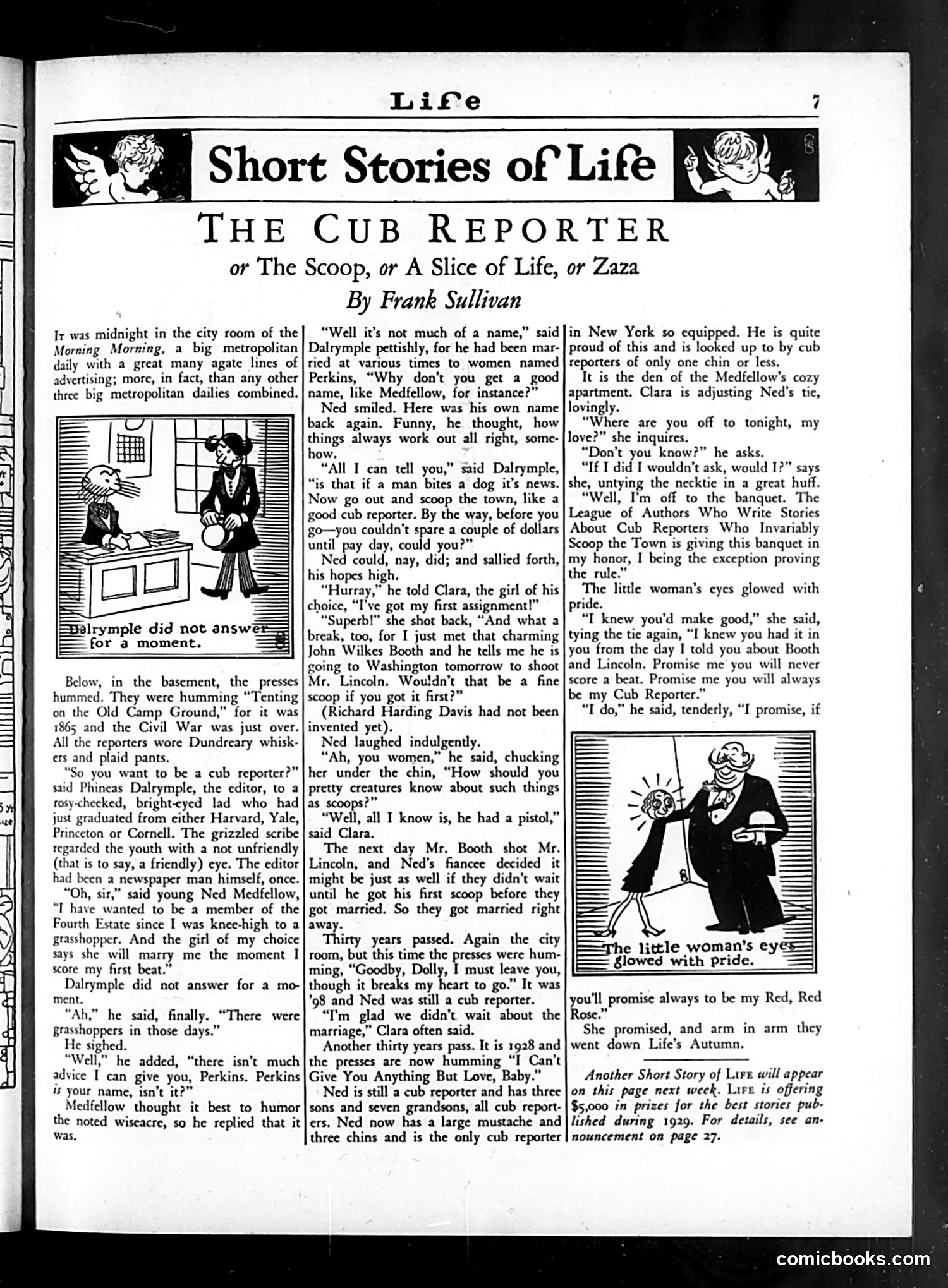
This satirical story mocks young newspaper reporters' ambitions and methods. The narrative follows Ned Meddellow, an eager cub reporter who dreams of landing a major scoop to advance his career. His editor, Dalrymple, cynically advises him that "biting a dog" (reversing the typical "dog bites man" story) constitutes real news—the implication being that reporters manufacture sensational stories rather than discover them. The humor targets journalistic ethics and the desperation of inexperienced reporters willing to fabricate or manipulate events for bylines. The story's resolution—Ned eventually marries and abandons reporting—suggests the profession attracts unrealistic young men who eventually abandon it for stability. The cartoon illustrations show the newsroom setting and Ned's earnest naiveté.
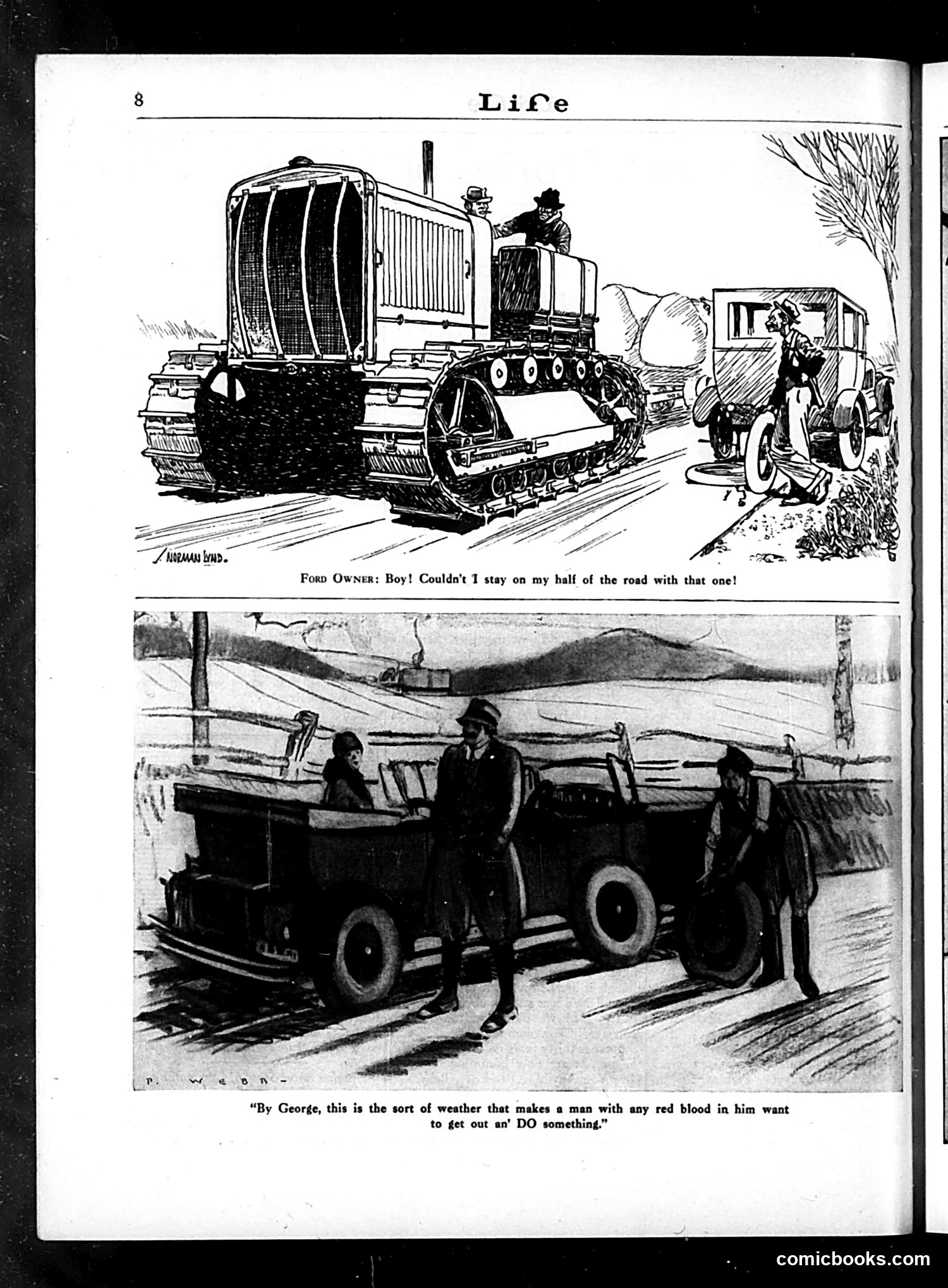
**Top Cartoon:** A Ford owner complains to a driver of an enormous, tank-like road vehicle: "Boy! Couldn't I stay on my half of the road with that one!" The satire mocks the impracticality of oversized vehicles—likely industrial or agricultural machinery—that monopolize roadways. It's a complaint about road-hog drivers and the growing tension between different vehicle types competing for space. **Bottom Photograph:** Three men stand beside a car during apparently poor weather. The caption reads: "By George, this is the sort of weather that makes a man with any red blood in him want to get out and DO something." This appears to satirize masculine bravado and the impulse to engage in pointless outdoor activity simply to prove one's vigor, regardless of practicality.
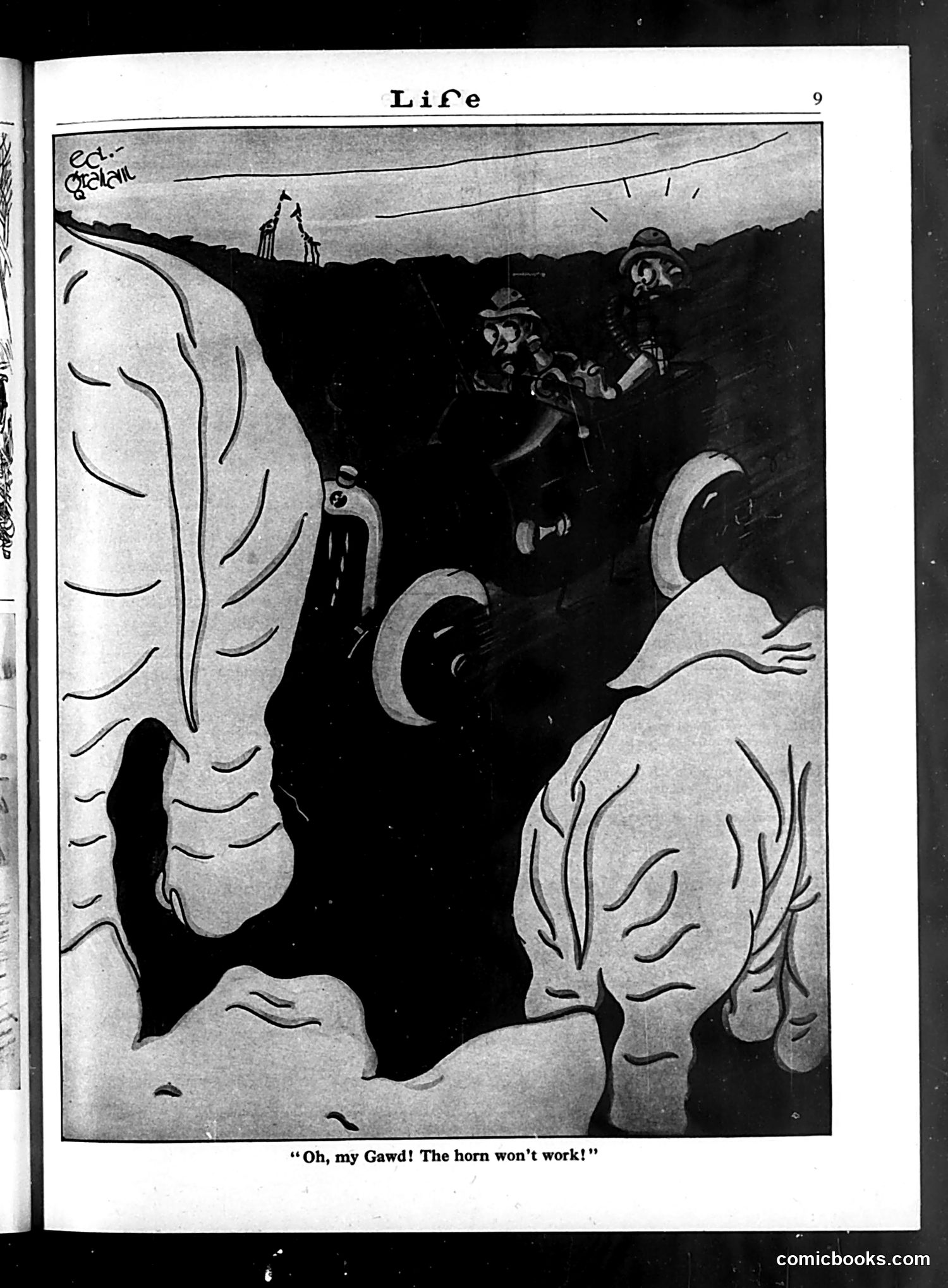
This single-panel cartoon depicts soldiers in a trench during what appears to be World War I, given the military uniforms and trench warfare setting visible in the background. The cartoon's humor centers on a malfunctioning military device—likely a gas horn or warning signal used to alert troops to gas attacks, a major threat in WWI combat. The exclamation "Oh, my Gawd! The horn won't work!" captures the dark comedy of military incompetence during wartime. The large elephant-like creatures in the foreground are unclear—they may represent gas canisters or be allegorical figures. The satire mocks the unreliability of military equipment and the absurdity of trench warfare conditions. The crude drawing style is typical of Life's comedic cartooning from this era.
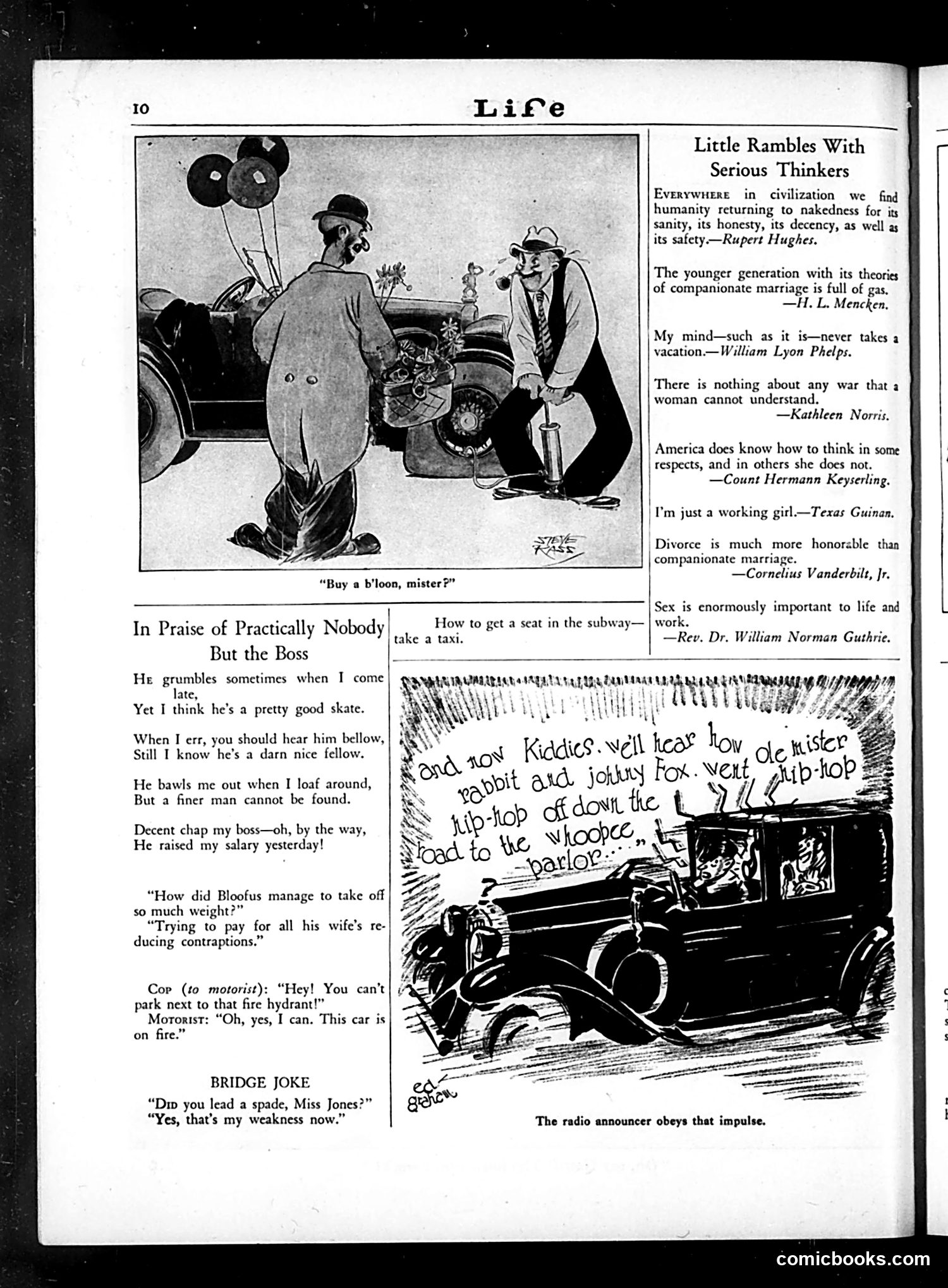
This page contains three separate pieces of humor: **Top cartoon** ("Buy a bloon, mister?"): Two men in bowler hats examine an early automobile. The joke plays on the prevalence of car tire punctures in this era—one man asks the other to "buy a bloon" (balloon), a colloquial term for an inflated tire patch or repair kit. **Middle poem** ("In Praise of Practically Nobody But the Boss"): A worker humorously describes his boss as occasionally grumpy yet fundamentally decent, culminating in the punchline that the boss raised his salary yesterday—thus earning forgiveness for all faults. **Bottom cartoon** ("The radio announcer obeys that impulse"): A car full of children singing a nursery rhyme ("Rabbit and Johnny Fox") suggests how radio broadcasts influence popular culture and children's behavior, likely satirizing radio's growing social power in this period.
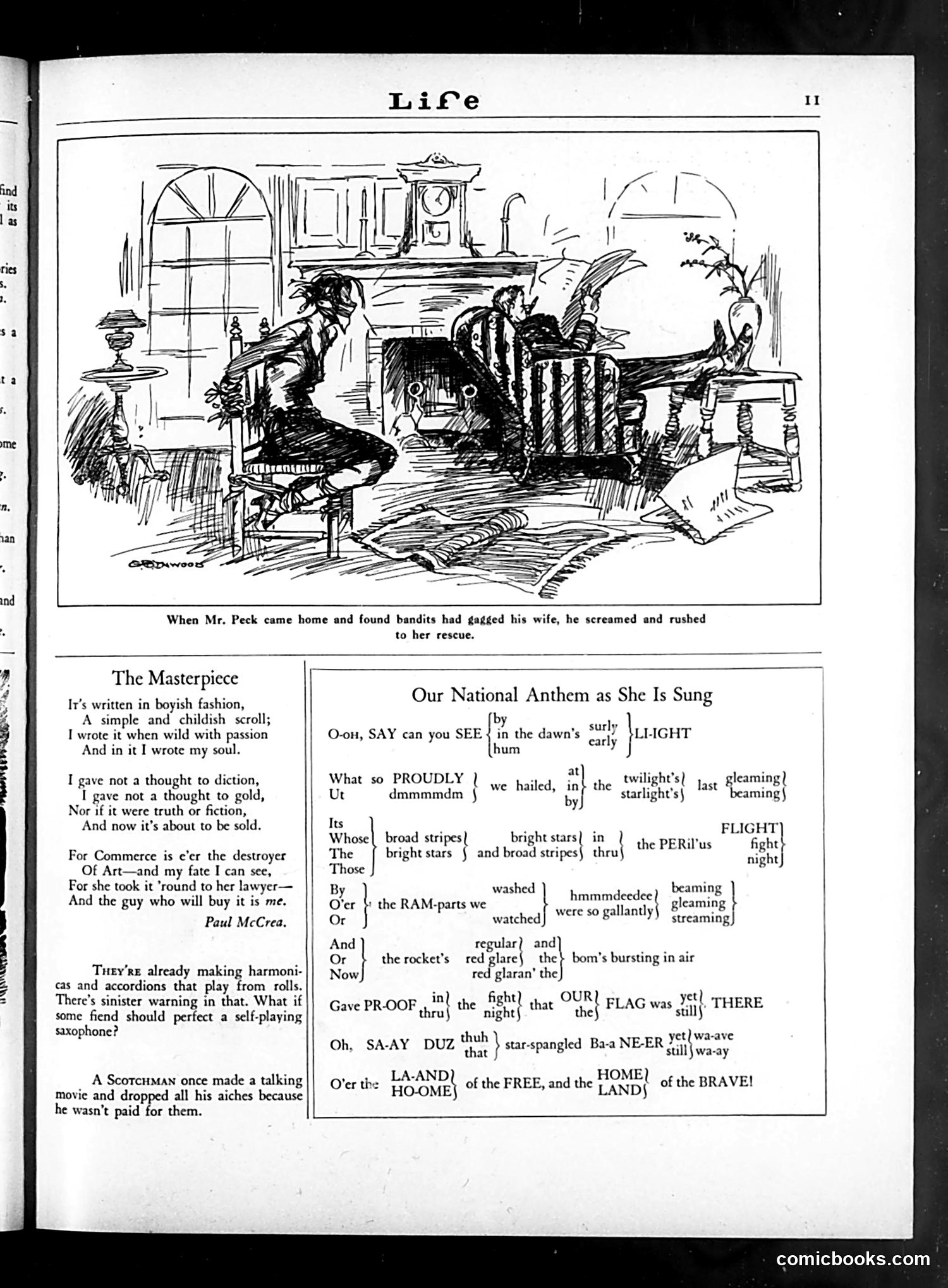
**The Cartoon:** The top illustration shows Mr. Peck discovering bandits have gagged his wife, prompting him to rush to her rescue. This appears to be a domestic humor sketch playing on the ironic appeal of silencing one's spouse. **The Literary Content:** Below are three separate pieces: "The Masterpiece" (a poem mocking commercial art by Paul McCrea), a joke about Scottish penny-pinching in cinema, and a satirical rewrite of "The Star-Spangled Banner" with phonetic spelling showing how Americans mispronounce the national anthem. **The Point:** This page combines domestic satire, critiques of commercialism in art, and gentle mockery of American cultural literacy—specifically how the national anthem's lyrics are mangled through careless singing.
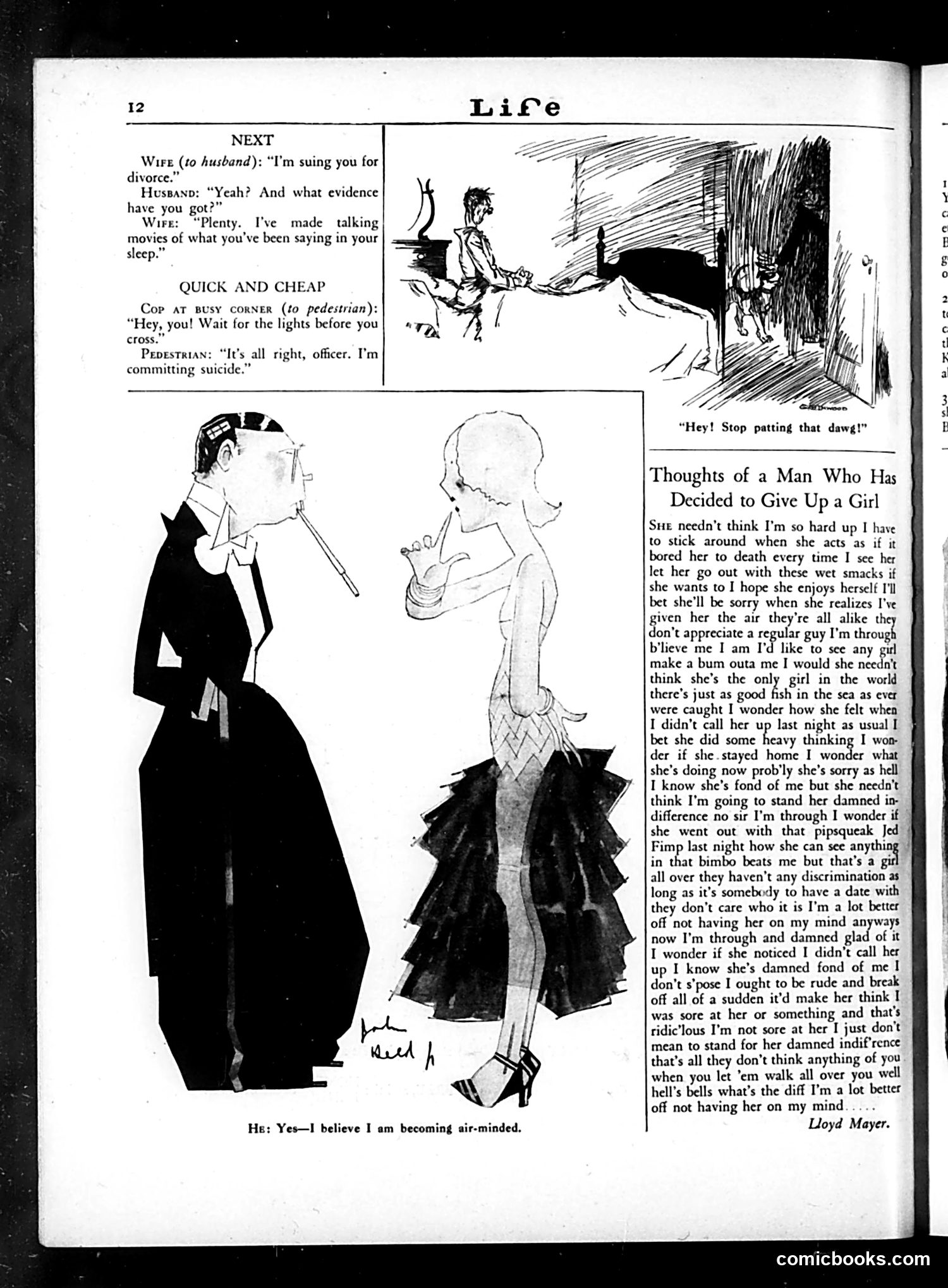
This page contains three humor pieces targeting early 20th-century social attitudes: **"Next"** mocks divorce proceedings through a wife's claim that her husband talks in his sleep—a satirical jab at the legal absurdities required to obtain divorce. **"Quick and Cheap"** darkly jokes about a cop telling a pedestrian to wait for traffic before crossing, only for the pedestrian to respond they're committing suicide instead—gallows humor about urban danger. **The illustration** shows a couple where the man says "Yes—I believe I am becoming air-minded," likely referencing the then-novel aviation craze and perhaps suggesting romantic distraction or absent-mindedness. **"Thoughts of a Man..."** is a lengthy monologue by someone breaking up with a girlfriend, revealing period attitudes about casual dating, male entitlement, and dismissive treatment of women's feelings. The tone reflects contemporary male cynicism toward relationships.
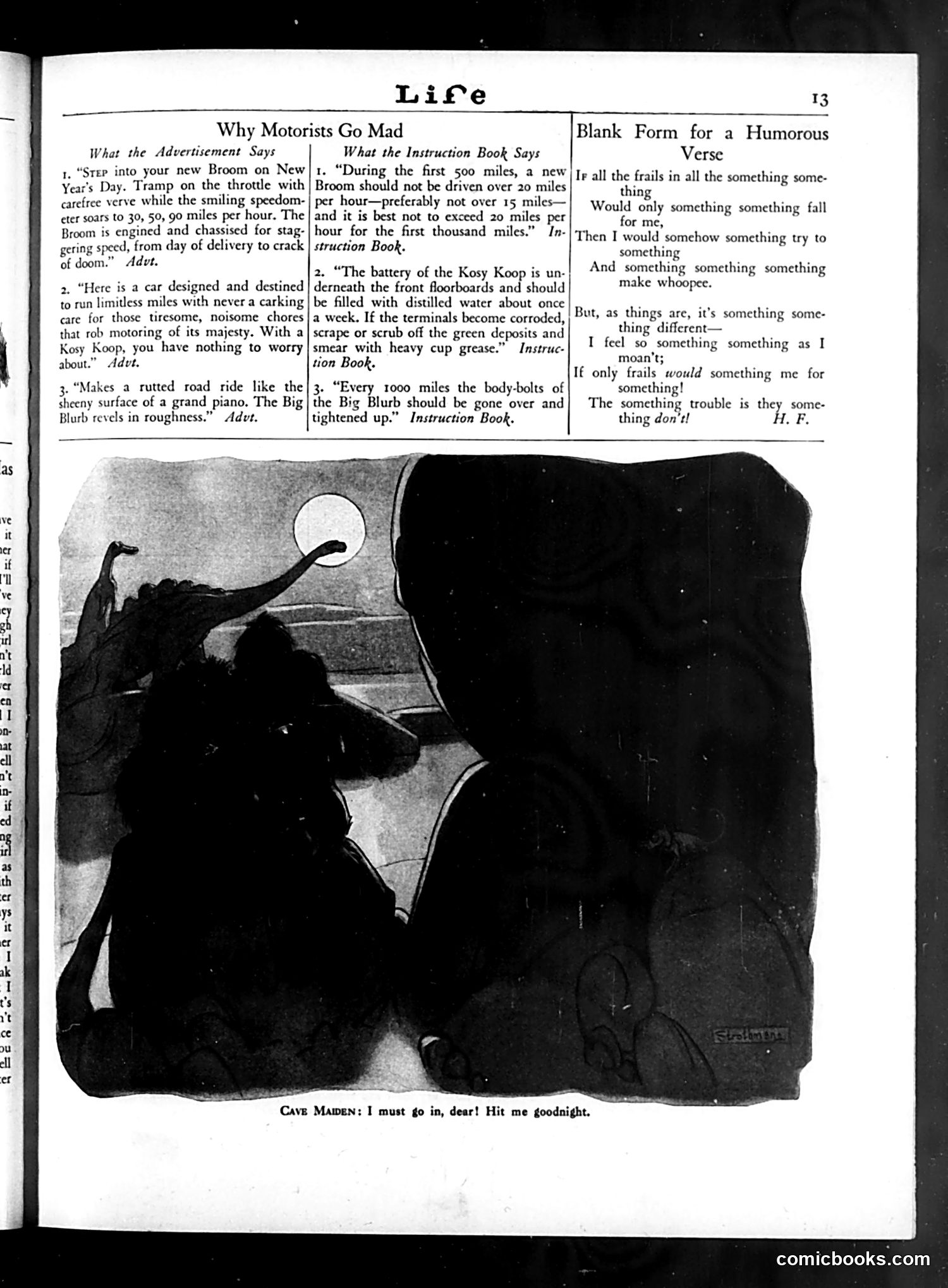
This page satirizes early automobile ownership through a three-part comparison: what car advertisements promise versus what instruction manuals actually require, alongside a humorous poem about automotive frustrations. The main cartoon depicts a silhouetted couple in a car at night. The caption reads "Cave Maiden: I must go in, dear! Hit me goodnight"—a dark joke about automotive danger. The woman gestures toward the moon, suggesting she's uncomfortable or frightened during a romantic drive. The upper text mocks the gap between marketing claims (cars require "nothing to worry about") and reality (batteries need maintenance, body bolts require tightening, etc.). The poem humorously catalogs car troubles using repetitive "something" language to emphasize how many problems plague early automobiles. This reflects early 1900s skepticism about cars as reliable transportation.
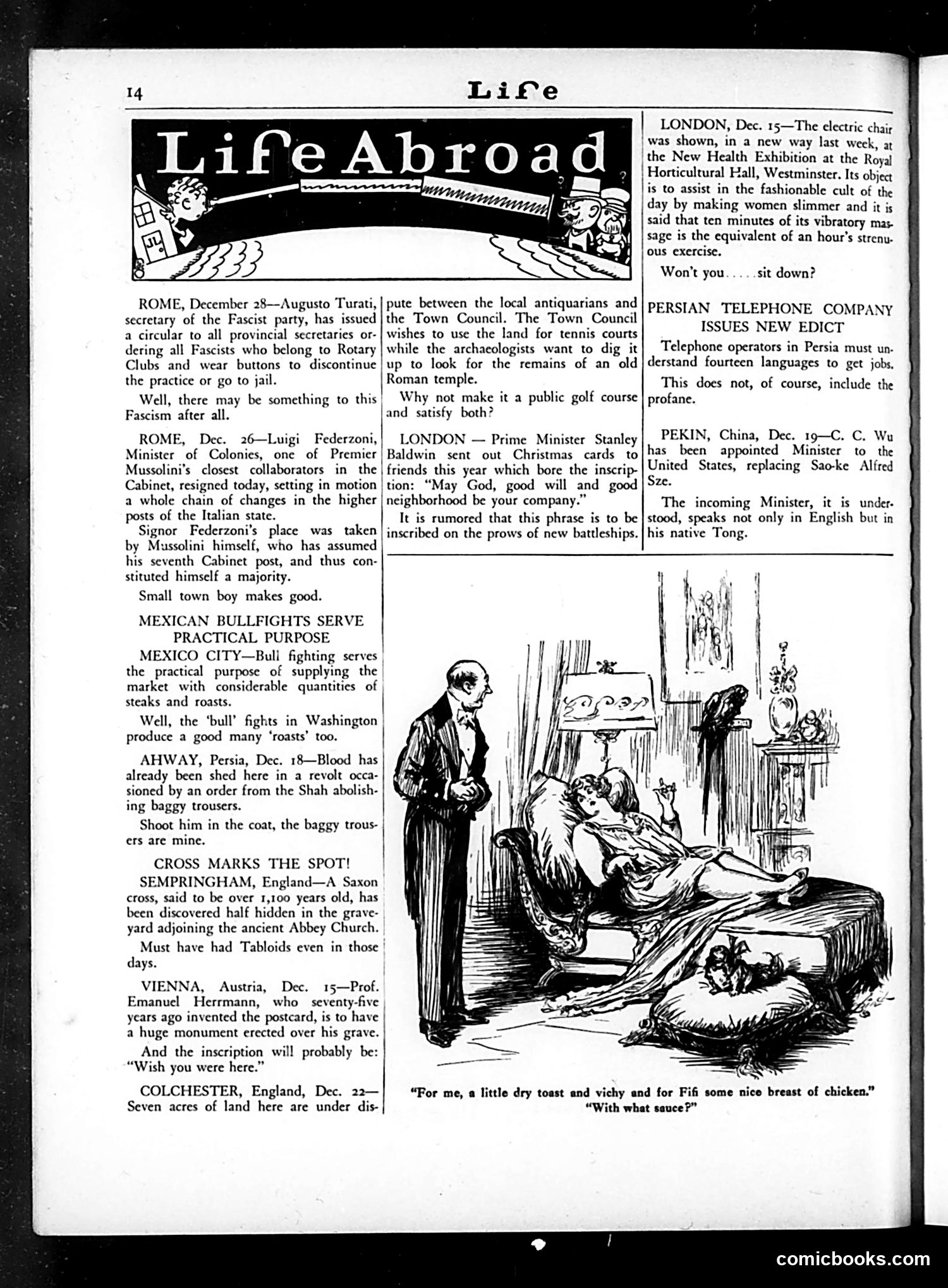
The single cartoon on this page depicts a sickbed scene where a man in formal dress addresses a reclining patient. The caption reads: "For me, a little dry toast and vichy and for Fifi some nice breast of chicken. With what sauce?" This appears to be a humorous commentary on class pretension and pet indulgence. The standing figure's fastidious ordering—requesting specific preparations for himself and his dog "Fifi"—satirizes affected, aristocratic behavior. The joke likely mocks wealthy individuals who fuss elaborately over trivial dietary preferences while neglecting the sick person's actual needs. The dog receiving gourmet treatment comparable to the human guest underscores the absurdity of misplaced priorities. This reflects early 20th-century satirical interest in lampooning upper-class affectation and vanity.
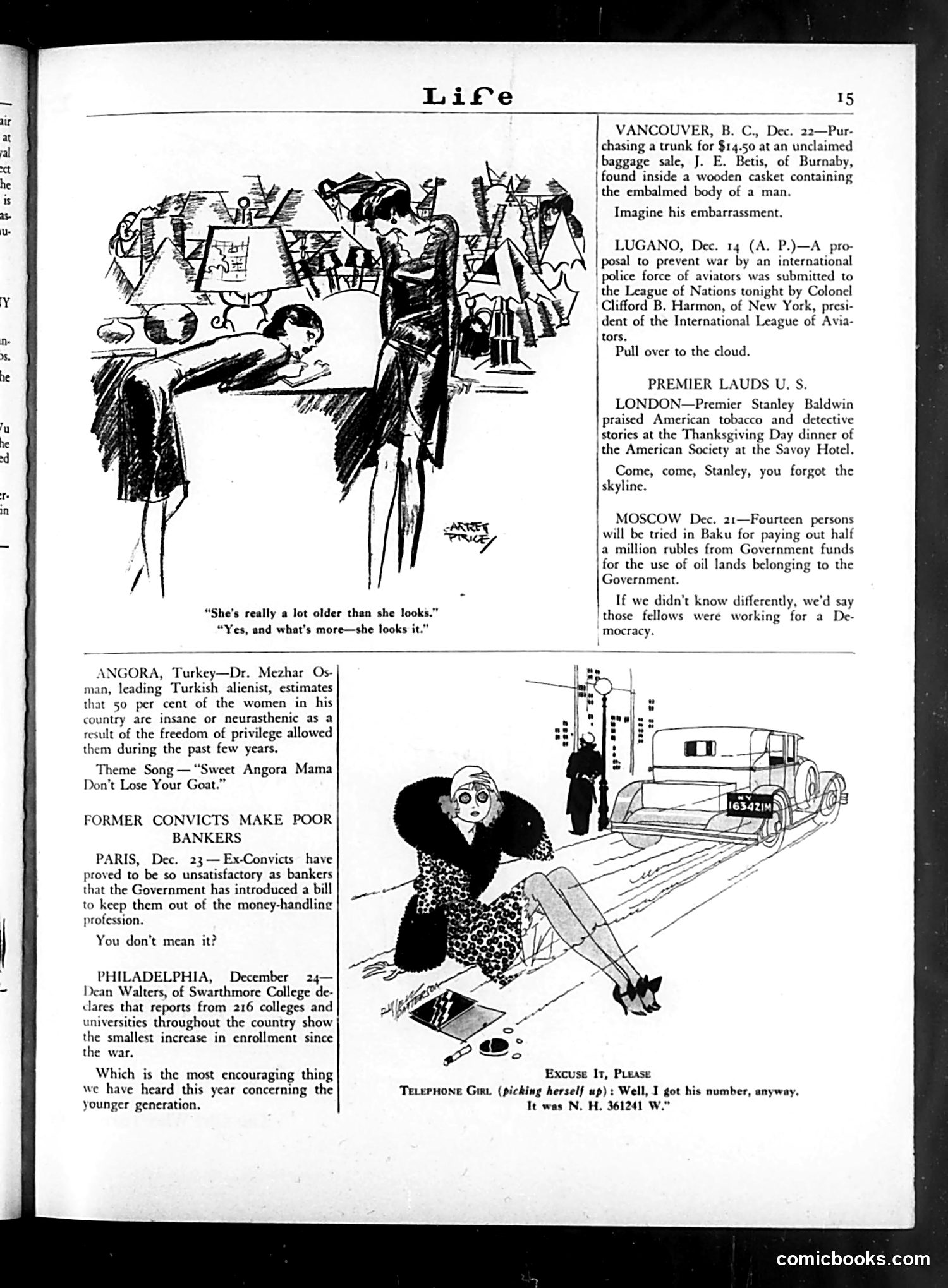
**Top Cartoon**: A woman confronts a man about his date's appearance. The woman says, "She's really a lot older than she looks" and the man replies, "Yes, and what's more—she looks it." This is a classic joke about deceptive appearance and romantic disappointment—the date appears young but isn't, and paradoxically, she also looks old. The satire targets male vanity and the gap between romantic expectations and reality. **Bottom Cartoon ("Excuse It, Please")**: A telephone operator kneels by a car, having apparently caused an accident while distracted. The joke mocks her excuse: she got the number but was distracted. This satirizes carelessness and the emerging distraction caused by technology—suggesting telephone operators (typically women in this era) were inattentive to their surroundings.
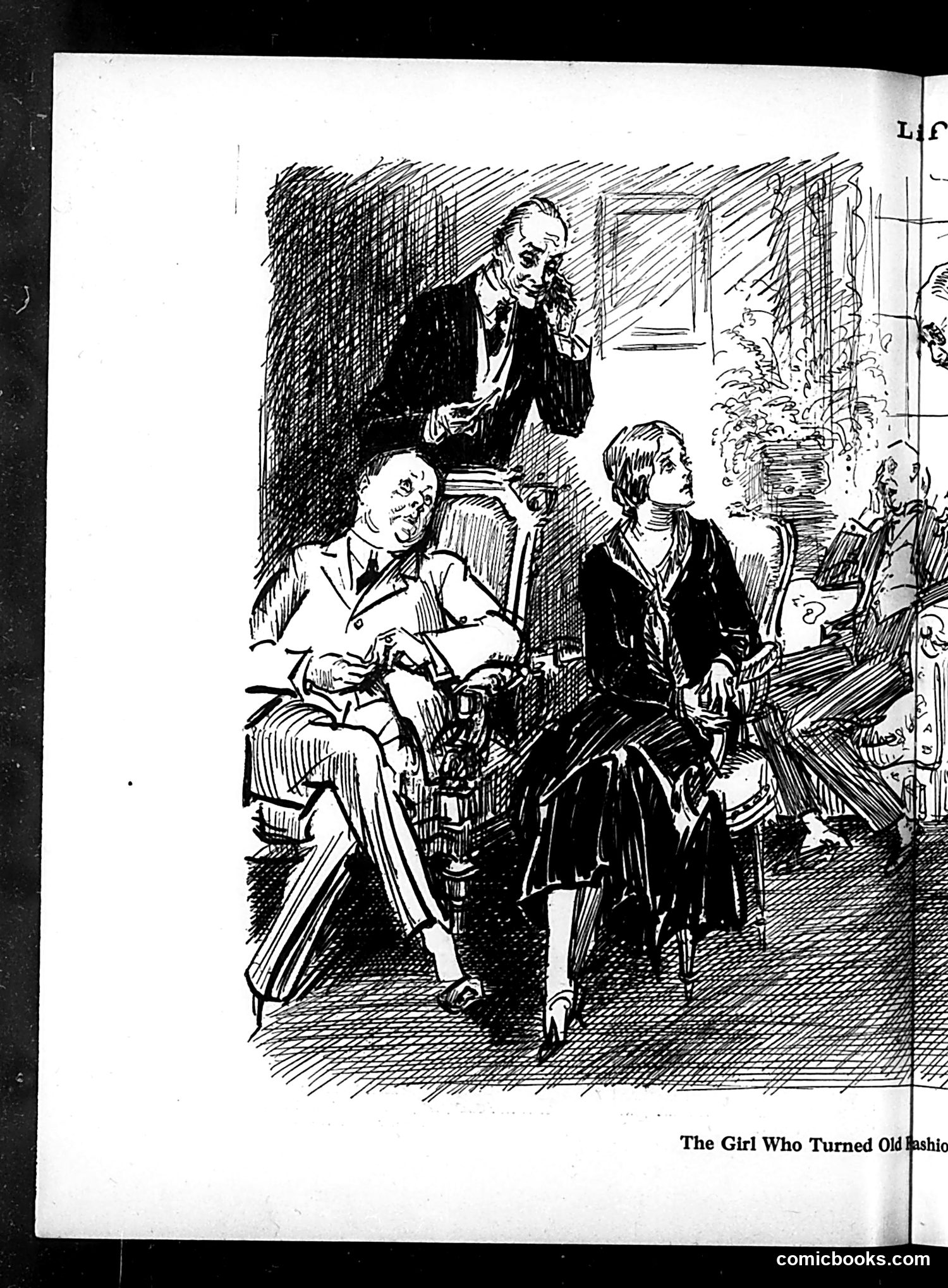
This illustration depicts a social commentary on changing fashion and aging. The scene shows what appears to be a salon or social gathering where a young woman in modern, shorter dress sits alongside an older woman in old-fashioned clothing. An elderly man stands between them, observing the contrast. The title's pun—"Old Fashion" (both a dated style and a cocktail)—suggests the cartoon mocks either a woman who clings to outdated dress styles, or conversely, satirizes how quickly modern fashion makes young women appear prematurely aged. The setting and formal attire suggest this targets upper-class social pretensions about fashion consciousness and generational style differences, likely from the 1920s-30s era when hemlines and silhouettes were rapidly evolving.
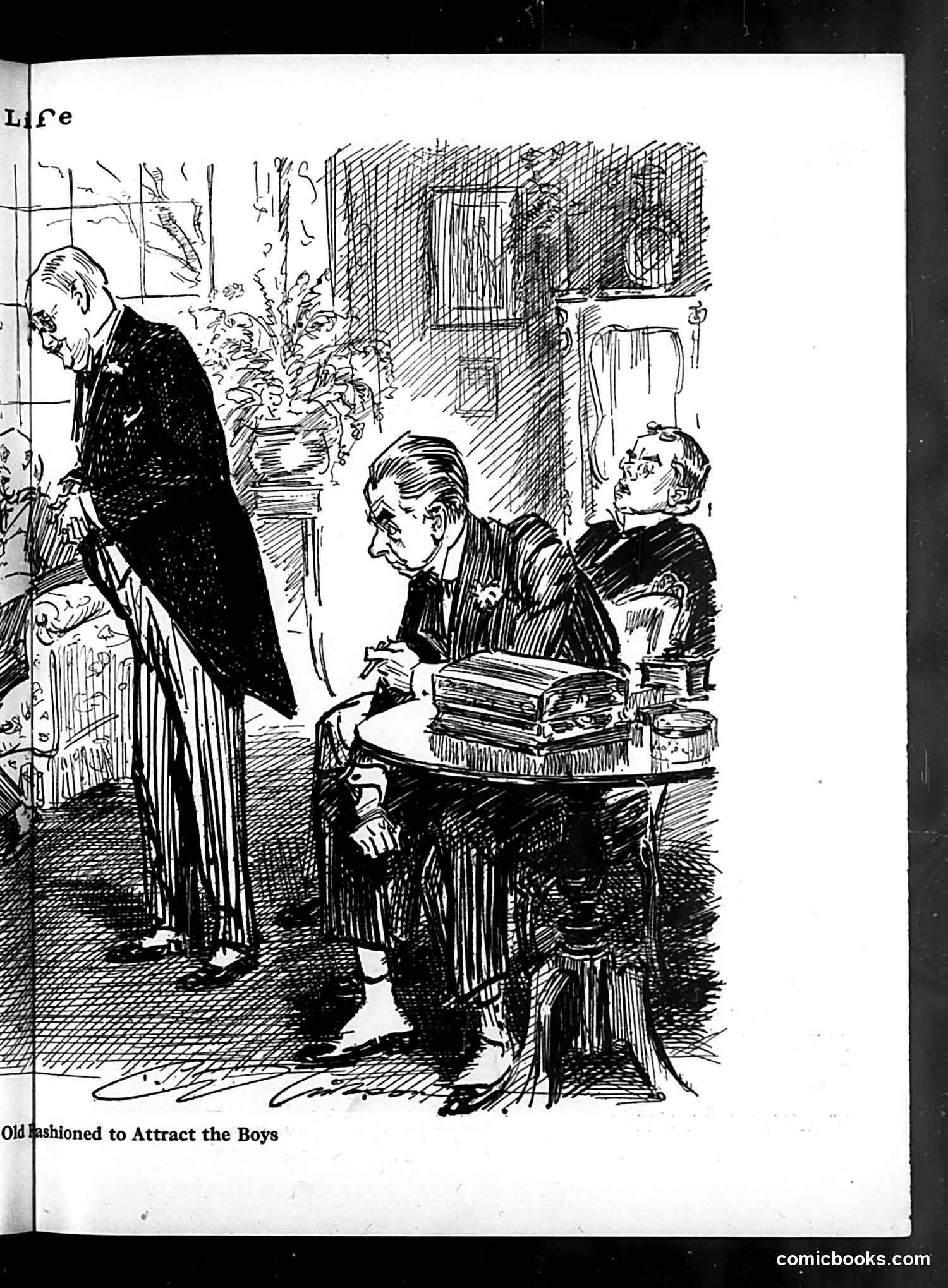
This satirical cartoon depicts a domestic scene where an older man stands prominently while younger figures sit reading. The caption "Old Fashioned to Attract the Boys" suggests the satire concerns outdated social practices meant to appeal to young men. The scene appears to mock either: (1) an older generation's misguided attempts to seem modern/attractive, or (2) deliberate adoption of old-fashioned behavior as a courtship strategy. The formal dress and interior setting suggest middle or upper-class domestic life. Without additional context from Life magazine's specific issue, the exact target of satire remains unclear—it could reference fashion trends, generational attitudes toward courtship, or contemporary social debates about modernity versus tradition. The precise historical reference would require knowing Life's publication date.
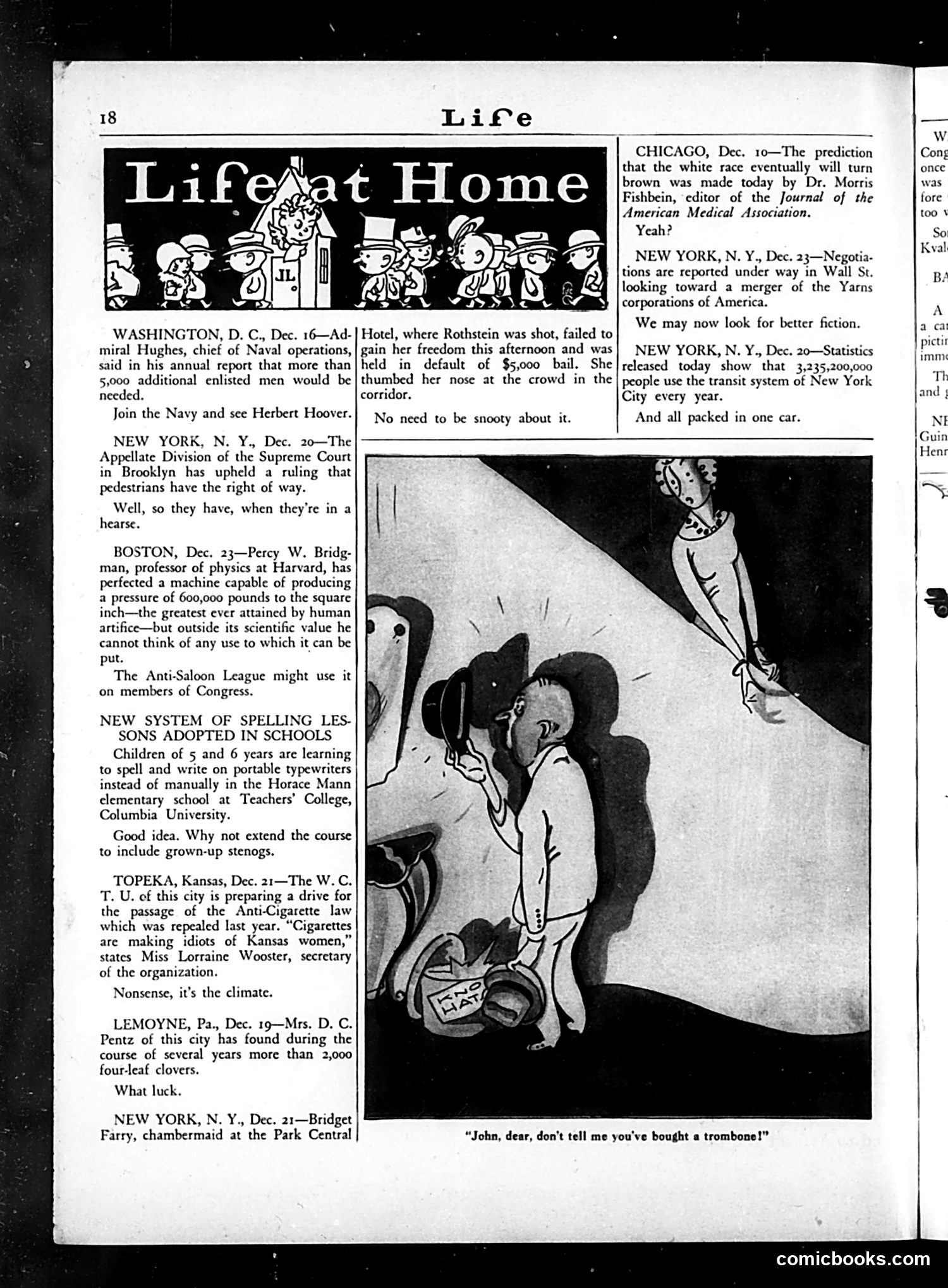
This page collects brief news items paired with sarcastic editorial quips. The main cartoon depicts a wife discovering her husband has purchased a trombone—a comedic domestic scene about wasteful spending during the Jazz Age. The accompanying "Life at Home" section mocks contemporary news through dry wit. Examples include: - **Naval recruitment**: After reporting the Navy needs 5,000 more enlisted men, the quip "Join the Navy and see Herbert Hoover" sarcastically references the then-President. - **Anti-Saloon League satire**: A Harvard physicist's pressure machine is jokingly suggested as a tool to coerce congressional temperance supporters. - **Transit statistics**: New York's transit ridership figure (3.2 billion) is mocked as impossible—"all packed in one car." - **Women and smoking**: Kansas's WCTU campaign against cigarettes is dismissed as misguided; the quip blames climate instead. The humor relies on readers recognizing current events and political figures, making pointed critiques of 1920s American society through absurdist exaggeration.
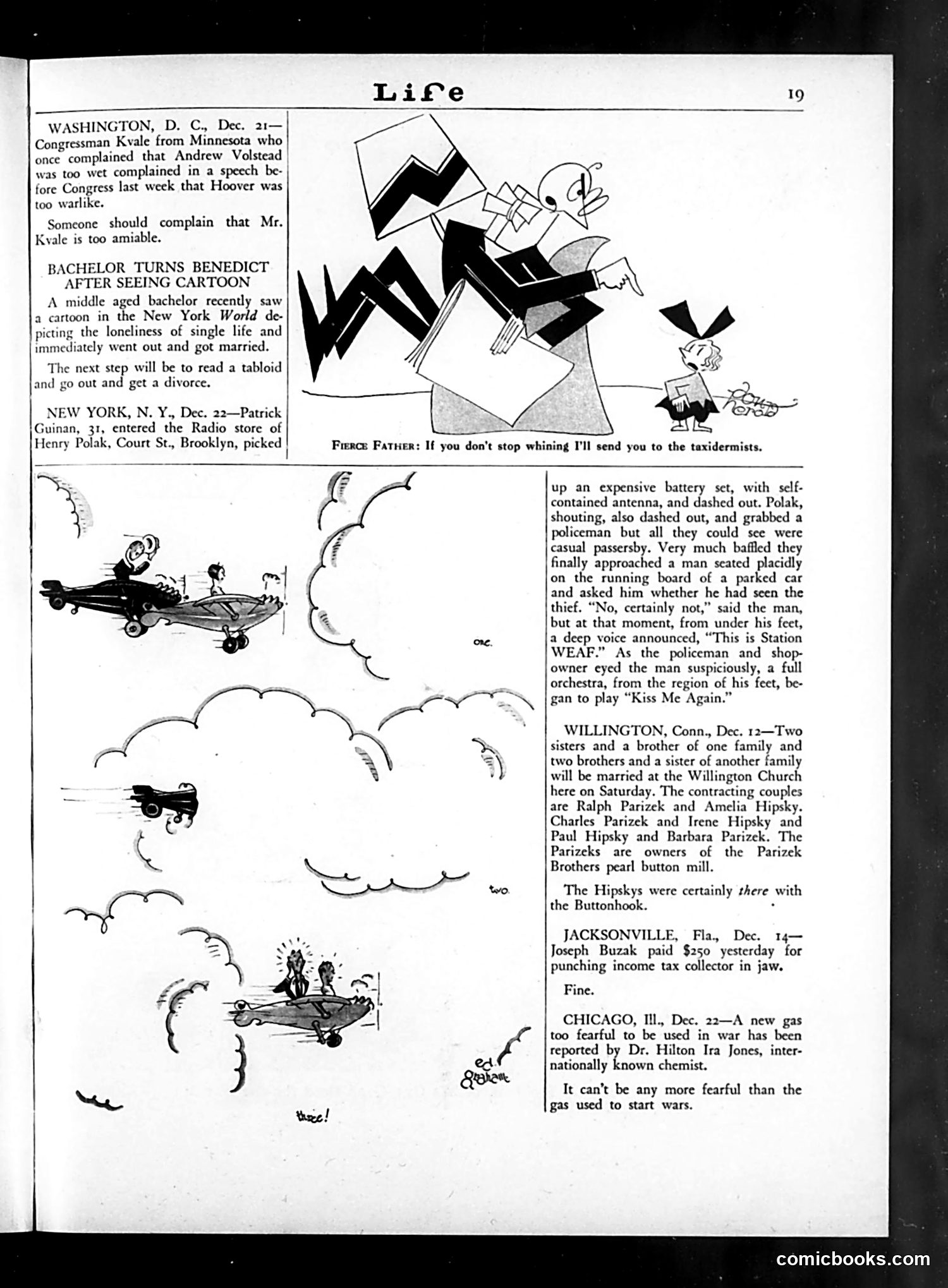
This page contains brief satirical news items and cartoons typical of Life's humor format. **Top cartoon** depicts a stern father threatening to send a whining child to "the taxidermists"—visual humor about parental exasperation with complaining. **News items satirize**: - Congressman Kvale's inconsistency (once calling Volstead "too wet," now calling Hoover "too warlike")—the joke being he's unreasonably critical either way - A bachelor moved to marry by a cartoon about single loneliness, with dark humor suggesting divorce will follow - A Brooklyn radio theft where a hidden radio announcer at Station WEAF broadcasts from under a parked car, interrupting a police investigation - A complex Connecticut wedding involving two families exchanging partners (the "Buttonhook" reference is unclear without more context) - Brief items about assault and a chemist's "fearful" new gas The final quip suggests war itself is the most frightening "gas"—likely referencing WWI chemical weapons, still topical in this era.
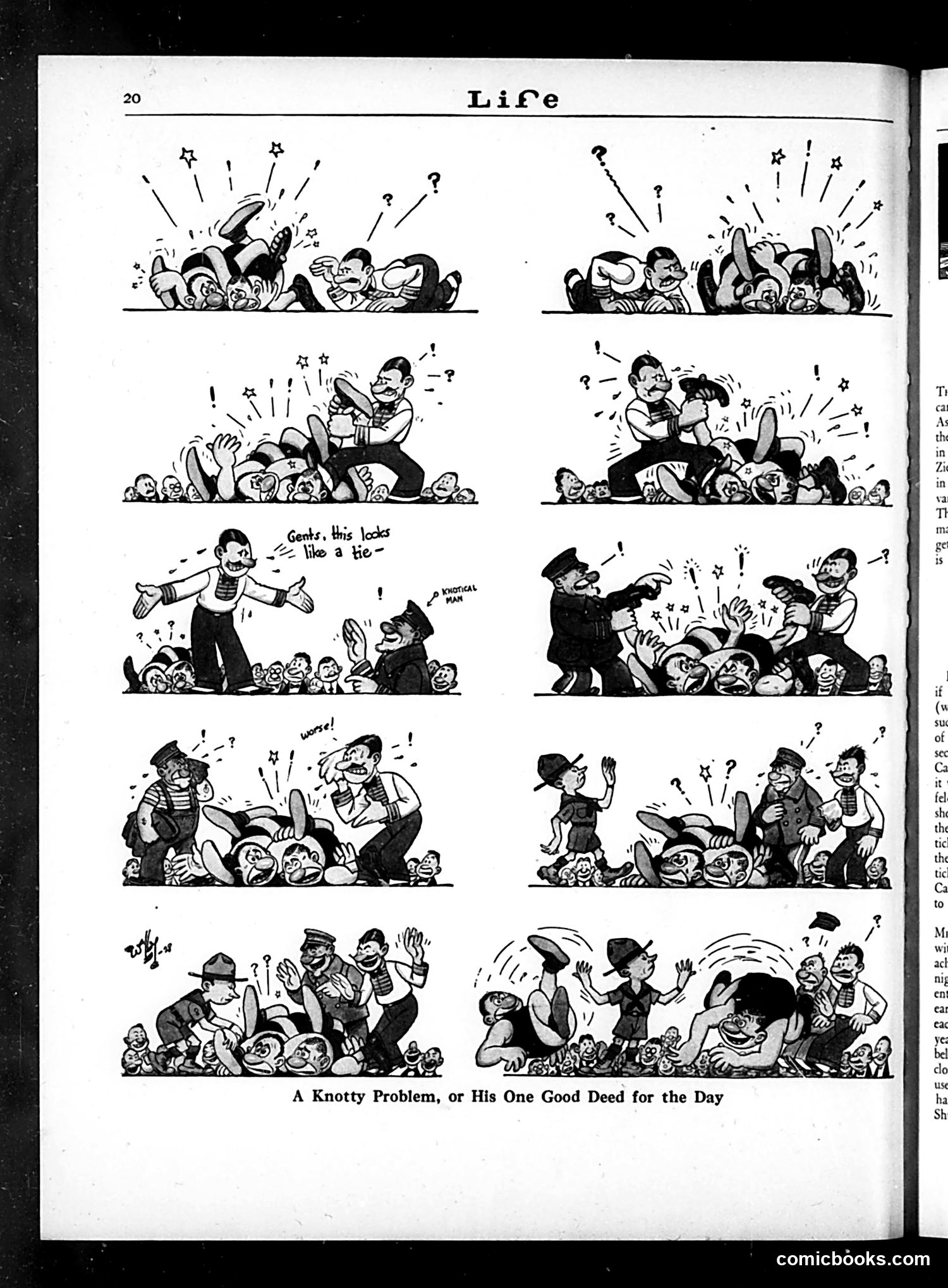
This wordless comic strip depicts a man attempting to untangle a knotted rope while surrounded by attentive onlookers. The sequence shows his escalating frustration as the knot resists his efforts—he pulls, struggles, and eventually appears to lose his temper, gesturing wildly. The satire likely mocks either bureaucratic incompetence or the futility of trying to solve an intractable social problem. The title's irony suggests that despite the man's dramatic efforts and apparent "good deed," he accomplishes nothing meaningful—the knot remains problematic throughout. The watching crowd's continued attention underscores the public nature of his failure. Without additional context about Life magazine's publication date or contemporary issues, the specific "problem" referenced remains unclear, though it appears to comment on ineffective leadership or problem-solving.
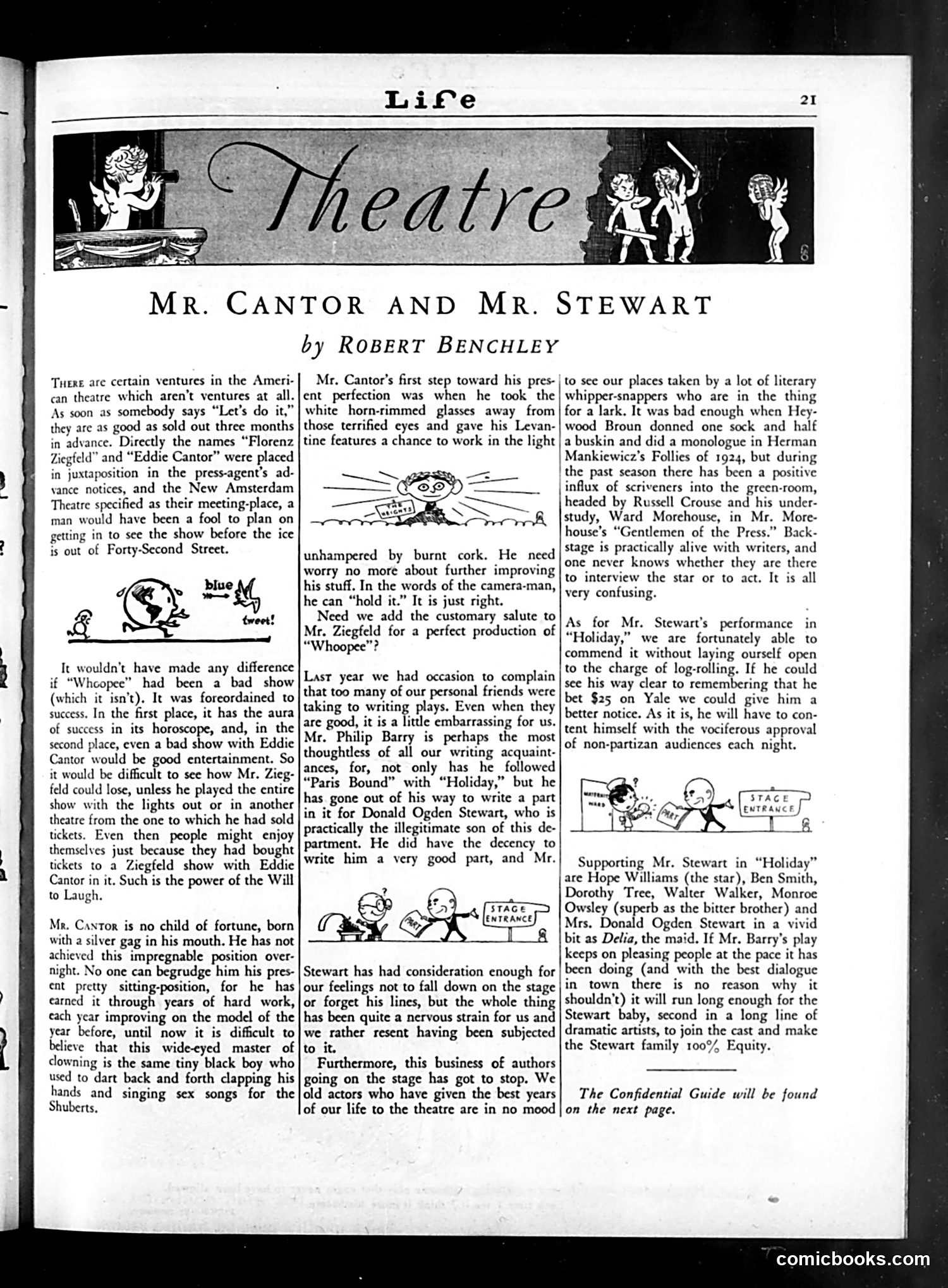
This is theater criticism by humorist Robert Benchley reviewing two Broadway shows: Florenz Ziegfeld's "Whoopee" starring Eddie Cantor, and Philip Barry's "Holiday" featuring Donald Ogden Stewart. **The satire:** Benchley praises Cantor's star power—the show is guaranteed success simply because Cantor's name is attached, regardless of quality. He notes Cantor's evolution from a blackface performer (the "tiny black boy" who sang for the Shuberts) to a polished entertainer who removed the burnt cork makeup and horn-rimmed glasses. **The complaint:** Benchley humorously gripes that too many *writers* are now performing on stage (Stewart, Heywood Broun, Russell Crouse). As someone claiming theatrical legitimacy, he resents these "literary whipper-snappers" taking roles meant for professional actors. This is gentle satire about theatrical gatekeeping and changing entertainment industry practices in the late 1920s. The cartoons illustrate these theater figures in caricature form.
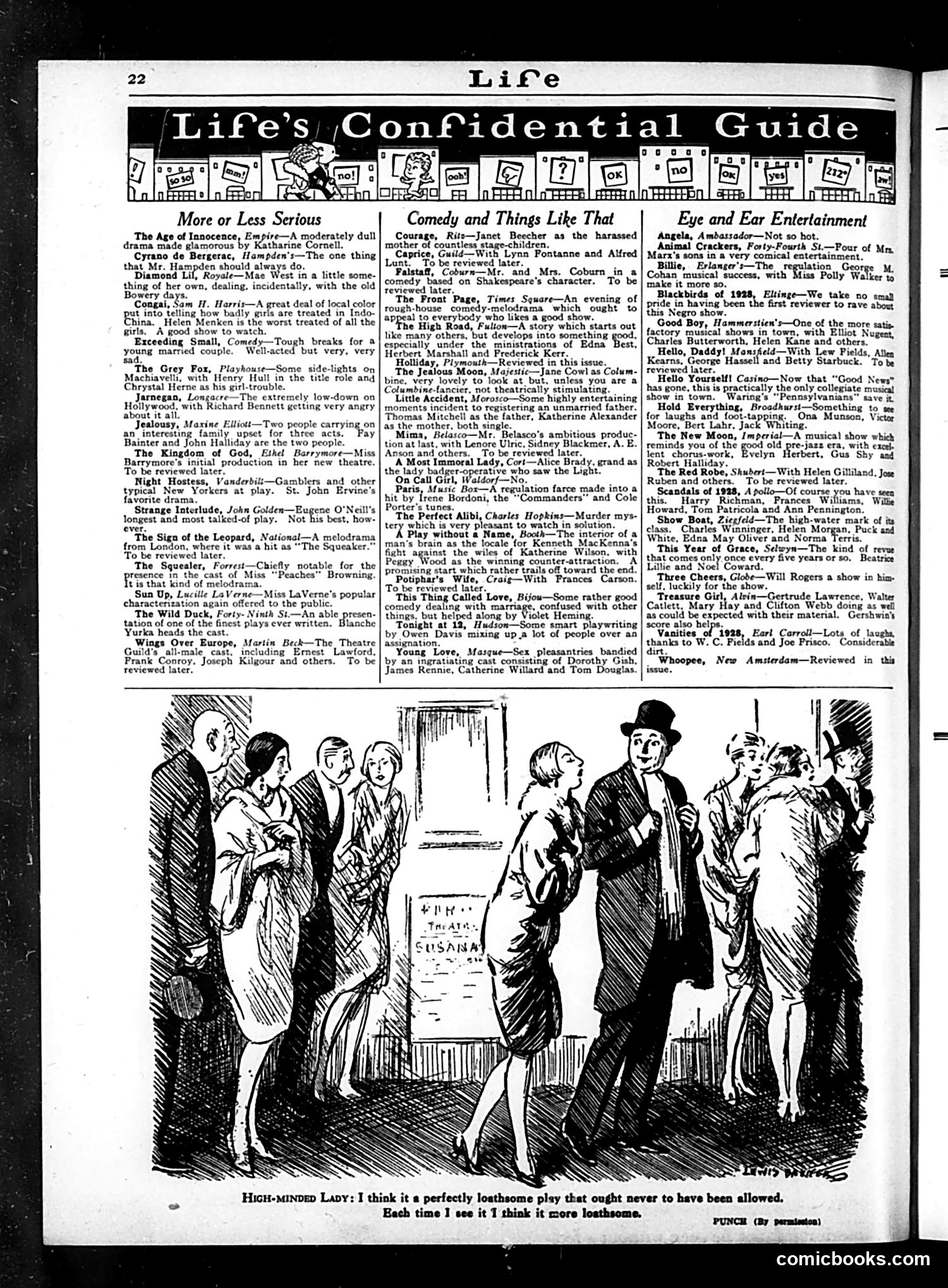
This is a theater review section from Life magazine's "Life's Confidential Guide" feature. The page lists current Broadway productions with brief critical assessments—ranging from "moderately dull" to "good show to watch." The cartoon below depicts a well-dressed woman at a theater entrance complaining to companions about a play. The caption reads: "HIGH-MINDED LADY: I think it a perfectly loathsome play that ought never to have been allowed. Each time I see it I think it more loathsome." **The satire**: The joke mocks theater-goers who repeatedly attend plays they claim to despise, perhaps for social status or habit rather than genuine enjoyment. The woman's contradiction—seeing a show multiple times while denouncing it—skewers pretentious audiences who publicly condemn entertainment while privately supporting it. The reviews themselves cover comedies, melodramas, and experimental works (notably O'Neill's "Strange Interlude"), reflecting 1920s Broadway's mix of commercial and serious theater.
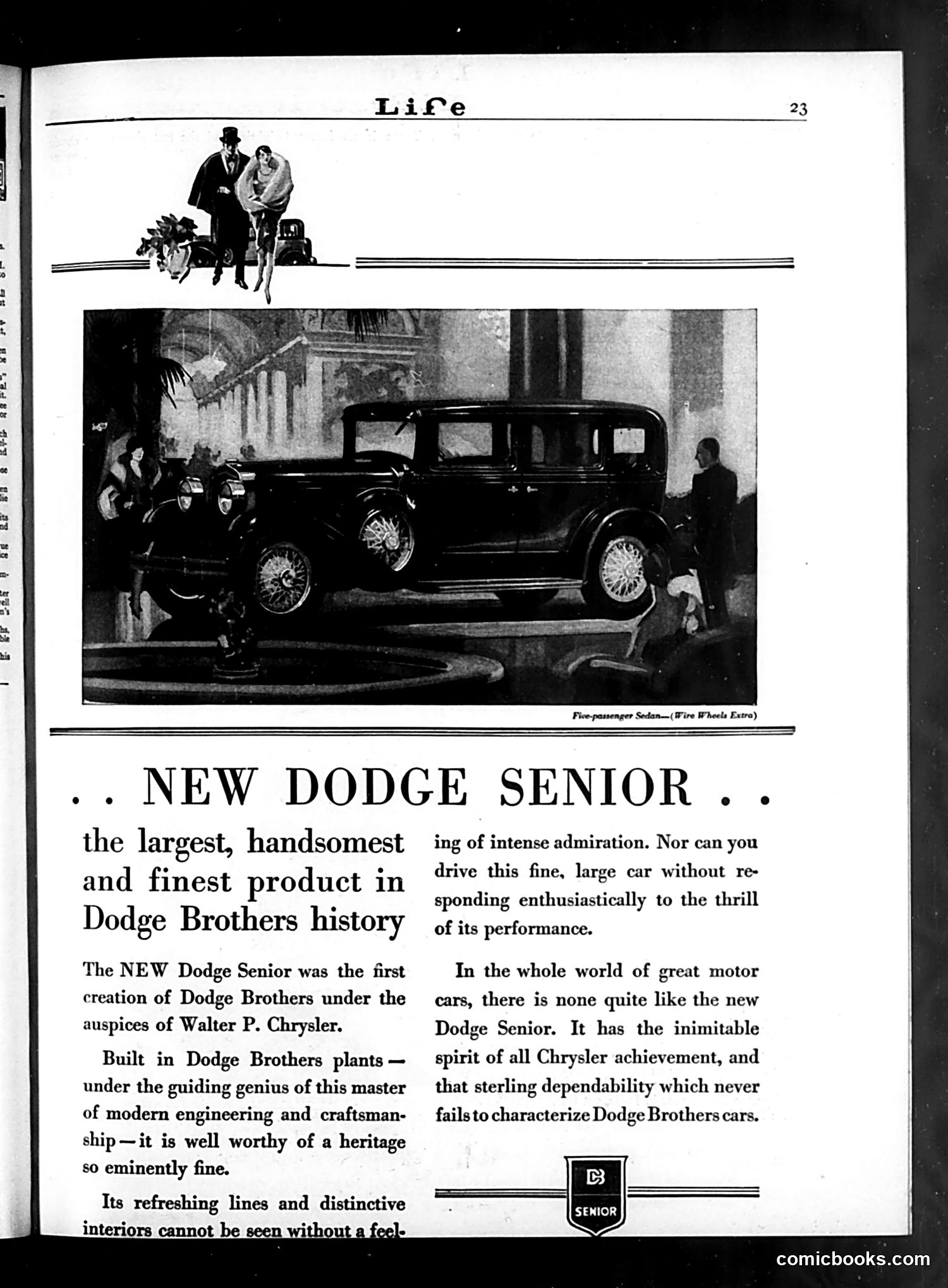
This is primarily a **car advertisement**, not satire or political commentary. The page features a promotional ad for the new Dodge Senior automobile in Life magazine (page 23). The illustration shows a five-passenger sedan displayed at night with well-dressed figures nearby, emphasizing its luxury status. The text highlights that this was "the first creation of Dodge Brothers under the auspices of Walter P. Chrysler"—a significant corporate moment when Chrysler took control of Dodge Brothers. The ad emphasizes engineering quality, craftsmanship, and performance to appeal to affluent buyers. The decorative illustration at the page top (showing a couple with luggage and vehicle) reinforces the car's association with leisure and travel. This represents typical 1920s-era automotive advertising in an upscale magazine, targeting middle-to-upper-class readers. There is no apparent satire or political commentary—it is straightforward commercial promotion of an American automobile brand.
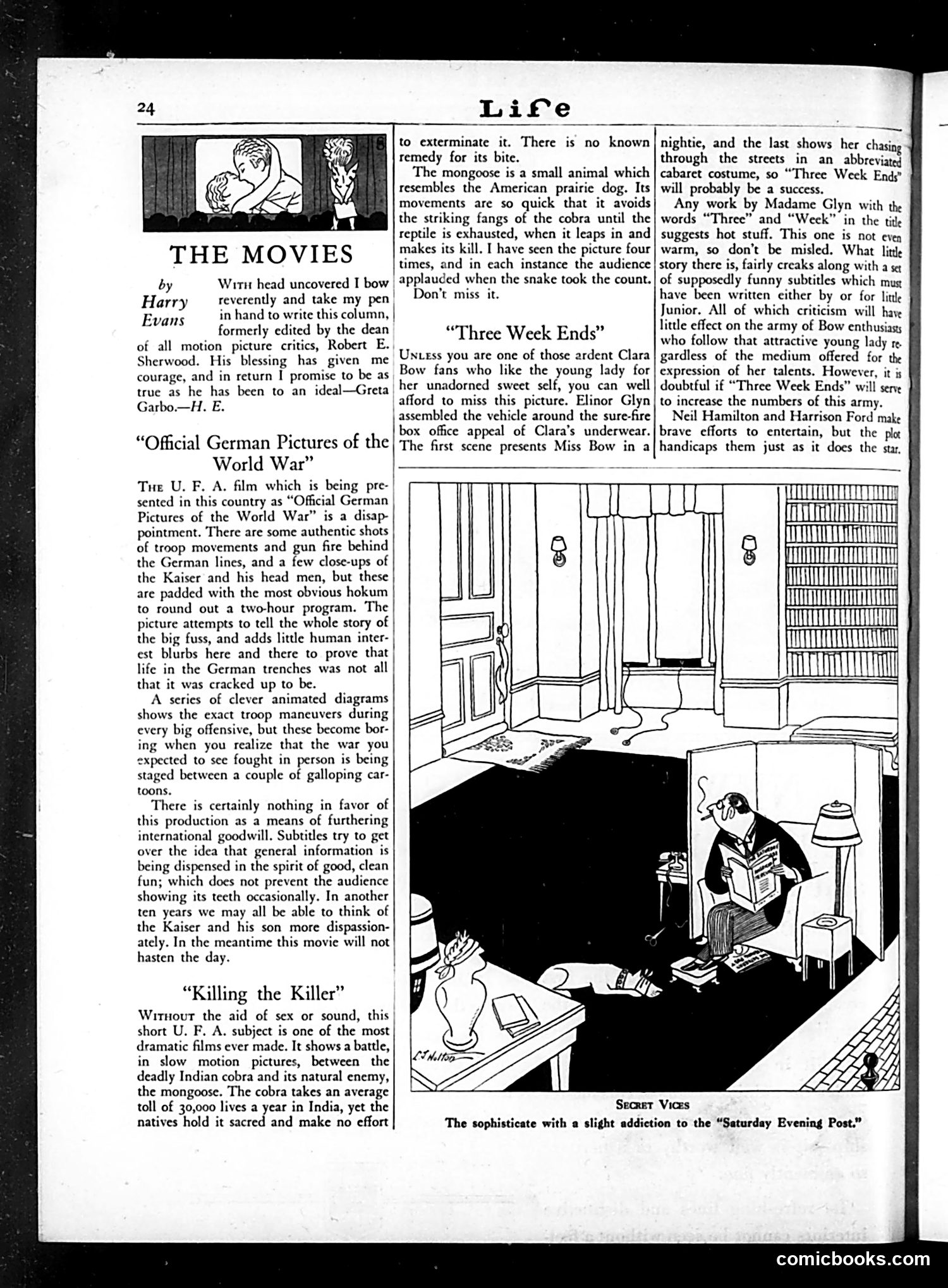
This cartoon satirizes the hypocrisy of respectability in the 1920s. It depicts a well-dressed gentleman sitting in what appears to be a library or study, openly reading what the caption identifies as "The Sophisticate with a slight addition to the 'Saturday Evening Post.'" The joke relies on the contrast between outward propriety and private behavior. The man's formal attire and refined surroundings suggest respectability, yet he's secretly reading salacious material—implied to be more explicit than the wholesome *Saturday Evening Post* magazine. The caption's coy phrasing ("slight addition") underscores the humor: respectable society members maintained facades of morality while indulging in "secret vices" behind closed doors. This reflects 1920s anxieties about changing social norms, post-WWI loosening of Victorian standards, and the gap between public morality and private desires—themes throughout Life magazine's satirical commentary.
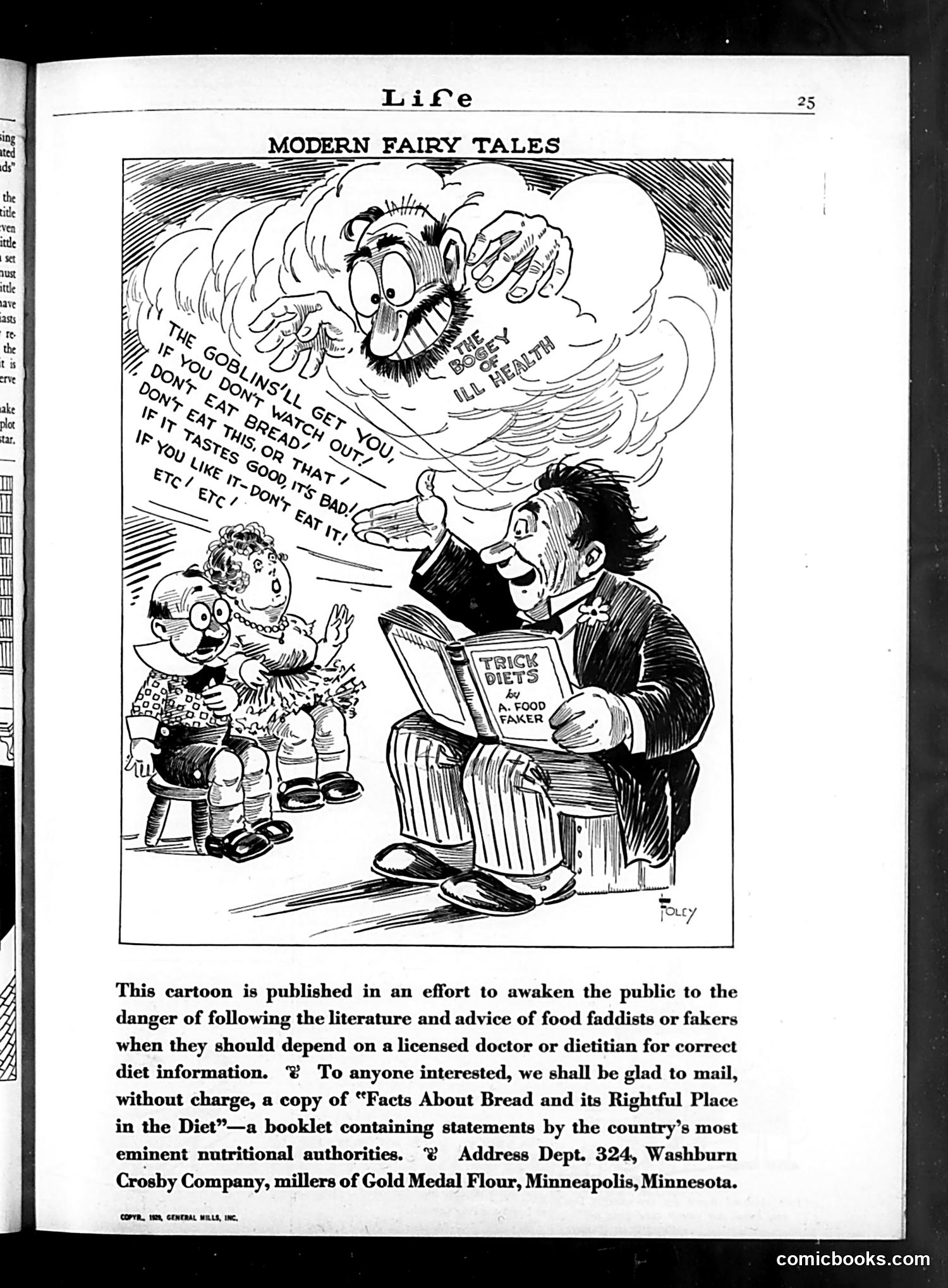
This is a satirical advertisement disguised as public service messaging. The cartoon depicts a menacing goblin-like figure promoting dangerous diet advice ("The goblins'll get you / if you don't eat bread..."), while a man reads "Trick Diets by a Food Faker" to a concerned mother and child. The "fairy tale" framing mocks pseudo-scientific diet trends and charlatan nutritionists popular in the early 20th century. The goblin represents the threat of misinformation—the real danger being not the monster, but following unqualified "faddists or fakers" instead of licensed professionals. This is actually an advertisement by Washburn Crosby Company (Gold Medal Flour), using fear-based marketing to promote bread consumption and their educational booklet. The irony: while claiming to combat food misinformation, they're promoting their own product through the cartoon.
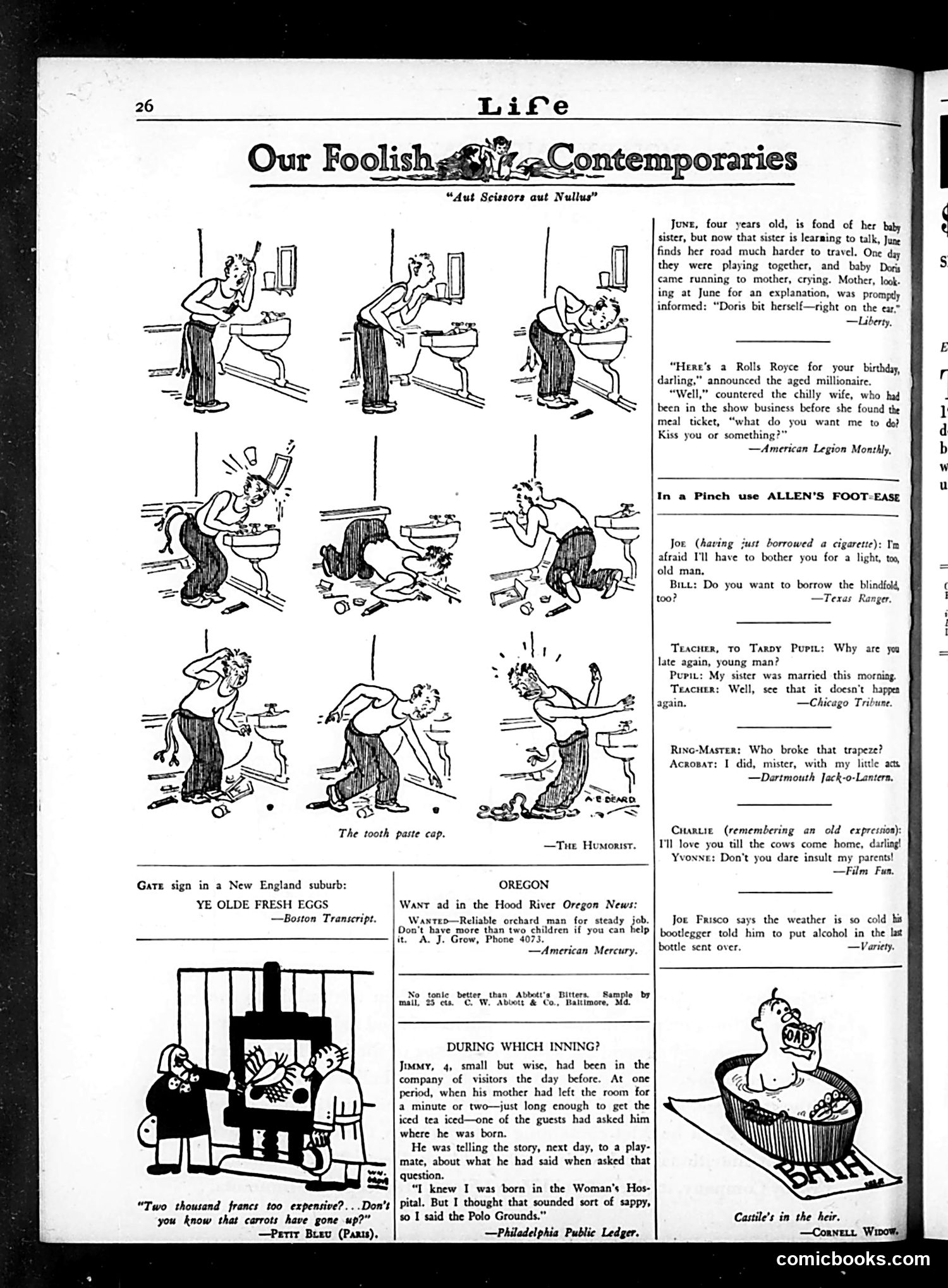
This page compiles humorous anecdotes and visual gags satirizing contemporary foolishness. The main comic strip (top left) depicts a woman's escalating bathroom mishaps with a toothpaste cap—a visual punchline about domestic absurdity. The text snippets mock modern society's peculiarities: - A New England shop sign ironically mimics colonial language while selling ordinary eggs - A job posting refusing candidates with more than two children reflects post-WWI economic anxiety - A child claiming he was born at "the Polo Grounds" (a baseball stadium) rather than a hospital humorously captures children's logic - References to Prohibition-era bootleggers and the absurdity of wartime scarcity (carrots being expensive in France) The page satirizes everyday foolishness—urban pretension, economic hardship, parental bewilderment, and social hypocrisy—through brief, punchy jokes. This format was Life magazine's signature approach: collecting contemporary absurdities to amuse readers by holding up a mirror to their own society's quirks and contradictions.
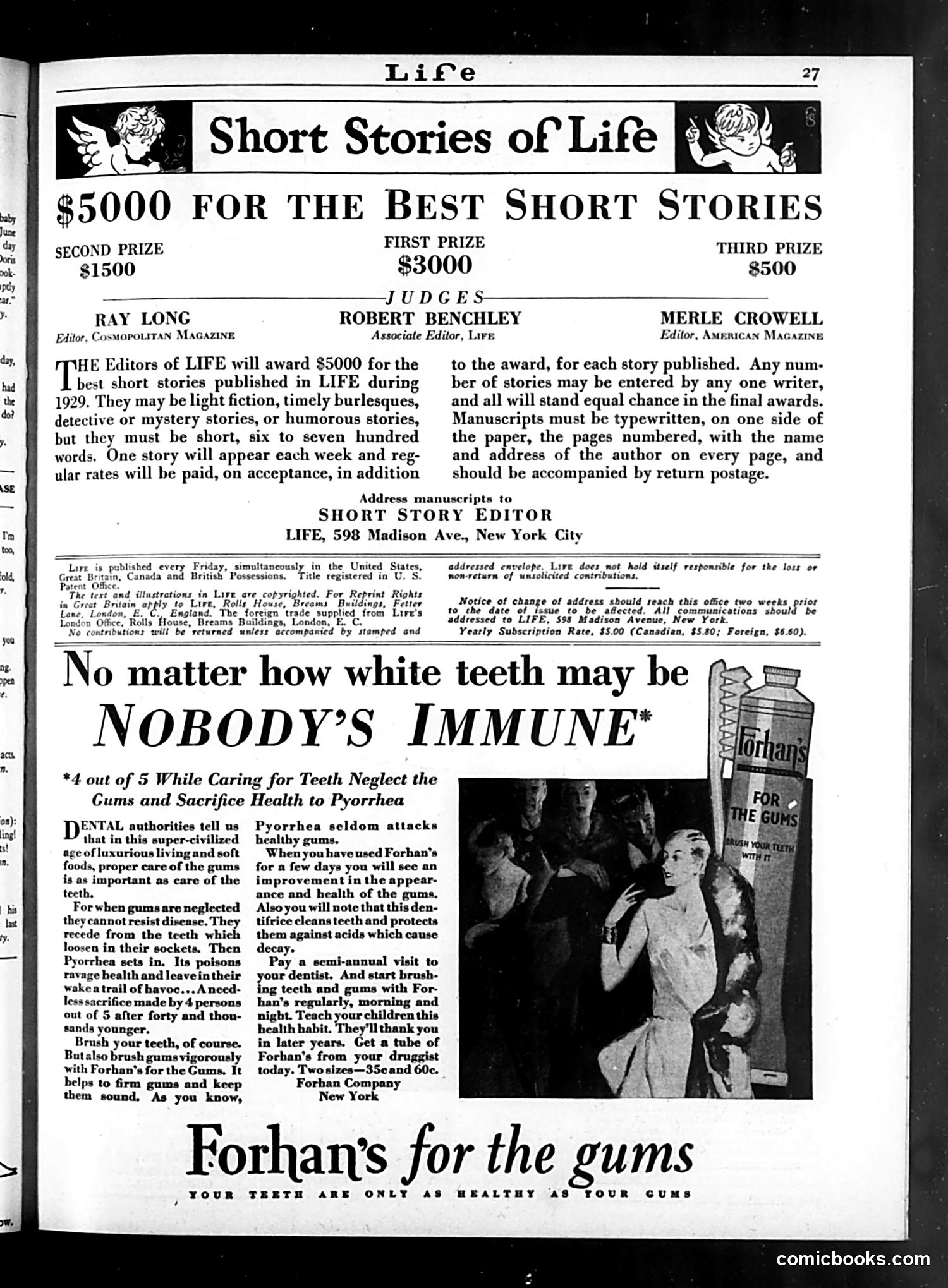
This page is primarily **advertising and editorial content**, not satirical cartoon material. The top section announces a short story competition offering $5,000 in prizes for fiction published in *Life* magazine during 1929, judged by prominent editors Robert Benchley, Ray Long, and Merle Crowell. The contest solicits six-to-seven-hundred-word stories of any genre. The bottom half is a full-page **advertisement for Forhan's toothpaste**, marketed as a gum-care product. The ad employs scare messaging typical of 1920s-30s health advertising, warning that four out of five people over forty neglect their gums and risk pyorrhea (a periodontal disease). The text emphasizes that healthy teeth require healthy gums, positioning Forhan's as the solution. There is no political satire or social commentary present. This is a straightforward mix of magazine business announcements and period advertising using health anxiety as a sales tactic.
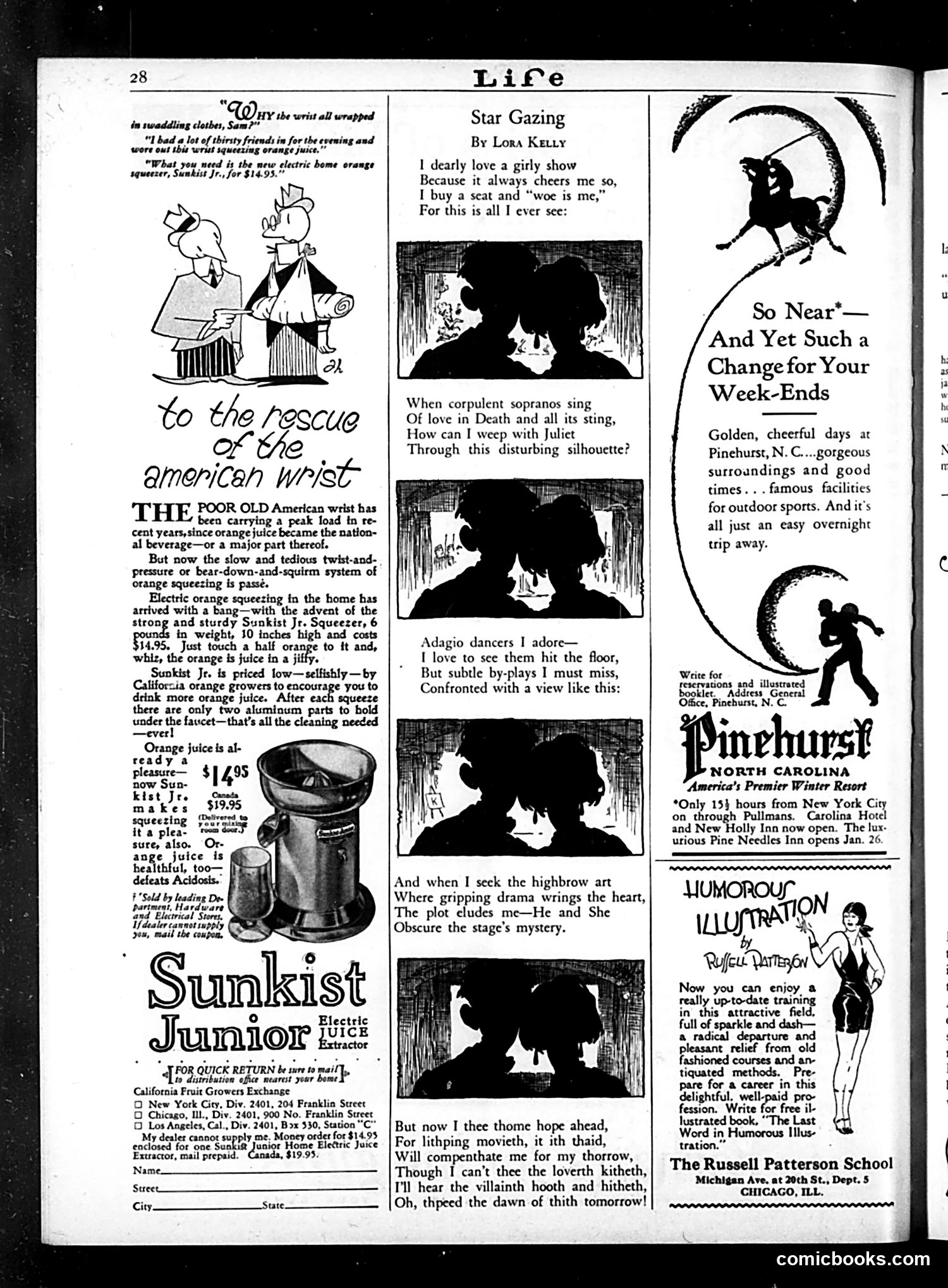
This page mixes advertising with light satirical content typical of 1920s Life magazine. **Main Advertisement:** The Sunkist Jr. electric orange squeezer dominates the left side. The opening cartoon jokes about a man's wrist being injured from manually squeezing oranges for guests—a humorous exaggeration playing on the "orange juice craze" that had made fresh-squeezed juice fashionable. The ad promotes the new electric appliance as salvation for tired wrists, priced at $14.95. **"Star Gazing" Poem:** Lora Kelly's verse satirizes theatergoers' frustration with obstructed stage views—specifically women's large hats blocking sightlines, shown in the silhouette illustrations. The poem celebrates coming "talking pictures" (early sound films) as a solution, since audiences can hear dialogue even if they can't see actors clearly. **Minor Ads:** Pinehurst resort in North Carolina and the Russell Patterson School for humorous illustration round out the page. The satire reflects genuine 1920s complaints: the popularity of orange juice as a health beverage, theater etiquette problems, and anticipation of cinema's new sound technology.
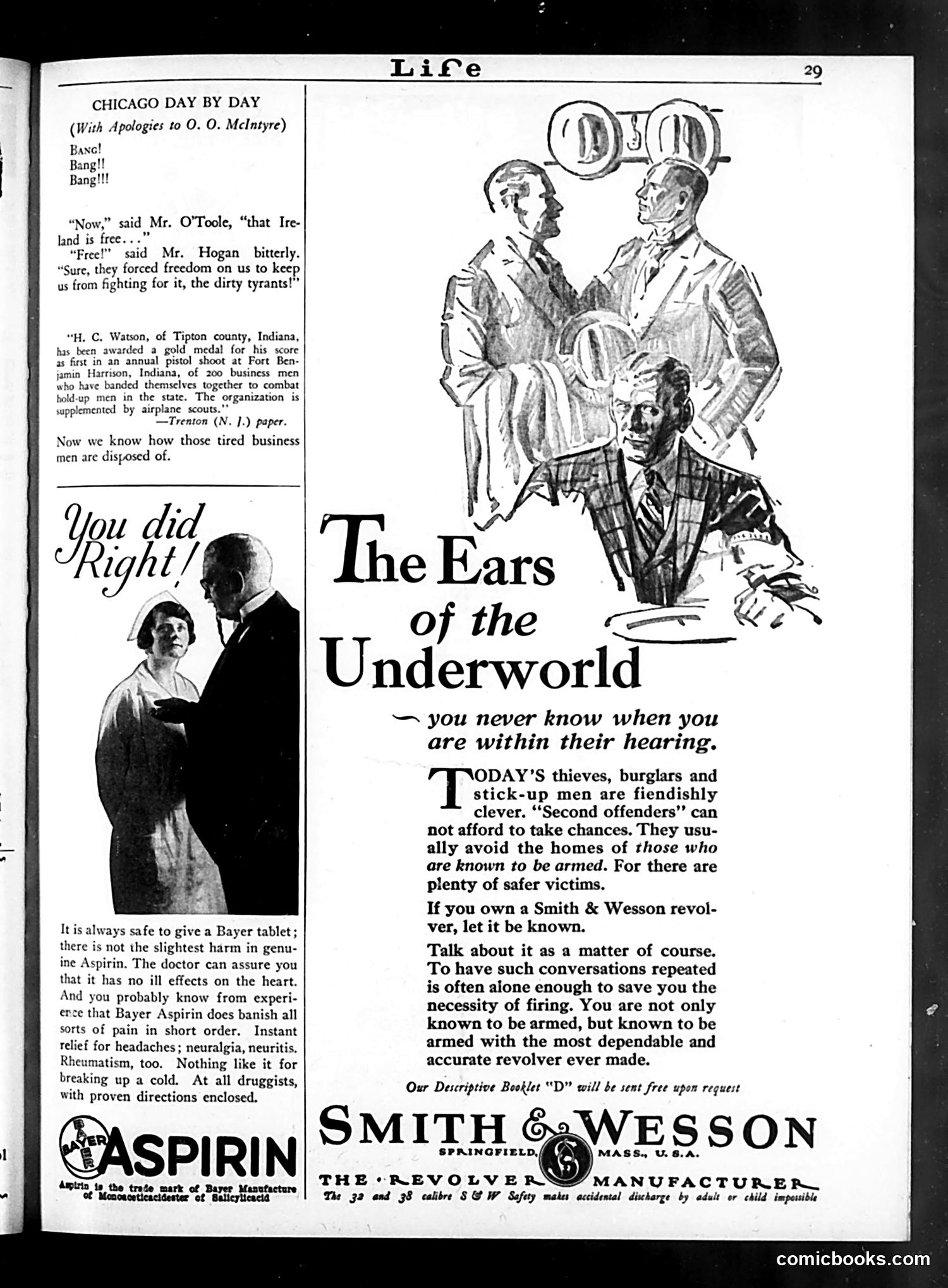
This page mixes political satire with advertising. The "Chicago Day by Day" column satirizes Irish-American politics: Mr. Hogan's complaint that Ireland's independence was granted by Britain—removing the cause for Irish-Americans to fight for it—is darkly comic commentary on how political grievance fueled immigrant identity. The buried news item about 200 Indiana businessmen forming an armed anti-robbery group prompts Life's joke: these "tired business men" shooting competitively suggests they're being "disposed of" through the very activity meant to protect them—implying incompetence or fatal accidents among amateur gunmen. The page's advertisements (Bayer Aspirin and Smith & Wesson revolvers) work ironically alongside the satire: the gun ad promises safety through visible weaponry, while the news item hints guns cause the opposite. This juxtaposition reflects 1920s anxieties about armed civilians, crime prevention, and American violence—positioning the satirical jab at well-meaning but bumbling businessmen against commercial appeals to arm oneself.
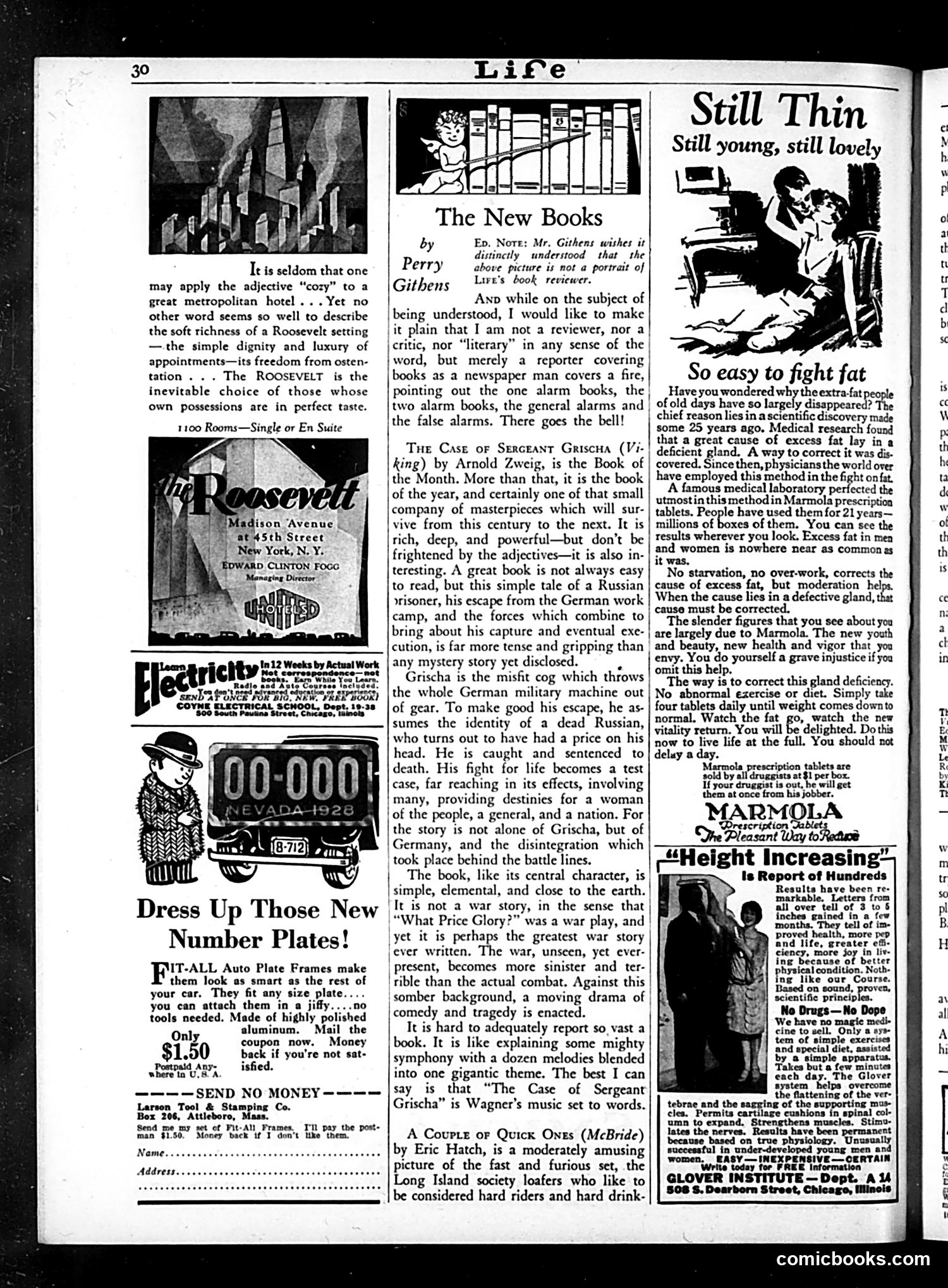
This page primarily contains **book reviews and advertisements** rather than political cartoons. The main content is Perry Gibhens' book review column, discussing three new publications. The featured book review covers *The Case of Sergeant Grischa* by Arnold Zweig—a novel about a Russian prisoner's escape from a German WWI work camp. Gibhens praises it as a masterpiece, comparing its scope to Wagner's music. He emphasizes it's not merely a war story but explores Germany's disintegration and the fate of multiple characters (a woman, general, and nation). The review stresses the book's psychological tension exceeds actual combat descriptions. Two lighter works are briefly mentioned: *A Couple of Quick Ones* by Eric Hatch, satirizing Long Island society "loafers." The page also features period advertisements—for the Roosevelt Hotel, auto license plate frames, and an electrical school—typical of 1920s Life magazine layout. There are **no political cartoons** on this page. The content reflects 1920s post-WWI literary culture and consumer advertising.
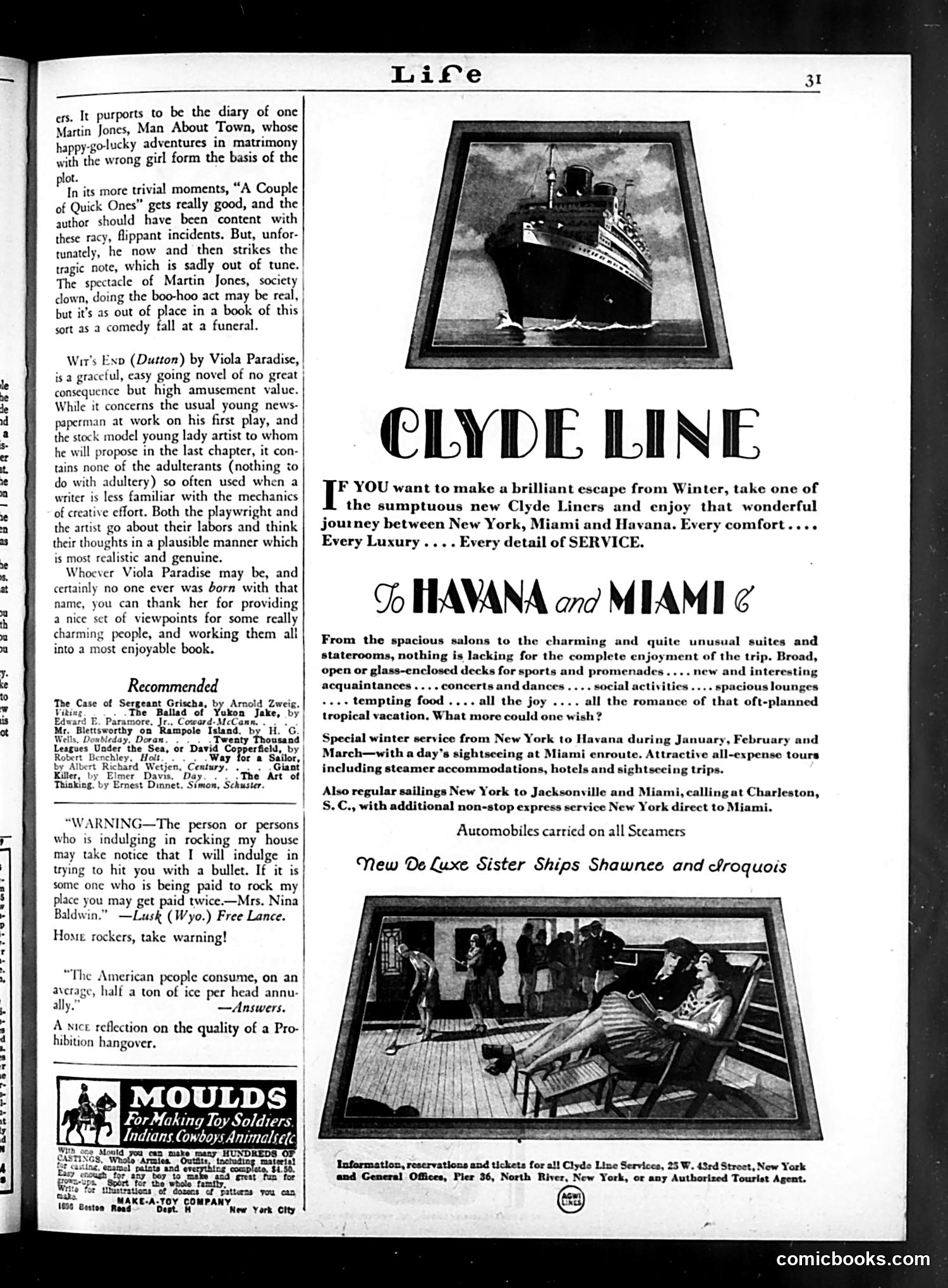
This page is primarily **advertising and book reviews**, not political satire. The left column contains **book reviews** of contemporary novels, notably critiquing "Man About Town" (a diary-style novel about a man's marital misadventures) for inconsistent tone—mixing comedy with tragedy "as out of place...as a comedy fall at a funeral." The dominant content is **two large Clyde Line cruise ship advertisements** featuring photographs of luxury ocean liners. The ads promote winter escapes from New York to Miami and Havana, emphasizing comfort, entertainment, and romance—appealing to affluent travelers seeking tropical vacations. A small advertisement for **toy soldiers** (the "Make-a-Toy Company") appears at the bottom. The page also includes a humorous filler quote about Prohibition hangovers and home-rockers, typical of Life's satirical content. **Overall context**: This reflects 1920s consumer culture—luxury travel promotion alongside literary criticism and commercial entertainment aimed at middle-to-upper-class readers.
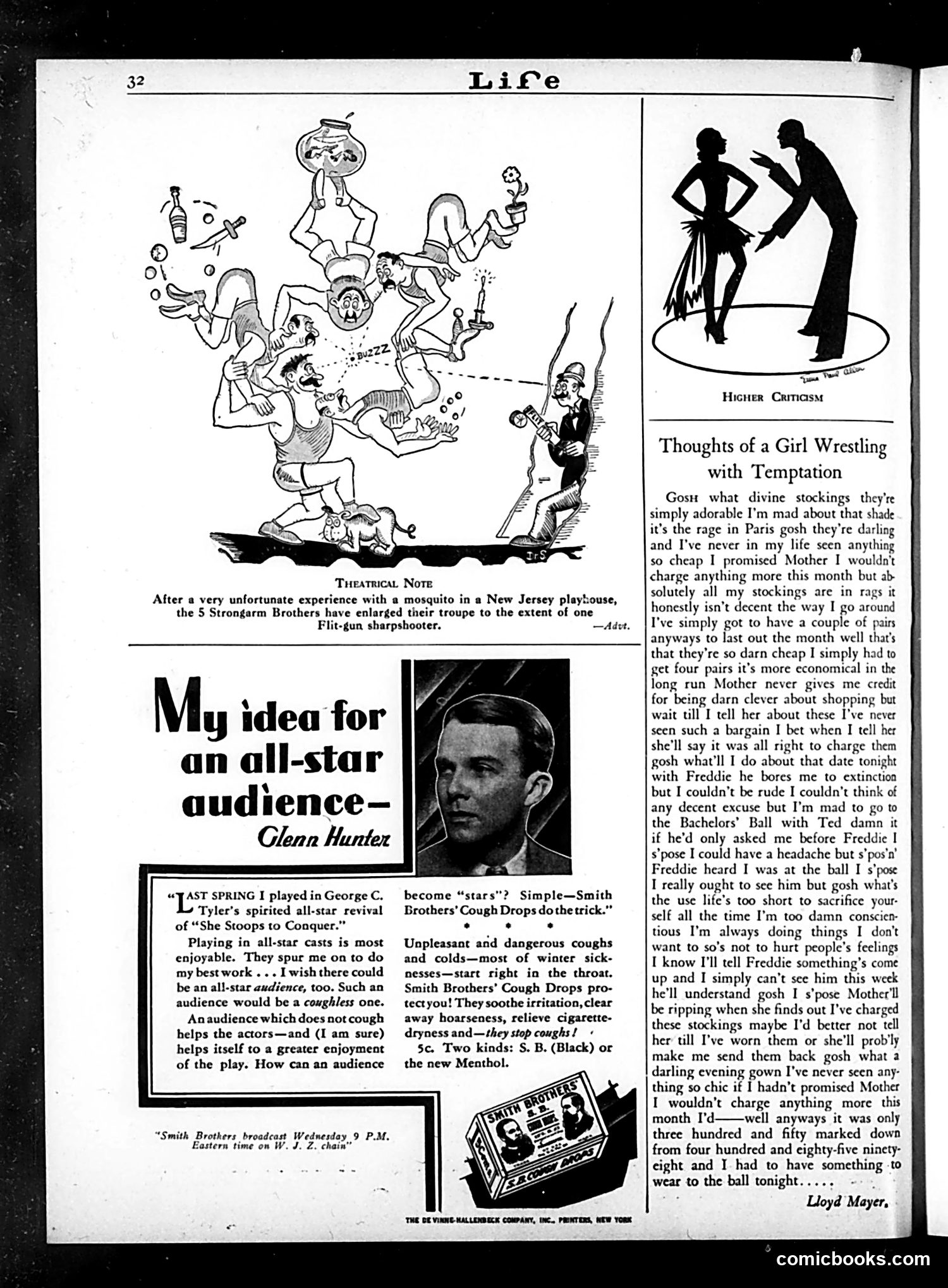
This page contains **advertising and humor columns** rather than political cartoons. The top cartoon satirizes theatrical mishaps: the S Stormarm Brothers expanded their troupe to include a "Flit-gun sharpshooter" after a mosquito incident at a New Jersey playhouse—a humorous jab at pest problems in theaters. **"My Idea for an All-Star Audience"** by Glenn Hunter is an advertisement for **Smith Brothers' Cough Drops** disguised as editorial content. Hunter, an actor, argues audiences should be "all-star" by being cough-free, promoting the product as a solution to throat irritation that ruins theatrical performances. **"Thoughts of a Girl Wrestling with Temptation"** by Lloyd Mayer depicts internal monologue of a young woman rationalizng impulsive shopping—buying stockings despite promising her mother she wouldn't charge anything. The humor lies in her self-justifying logic: bargains are "economical," and she's too conscientious to disappoint dates. It satirizes female consumerism and the gap between promises and behavior among 1920s youth.
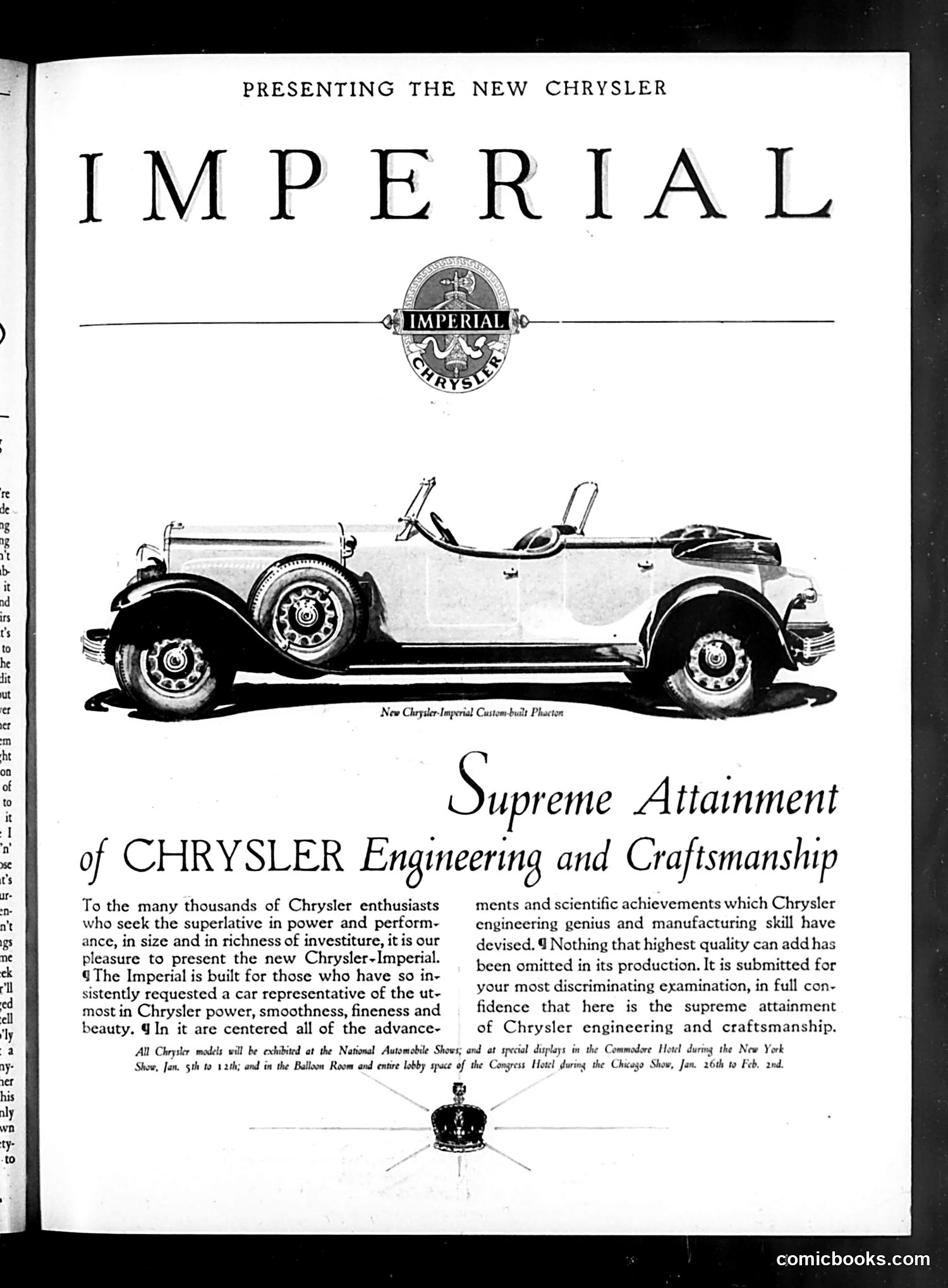
This is **not a cartoon or satire**—it's a straightforward **automobile advertisement** from Life magazine's early 20th century. The page presents Chrysler's new "Imperial" luxury car model as the pinnacle of American engineering. The ad appeals to affluent buyers by emphasizing exclusivity ("for those who have so insistently requested"), superior craftsmanship, and power. The language is reverential ("supreme attainment"), and the car illustration is rendered in formal, dignified style. The crown symbol at the bottom reinforces the "Imperial" branding—suggesting royalty and prestige. The advertisement notes the car will be displayed at major automotive shows in New York and Chicago. This reflects 1920s consumer culture, when automobiles were luxury goods marketed to the wealthy as status symbols. There is no political satire present—merely corporate promotion of a premium product.
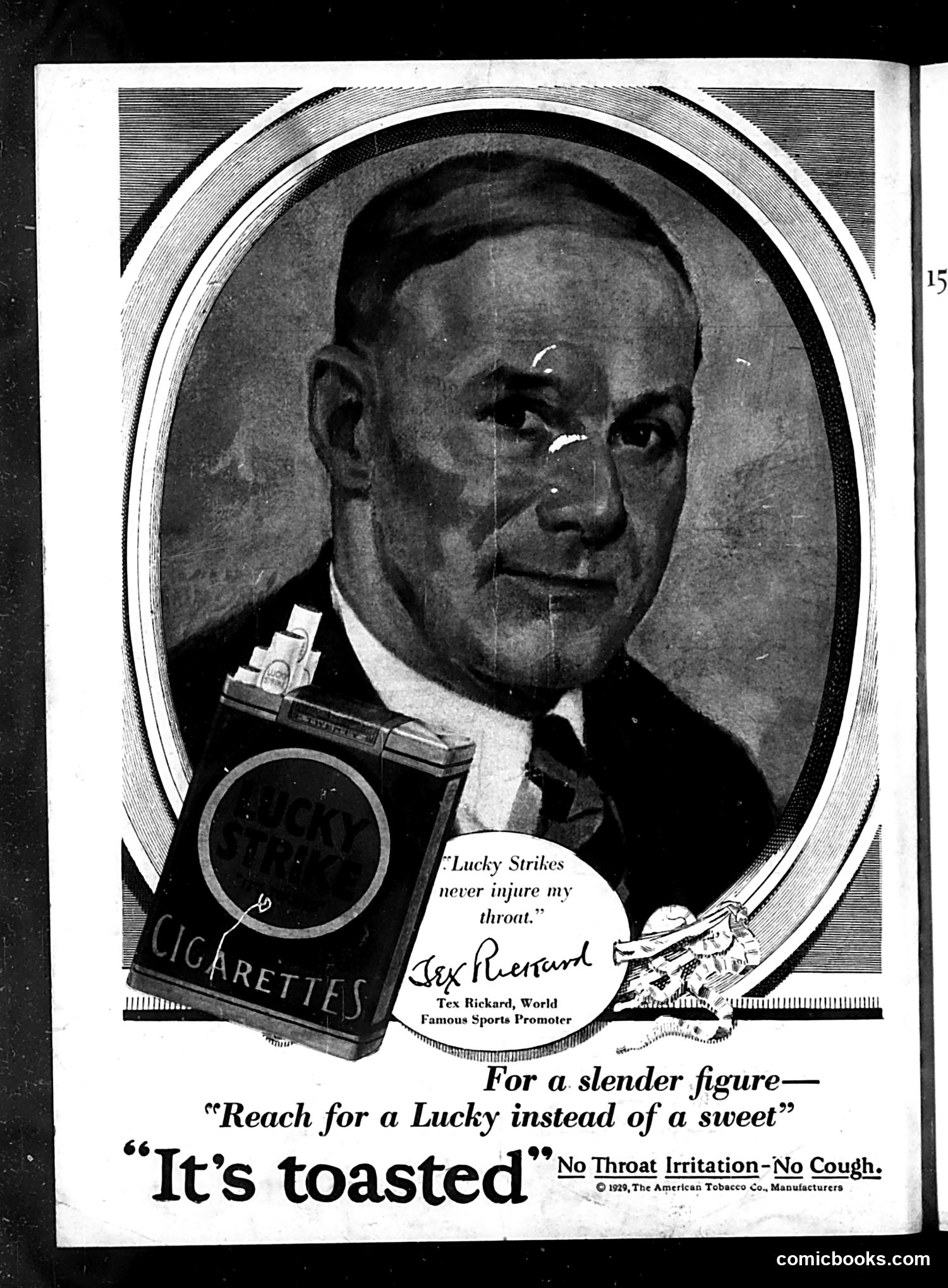
This is a **Lucky Strike cigarette advertisement**, not satire. It features Tex Rickard, identified as a "World Famous Sports Promoter," endorsing the brand. The ad employs two marketing appeals: 1. **Health claim**: "Lucky Strikes never injure my throat" and "No Throat Irritation—No Cough," playing on consumer anxieties about smoking's dangers. 2. **Weight management**: "Reach for a Lucky instead of a sweet" targets women concerned about staying slim—a common advertising strategy of the era. The "It's toasted" slogan refers to Lucky Strike's manufacturing process. This represents pre-regulation tobacco advertising, when such health and lifestyle claims were legal and uncontested. Modern readers would recognize the irony: cigarettes are now known to cause serious health harm, making these claims laughably false by today's standards.