
A complete issue · 36 pages · 1929
Life — February 22, 1929
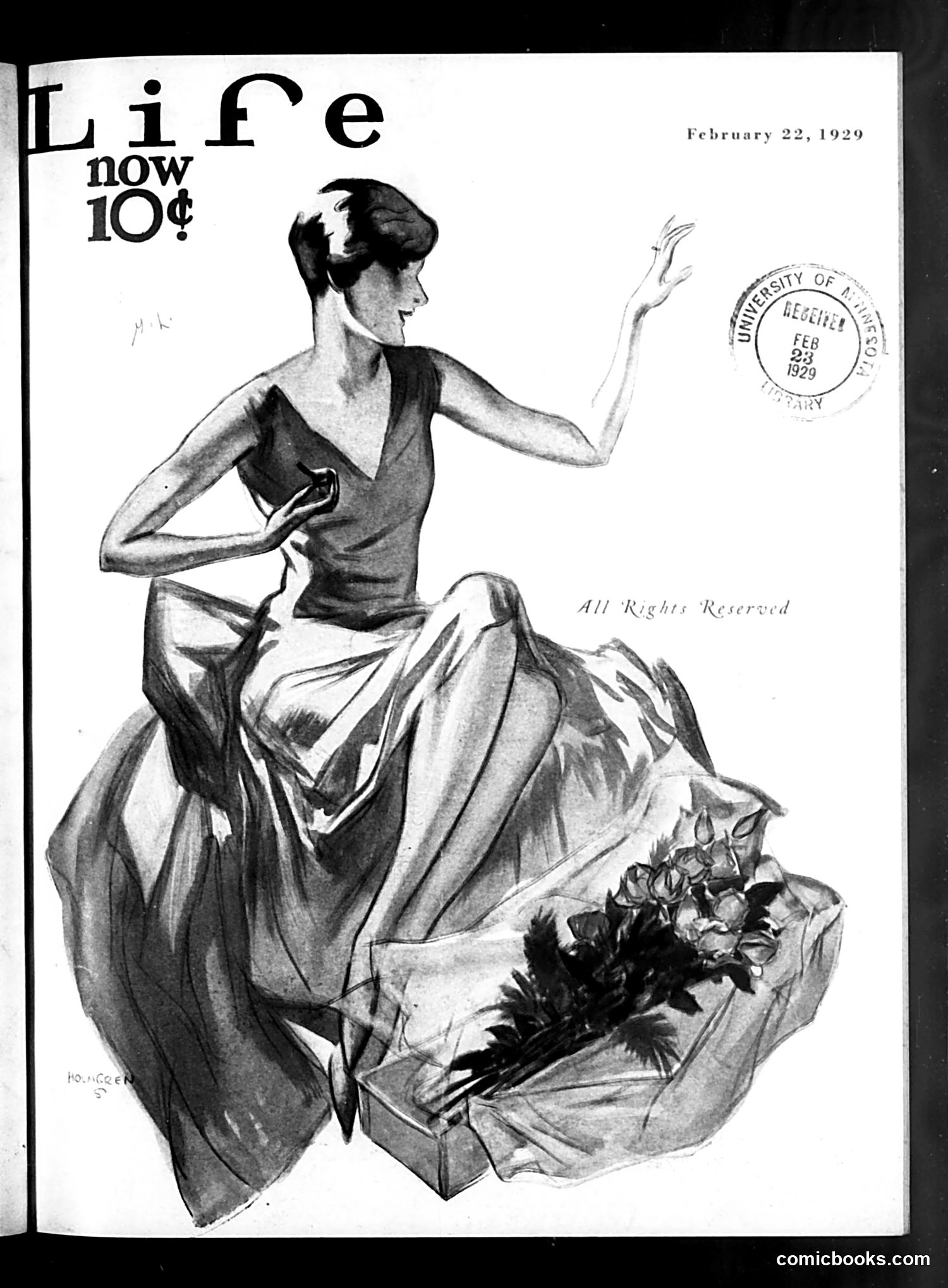
This is a **cover illustration**, not political satire. It depicts an elegant woman in 1920s fashion—a sleeveless dress with flowing, dramatic fabric and flowers at her feet. She's posed gracefully, one arm raised, embodying the aesthetic ideals of the Jazz Age. The image likely celebrates contemporary fashion and feminine beauty standards of the late 1920s. The figure appears to be an idealized portrait rather than a caricature of a specific person. The artistic style is typical of Life's cover illustrations from this era, which frequently featured fashionable women as decorative, aspirational imagery. At 10 cents, this magazine served middle-class American readers seeking entertainment, humor, and cultural commentary during the prosperous pre-Depression period.
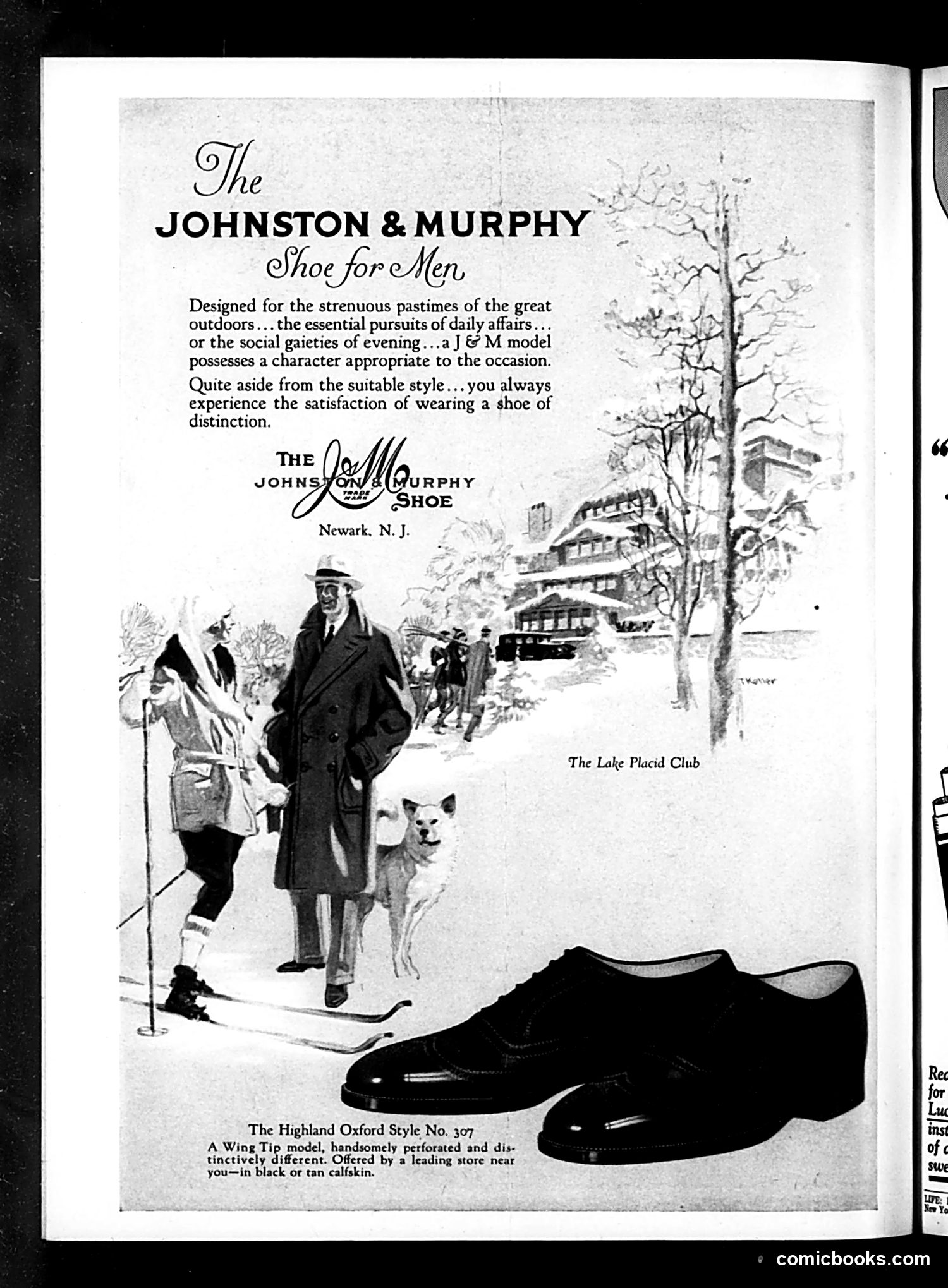
This is an advertisement, not political satire. It promotes Johnston & Murphy shoes for men, a Newark, N.J. company. The ad emphasizes that their shoes suit various occasions—from "strenuous pastimes of the great outdoors" to "social gaieties of evening." The illustration depicts a winter scene at "The Lake Placid Club" showing well-dressed men and a woman engaged in outdoor activities (skiing visible on the left). The imagery suggests affluence and leisure—the target market for quality footwear. Below, the "Highland Oxford Style No. 307" shoe is displayed as a "Wing Tip model, handsomely perforated and distinctively different," available in black or tan. The advertisement appeals to masculine sophistication and status through aspirational imagery of exclusive winter resort culture.
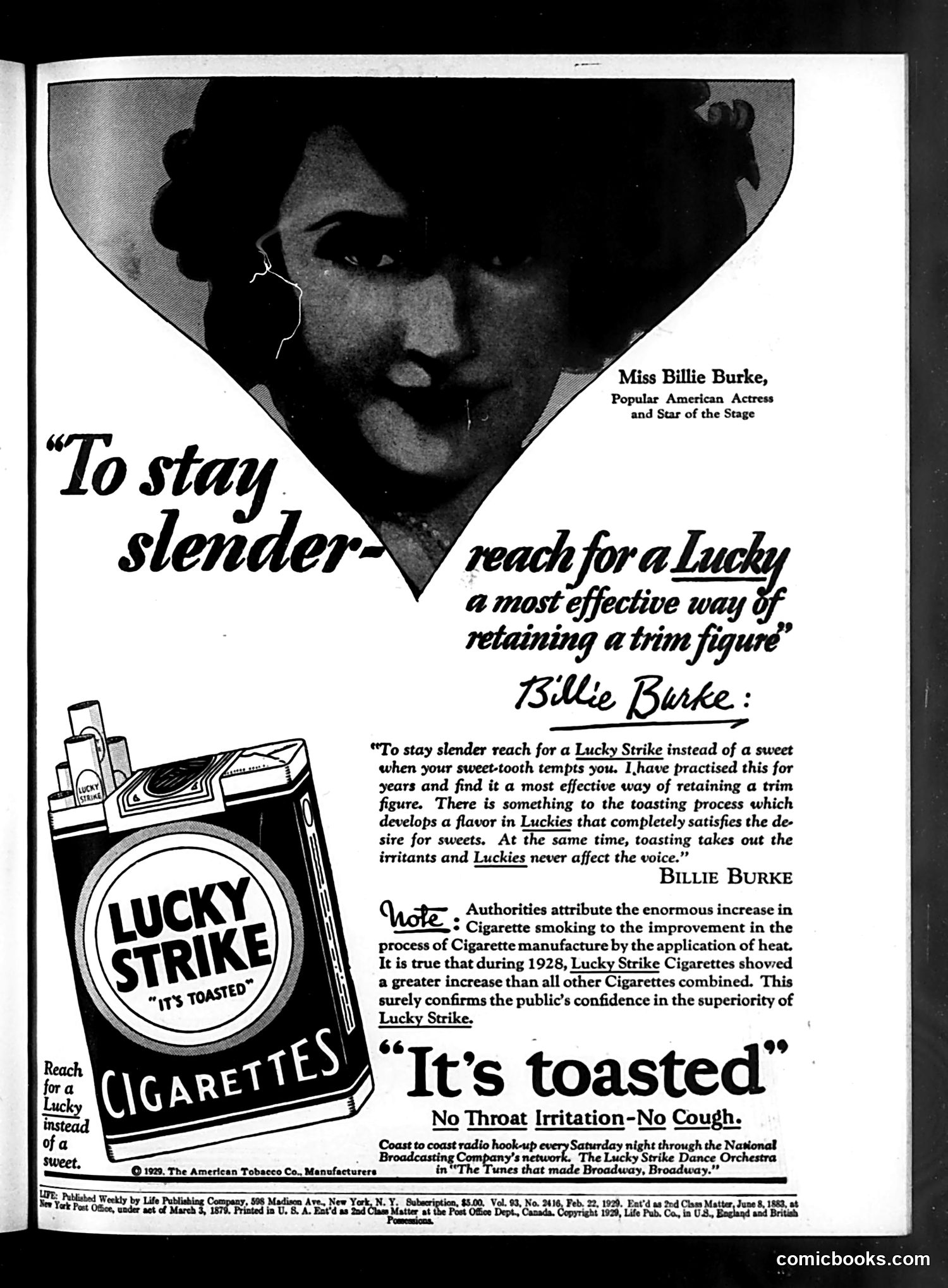
This is a **cigarette advertisement**, not satire or political commentary. It features actress Billie Burke endorsing Lucky Strike cigarettes (1928). The ad uses Burke's celebrity status to promote the product's "toasted" process, claiming it satisfies sweet cravings while maintaining a slim figure—a sales pitch combining vanity and appetite suppression. Burke testifies that Lucky Strikes help her "stay slender" instead of eating sweets. The accompanying note boasts that Lucky Strike showed greater sales increases than competing cigarettes in 1928, attributed to manufacturing improvements. The slogan "It's toasted—No Throat Irritation—No Cough" was a major marketing claim of the era. By modern standards, this advertisement is striking for openly promoting cigarettes for weight management and featuring celebrity health endorsements now recognized as deeply problematic.
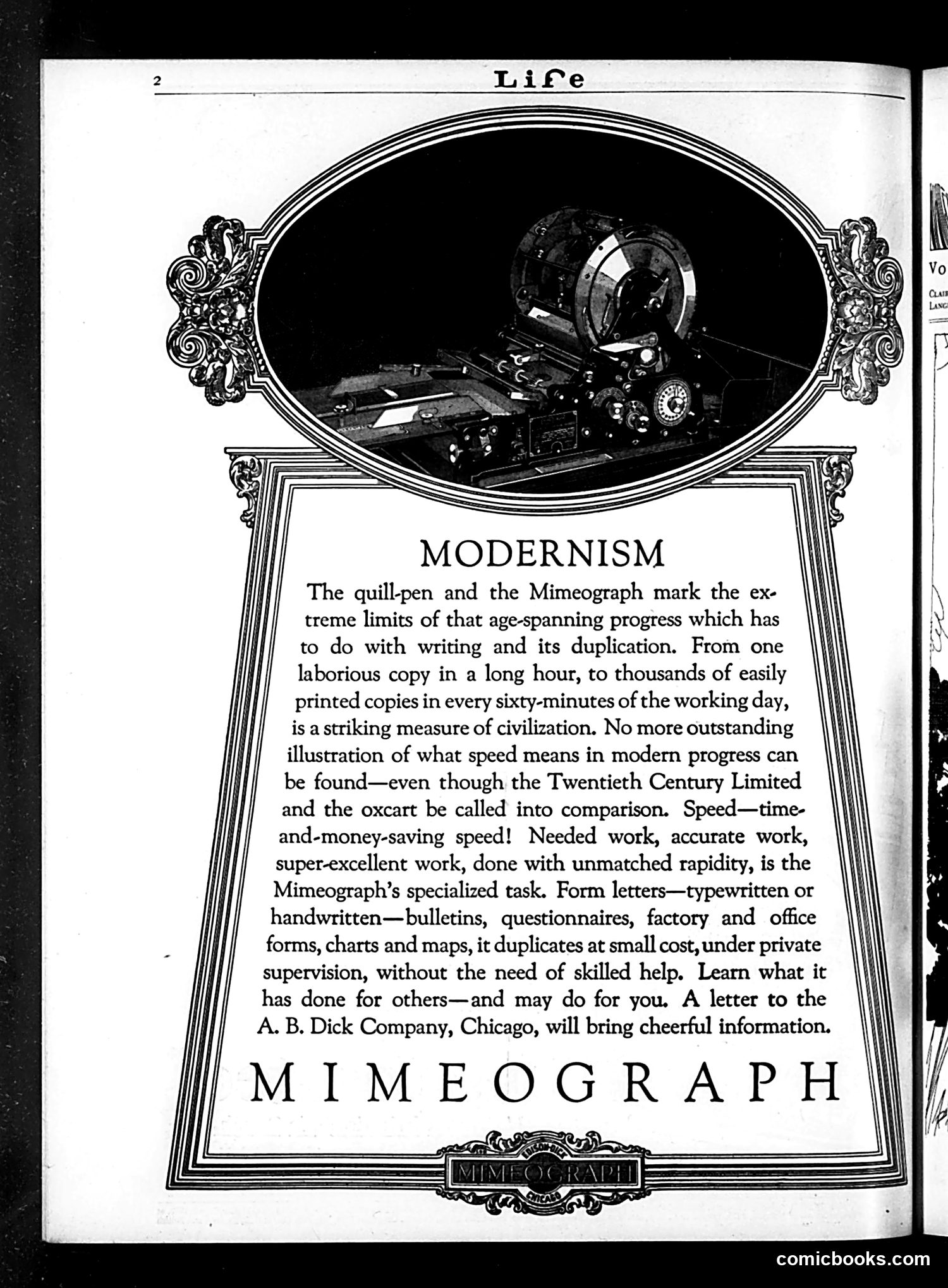
This page is primarily **advertising**, not satire or political commentary. It promotes the Mimeograph machine, manufactured by the A. B. Dick Company of Chicago. The ad's headline "MODERNISM" frames the mimeograph as a symbol of progress and civilization. It emphasizes the machine's speed advantage over manual copying—producing thousands of printed copies every hour versus one laboriously handwritten copy in an hour. The text celebrates this as representing modern efficiency and time-saving technology. The image shows the mimeograph apparatus itself. The ad targets businesses needing to duplicate letters, bulletins, questionnaires, and forms quickly and cheaply, claiming the machine requires no skilled operation. This reflects early 20th-century business enthusiasm for new copying technology and mechanized efficiency.
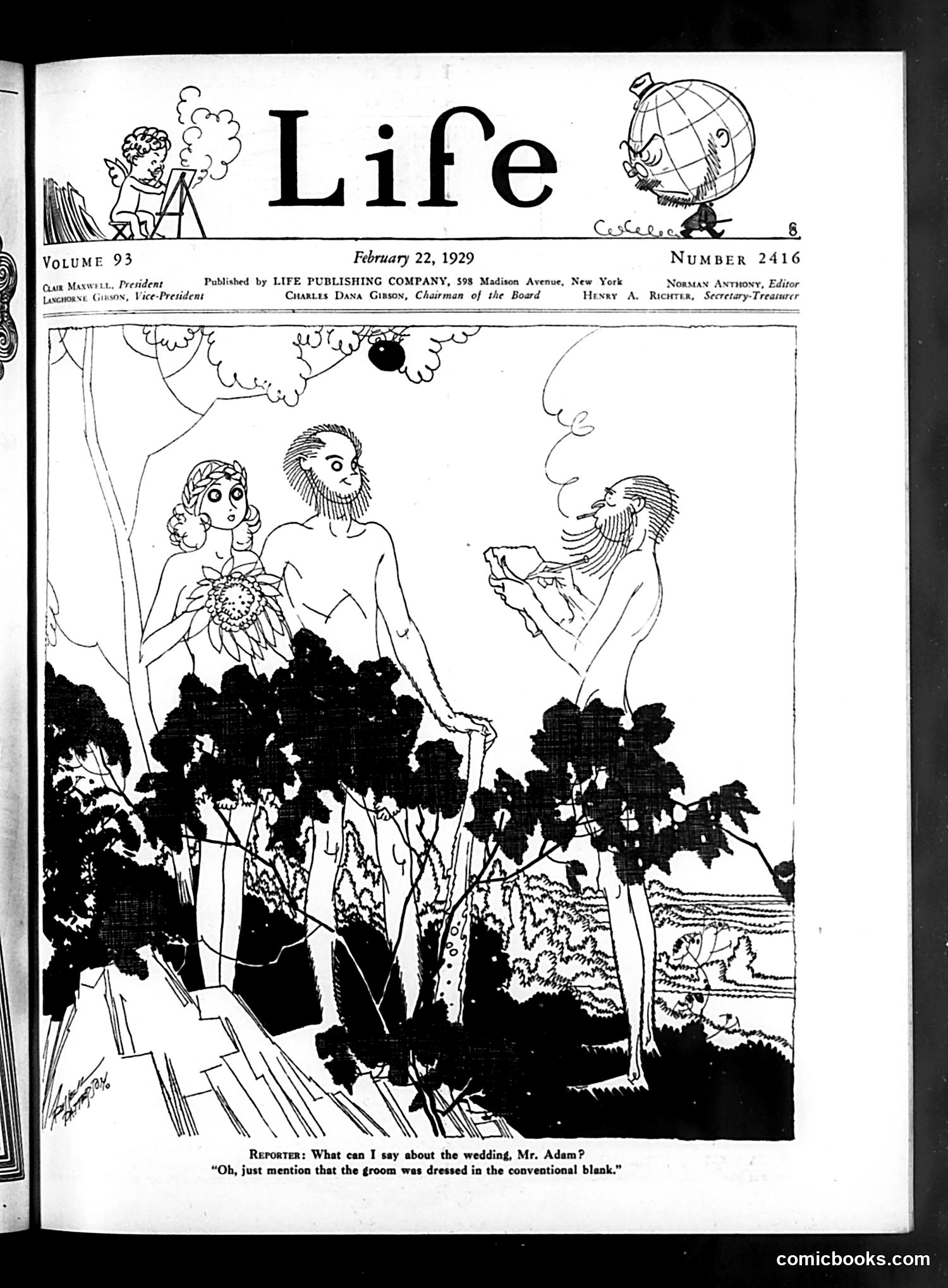
This is a humorous cartoon about wedding reporting. A journalist asks "Mr. Adam" (representing the groom) what he can say about the wedding, with Adam replying to mention only that "the groom was dressed in the conventional blank." The joke satirizes the formulaic, uninformative nature of wedding announcements in newspapers of the era. The groom is literally depicted as a featureless silhouette—a "blank"—suggesting that grooms were interchangeable nonentities in wedding coverage. The satire targets how newspapers reduced male wedding participants to mere conventional props, focusing instead on the bride's appearance and clothing. This reflects 1920s social attitudes where weddings were treated primarily as showcases for women's fashion and beauty rather than as events involving actual people.
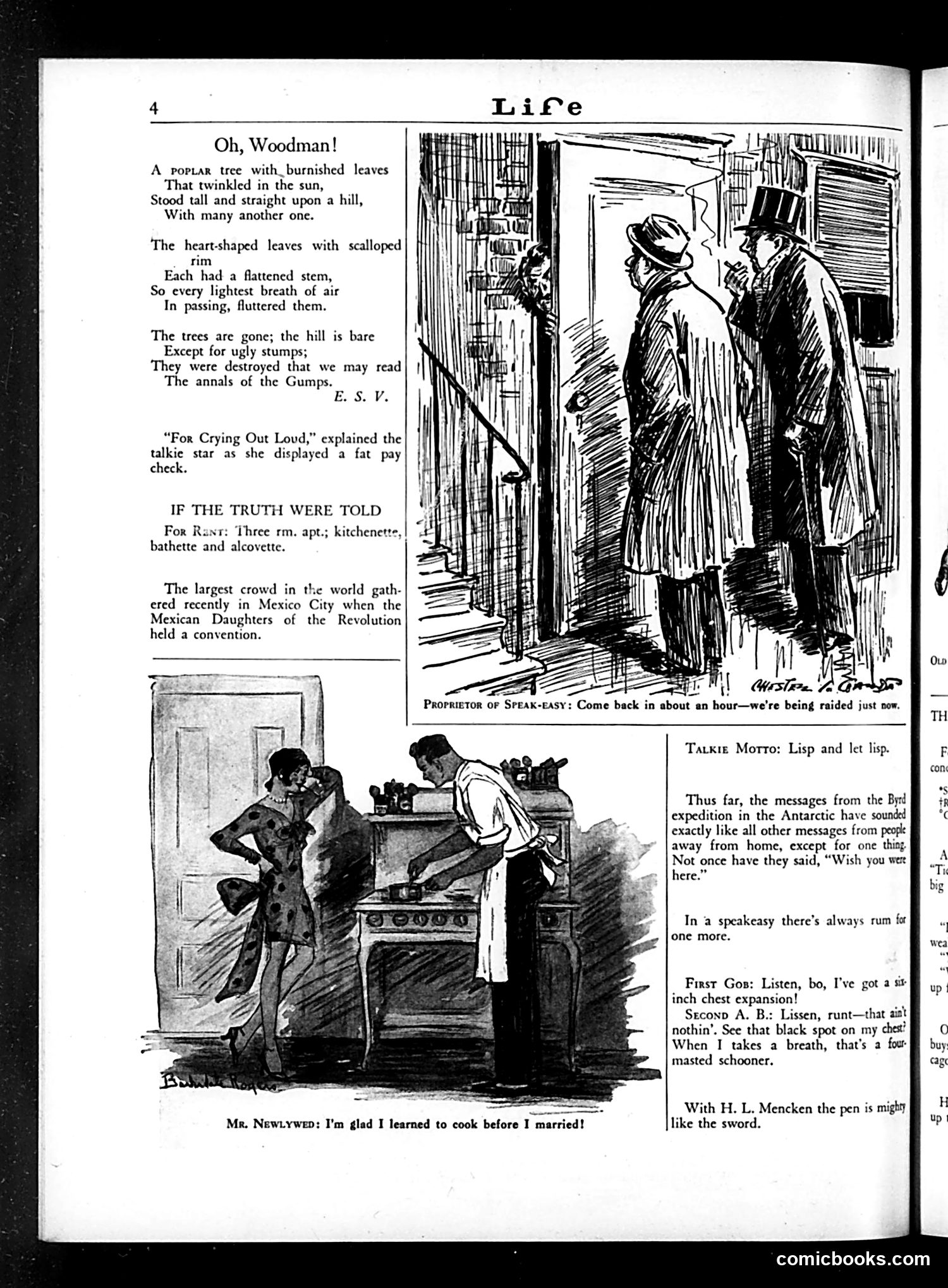
This page contains three distinct satirical pieces: 1. **"Oh, Woodman!"** - A poem about a poplar tree, attributed to E.S.V., appears to be literary satire rather than political commentary. 2. **Top cartoon** - Shows a speakeasy proprietor warning two men about a police raid. This references Prohibition-era illegal bars, satirizing the constant threat of law enforcement raids during the 1920s-1930s. 3. **Bottom cartoon** - Depicts a newlywed man cooking while his wife watches. The caption "I'm glad I learned to cook before I married!" satirizes changing gender roles and domestic expectations, suggesting irony about who should handle kitchen duties. The "Talkie Motto" section jokes about early sound film technology. Overall, the page mixes literary satire with social commentary on Prohibition and marriage dynamics.
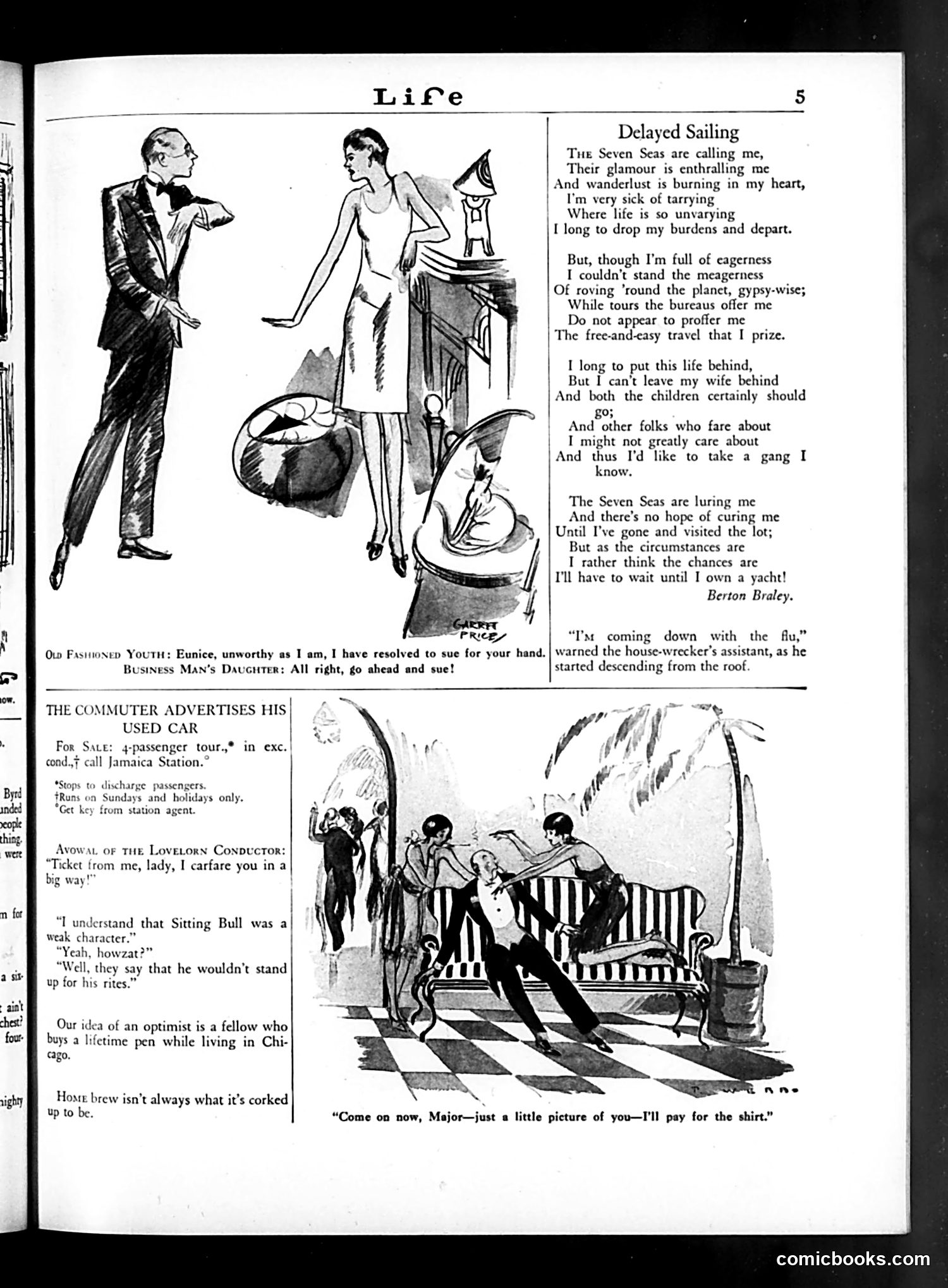
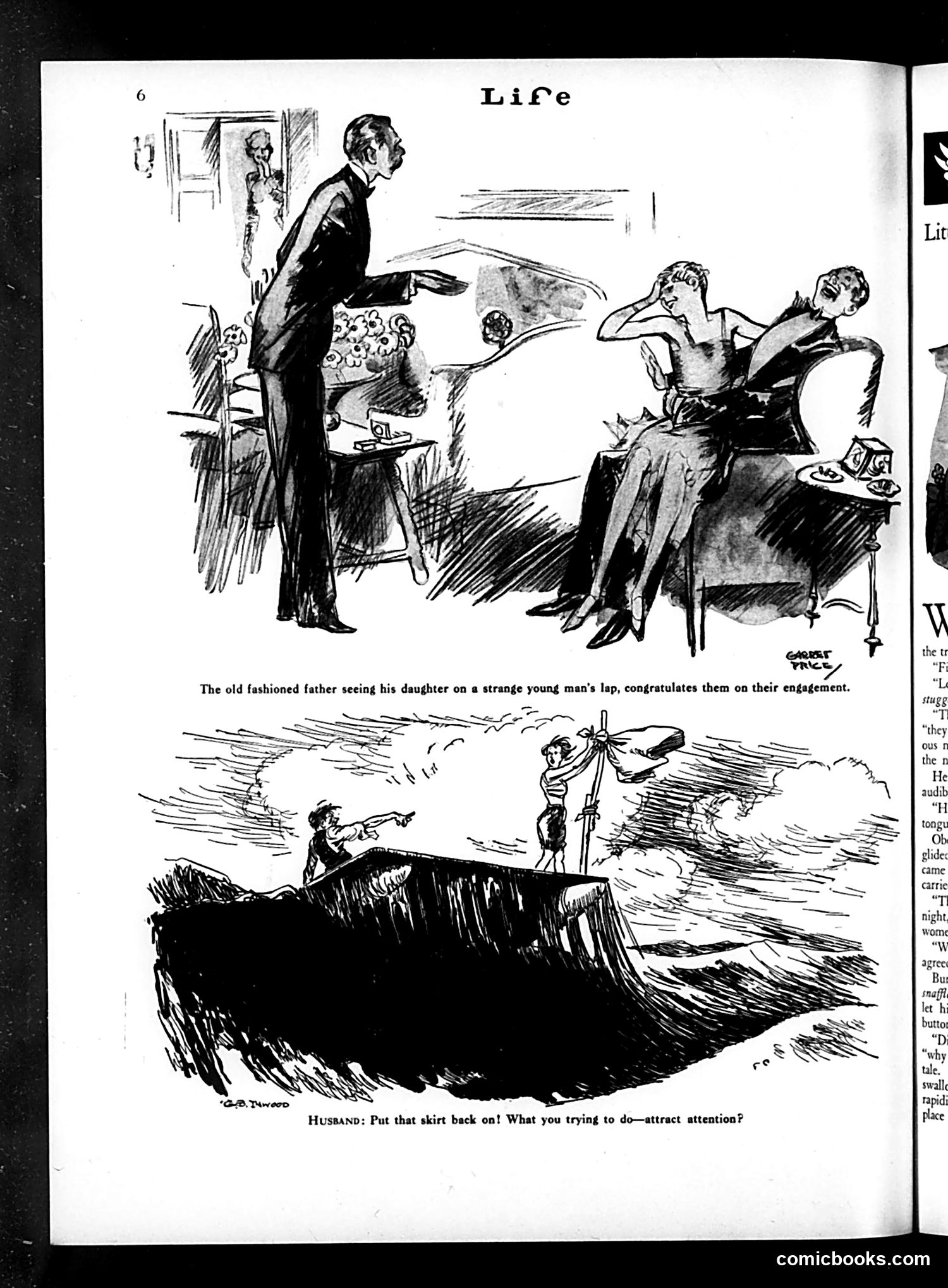
This page contains two satirical cartoons about courtship and marriage customs. The **top cartoon** depicts an old-fashioned father witnessing his daughter sitting on a young man's lap and congratulating them on their engagement. The satire mocks outdated social conventions where such physical familiarity would be scandalous unless the couple was already formally engaged. The **bottom cartoon** shows a husband objecting as his wife wades into the ocean with her skirt hiked up, accusing her of "trying to attract attention." The joke satirizes the tension between prudish husband and wife's desire for practical freedom—wading requires lifting one's skirt, yet he perceives this as improper attention-seeking. Both cartoons critique rigid social propriety and gendered double standards regarding public behavior and modesty.
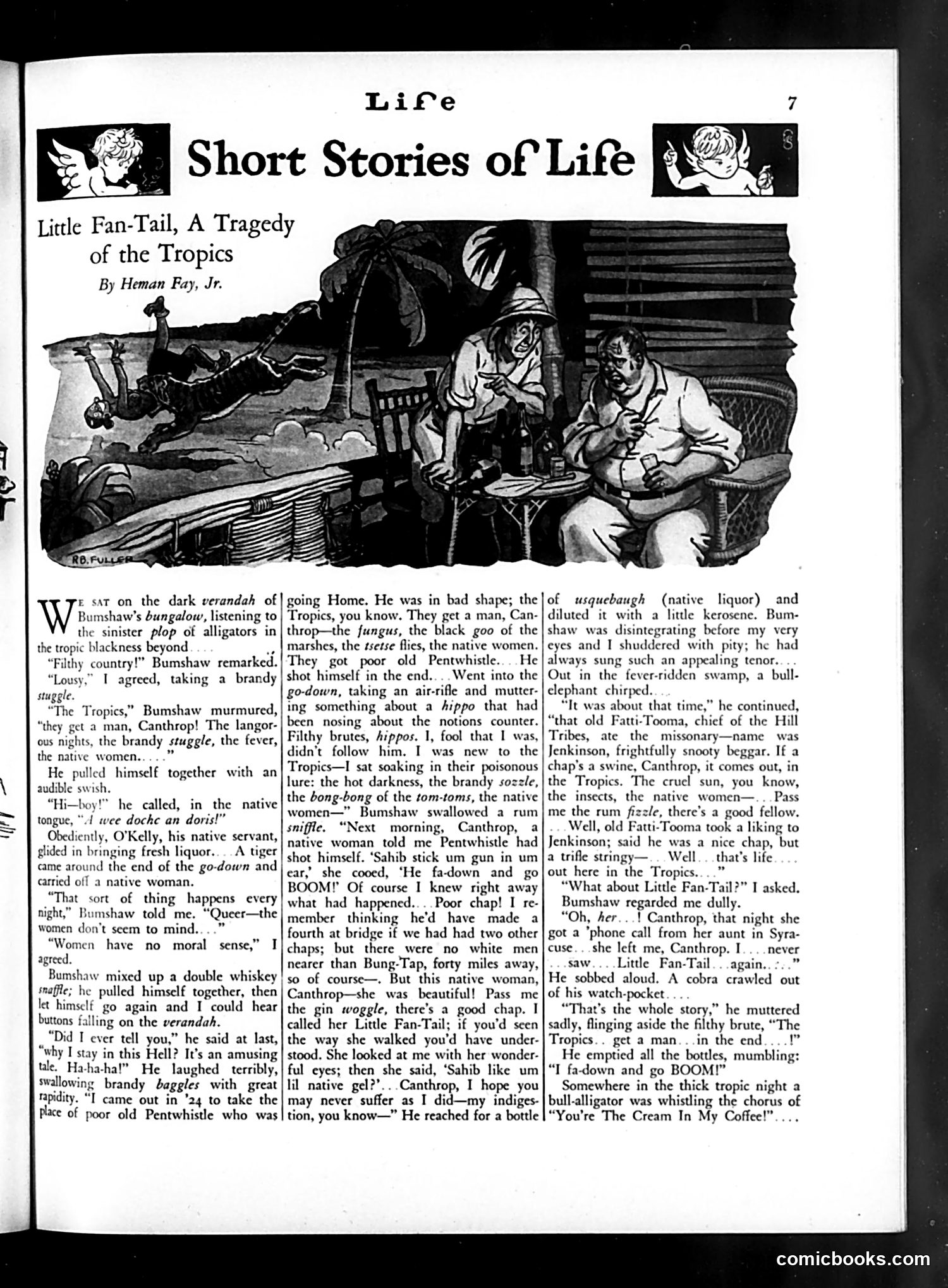
This is a short story rather than a political cartoon. The illustration shows two men in colonial dress listening to a third man's account of tropical misadventure. The narrative concerns a man named Pentwhisile who, while stationed in the tropical colonies, became an alcoholic ("the Tropics get a man, Canthrop"). The story traces his degradation through drink and involvement with native women, culminating in his suicide by gunshot in a swamp. The tale appears to satirize British colonial life—particularly the dangers of alcoholism, racial attitudes toward indigenous populations (referred to by period-appropriate slurs), and the moral corruption supposedly inherent to tropical postings. It's a cautionary narrative about colonial excess and its consequences.
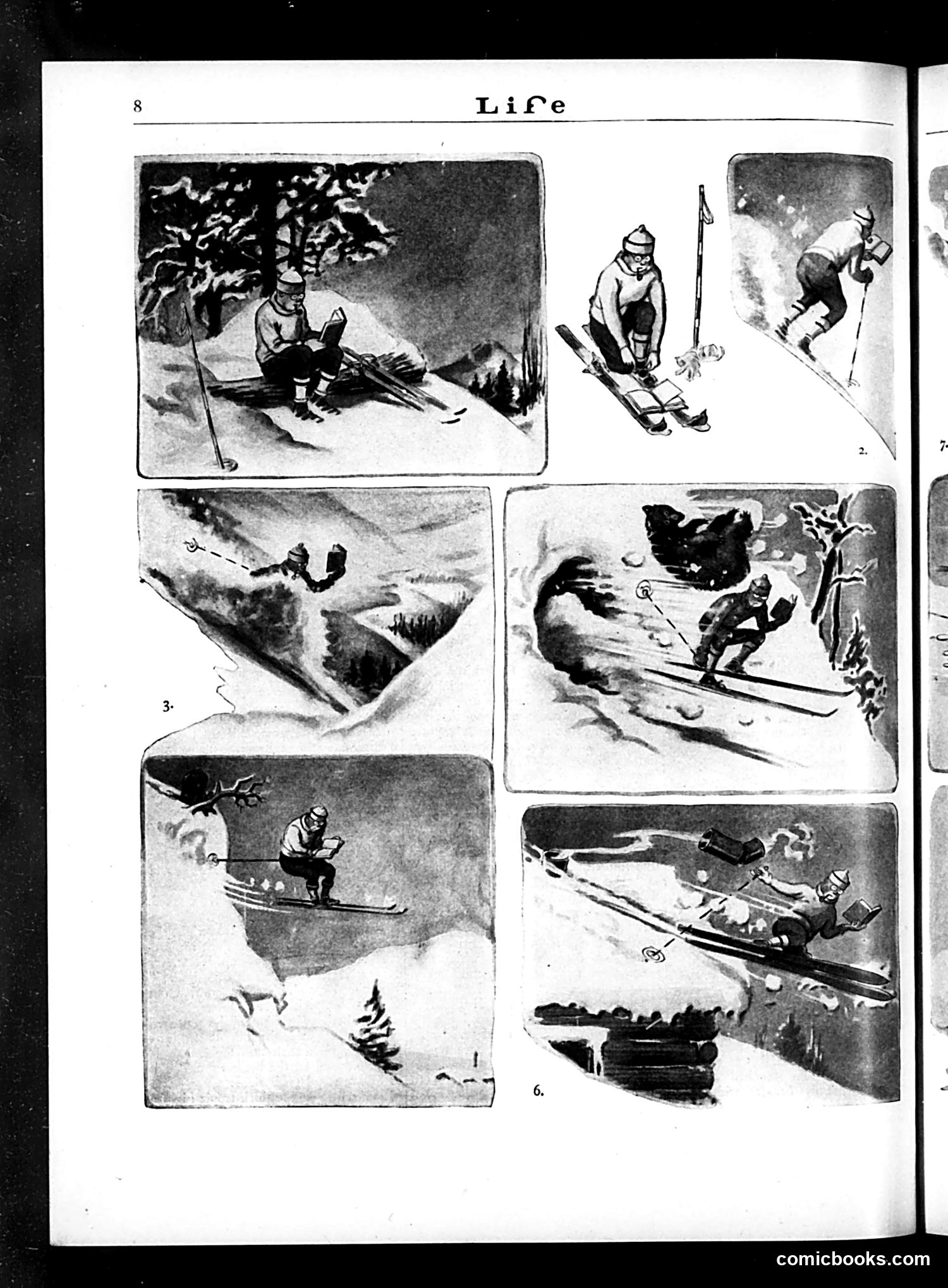
This page from *Life* magazine appears to be a comedic photo essay or illustrated sequence about **skiing accidents and mishaps**. The six numbered panels show various ski-related falls, tumbles, and collisions in snowy mountain settings. The humor derives from **slapstick physical comedy**—skiers losing control, falling awkwardly, colliding with trees or each other, and generally struggling with winter sports. The drawings capture exaggerated poses of people tumbling down slopes or crashing into obstacles. This reflects early 20th-century *Life's* characteristic style: satirizing contemporary recreational activities (skiing was becoming more popular among the leisure classes) through visual humor rather than political commentary. The joke is simply that skiing, while fashionable, frequently results in undignified, painful-looking accidents—a relatable observation for readers unfamiliar with the sport.
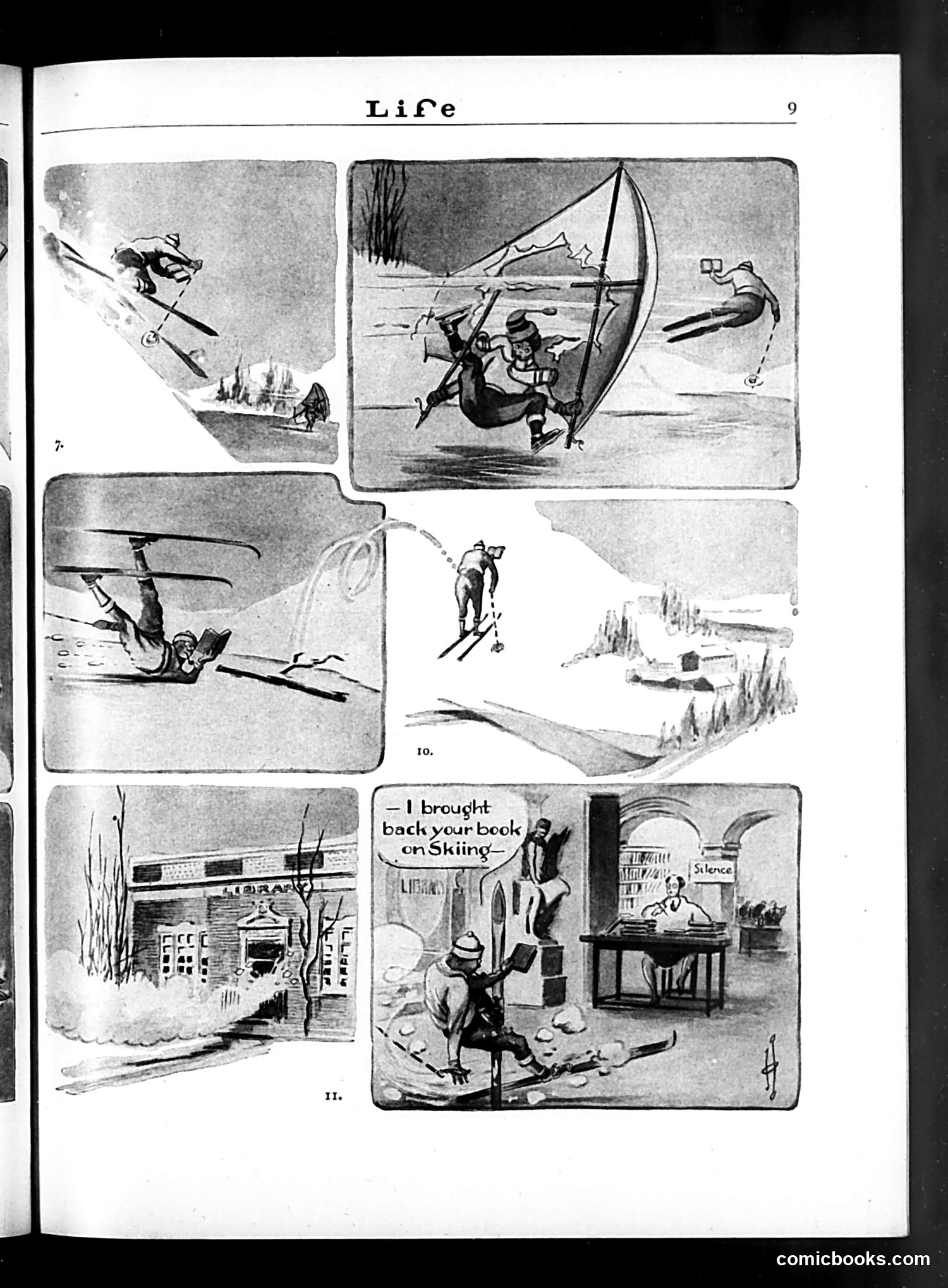
This page contains six cartoon panels depicting winter sports mishaps and a library joke. The top panels show skiing and ice-sailing accidents with figures tumbling or losing control of equipment. The middle panels illustrate more skiing disasters on snowy slopes. The bottom panel presents a punchline joke: a person has brought a book on skiing to a library, where the librarian (labeled "Silence") presides. The humor lies in the contrast between the book's subject matter—skiing, an active outdoor sport—and the library setting, which demands quiet and stillness. These appear to be general humor cartoons rather than political satire, mocking the physical comedy of winter sports participation and the absurdity of studying such activities indoors.
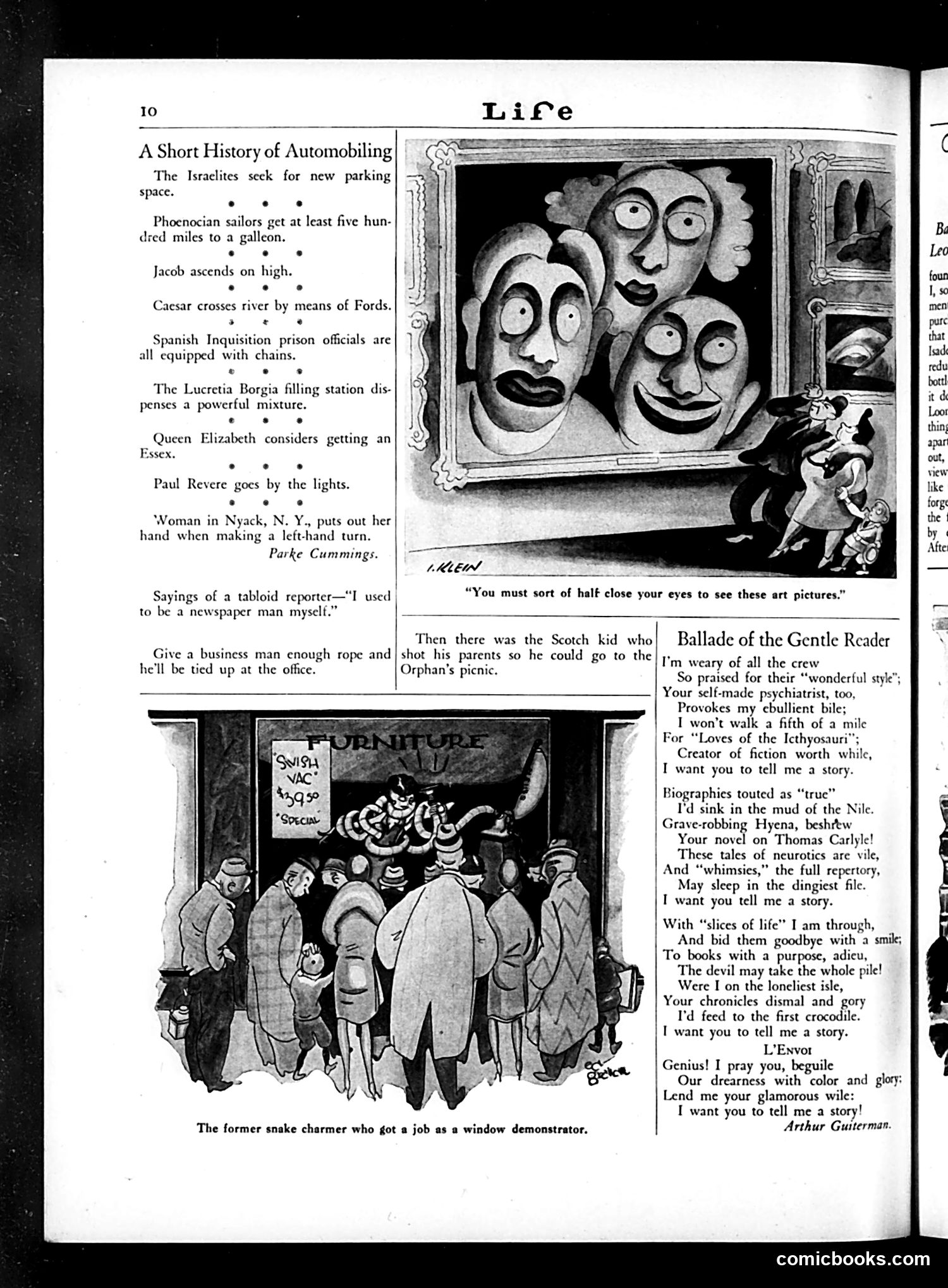
This page contains two cartoons and a poem. The upper cartoon shows a man and children viewing grotesque face masks or heads through a window, with the caption "You must sort of half close your eyes to see these art pictures." This satirizes modernist or abstract art as incomprehensible nonsense requiring self-deception to appreciate. The lower cartoon depicts a furniture showroom where a former snake charmer now works as a window demonstrator, surrounded by customers examining furniture. The joke plays on the absurdity of career transitions—a snake charmer's skills have no obvious application to furniture sales, suggesting desperation or poor job matching. The right column features "Ballad of the Gentle Reader," a poem by Arthur Guiterman critiquing various literary trends and pretentious writers of the era.
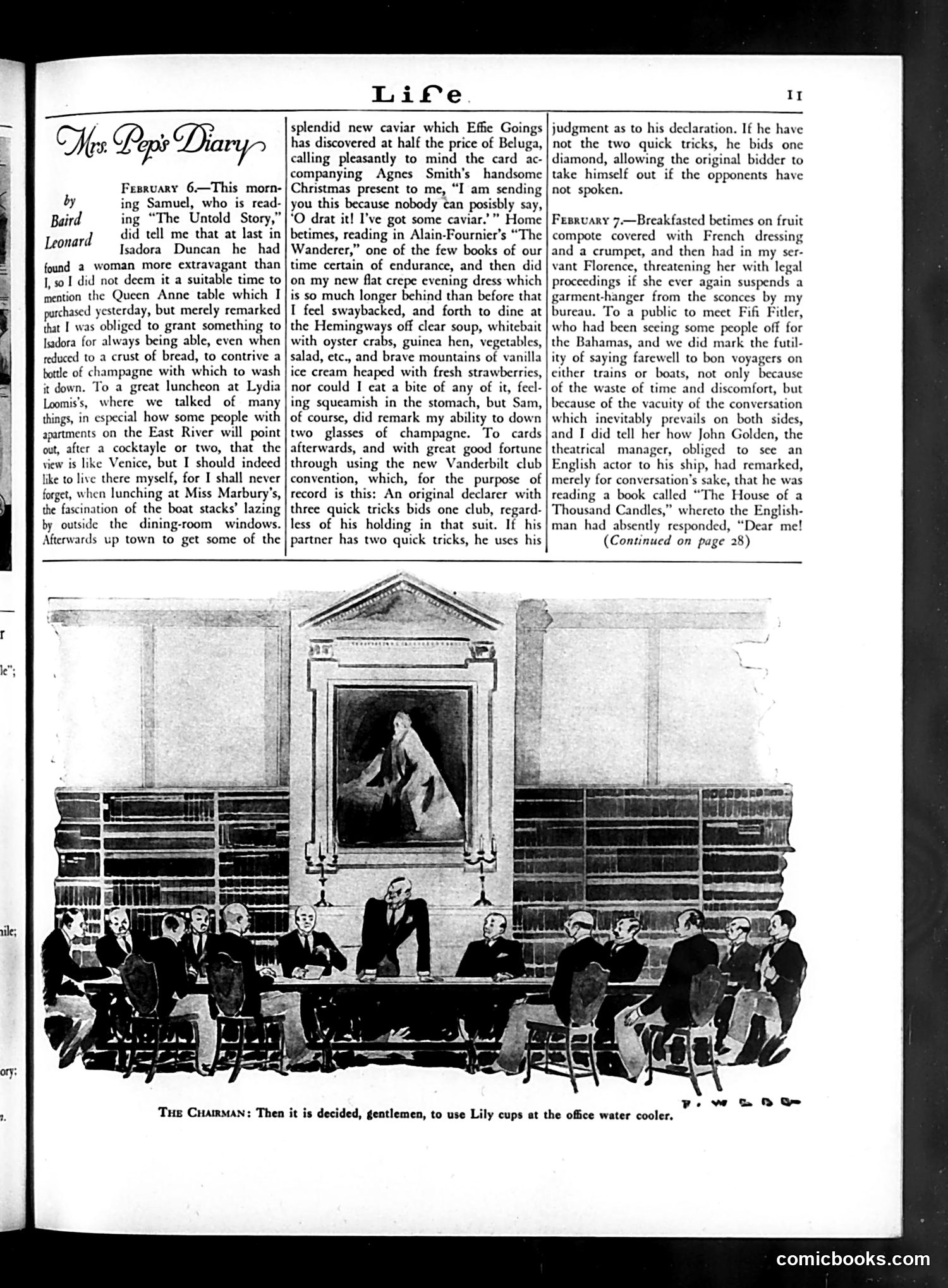
This page contains **"Mrs. Pep's Diary,"** a satirical society column by Baird Leonard dated February 6-7. The diary mocks upper-class social rituals and pretensions—describing elaborate luncheons, fashionable clothing, and frivolous conversation among wealthy New Yorkers. The cartoon at bottom depicts a **board meeting** where a chairman announces: "Then it is decided, gentlemen, to use Lily cups at the office water cooler." The satire targets corporate bureaucracy and absurd decision-making—suggesting executives waste time debating trivial matters (water cup choices) with excessive formality, treating minor office details as significant business decisions requiring formal votes. Both pieces mock American class pretension and institutional inefficiency through exaggeration.
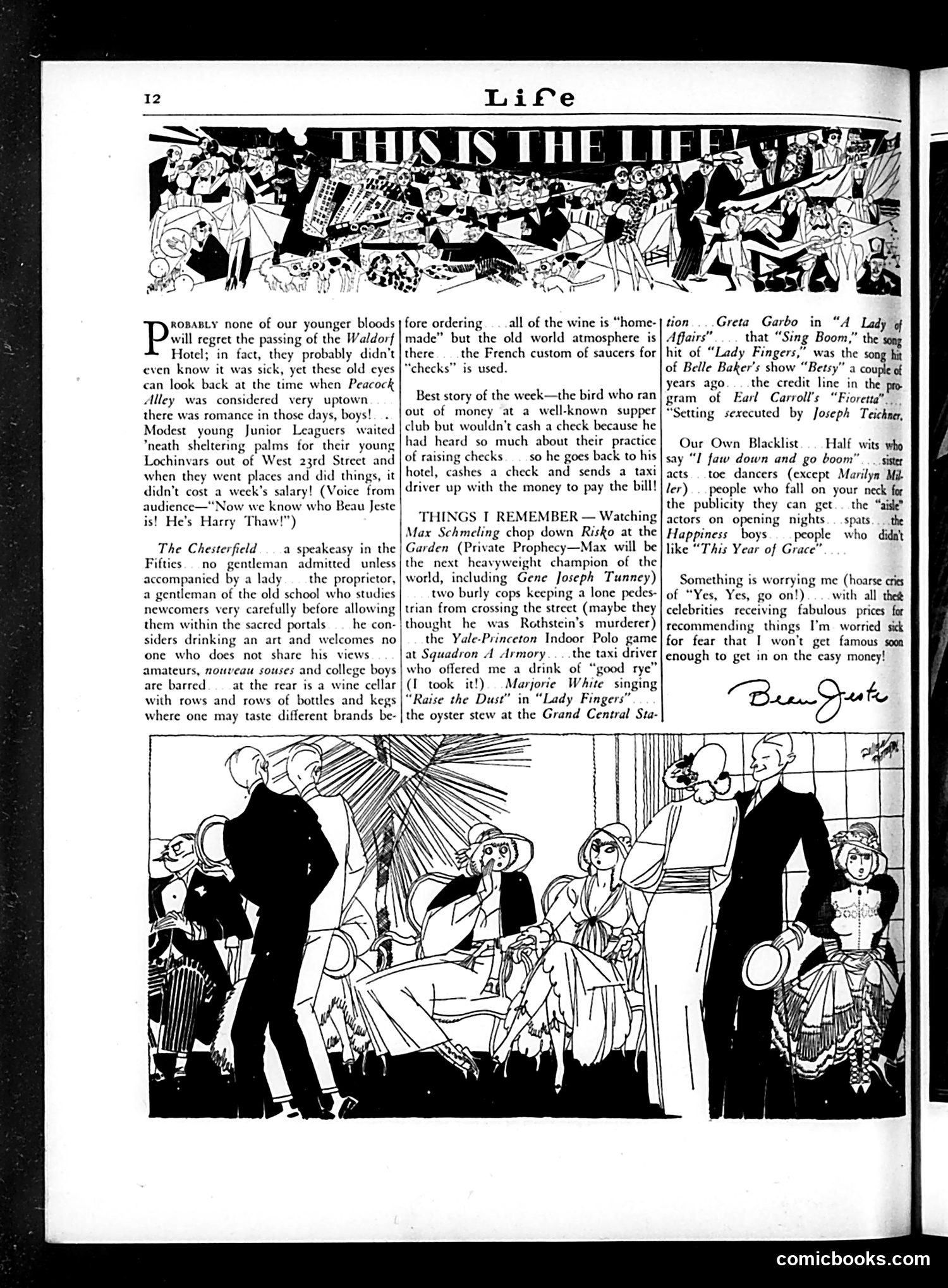
This page satirizes 1920s high society and entertainment venues. The header "THIS IS THE LIFE!" accompanies an illustrated frieze depicting various leisure activities—dining, dancing, socializing—representing the era's Jazz Age excess. The text discusses the **Waldorf Hotel** and speakeasies, referencing Prohibition-era culture where alcohol was illegally served. It mentions the **Chesterfield**, a speakeasy requiring "a gentleman of the old school" as escort, satirizing exclusivity and hypocrisy—gentlemen openly violated Prohibition laws while maintaining pretense of respectability. The illustration shows well-dressed patrons at what appears to be an upscale club or restaurant, with formal attire and leisure activities typical of wealthy New Yorkers during Prohibition. The column by "Bea Juke" reviews theatrical performances and social observations, maintaining Life's satirical tone about privileged society during this period of legal alcohol prohibition and underground drinking culture.
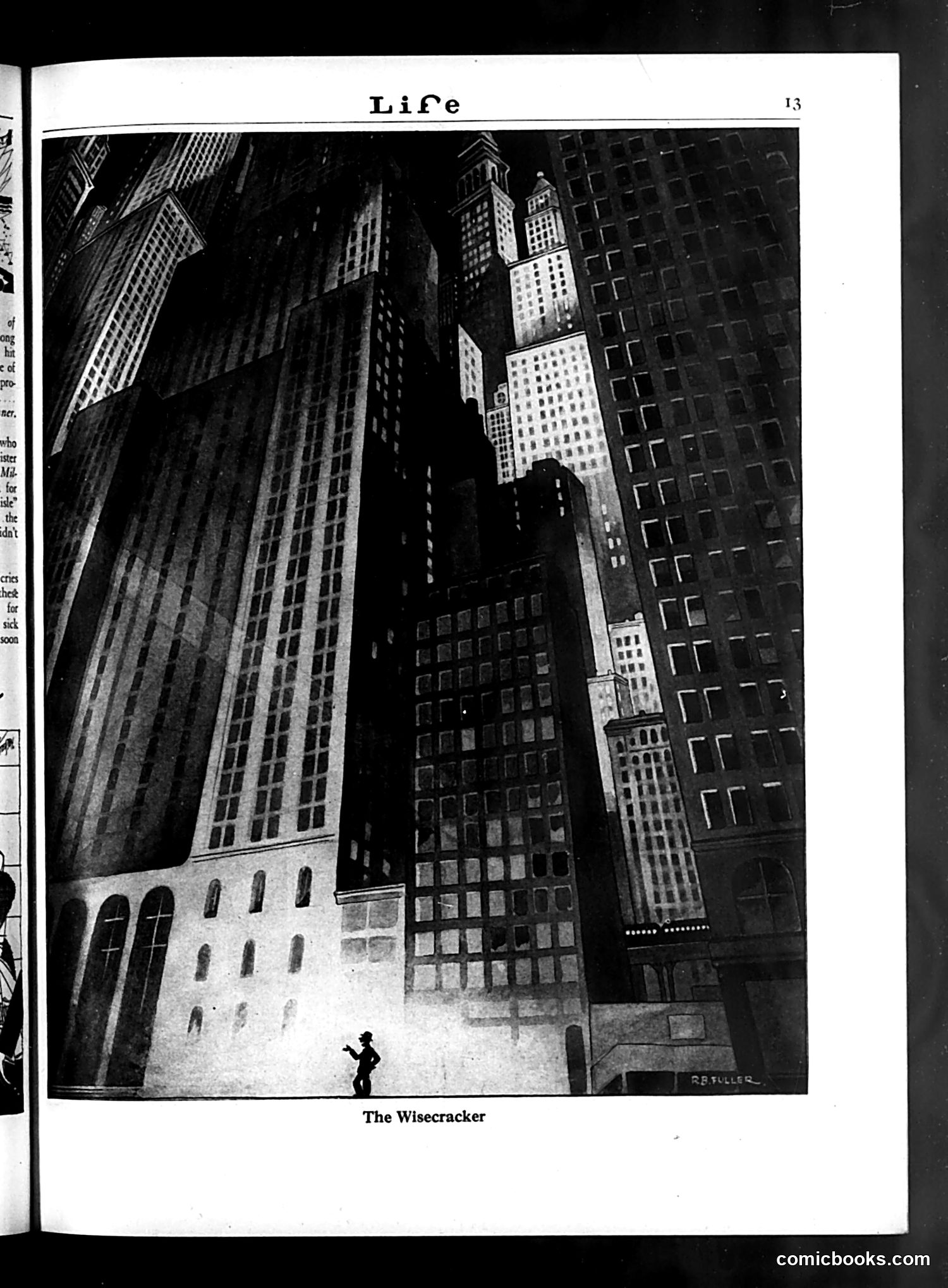
This is a black and white photograph titled "The Wisecracker," appearing in *Life* magazine (page 13). It shows a lone, small human figure standing at street level, dwarfed by imposing Art Deco skyscrapers towering above. The composition emphasizes the figure's insignificance against the massive urban architecture. The satire likely critiques urban alienation or the powerlessness of individuals within modern industrial society. The "wisecracker" may represent an ordinary person attempting humor or bravado as a coping mechanism while surrounded by overwhelming corporate/architectural forces. The dramatic upward perspective underscores human vulnerability in the face of impersonal modernization—a common satirical theme in early-to-mid 20th century American commentary on urban life.
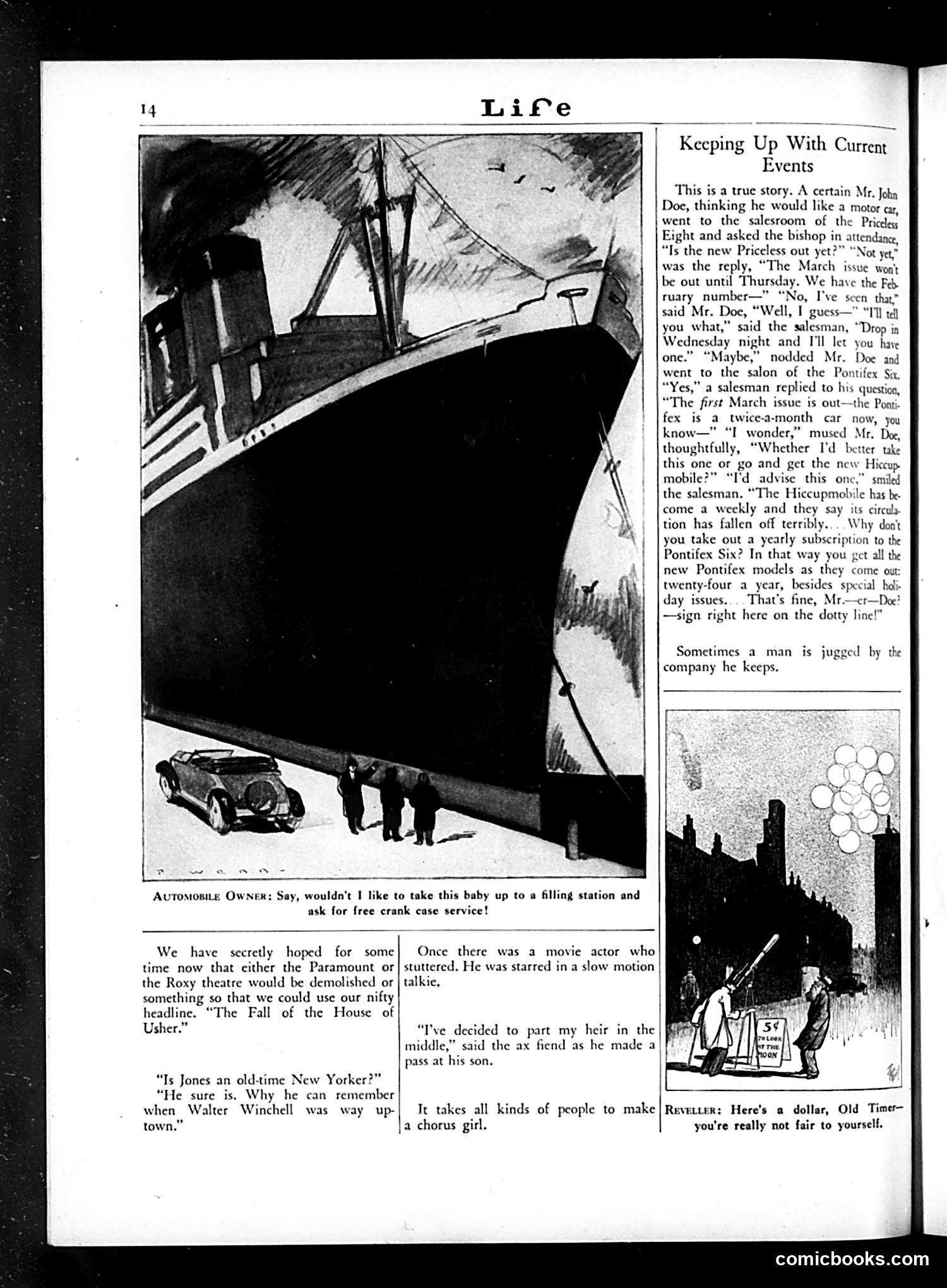
This page contains automotive and social satire from the early 20th century. The main illustration shows a man with a tiny car dwarfed beside a massive ship, captioned with a joke about taking the car to a filling station for "free crank case service"—satirizing automobile owners' penny-pinching despite owning luxury vehicles. The "Keeping Up With Current Events" section mocks Mr. Doe, an everyman character, who considers purchasing a Priceless Eight automobile. A salesman persuades him to buy a yearly subscription to Pontifex Six magazine instead, getting new car models delivered regularly. The page satirizes consumerism, automobile culture, and aspiring middle-class buyers trying to keep pace with luxuries they can barely afford—a recurring theme in Life's social commentary of this era.
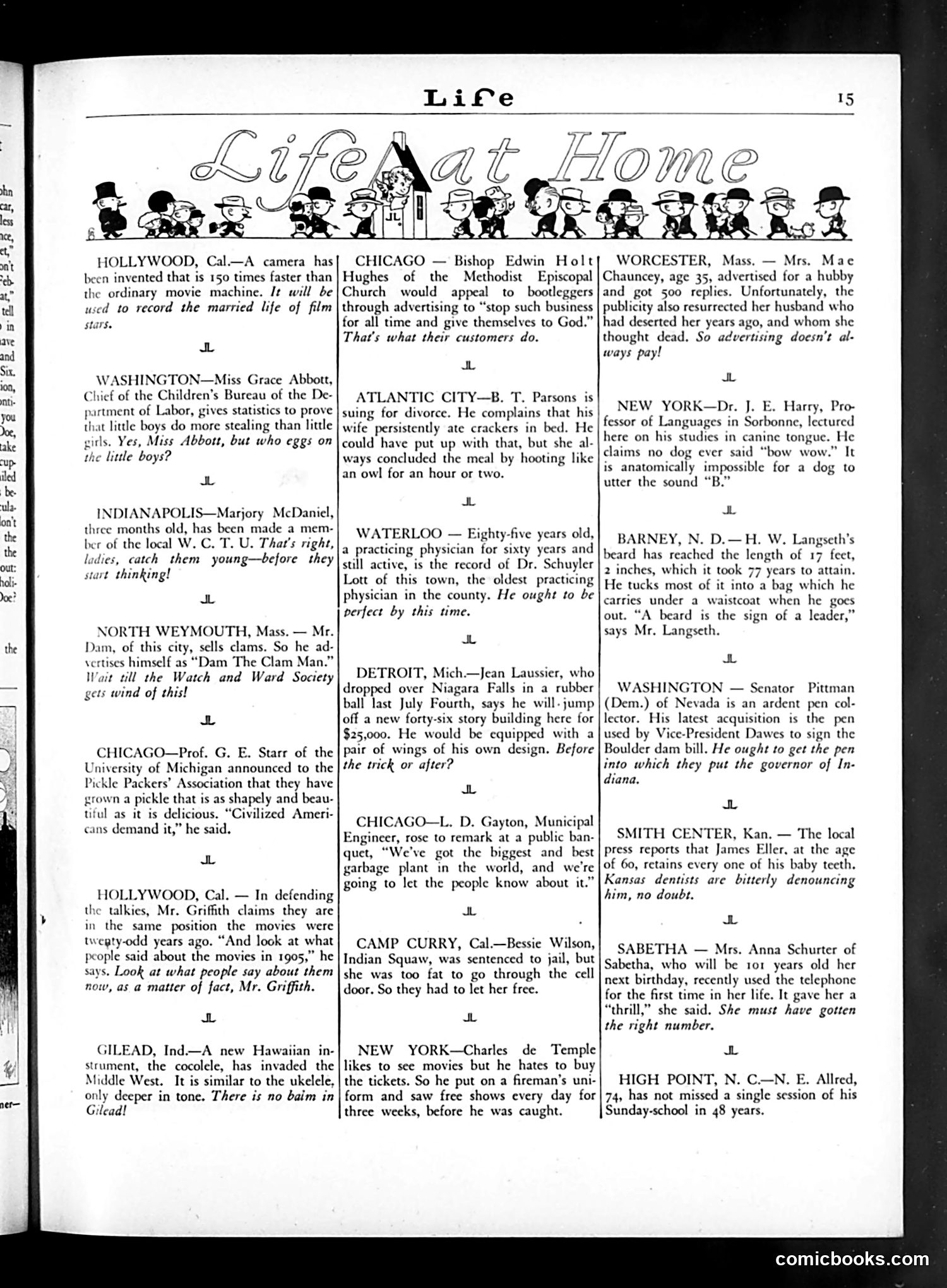
This page from *Life* magazine's "Life at Home" section contains humorous anecdotes from various American towns rather than political cartoons. The header illustration shows a row of small figures in formal dress (top hats and suits) standing before a house—likely representing the diverse subjects described below. The content satirizes everyday American life through brief, comedic stories: a clergyman wanting advertising to fight business competition, a husband who hoots like an owl during meals, a man selling clams while advertising himself, and various other absurdist scenarios. The humor relies on exaggerated character quirks and social observations rather than political commentary. This reflects *Life*'s early 20th-century format: satirizing middle-class American eccentricities and small-town customs through whimsical reportage.
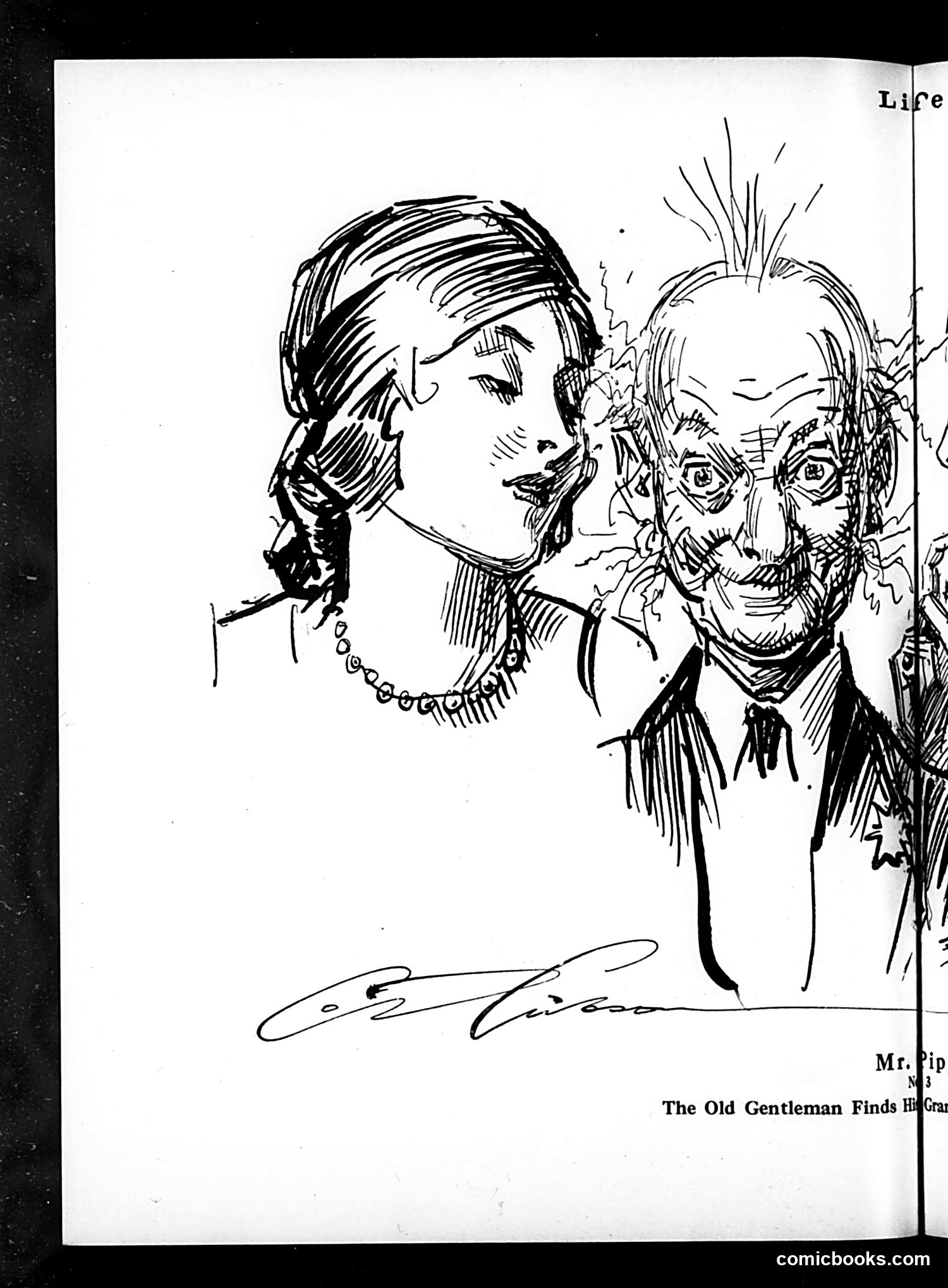
This appears to be a satirical illustration from Life magazine showing two contrasting character sketches. On the left is a refined woman with styled hair and a pearl necklace, drawn in a more flattering style. On the right is an exaggerated caricature of an elderly man with wild, spiky hair and sharp, angular features, wearing formal attire. The caption suggests a humorous scenario about an old gentleman encountering or recognizing his granddaughter. The stark stylistic difference between the two figures—the idealized woman versus the grotesque old man—likely satirizes generational differences, changing beauty standards, or the passage of time. The artwork's satirical tone is typical of Life magazine's social commentary.
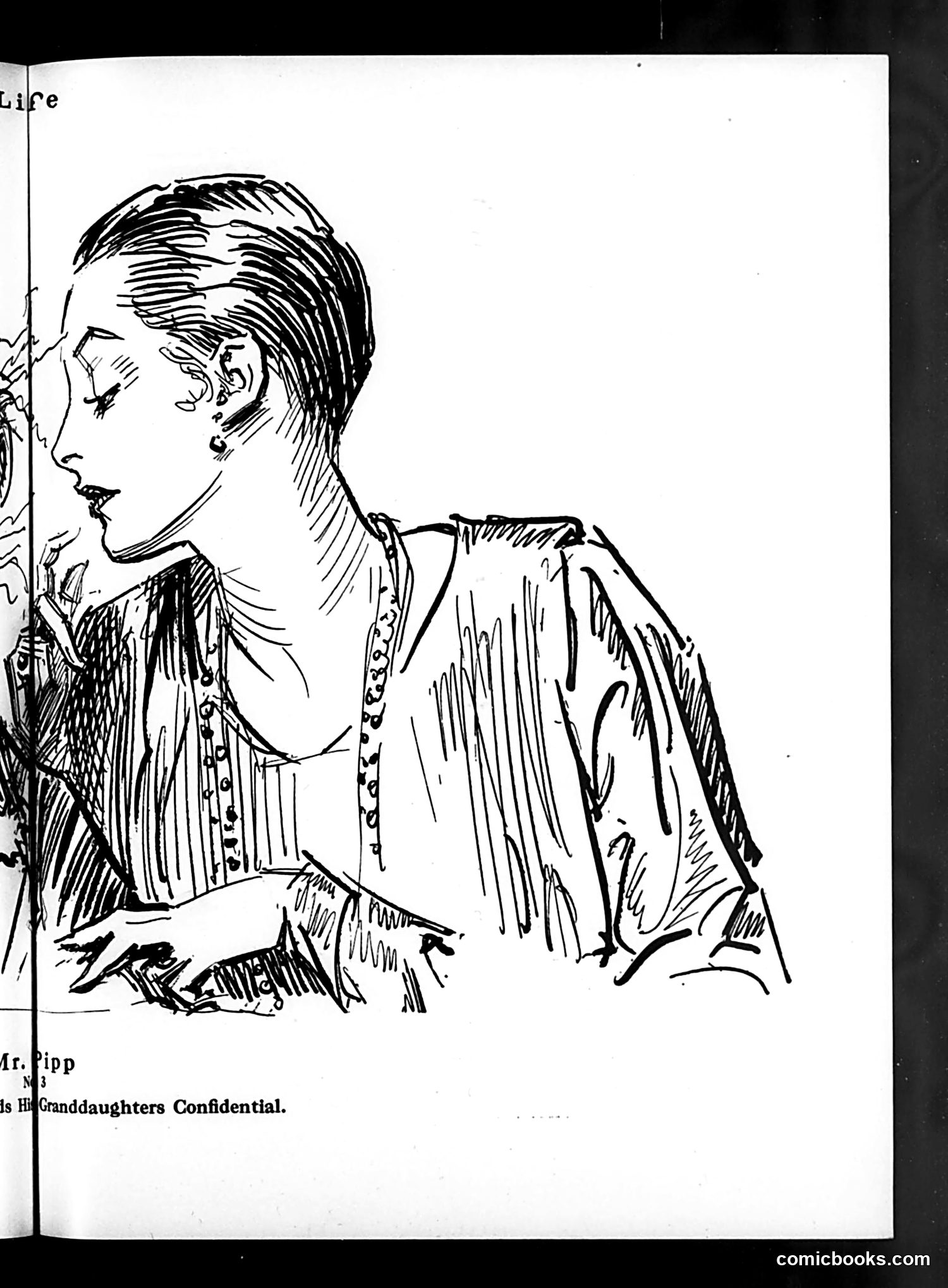
This page features a pen-and-ink portrait sketch of a woman in profile, drawn in an expressive, loose style typical of Life magazine's satirical illustration work. The subject wears what appears to be early 20th-century clothing with detailed cross-hatching on the fabric. The caption reads "Mr. Pipp" and references "Granddaughters Confidential," though the OCR is unclear. Without additional context about the specific issue or artist, I cannot definitively identify which public figure this caricatures or what particular social/political commentary it aims at. The sketch's style and placement suggest it's meant as social satire or commentary on a contemporary figure, but the specific target and point of the joke remain unclear from this image alone.
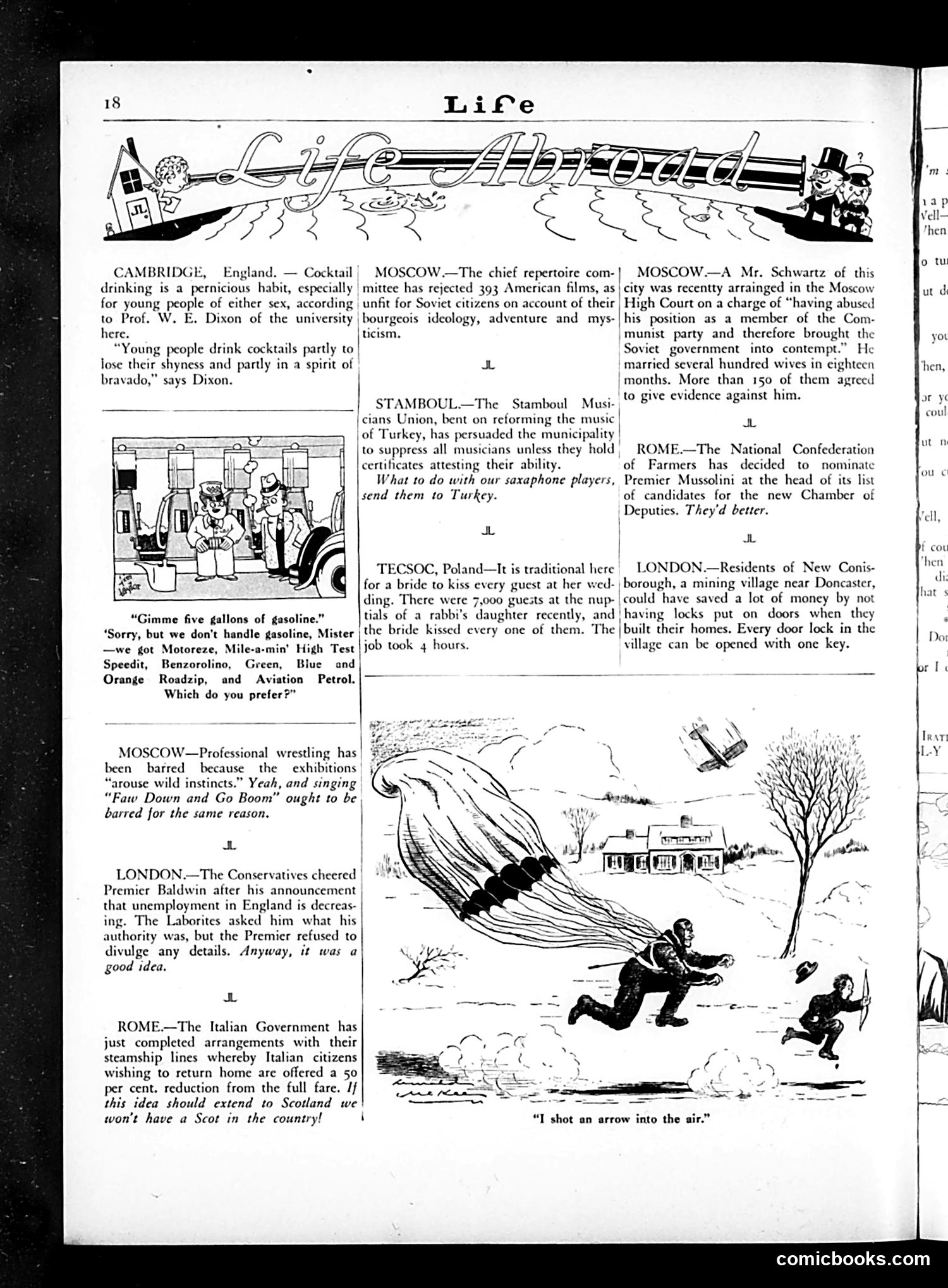
This page contains international news briefs lampooning various governments and social trends circa the 1920s-30s: **Moscow items** mock Soviet censorship (rejecting 393 American films as "bourgeois"), the ban on professional wrestling as "arousing wild instincts," and a political purge against a Communist Party member who married hundreds of women. **Cambridge** references a professor claiming young people drink cocktails to overcome shyness—satirized by the gasoline/fuel brand parody below, where absurdly named products substitute for actual gasoline. **London** jabs at Conservative Premier Baldwin's vague unemployment claims and Italian government's discount fares for emigrating citizens. **Stamboul** jokes about musicians being suppressed unless certified, sarcastically suggesting sending problematic saxophone players there. **Poland's** rabbi's daughter kissed 7,000 wedding guests in four hours—an absurdist human-interest story. The **illustrated cartoon** ("I shot an arrow into the air") appears unrelated, showing figures outdoors. The humor targets authoritarian overreach, propaganda, and bureaucratic absurdity across Europe.
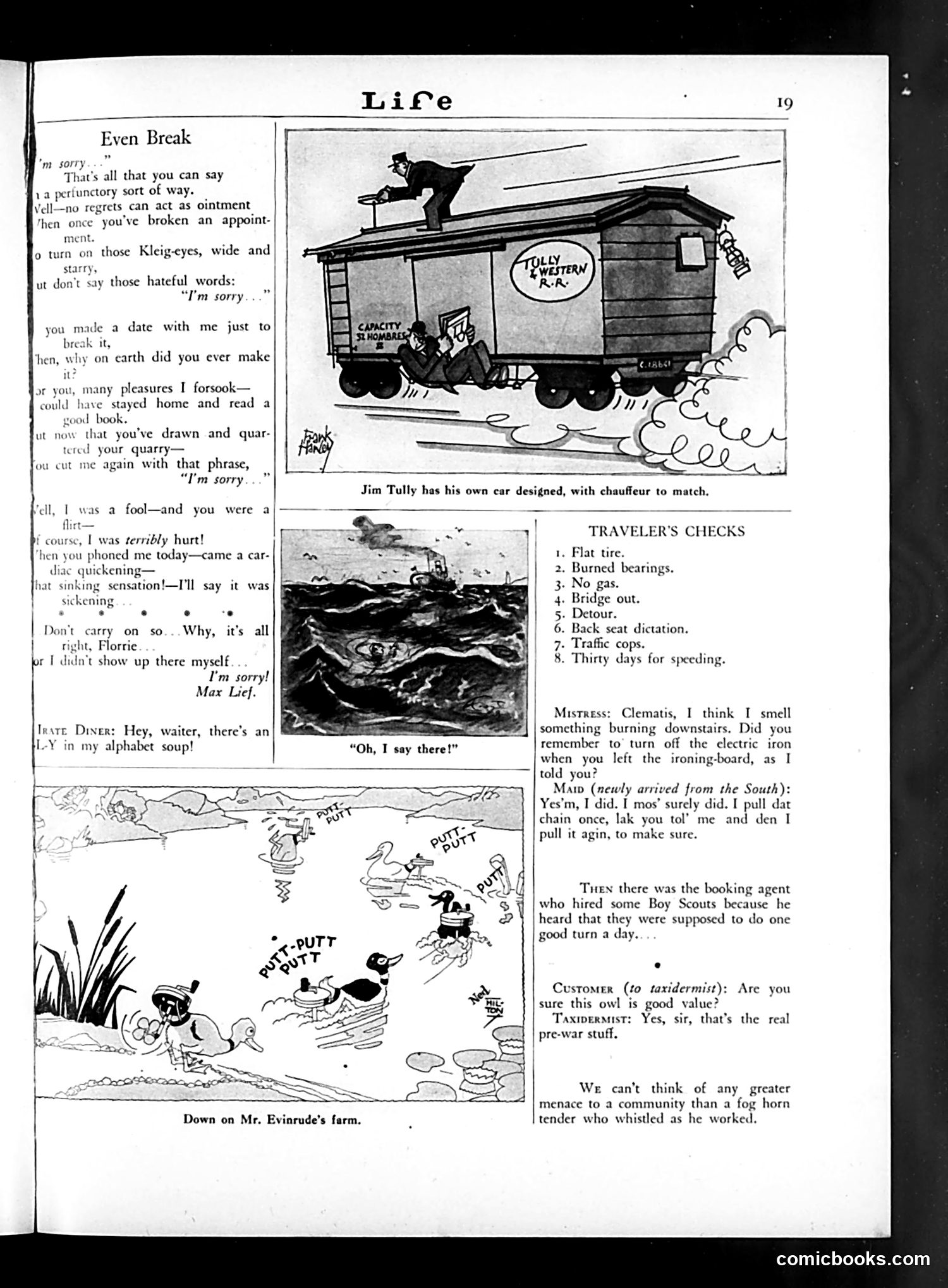
This page contains multiple satirical pieces typical of early-to-mid 20th century American humor: **"Even Break"** is a poem about dating disappointment—a woman's bitter complaint after a man cancels their appointment, expressing how his perfunctory apology ("I'm sorry") fails to compensate for the emotional hurt and wasted time. **The cartoons** include: - A joke about alphabet soup with a letter "Y" (visual pun on "alphabet") - Jim Tully's custom car design (labeled "Tully Western A.A.") - A farm scene with duck hunting ("putt-putt" sound effects) - "Traveler's Checks"—humorous list of car troubles and police encounters common to road trips **The brief anecdotes** mock domestic servants, business practices (hiring Boy Scouts expecting free labor), and taxidermists selling "pre-war" goods as value. The page's overall tone reflects mid-century American social anxiety: romantic disappointment, automotive inconvenience, class dynamics, and commercial opportunism. The humor assumes readers share these everyday frustrations.
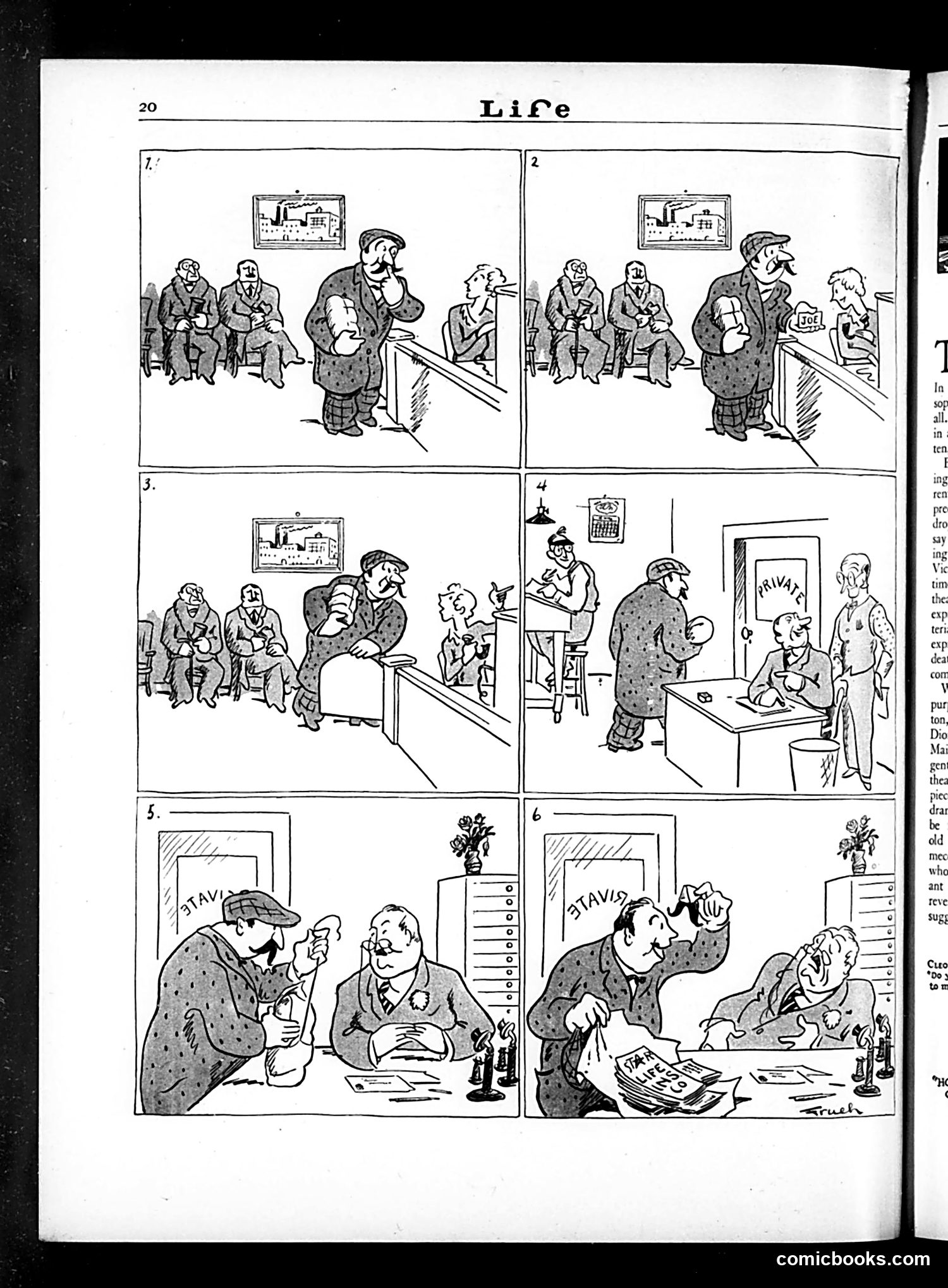
This six-panel comic depicts a sequential narrative about office conduct and privacy. The story appears to show a man repeatedly visiting an office marked "PRIVATE," initially being turned away by colleagues, then gaining entry through increasingly assertive behavior. In panels 5-6, the action moves to what appears to be a private office or establishment (marked "STAVIS"), where the man is shown drinking and socializing. The humor likely satirizes office workplace dynamics—specifically the tension between public and private spaces, hierarchy, and persistence in gaining access to exclusive areas. Without clearer signage or identifiable public figures in caricature, the exact political target remains unclear, though it appears to be general social commentary on workplace behavior and exclusivity rather than specific political satire.
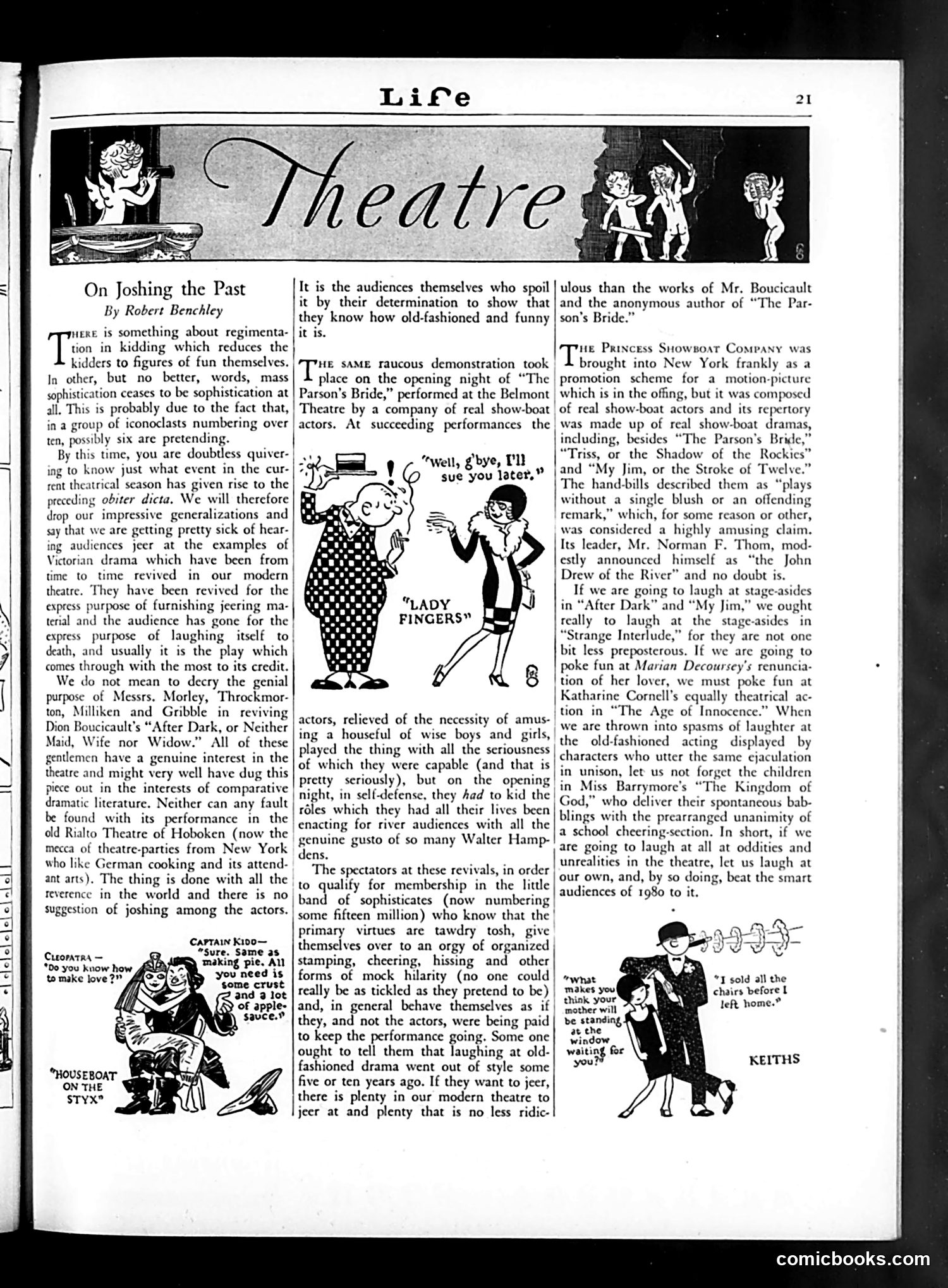
Robert Benchley critiques audiences who attend revivals of old theatrical productions—specifically *After Dark* (Dion Boucicault's Victorian melodrama) and *The Parson's Bride* (performed by the Princess Showboat Company)—solely to mock them as outdated and ridiculous. Benchley's argument: the audiences themselves ruin these performances by demonstrating their supposed sophistication through jeering and laughter. The actors, including genuine showboat performers, treat their material seriously and professionally. But modern audiences attend expressly to laugh at the old-fashioned conventions—a form of shallow, performative superiority Benchley finds tiresome. The small cartoons appear to be unrelated gags typical of Life's humor sections. Benchley argues that if audiences want to laugh at theatrical conventions, they should acknowledge equally absurd elements in contemporary plays like Eugene O'Neill's *Strange Interlude*.
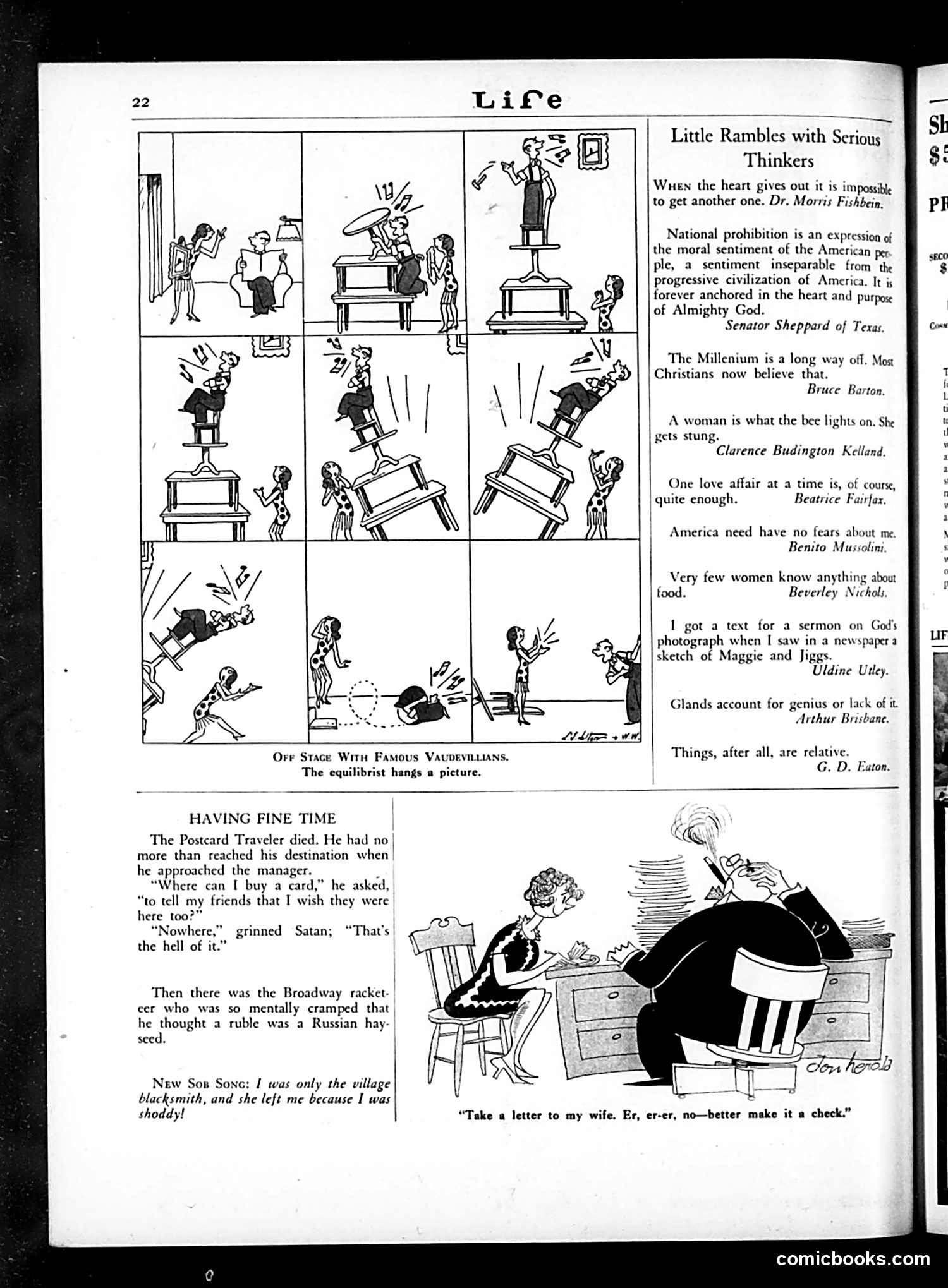
This page from *Life* magazine contains two main sections: **"Little Rambles with Serious Thinkers"** presents satirical quotes from public figures of the era. The humor lies in juxtaposing serious-sounding names (Dr. Morris Fishbein, Senator Sheppard, Benito Mussolini) with absurd or contradictory statements—such as Mussolini claiming "America need have no fears about me" (clearly ironic given fascist threats) and various claims about women, genius, and morality that range from pompous to ridiculous. **The comic strip "Off Stage With Famous Vaudevillians"** shows an acrobat/equilibrist literally balancing objects while people wobble around him—a visual metaphor about maintaining balance amid chaos. **"Having Fine Time"** contains brief humorous anecdotes: a postcard traveler in hell unable to send postcards, and a Broadway criminal confusing "ruble" with "hayseeds." The final illustration shows a man asking his secretary to write a check to his wife instead of a letter—implying he prefers financial settlement to actual communication. The overall tone mocks contemporary celebrities, prohibition-era moralism, and marital discord.
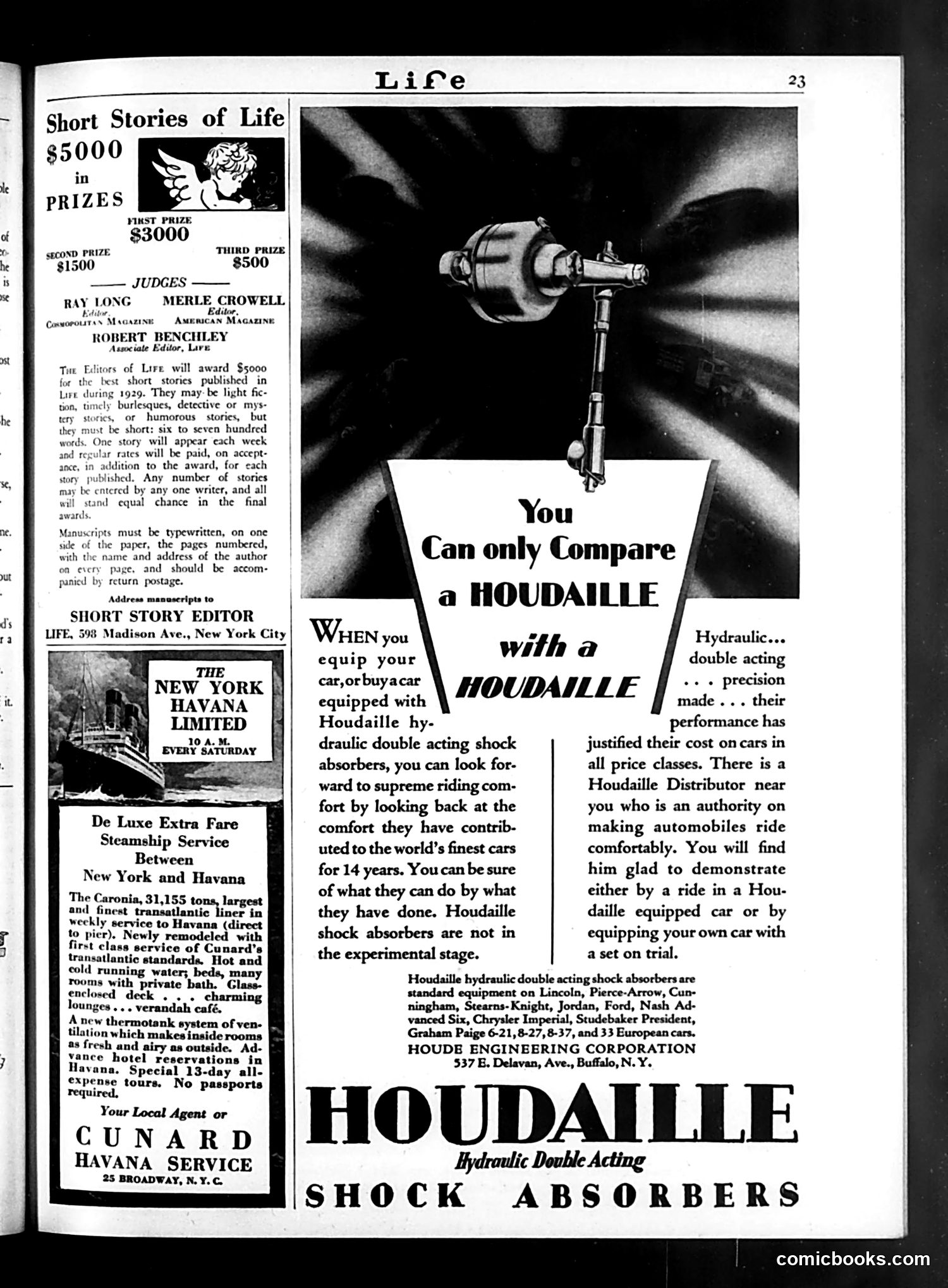
This page is primarily **advertising and announcements** rather than editorial content or satire. The left side features a **$5,000 short story contest** sponsored by *Life* magazine for 1929, with judges including Ray Long, Merle Crowell, and Robert Benchley. Stories must be 600-700 words and appear weekly. Below that are **travel advertisements**: the Cunard steamship line promoting the *Caronia*, a luxury liner serving New York-Havana routes, and the "New York Havana Limited" service. The dominant right-hand advertisement promotes **Houdaille hydraulic shock absorbers** for automobiles. The ad includes a photograph of the mechanical component and claims Houdaille technology has been standard equipment on premium car brands (Lincoln, Pierce-Arrow, Chrysler, Studebaker, etc.) for 14 years, positioning it as proven rather than experimental. There is **no cartoon or satirical content** on this page—it consists entirely of commercial messaging typical of 1920s magazine layout.
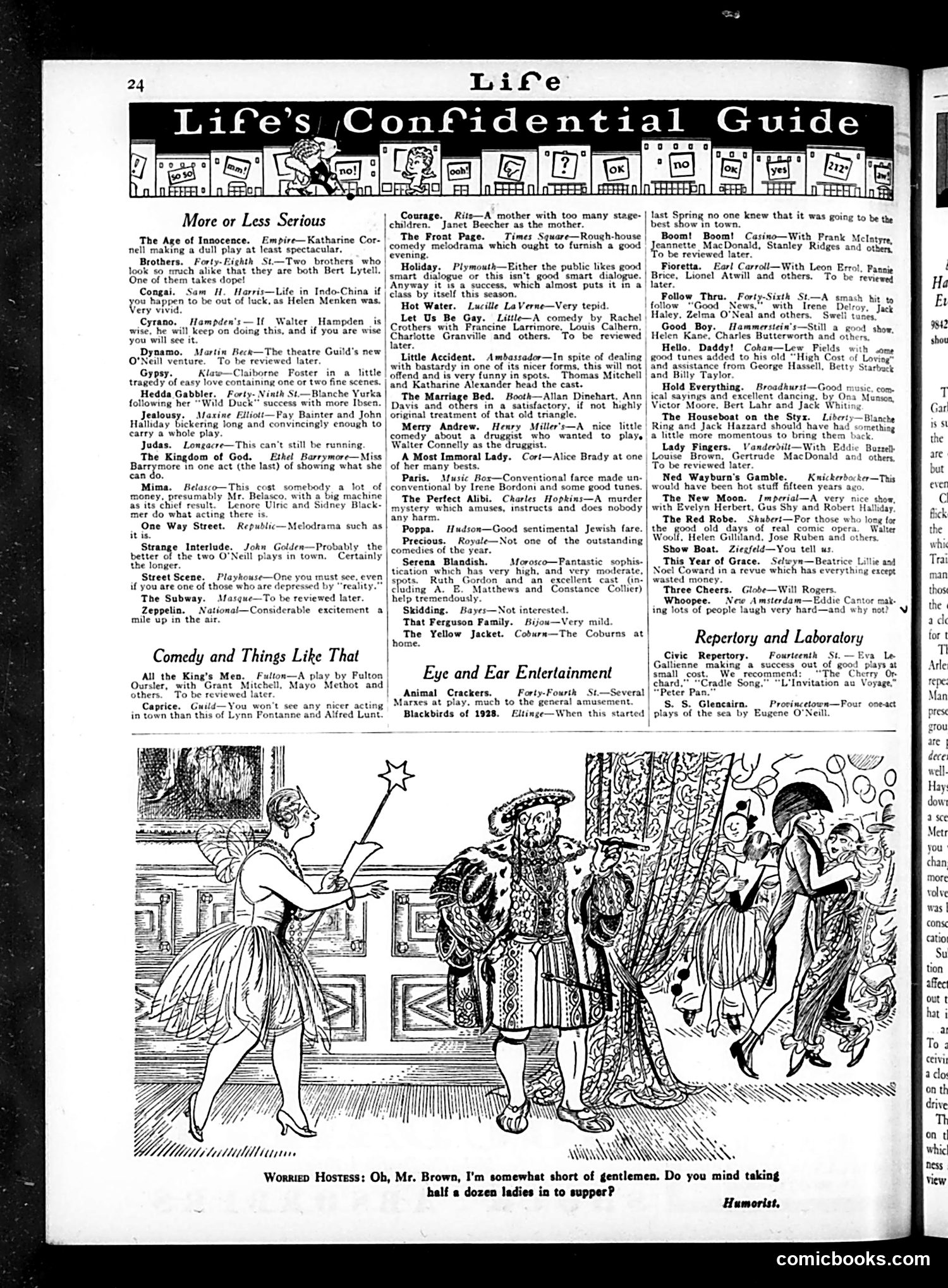
This page presents **Life's theater reviews** from 1928, organized by tone ("More or Less Serious" and "Comedy and Things Like That"). The reviews are brief, witty assessments of Broadway shows with cast members listed. The cartoon at bottom depicts a **worried hostess** asking a gentleman (Mr. Brown) if he minds taking "half a dozen ladies in to supper"—a humorous social situation about managing unequal gender ratios at dinner. The illustration shows a fairy godmother-like figure with a wand directing numerous women toward what appears to be a formal gathering. **Context for modern readers:** This reflects 1920s social anxieties about proper entertaining and gender balance at formal dinners—concerns largely absent today. The cartoon plays on the awkwardness of hosting when guest numbers don't divide evenly between men and women, a genuine etiquette problem of that era. The page primarily serves as **entertainment industry coverage**, typical of Life's role as a satirical weekly commenting on theater, society, and contemporary concerns.
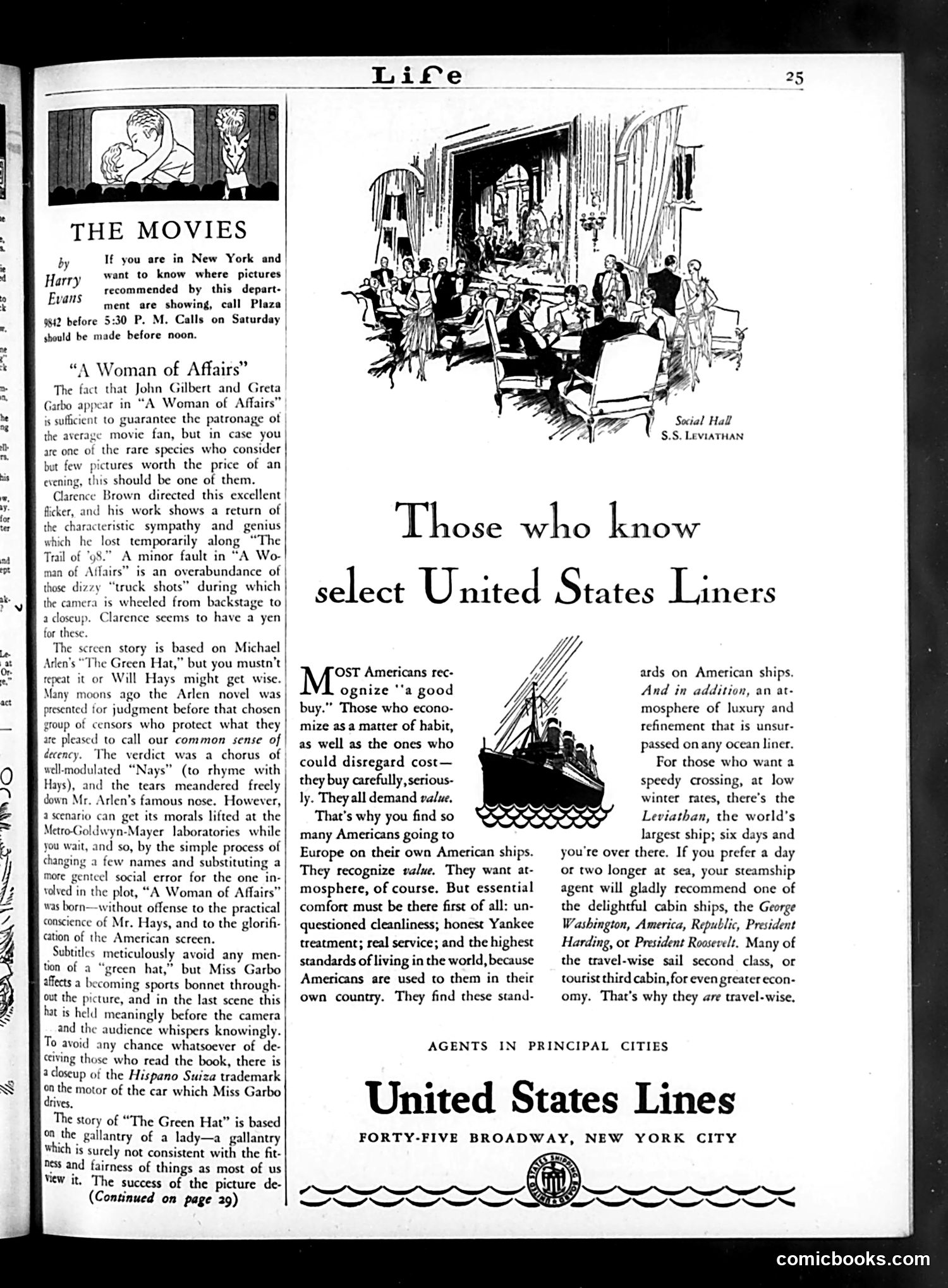
This page contains a film review column and a shipping advertisement. **The Movie Review:** Harry Evans critiques "A Woman of Affairs," starring Greta Garbo and John Gilbert. The satire targets **Will Hays**, the film industry censor (head of the Motion Picture Producers and Distributors of America). Evans jokes that the film is based on Michael Arlen's scandalous novel "The Green Hat" but the studio altered the plot to pass censorship—changing "morals" through "Metro-Goldwyn-Mayer laboratories" and substituting "a more genteel social error" for the original transgression. He notes the censor board gave the novel "a chorus of well-modulated 'Nays' (to rhyme with Hays)," mocking both the rejection and Hays's name. The humor lies in the obvious wink-wink substitution: Garbo wears a sports bonnet instead, but everyone knows what the original "green hat" symbolized (female sexual misconduct). **The Advertisement:** United States Lines promotes ocean liners, emphasizing quality and American standards for transatlantic travel.
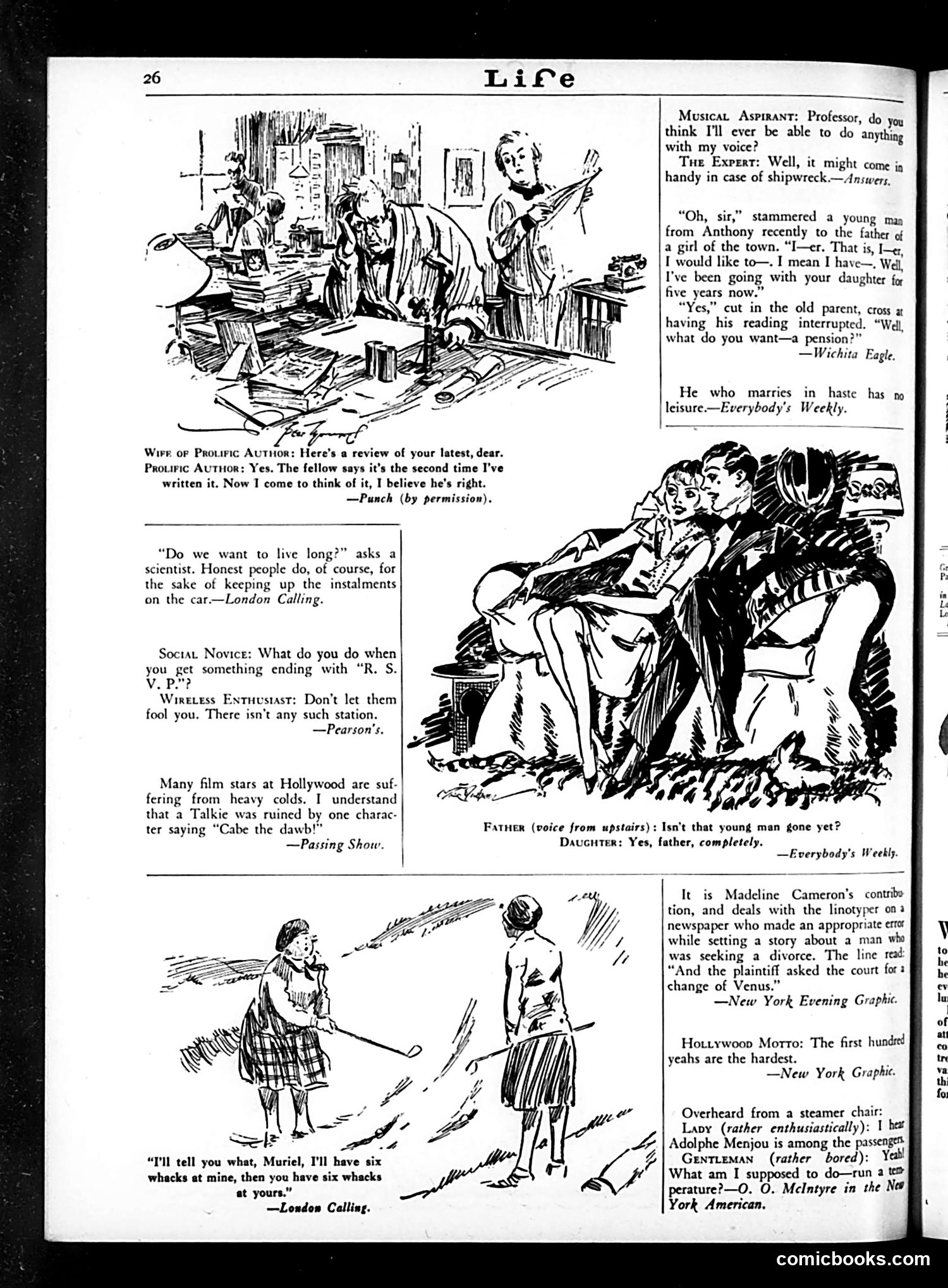
This page collects brief satirical jokes and observations from *Life* magazine and other contemporary sources, reflecting 1920s-30s social attitudes. **Key themes:** - **Show business**: A music student is told her voice would only be useful "in case of shipwreck"—mocking her lack of talent. A Hollywood joke references "Talkies" (early sound films) and actors with heavy colds ruining dialogue. - **Courtship/Marriage**: A young man stammers proposing after five years dating; the father cuts him off asking if he wants a "pension." Another joke: a daughter says an unwanted suitor is "completely" gone. - **Modern life complaints**: Installment payments on cars, RSVP etiquette confusion, divorce proceedings. - **Workplace humor**: A newspaper linotyper accidentally writes "change of Venus" instead of "change of venue" in a divorce story. The satire targets social pretension, romantic confusion, economic anxiety, and the confusion caused by new technologies (Talkies, wireless radio). These are gentle, observational jokes rather than biting political commentary.
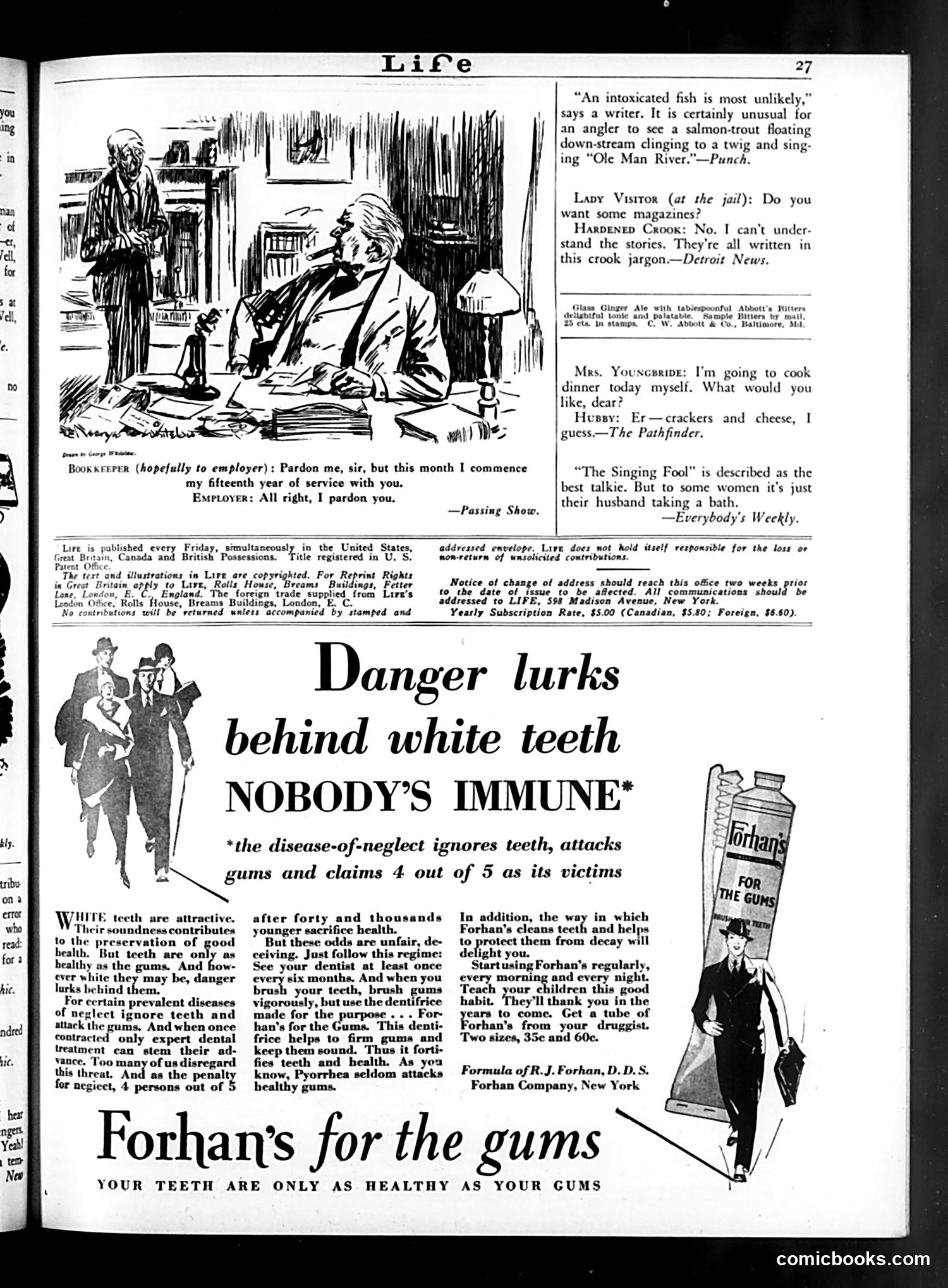
This page from *Life* magazine combines short humorous anecdotes with a full-page advertisement for Forhan's toothpaste. The cartoon at top shows a bookkeeper hopefully informing his employer he's completing 15 years of service; the employer's curt reply—"All right, I pardon you"—suggests the employee expects to be fired, making his long tenure seem more burden than asset. The scattered jokes mock various social types: a "hardened crook" who can't understand crime slang, a husband refusing dinner, and criticism of "The Singing Fool" (likely a 1928 talking picture). These brief, punchy gags reflect *Life*'s satirical style. The Forhan's advertisement dominates the lower half, warning that "4 out of 5" suffer from gum disease—a disease-of-neglect that attacks even those with attractive teeth. The ad promotes regular dental care and Forhan's specifically formulated dentifrice, appealing to vanity (white teeth) and health anxiety simultaneously.
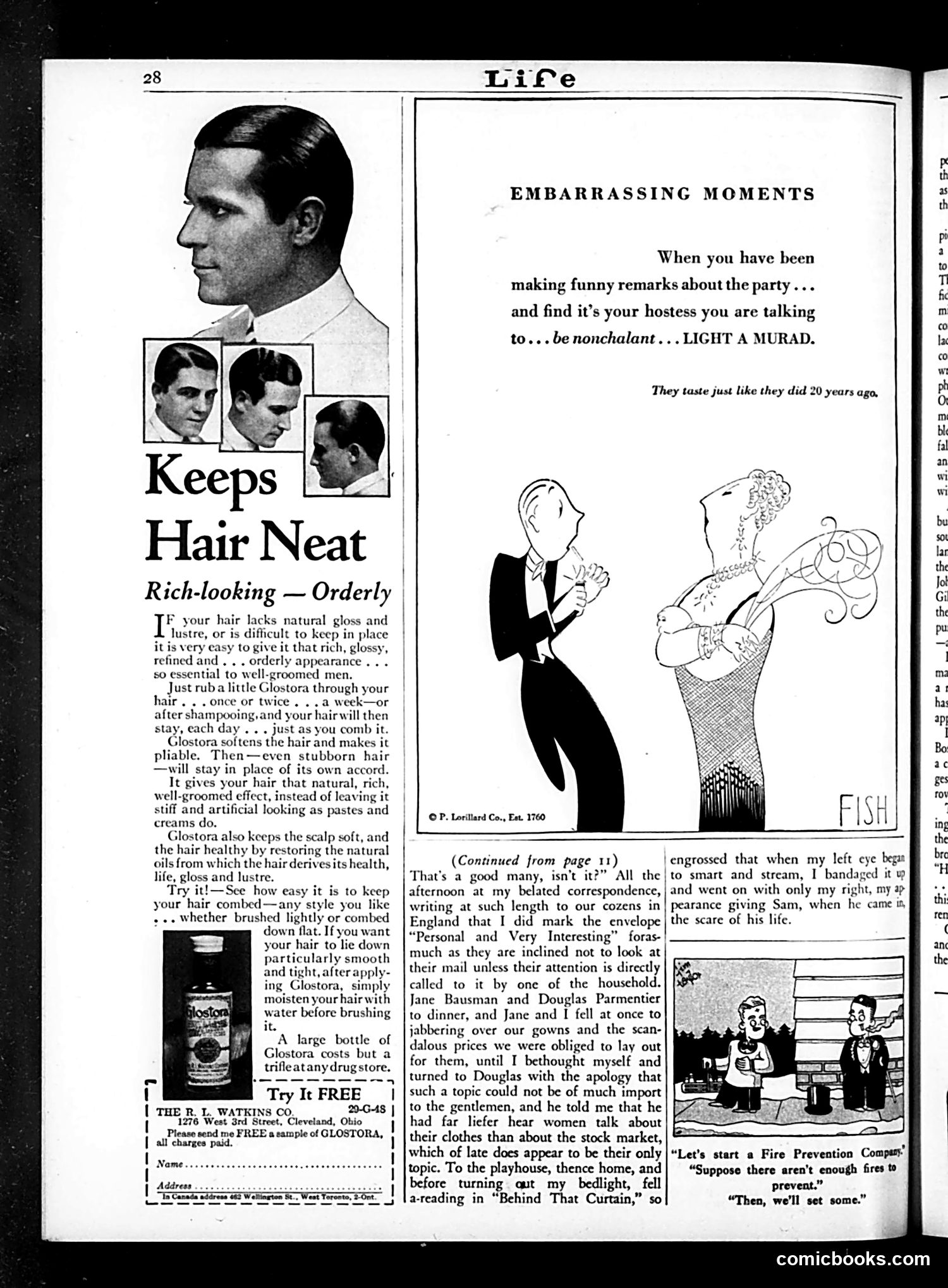
This page contains two distinct advertisements using humor to sell products: **Left side - Glostora Hair Product:** A traditional product ad emphasizing grooming standards for men. The multiple head studies show how the product keeps hair "neat" and "orderly"—values aligned with early 20th-century masculine ideals of respectability and professional appearance. **Right side - "Embarrassing Moments" (Murad Cigarettes):** A comic scenario depicting social anxiety. The joke: you've been making insulting remarks about a party, only to realize you're speaking to the hostess. The "solution" is to light a cigarette and act casual. The humor relies on the relatable awkwardness of social missteps. Murad emphasizes their product's consistency ("taste just like they did 20 years ago"), suggesting reliability as a comfort object during uncomfortable moments. **Bottom:** Brief narrative text and a comic strip about a woman's evening, ending with a domestic joke about fire prevention. These ads reflect period values: male grooming anxiety and the normalization of smoking as social lubricant for managing embarrassment.
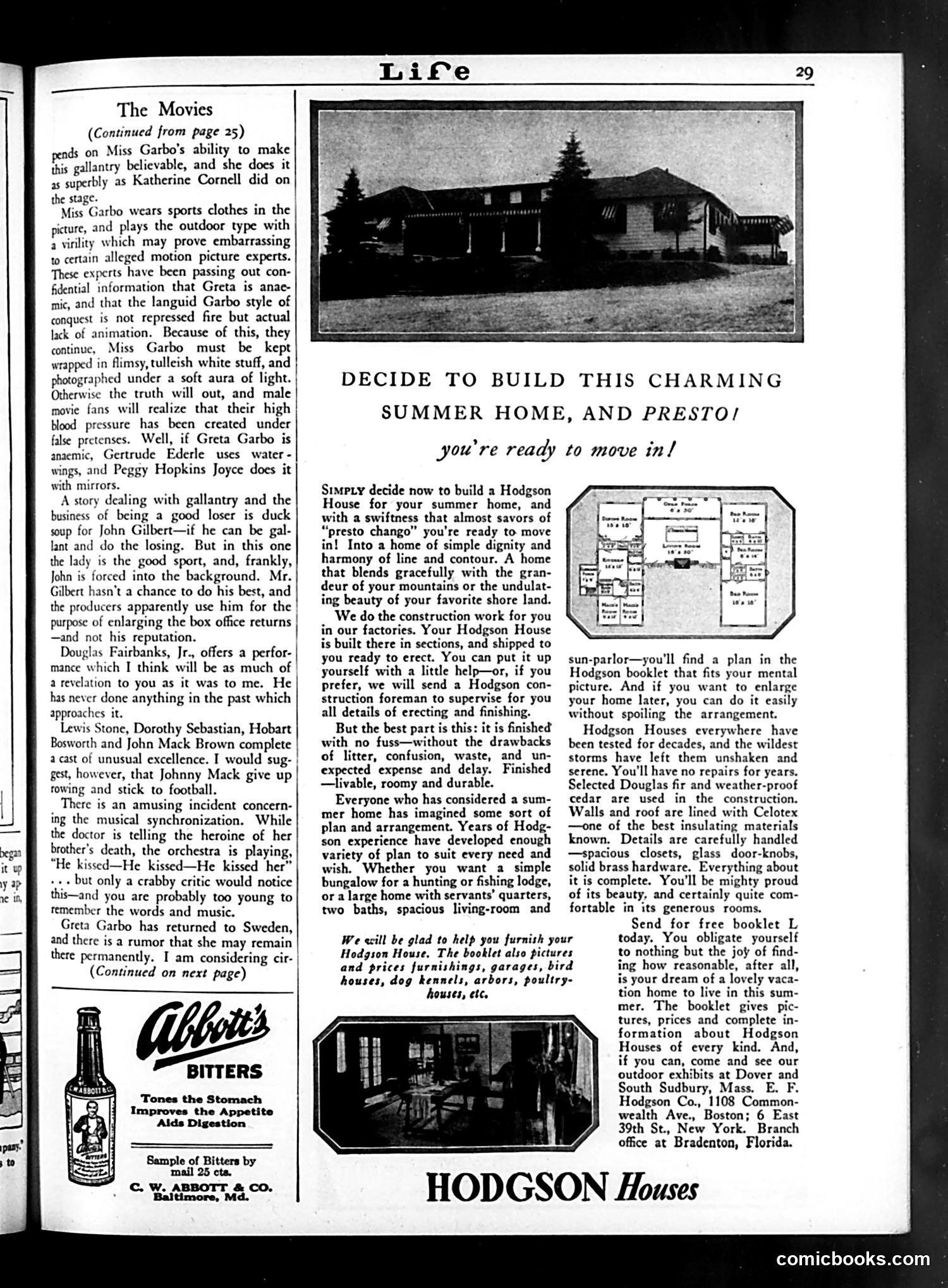
This page mixes movie criticism with advertising and contains no political cartoons. **The Movies Section** reviews a Greta Garbo film, addressing contemporary gossip about the actress. Critics claimed Garbo was "anaemic" and lacked animation, requiring her to be photographed in soft, romantic lighting to maintain her appeal. The reviewer dismisses this as nonsense, comparing it to claiming swimmer Gertrude Ederle used water-wings. The piece suggests Garbo demonstrates genuine vitality in sports clothes, contradicting expert speculation that her "languid" style masked lifelessness rather than repressed passion. **The Advertisement** promotes Hodgson Houses—prefabricated summer homes built in factories and shipped in sections for easy assembly. It emphasizes convenience and speed ("presto chango"), positioning factory-built homes as modern, dignified alternatives to traditional construction's mess and delays. Both sections reflect 1920s concerns: Hollywood's control of star images and the era's embrace of mass production and prefabrication as solutions to modern living.
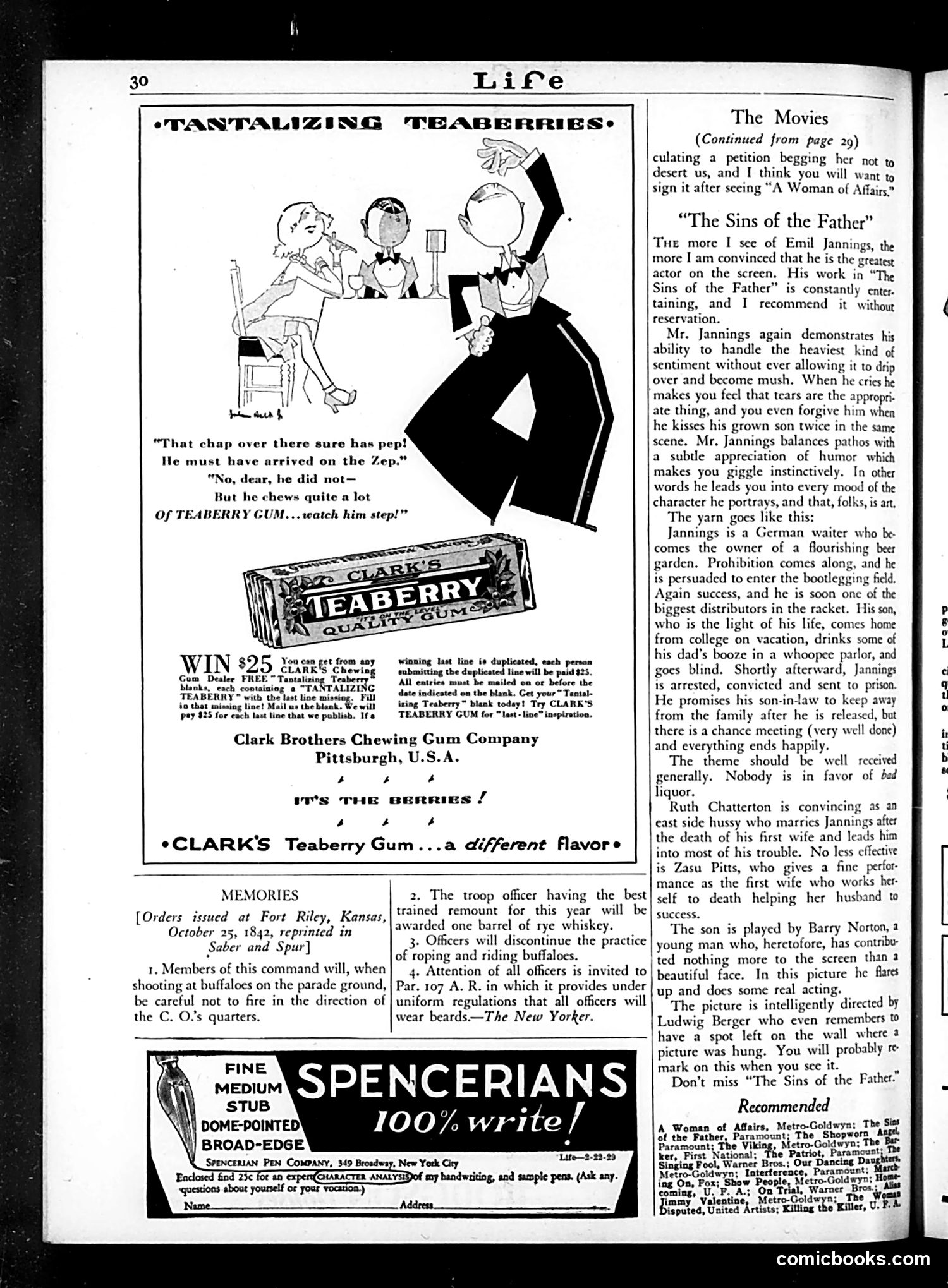
This page contains a **Teaberry Gum advertisement cartoon** and unrelated content. The cartoon jokes about energetic behavior: a man arrives so lively that observers assume he came by "Zep" (zeppelin), but he actually "chews quite a lot of TEABERRY GUM." The humor plays on gum-chewing's association with vigor and animation—a common advertising trope of the 1920s era. The ad includes a contest offering $25 for completing a missing limerick line about the product. The page also contains a **historical military memo** (reprinted from 1842) humorously documenting frontier army regulations, including orders against shooting buffalo and requiring officers to wear beards—presented as period curiosities. Finally, there's a **movie review** praising German actor Emil Jannings in "The Sins of the Father," discussing Prohibition-era bootlegging themes and supporting cast members. The review celebrates Jannings's ability to convey emotion without excess sentimentality.
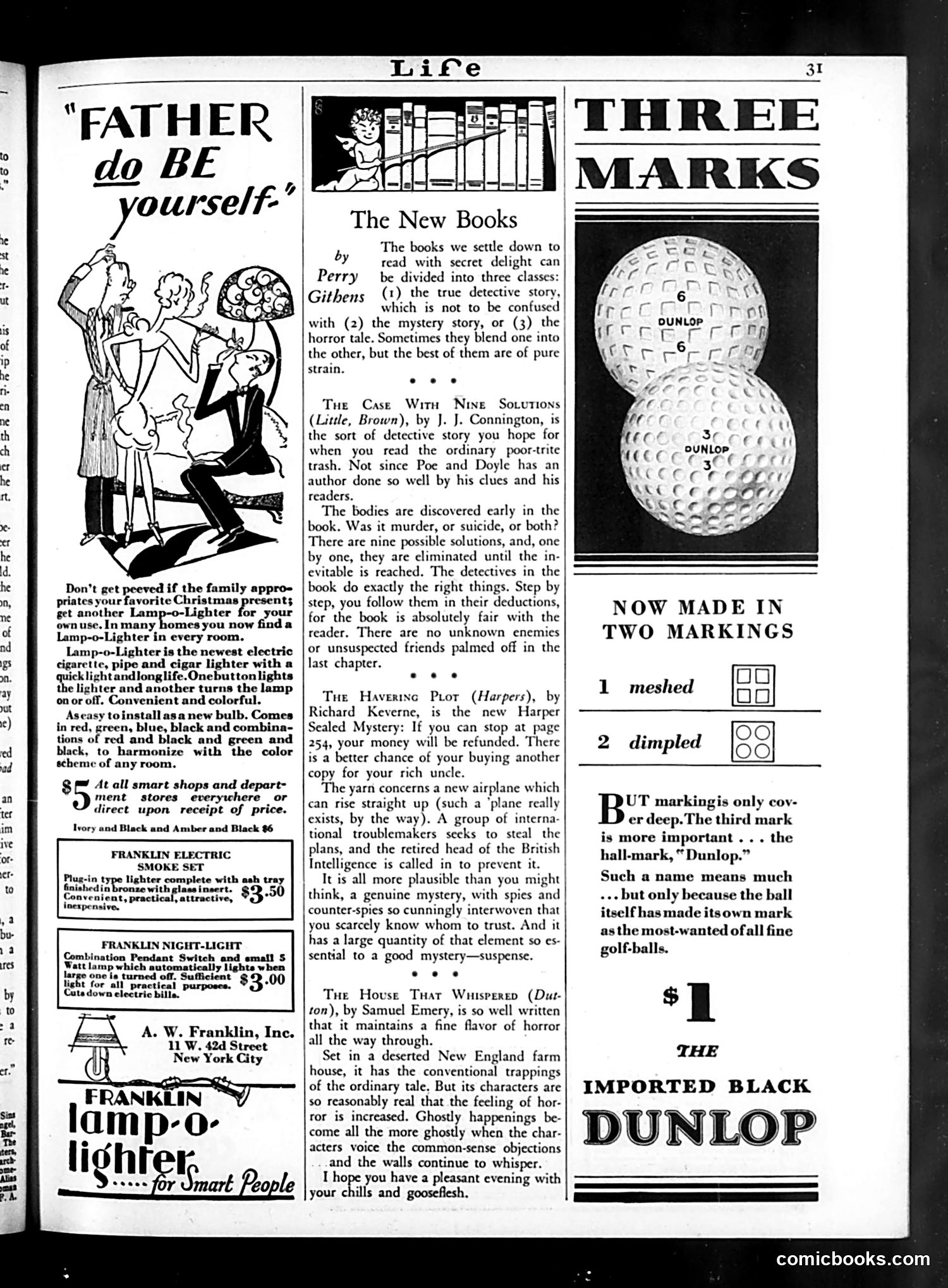
This page is primarily **advertising and book reviews**, not political satire. The left side features a **Franklin Electric ad** for "Lamp-o-Lighter" — a newly marketed electric lighter for cigarettes and pipes. The cartoon showing a father and family members illustrates the product's appeal: it's so convenient that families will want multiple units for different rooms. The tagline "Father do BE yourself" suggests masculinity and modern convenience. The main content is book reviews by Perry Githens covering three detective/mystery novels: *The Case with Nine Solutions*, *The Havering Plot*, and *The House That Whispered*. These are straightforward literary recommendations for readers seeking intelligent mysteries. The right side advertises **Dunlop golf balls** in two marking styles. **No political satire is present.** This is a 1920s-era lifestyle and consumer goods page reflecting post-WWI consumer culture and leisure activities among middle/upper-class readers.
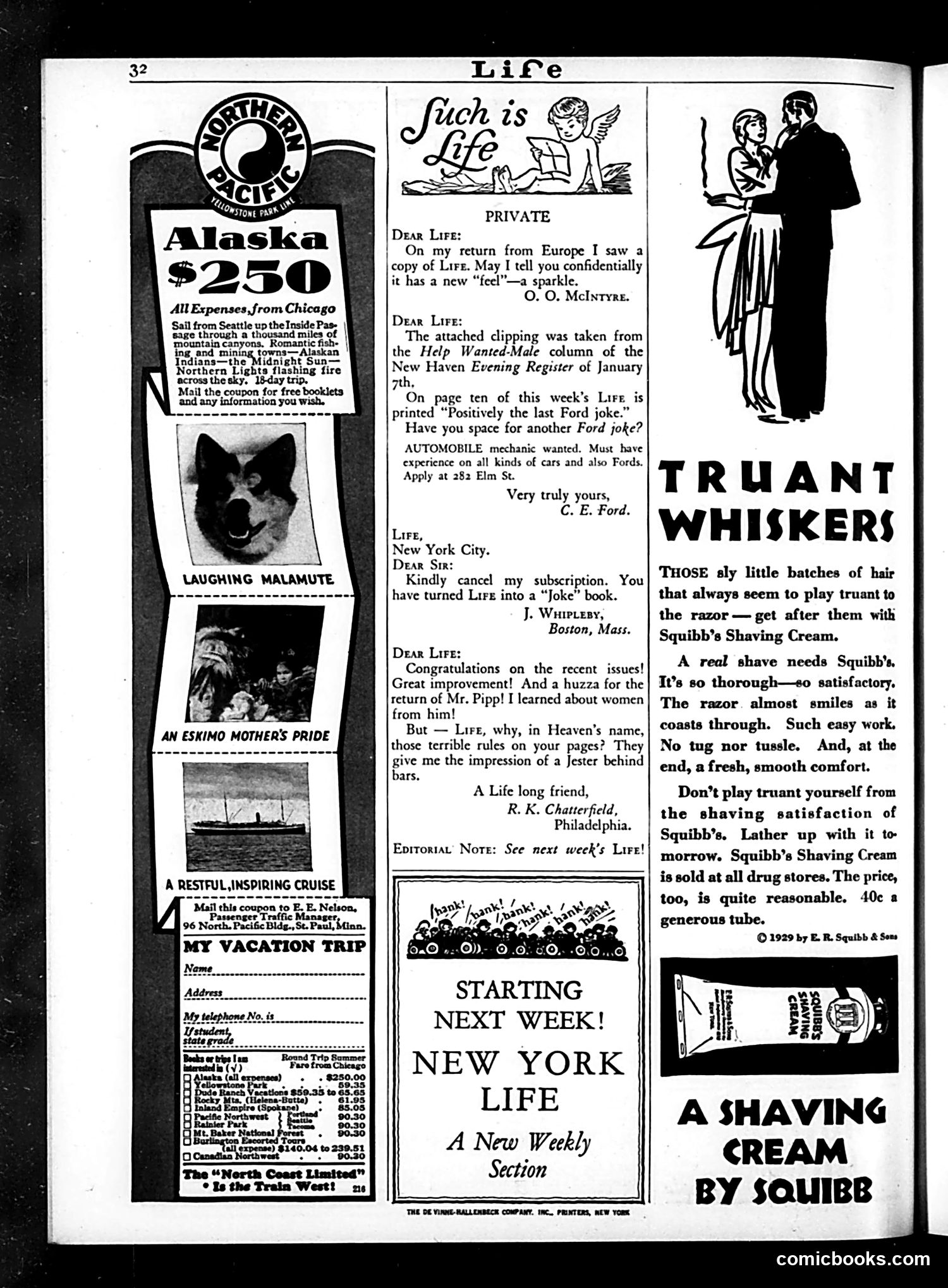
This page is primarily **advertising and reader correspondence**, not political satire. The "Such is Life" section features letters to the editor with mixed reactions to the magazine's content. **Key context for modern readers:** The **Ford joke references** are significant: readers complain that Life has become a "joke book" filled with Ford automobile jokes—suggesting the magazine was heavily publishing humor about Henry Ford's Model T, likely mocking its ubiquity and mechanical failures. One reader even submits a newspaper clipping showing "help wanted" ads specifically listing Ford experience, implying Fords were notoriously unreliable. The **left column** advertises Alaska vacations and train trips—period travel marketing emphasizing exotic destinations and luxury rail service. The **right column** is a Squibb shaving cream advertisement using playful language ("truant whiskers") to sell a product at 40 cents—typical 1929 advertising copy emphasizing quality and ease. The page reflects 1920s consumer culture and Life magazine's identity as a humor-focused publication, not a serious news source.
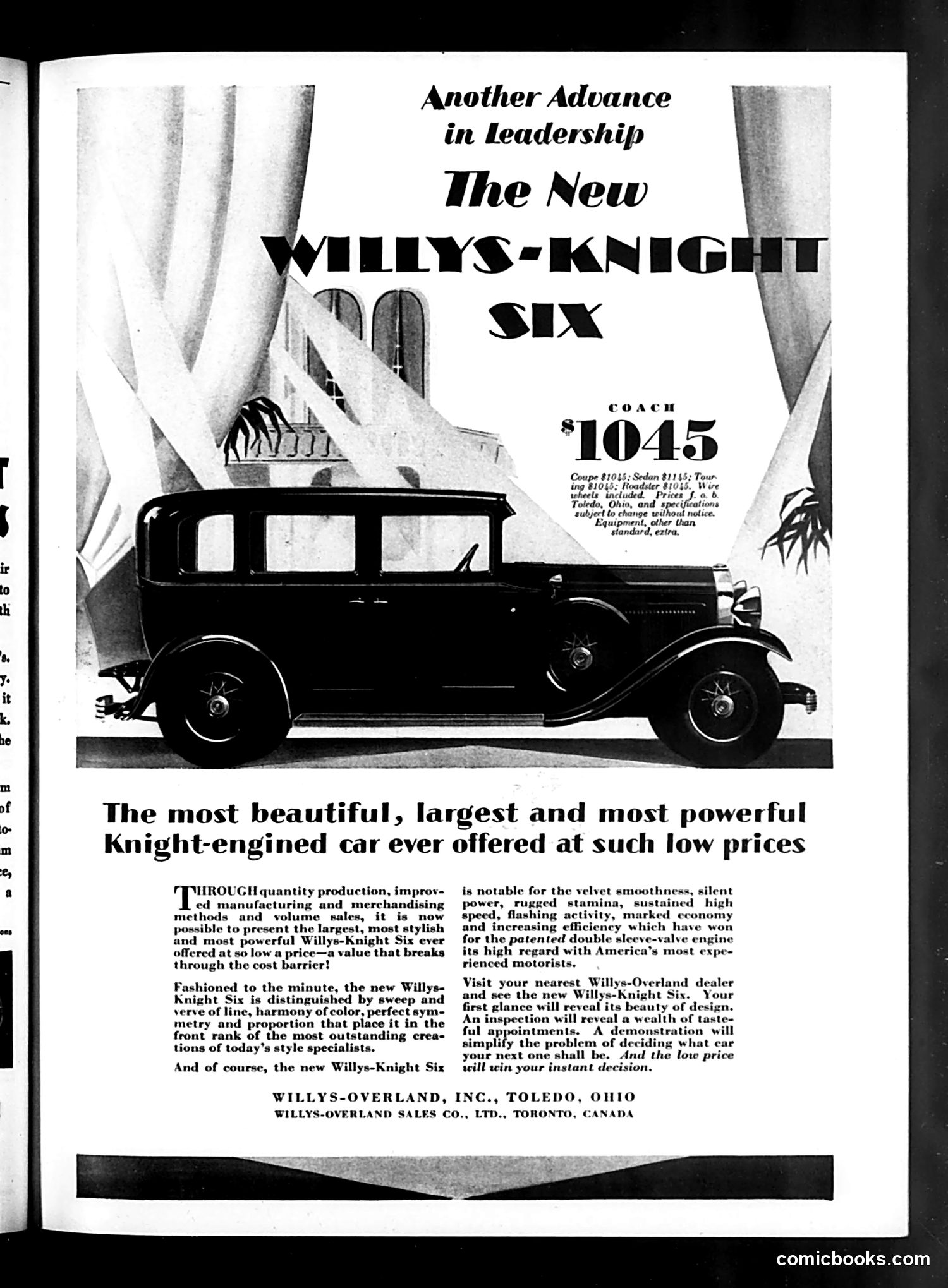
This is **not a political cartoon or satire**—it's a straightforward automobile advertisement. The page promotes the new Willys-Knight Six coach model, priced at $1045. The "leadership" language in the headline reflects 1920s-30s marketing rhetoric, positioning affordable mass production as an industrial achievement. The imagery shows a sleek, modern sedan silhouetted against Art Deco curtains, emphasizing contemporary styling and accessible luxury. The ad emphasizes the car's features: the patented "double sleeve-valve engine" (a technical selling point), elegant design, power, and crucially, **low pricing made possible by volume manufacturing**—a common theme in interwar automotive advertising. The comedic element, if any, is mild: the breathless copy overstates mundane vehicle qualities ("velvety smoothness," "silent power") in typical period advertising style. This represents Depression-era marketing attempting to position cars as attainable status symbols through mass production efficiency.
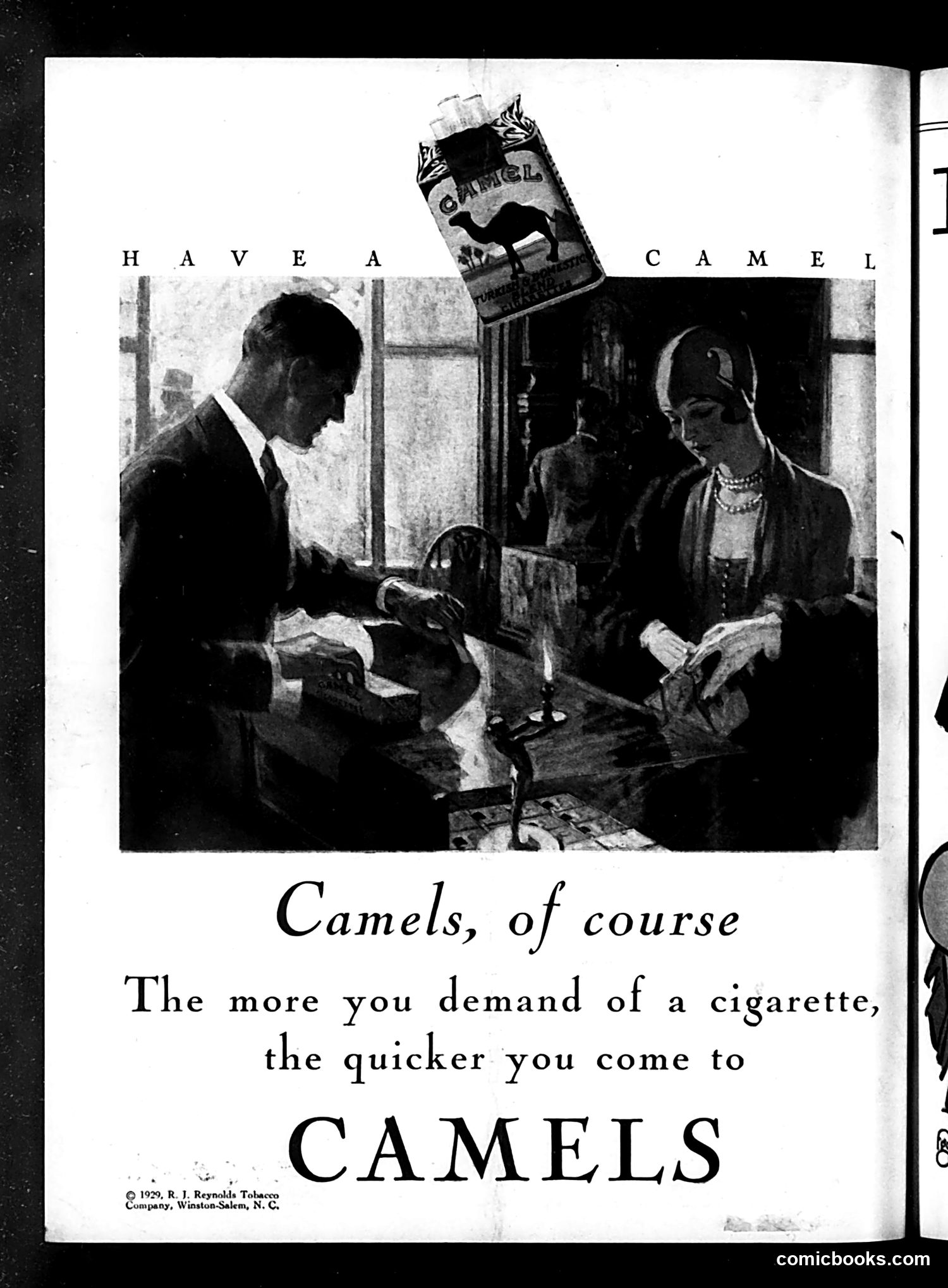
This is a **Camel cigarette advertisement**, not political satire. The image shows a well-dressed man and woman in what appears to be a formal or business setting, examining cigarettes together. The ad's tagline suggests that demanding smokers—those with high standards—inevitably choose Camels because the brand supposedly delivers superior quality and satisfaction more quickly than competitors. The "of course" in the headline implies Camels are the obvious, natural choice for discerning consumers. This represents typical mid-20th century tobacco advertising that emphasized sophistication and quality to market cigarettes to affluent audiences. The copyright dates to 1928.